
[AI-Driven New Business Creation] AI Basics: A Beginner's Guide
On the Qualiteg blog, we answer common questions about AI-driven business and marketing, and explain the basic concepts and applications of AI in a way that is easy for beginners to understand. This post serves as an introductory guide to exploring and making use of AI's potential.

![[AI-Driven New Business Creation] AI Basics: A Beginner's Guide](https://images.unsplash.com/photo-1677442136019-21780ecad995?crop=entropy&cs=tinysrgb&fit=max&fm=jpg&ixid=M3wxMTc3M3wwfDF8c2VhcmNofDV8fEFJfGVufDB8fHx8MTcxMjkyMDE4N3ww&ixlib=rb-4.0.3&q=80&w=1200)
Hello to everyone visiting the Qualiteg blog. I'm Michele. In my work on AI-driven new business development and marketing, there are certain questions I hear from clients again and again. Through this blog, I would like to offer my own answers to the challenges that anyone considering an AI-based business is likely to face.
Artificial intelligence (AI) is revolutionizing many aspects of the world around us, from business to everyday life. For many people, however, AI may still seem complex and hard to understand. In this column, I will briefly explain the basic concepts of AI and provide an introductory guide so that even beginners can understand and make use of what AI has to offer.
1. What Is AI?
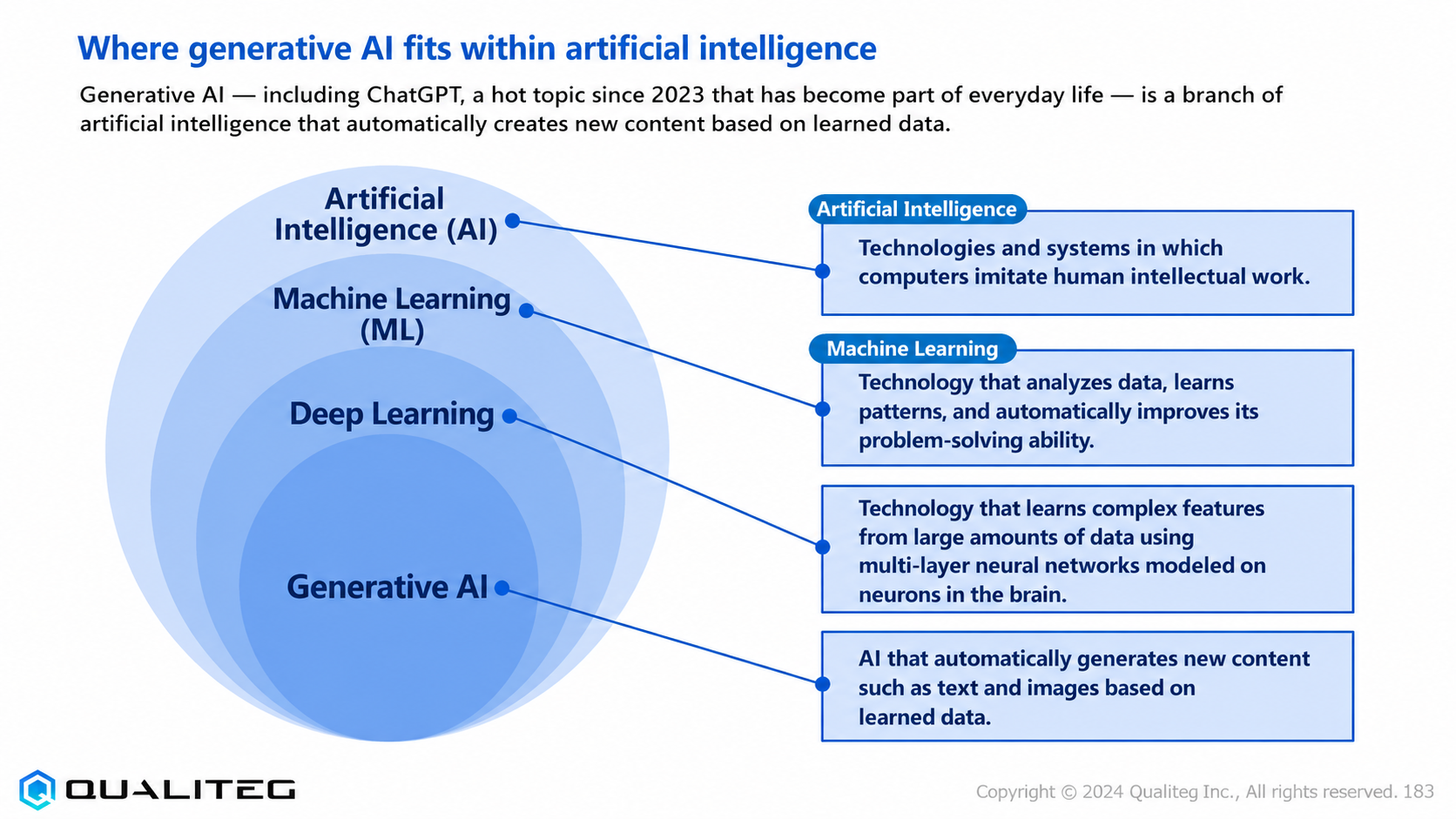
AI stands for "Artificial Intelligence." It refers to technology that enables computers to perform recognition and analysis in the way humans do. AI, or artificial intelligence, consists of computer systems and software designed to imitate human intellectual behavior. AI has the ability to carry out activities that would normally require human intelligence, such as learning and problem-solving.
2. The Main Types of AI
AI can be broadly divided into two categories: weak AI and strong AI. Weak AI is designed to perform specific tasks efficiently (for example, speech recognition and web search). Strong AI, on the other hand, is a theoretical form of AI that could perform any intellectual task as well as a human; it does not yet exist in a complete form.
Examples include "speech recognition," which can analyze audio data to extract information or recognize human speech and convert it into text, and "image recognition," which analyzes still images and video to recognize information.
3. What Is Machine Learning?
Most of the progress in AI is the result of machine learning (ML). Machine learning is a form of AI that learns from data and improves itself. It can analyze large volumes of data, find patterns within that data, and make predictions.
4. Deep Learning and Its Impact
Deep learning is a type of machine learning that uses multi-layered neural networks to solve complex problems. This technology has brought about groundbreaking advances in many fields, including image recognition, speech recognition, and language processing.
The wave of digitalization and structural changes in the market mean that many companies are now facing a time of major transformation. Innovation-Cross from Qualiteg Inc. is a program that realizes corporate transformation through co-creation. Through analysis of the current situation, we clarify the direction of transformation and the challenges involved, and formulate strategies for large-scale transformation that would be "difficult to achieve alone."
We explore creative approaches to transformation through idea workshops, and leverage external resources that accelerate transformation through open innovation and partner development. Including support for adopting cutting-edge AI technology, our experienced expert consultants provide integrated support for multifaceted transformation across business models, organizations, and technology. Transformation that adapts to the future while preserving the essence of your company: through the power of co-creation, we lead that great challenge to success.
5. Applications of AI
AI is applied across a wide range of industries, from healthcare to the automotive industry, and from financial services to customer service. In healthcare, for example, AI plays an important role in areas such as diagnostic support, personalized medicine, and efficient resource management.
6. What Is Generative AI?
Generative AI is a branch of artificial intelligence that automatically generates new content based on the data it has learned from. It is applied in a wide range of fields, including text, images, and music, and because it uses deep learning to create realistic works, it is revolutionizing creative tasks.
7. The Future of AI and Ethical Considerations
Advances in AI technology also raise ethical issues. Matters such as privacy violations, job losses, and transparency in decision-making call for public debate. Understanding and addressing these issues will be key to supporting the healthy development of AI technology.
Summary
AI has the potential to fundamentally change how we live and work. I hope this basic overview sparks at least a little interest in the world of AI and helps you explore it more deeply. AI is evolving quickly, and what you learn today may lead to new discoveries tomorrow, so please keep an eye on the latest developments.
Thank you very much for reading this column to the end. At Qualiteg, we provide training and consulting on AI technology and on how to plan new businesses. If you are interested, or have any specific requests, please feel free to contact us through the inquiry form here.

We also offer a popular workshop for those who want to master the steps of creating a new business. The training focuses on having each participant think about the business from an executive's perspective, and the content is designed not only for planning staff but also for their counterparts in engineering, design, and marketing.

We look forward to hearing from you. Please stay tuned for the next column.
navigation