Vertical Integration by AI Platform Providers, and the Strategic Options That Remain

Hello!
Greetings from the Qualiteg consulting team!
As of 2026, we believe coding is one of the biggest use cases for LLMs. Indeed, Menlo Ventures' research positions coding as a flagship use case for enterprise AI.
Having recognized this, AI platform providers have been launching their own AI coding tools one after another, to considerable popularity.
Conversely, the developers of the coding SaaS products that discovered and productized this use case early must be uneasy: the platform providers, the "house" in this game, are now moving into their SaaS territory.
So today, we want to think through vertical integration by AI platform providers and the strategic options available to the rest of us.
2025 was the year the competitive map of the AI coding agent market was decisively redrawn.
Anthropic's Claude Code started as a research preview in February 2025 and reached an annualized run rate (ARR) of one billion dollars in just six months.
Analyst estimates in early 2026 put its run rate at over 2.5 billion dollars (based on a Reuters article carried by Investing.com and on reporting by Moneycontrol).
Anthropic's company-wide run rate likewise surged from roughly one billion dollars in early 2025 to over five billion dollars by August of the same year.
We make full use of Claude Code ourselves; in stages such as initial prototype construction and PR creation, we have seen work proceed at what feels like several times to more than ten times the previous speed.
What these numbers show is not simply that one product succeeded. AI "model providers" are advancing into "tool providers" through vertical integration, absorbing along the way the entire markets that third-party startups had built. This is a structural pattern that has repeated throughout the technology industry, and it is now replaying in AI.
In this article, we take a sober look at this structural shift, examine the impact of two variables, open-source LLMs from China and OSS agent infrastructure, and consider the strategic options available in this environment, particularly for Japanese startups like us.
The Structure of Vertical Integration by Platform Providers
The information asymmetry inherent in the API business
First, let's lay out the structural disadvantage AI startups face.
Model providers such as Anthropic and OpenAI state in their terms of service that, as a rule, they do not use customers' API prompts for model training. The details differ, such as retention for safety purposes and opt-out conditions, but the basic policy can be taken at face value.
The important point, however, is that even without accessing the text itself, the metadata of API traffic, that is, what times of day, what context lengths, which tool calls, in what order and at what frequency, is naturally visible to whoever operates the infrastructure.
To an AI professional, the "shape" of this traffic is remarkably eloquent. Which use cases demand is concentrating on, and which design patterns are producing results, can be inferred without reading a single line of text. On top of that, startups that are major customers feed the most advanced edge cases directly back to the platform provider through bug reports and feature requests.
This is not a question of malice; it is a question of structure. Platform providers sit in a position where, simply by operating the platform, they can observe the results of market validation that the entire ecosystem paid for with its time and money.
The impact of launching an "official tool"
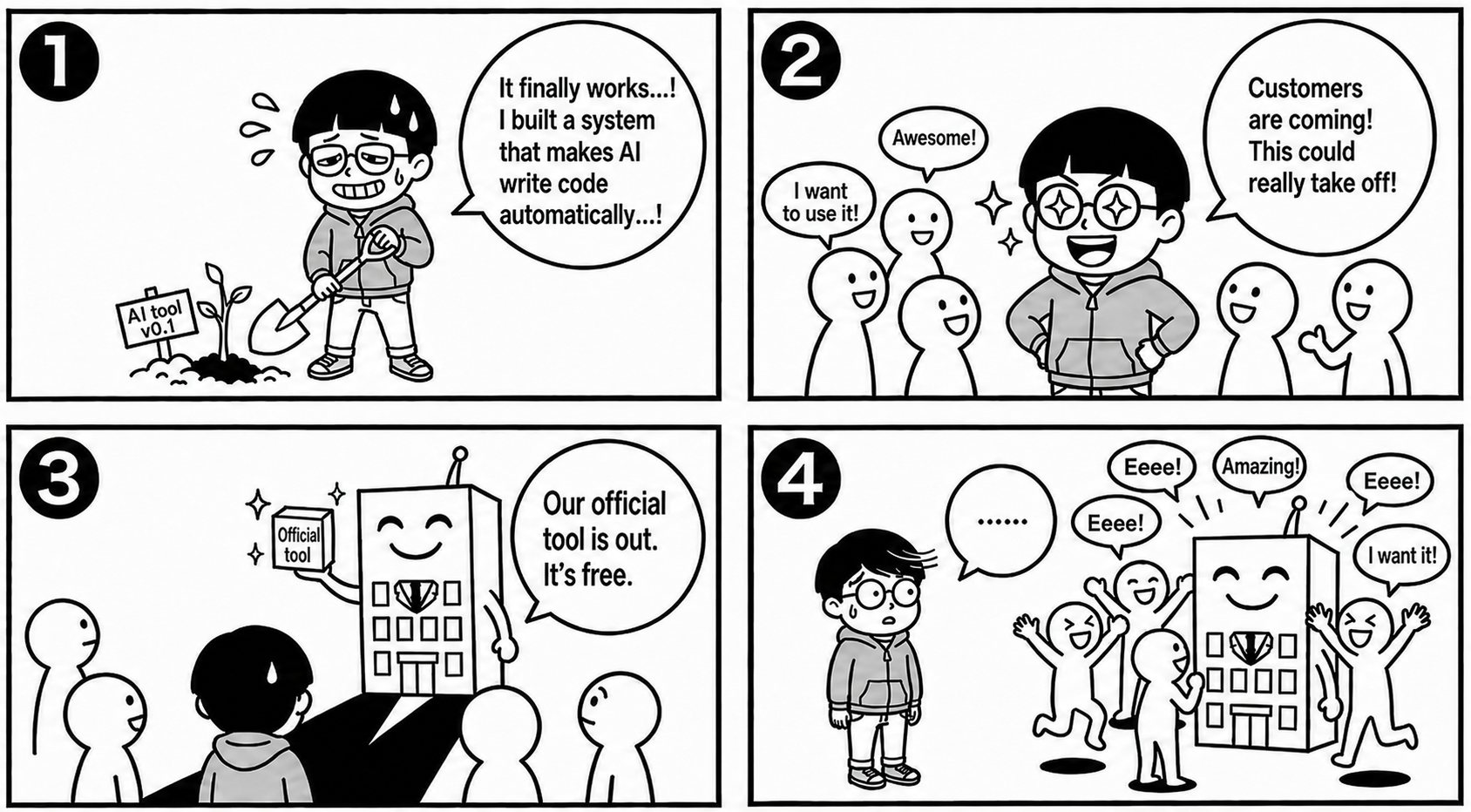
This information asymmetry becomes most visible the moment a platform provider launches its own official tool.
Claude Code is the emblematic example.
Anthropic delivered a development environment optimized for its own latest models, as an agent operable directly from the command line. Capabilities that third parties had achieved with elaborate prompt chains were folded into a seamless official experience. User migration proceeds rapidly.
According to a Menlo Ventures report (*1), Anthropic holds a 40% share of the enterprise market and 54% in coding. Accenture announced plans to train roughly 30,000 professionals on Claude Code through its partnership with Anthropic (*2). With Snowflake, Anthropic signed a multi-year partnership worth 200 million dollars (*3).
※1 Menlo Ventures "2025: The State of Generative AI in the Enterprise"
※2 Accenture official press release (December 9, 2025)
Anthropic's announcement
※3 Snowflake and Anthropic Announce $200 Million Partnership (Morningstar/Business Wire, December 3, 2025)
This pattern is structurally identical to how AWS has absorbed third-party infrastructure tools into its own services, or how Apple has folded third-party app features into its OS. Platform providers wait for the ecosystem to mature, then integrate the most valuable layer into themselves.
Two Variables Changing the Premises of the Game
Variable 1: the rise of open LLMs from China
What is shaking the very premises of this "the house always wins" game is the open-source LLMs coming out of China.
DeepSeek-R1, released in January 2025, has 671B total parameters (a Mixture-of-Experts design that activates 37B per token) and is reported to have achieved reasoning performance on par with OpenAI's o1.
Its published training cost was roughly 5.6 million dollars.
That figure excludes R&D and infrastructure maintenance costs; SemiAnalysis estimates DeepSeek's total server capital expenditure at around 1.6 billion dollars. Even so, at a time when major Western AI companies were spending over 100 million dollars on a single model, it is a fact that architectural ingenuity delivered dramatic cost efficiency.
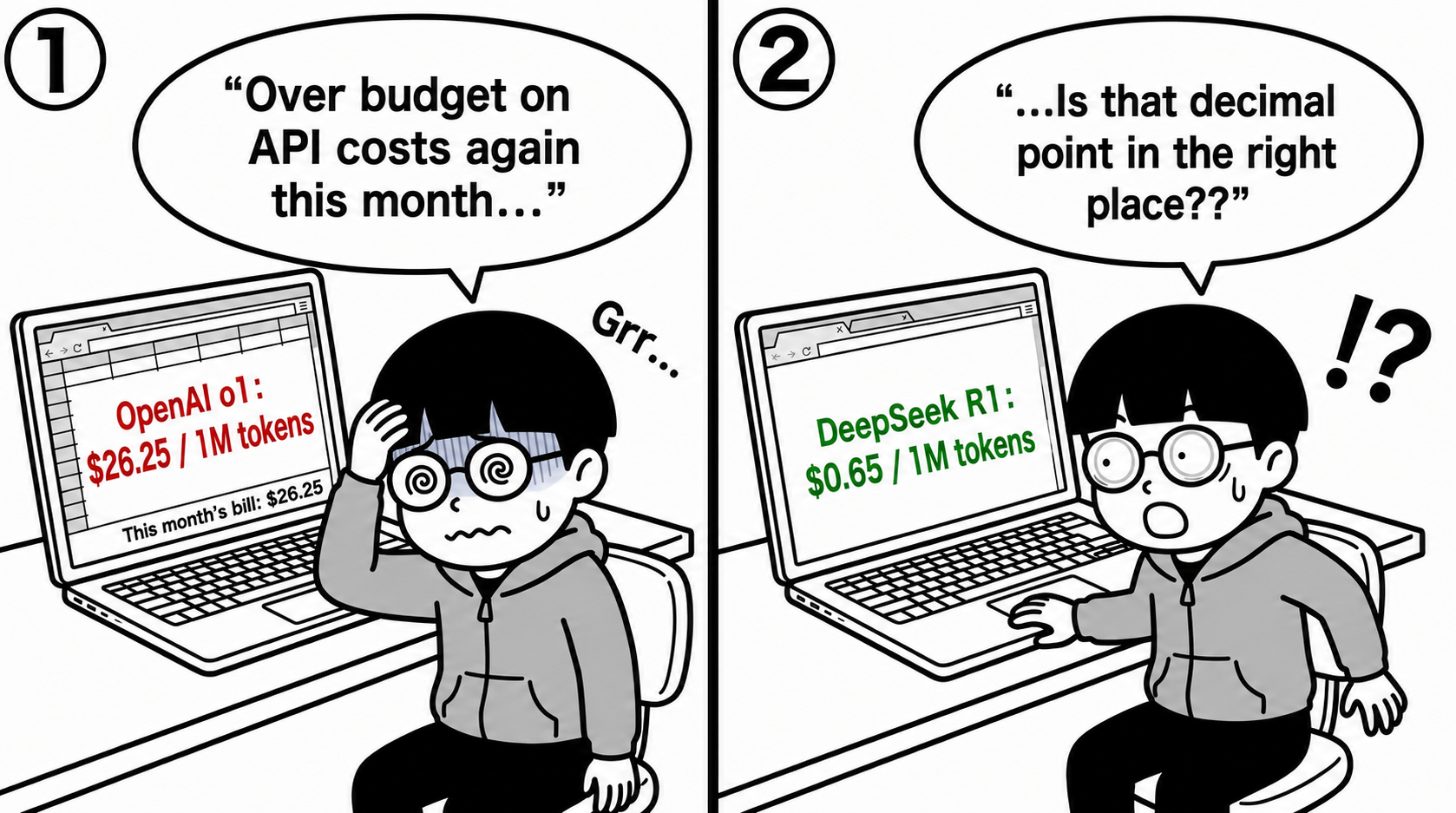
The gap in API pricing is even starker.
According to DeepSeek's official API documentation (as of 2025), DeepSeek-R1 is priced at $0.28 input / $0.42 output (per million tokens, on cache miss). At a 3:1 input-output ratio, the blended cost comes to about $0.32. OpenAI's o1, at $15 input / $60 output (same basis), works out to a blended cost of about $26.25 under the same conditions. The price difference is roughly 80x. (Prices are subject to revision; see DeepSeek: api-docs.deepseek.com and OpenAI: platform.openai.com.)
Meanwhile, Alibaba's Qwen series is also rapidly gaining presence.
According to Alibaba's published report, Qwen2.5-Coder-32B achieved top-tier performance among open-source models on major coding benchmarks such as HumanEval and LiveCodeBench, with scores said to rival GPT-4o.
For the latest Qwen3-Coder, press coverage and review sites report a score of 69.6% on SWE-Bench Verified, a level said to rival leading US models under certain conditions
(based on VentureBeat and an index.dev review; note that this score was obtained under specific conditions such as a 500-turn setting and can vary with configuration).
The license is Apache 2.0, permitting commercial use.
The significance of these models being released with open weights is clear: startups now have the option of running frontier-class reasoning capability in their own environments, without depending on a platform provider's API.
Variable 2: the maturation of OSS agent infrastructure
Models alone are not enough. You also need agent infrastructure to actually put the models to work.
The project to watch in this space is OpenHands.
OpenHands launched as a project in March 2024 and, within 18 months, passed 60,000 GitHub stars and 4 million downloads (as of the Business Wire announcement of November 18, 2025).
What stands out in OpenHands' design philosophy is its model-agnostic architecture. Any LLM, whether Claude, GPT, DeepSeek, or Qwen, can be swapped in. Execution is fully isolated in a Docker sandbox, and both self-hosting and cloud deployment are supported. It is open source under the MIT license.
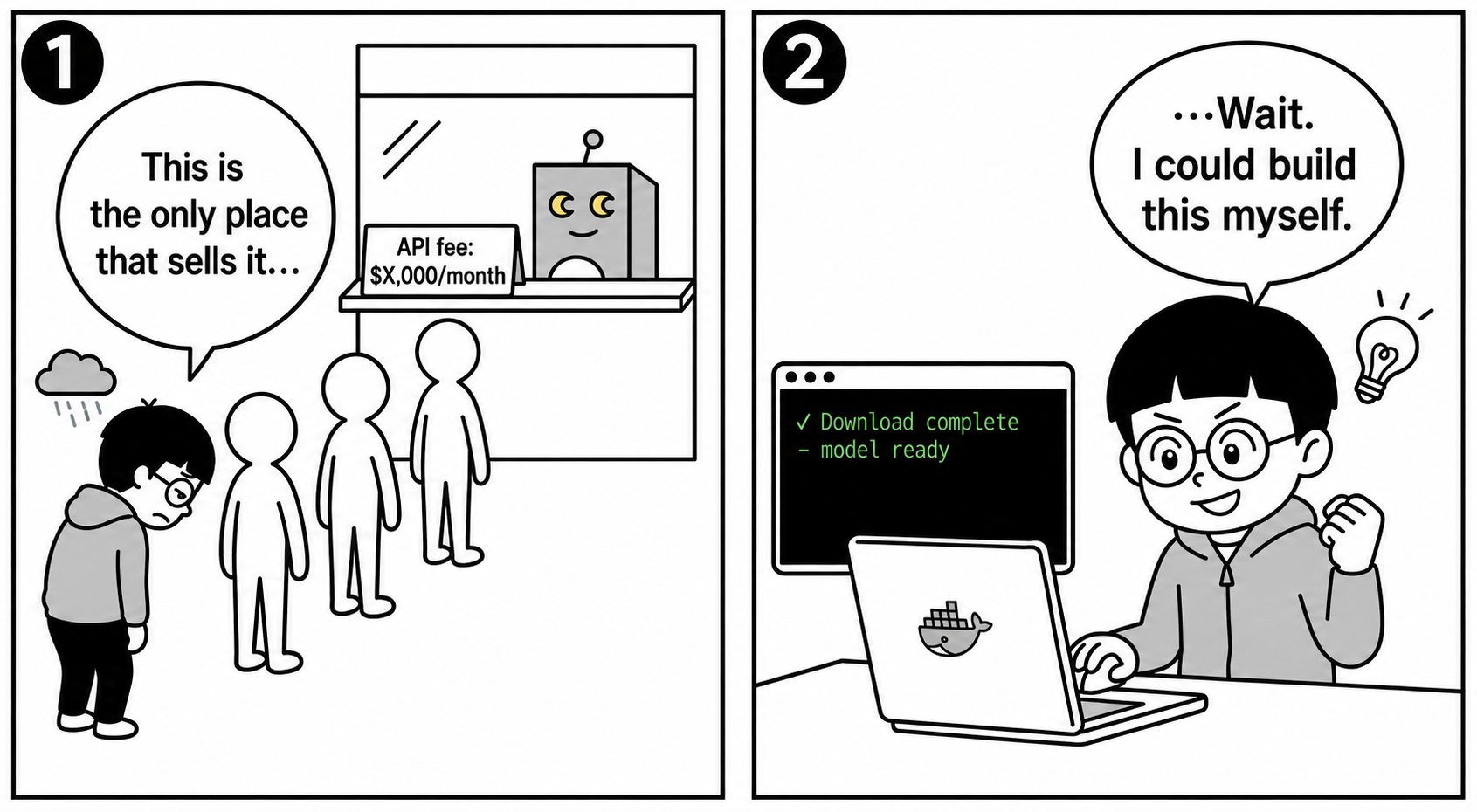
Open LLMs from China combined with OSS agent infrastructure: in theory, this combination makes it possible to build an autonomous development environment with zero dependence on platform-provider APIs.
Reservations About the Optimistic View
That said, whether this "free combination" is a realistic option for every startup deserves sober scrutiny.
The reality of operating costs
Self-hosting open models requires substantial infrastructure investment. Running the full version of DeepSeek V3 is said to require 8 to 16 A100/H100-class GPUs, an initial outlay of $50,000 to $200,000, and one or two full-time MLOps engineers ($120,000 to $200,000 per year). Even if you are "freed from API billing," it is entirely possible for infrastructure costs to exceed what you save.
Geopolitical risk
In Italy, following action by the data protection authority (Garante), the DeepSeek-R1 app became unavailable on the App Store and Google Play Store at the end of January 2025 (Reuters, January 29, 2025).
Observers also point to the possibility of tighter EU-wide regulation of Chinese models. Companies should anticipate cases where the mere fact of "using a Chinese model" becomes a sales hurdle with enterprise customers.
Reliability challenges. DeepSeek-R1 experienced partial outages lasting several days in January and February 2025, with reports of empty responses returned after tokens had been consumed. Using it in production presupposes a multi-provider failover design, with the added architectural complexity that entails.
In short, "API dependence" versus "full self-hosting" is not a binary choice; the real question is where to position yourself along the gradient between them.
Where Are the Winning Moves in This Structure?
The analysis so far raises several questions.
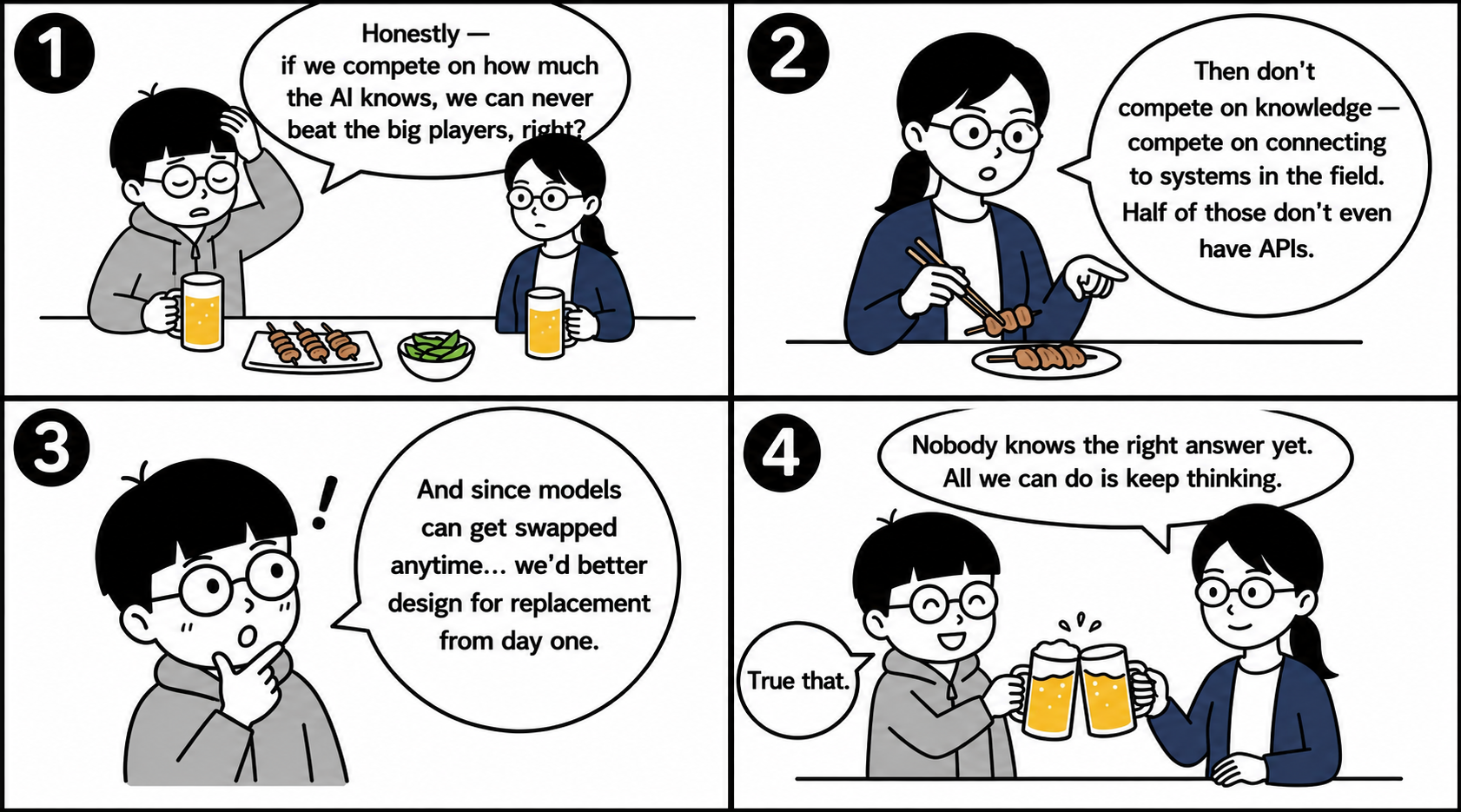
Is "domain specialization" still a moat?
Frankly, it is looking shaky.
Ask Claude about construction-industry expertise and you will get remarkably accurate answers. The same goes for medicine and law.
With the general-purpose capability of frontier models having risen this far, differentiating on "whether the AI knows the field" gets harder every year.
So where are the areas that platform providers structurally cannot enter?
One hypothesis is "connection."
The back offices of Japan's small and mid-size companies are still full of on-premises systems with no APIs, paper-based workflows, and Excel files in idiosyncratic formats. Even at large enterprises, integration between core systems is complex, and embedding AI into business workflows inevitably requires unglamorous, case-by-case implementation.
Neither Anthropic nor OpenAI has an incentive to fill in this "last mile" one company at a time. Their business model is providing APIs, not individual system integration.
If so, what can become a moat may not be "how smart the AI is" but rather
"a track record of fitting AI to the realities of the field, and the accumulated feedback data that comes from doing so"
.
That is not easily replicated even when models change or official tools appear. Whether this hypothesis holds, however, is something each company can only verify with its own customers and its own market.
Is model-agnostic design now simply "table stakes"?
In 2024, Claude 3.5 Sonnet was dominant. In 2025, DeepSeek-R1 rose to prominence, and there have been moments when the Qwen series pulled ahead on SWE-Bench. There is no guarantee that today's best model will still be best six months from now.
Is a model-agnostic architecture of the kind OpenHands achieves through LiteLLM merely a matter of technical taste, or is it becoming an essential requirement of business risk management? How do you weigh the cost of designing from day one so that Claude, GPT, DeepSeek, or Qwen can be swapped in, against the trade-off of optimizing for a specific model to capture short-term performance? There is no single right answer, but a year from now, the companies that made this choice deliberately will stand in a very different place from those that did not.
Which layer should hold your "secret sauce"?
Clever prompt engineering, the so-called "secret sauce," risks being made obsolete by a single major model update.
Prompt chains optimized for Claude 3.5 Sonnet became unnecessary with Claude 4: cases like this have been reported across the industry many times over.
If so, durable advantage should perhaps be built not in the model layer but outside it: proprietary business data, user feedback loops, industry-specific knowledge bases, and the RAG (Retrieval-Augmented Generation) mechanisms that put them to work. Where are the assets that survive a change of models? That judgment is probably one of the most important questions in product design over the next few years.
Is investing in OSS rational as "insurance"?
Asked whether you need to move to full self-hosting right now, for most companies the answer is no. But the cost of watching developments in OpenHands and vLLM and running small internal PoCs is not that large.
When the platform provider changes its API specification, revises its pricing, or discontinues a feature, are you in a position to activate "Plan B"? How you value that option depends on each company's risk tolerance and business structure. But it is worth recognizing that this option is shifting from something available at zero cost to something you can secure only through meaningful investment.
Closing Thoughts
The structure outlined in this article is by no means cause for pessimism.
The pressure of vertical integration by platform providers is certainly intensifying.
At the same time, the maturation of open LLMs from China and OSS agent infrastructure has made options other than "standing on the single leg of API dependence" genuinely realistic.
Neither entrusting everything to the platform providers nor carrying everything yourself: the emergence of room to choose a position along this gradient is itself the biggest change of the past year.
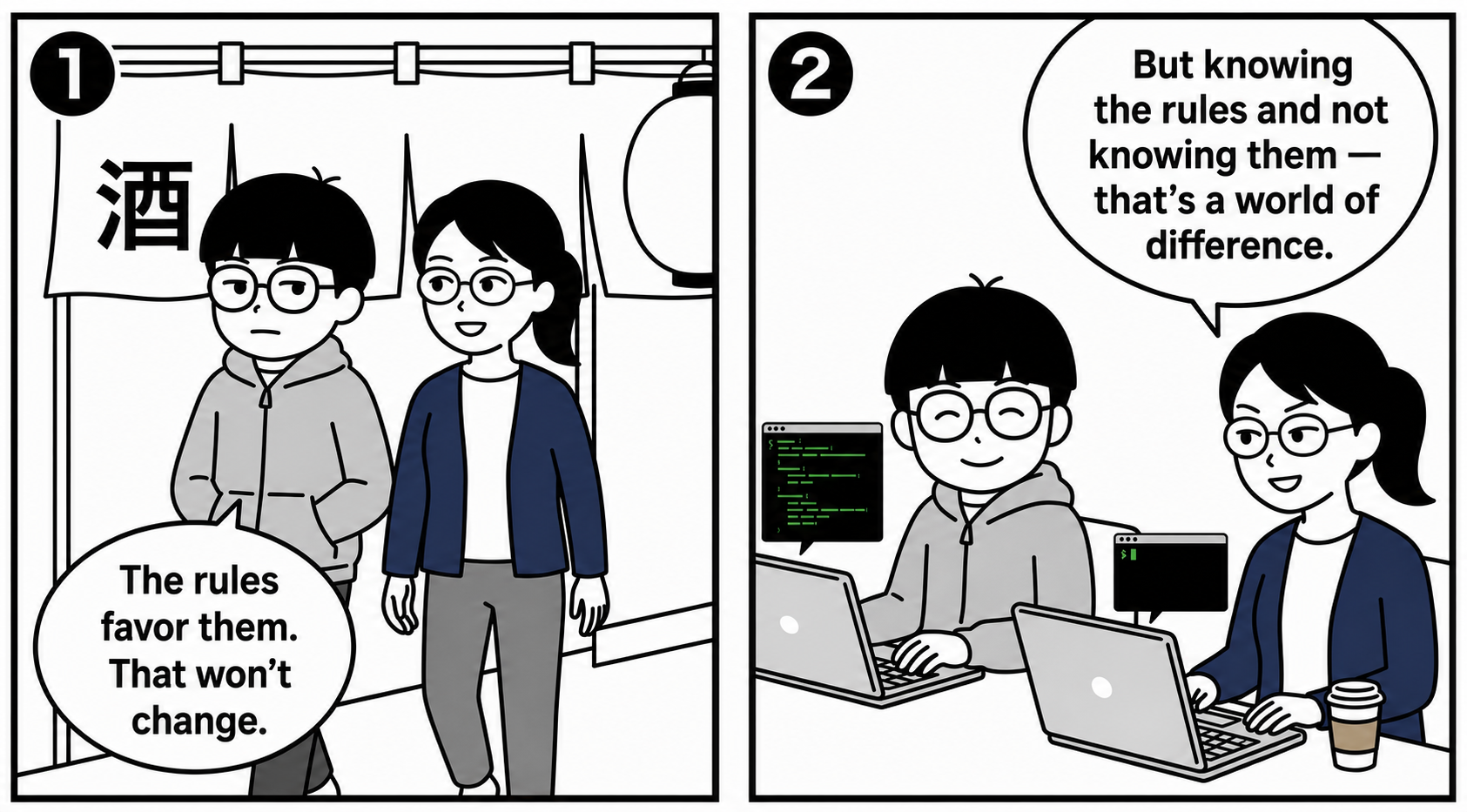
It cannot be denied that the rules of the technology industry's game favor the platform providers who control the infrastructure.
But sitting down at the table with an accurate grasp of the rules produces a very different outcome from sitting down without one.
Finally, there is one thing we want to emphasize.
We have discussed "the pressure of vertical integration" and "a structure that favors the house," but not because we want to pass moral judgment on the platform providers.
It was OpenAI that opened this market in the first place, releasing generative AI to the public in the form of ChatGPT and establishing it in society as a tool people can actually use.
Without that turning point, the ventures of many startups, including ours, and the very arena for this discussion would not exist.
Since we build our business on top of that foundation, we want to participate in this ecosystem with respect.
At the same time, respect and strategy can coexist. Respect those who made the rules, while thinking hard about how to build a winning position within them. We hope this article serves as a useful guide for doing exactly that.
Sources and References
- Menlo Ventures (enterprise generative AI report: market share estimates, etc.)
- Investing.com (Reuters syndication: article touching on Anthropic's run rate)
- Moneycontrol (Reuters-based: article touching on Claude Code's $2.5B+ run rate)
- Reuters (DeepSeek app becoming unavailable in Italy: reporting around January 29, 2025)
- OpenAI official documentation (o1: page used as the basis for model/pricing assumptions)
- DeepSeek official API documentation (Pricing: page used as the basis for input/output rates)
- SWE-bench Verified (benchmark reference)
- Business Wire (OpenHands' Series A, star count, download count, etc.)