
Claude Opus 5.5 Complete Guide: Model Specifications, API Notes, and Claude Code Operations
A complete guide to Claude Opus 5.5: prices 20% below Opus 5 with 60% cheaper cache reads, API migration notes such as the medium default effort and thinking that can no longer be disabled, and the new default model and Fast mode in Claude Code.

Hello!
On September 22, 2026 (US time), Anthropic announced Claude Opus 5.5. It is the first model in the new Claude 5.5 family. On the same day, OpenAI also announced GPT-6 Sol and GPT-6 Luna.
First, to sum up this model in a sentence:
"Opus 5.5 aims for Fable 5.1-class performance at a lower per-token price than Opus 5, with medium as the default effort. In exchange, older patterns such as turning off thinking, forcing tool use, and rewriting history no longer work."
That is the short version.
Now, let's start with the reduced API pricing. GPT-6 Sol and Luna, released the same day, halved their prices while keeping performance roughly level. Opus 5.5's cut is smaller, 20% (60% on cache reads), so it does not match Sol and Luna on price alone. In exchange, it pairs better performance with lower prices. That is the defining feature of this September 2026 update.
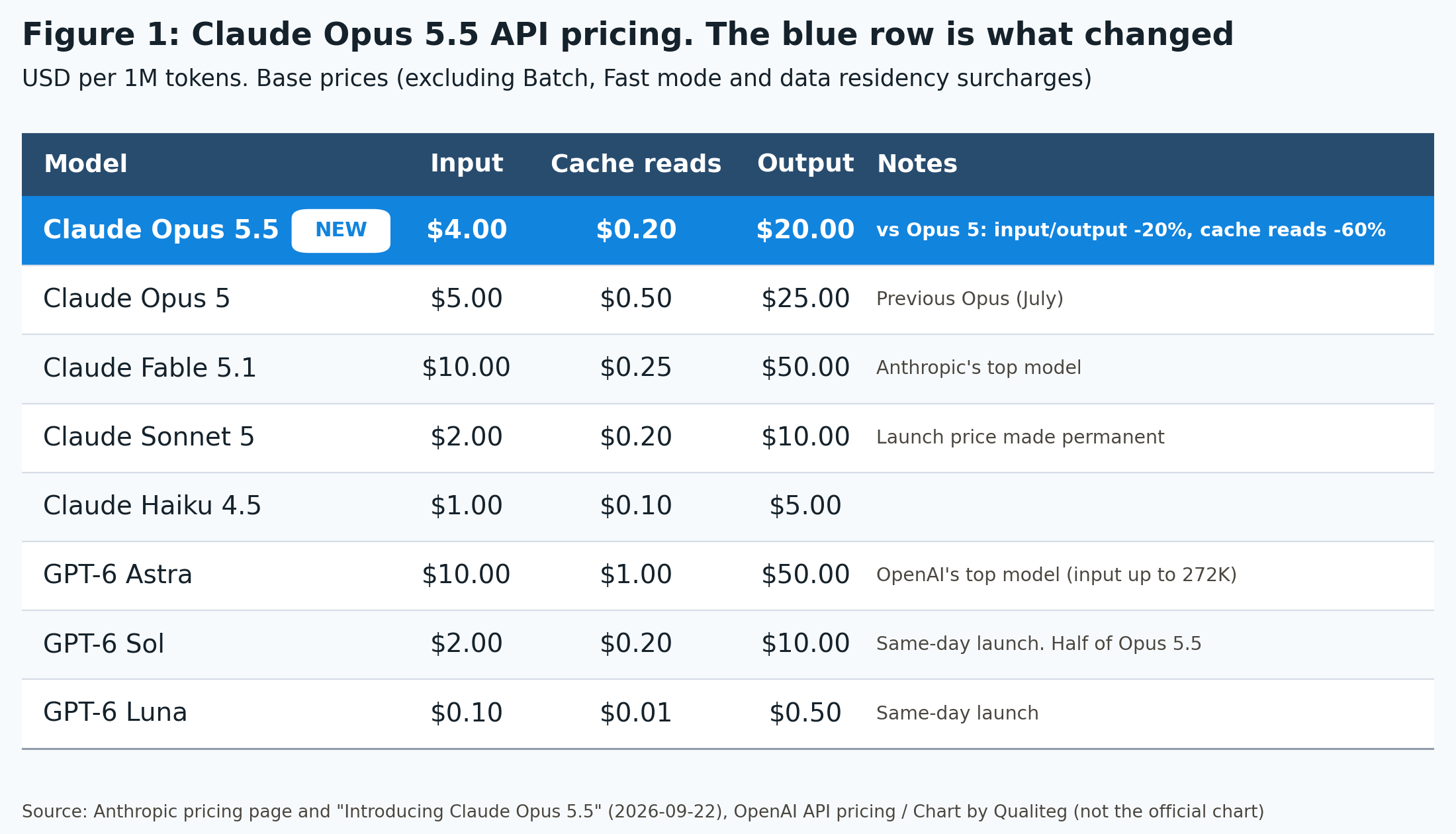
Opus 5.5 costs $4 for input and $20 for output, 20% less than Opus 5's $5 and $25. Cache reads went from $0.50 to $0.20, a 60% cut.
On the settings side, the API's default effort (the setting for how much the model thinks) dropped from high to medium, and thinking can no longer be turned off at any effort level. If you run Opus 5 code on Opus 5.5 by swapping only the model ID, some calls will return errors.
In July, in "Claude Opus 5.0 Complete Guide: Model Specifications, API Notes, and Claude Code Operations," we described Opus 5 as "not the top model, but the go-to model for real work." This article is its sequel.
We covered GPT-6, announced the same day, in our previous article, "GPT-6 Sol and Luna Explained: How They Differ from Astra, What Is Behind the 50% Price Cut, API Migration, and Using Them in Codex." This article also sorts out how to compare Opus 5.5 with Sol.
Our sources are Anthropic's official announcement, official docs, and system card, plus the independent evaluator Artificial Analysis. We keep Anthropic's published figures (vendor claims) separate from independent evaluation. We have not yet tested Opus 5.5 systematically ourselves.
It is a long article, so there is no need to read it from start to finish. Feel free to jump to the chapters that interest you.
Table of Contents
Part 1: What Claude Opus 5.5 Is
- 1. Opus 5.5 is the first model in the Claude 5.5 family
- 2. Basic specifications at a glance
- 3. Prices are 20% below Opus 5, and cache reads are 60% cheaper
- 4. Read Anthropic's published benchmarks together with cost
- 5. Independent evaluation puts it at the top of the Intelligence Index
- 6. How to compare it with GPT-6 Sol and Luna, announced the same day
- 7. Safety according to the system card
Part 2: Things to Watch When Using the API
- 8. Thinking can no longer be turned off
- 9. The default effort is now medium
- 10. Forced tool use and the old computer use tool return 400
- 11. Preserved thinking applies to accounts created on or after August 31
- 12. The biology classifier is broader, and a reasoning extraction classifier was added
- 13. Migration steps and updated cost estimates
Part 3: Using Opus 5.5 in Claude Code
- 14. Opus 5.5 became the default model in v2.1.280
- 15. Set effort through per-model settings
- 16. Fast mode costs $8 / $40 and is paid from usage credits
- 17. What happens when a classifier switches models
- 18. 1M context, the 5-hour limit, and a daily working rhythm
What Changed from Opus 5, in Brief
Each chapter covers the details, but here is the big picture first.
- Per-token prices fell 20%, and cache reads fell 60%. Input is $4, output $20, and cache reads $0.20. Anthropic says it "will cost 40% less than Opus 5 on typical workloads" at default settings (Chapter 3)
- The claim is Fable 5.1-class performance at less than half the price. In Anthropic's words, it "performs at the level of Claude Fable 5.1 on most work." It also ranked first on the independent Intelligence Index (Chapters 4 and 5)
- Thinking can no longer be disabled. On Opus 5 you could turn it off at high effort or below, but on Opus 5.5 it returns a 400 error at every effort level (Chapter 8)
- The default effort is now medium. If you omit effort, the model runs one level lower than Opus 5 did (Chapter 9)
- Forced tool use and the old computer use tool now return 400. You can no longer use tool_choice any or tool, or computer_20251124 (Chapter 10)
- Preserved thinking was introduced. For accounts created on or after August 31, 2026, rewriting any part of the history before a thinking block and sending it again returns 400 (Chapter 11)
- Safety classifiers were expanded. The biology classifier now covers the same broad scope as Fable 5.1's, and a reasoning extraction classifier was added (Chapter 12)
- Claude Code's default model is now Opus on Pro and Team Standard too. From v2.1.280, the default on almost every plan is Opus 5.5 (Chapter 14)
- Higher 5-hour limits and a "limit reset". These are for subscription users. Anthropic has not published how much the limits were raised (Chapter 18)
- Sonnet 5.5 and Haiku 5.5 are coming in the next few weeks. This is a preview in the official announcement, and prices and specifications are not out yet (Chapter 1)
Part 1: What Claude Opus 5.5 Is
1. Opus 5.5 is the first model in the Claude 5.5 family
Here is how the official announcement opens.
"It performs at the level of Claude Fable 5.1 on most work and costs 40% less to run than Opus 5."
The model page describes it as "For long-running agentic coding and knowledge work." Fable 5.1 is described as "For demanding reasoning and long-horizon agentic work," and Anthropic's guidance on choosing between them is as follows.
Start with Opus 5.5. Move up to Fable 5.1 only when Opus 5.5 at a high effort level still falls short on your evaluations.
| Model | Positioning | API price (input / output) | Confidence |
|---|---|---|---|
| Claude Fable 5.1 | For demanding reasoning and long-horizon agentic work | $10 / $50 | Official docs, pricing page |
| Claude Opus 5.5 | For long-running agentic coding and knowledge work | $4 / $20 | Official docs, pricing page |
| Claude Opus 5 | Previous model. Still available | $5 / $25 | Official docs, pricing page |
| Claude Sonnet 5 | Balance of speed and intelligence | $2 / $10 | Official docs, pricing page |
| Claude Sonnet 5.5, Haiku 5.5 | Coming in the next few weeks | Not announced | Official announcement |
In our previous article, we introduced Opus 5 as "a model that comes close to Fable 5 at half the price." This time, the claim is the same level as Fable 5.1 at 40% of its per-token price.
Anthropic lists five improvements. Performance is a major step up from Opus 5. It achieves the best scores to date on the automated behavioral audit. It costs 40% less to run and generates output more than 30% faster. Its writing is clearer and puts the most important information up front. And the 5-hour usage limits were raised, along with a limit reset.
One more point about the context of the announcement.
Opus 5.5 is Anthropic's "first release since we called for pacing the frontier." Before release, it was tested by external evaluators including Frontier Design and METR.
The official announcement also includes a candid caveat.
"At these levels of capability we've found that benchmark margins have become a less reliable guide to real-world differences. In our own use, the gap between Opus 5.5 and Claude Fable 5.1 is narrower than these scores suggest."
Chapter 4 covers how to read the benchmarks, but keep in mind that the vendor itself wrote this.
2. Basic specifications at a glance
| Item | Claude Opus 5.5 | Claude Opus 5 (previous) | Confidence |
|---|---|---|---|
| Model ID | claude-opus-5-5 | claude-opus-5 | Official docs |
| Amazon Bedrock ID | anthropic.claude-opus-5-5 | anthropic.claude-opus-5 | Official docs |
| Context window | 1M | 1M | Official docs |
| Max output | 128K (300K on the Batch API with a beta) | 128K | Official docs |
| Knowledge cutoff | June 2026 | May 2026 | Official docs, previous article |
| Thinking | Always on. Cannot be disabled | On by default. Could be disabled at high or below | Official docs |
| Default effort | medium | high | Official docs |
| Input and output | Text and images in, text out | Same | Official docs |
| Tokenizer | Same as Opus 5 | The one introduced with Opus 4.7 | Official docs |
| Minimum cacheable length | 512 tokens | 512 tokens | Official docs |
| Retirement | Not before September 22, 2027 | Date unconfirmed | Official docs |
| Zero data retention (ZDR) | Available | Available | Official announcement |
| Priority Tier | Not supported | Not supported | Official docs (Service tiers) |
It is available on the Claude API, Amazon Bedrock, Claude Platform on AWS, Google Cloud (Vertex AI), and Microsoft Foundry. Opus 5 also remains available on all of them.
Like Opus 5, Sonnet 5, and Fable 5.1, Opus 5.5 is not covered by Priority Tier. According to the official Service tiers page, Priority Tier capacity commitments are no longer sold to new buyers, and only existing contracts can be used until they end.
Context length, max output, and tokenizer are the same as Opus 5, so your token estimates carry over as is. If you are moving from Opus 4.6 or earlier, note that the tokenizer difference means about 30% more tokens.
The knowledge cutoff is June 2026, the same as Fable 5.1. In our previous article, we named Opus 5's recent cutoff as a hidden strength, and this time it is another month newer.
Availability under ZDR is a major difference from Fable 5.1. Fable 5.1 requires 30-day data retention, so for organizations with a ZDR agreement, Opus 5.5 is the top option.
Like Fable 5.1, it carries watermarking to comply with the EU AI Act.
In the relative latency column of the official model list, Opus 5.5 is Moderate, Fable 5.1 is Slower, and Sonnet 5 is Fast.
3. Prices are 20% below Opus 5, and cache reads are 60% cheaper
Here are the values from the official pricing page, in US dollars per 1 million tokens. The write columns are cache write prices.
| Model | Input | 5-minute write | 1-hour write | Cache read | Output | Confidence |
|---|---|---|---|---|---|---|
| Claude Opus 5.5 | $4 | $5 | $8 | $0.20 | $20 | Pricing page |
| Claude Opus 5 | $5 | $6.25 | $10 | $0.50 | $25 | Pricing page |
| Claude Fable 5.1 | $10 | $12.50 | $20 | $0.25 | $50 | Pricing page |
| Claude Sonnet 5 | $2 | $2.50 | $4 | $0.20 | $10 | Pricing page |
| Claude Haiku 4.5 | $1 | $1.25 | $2 | $0.10 | $5 | Pricing page |
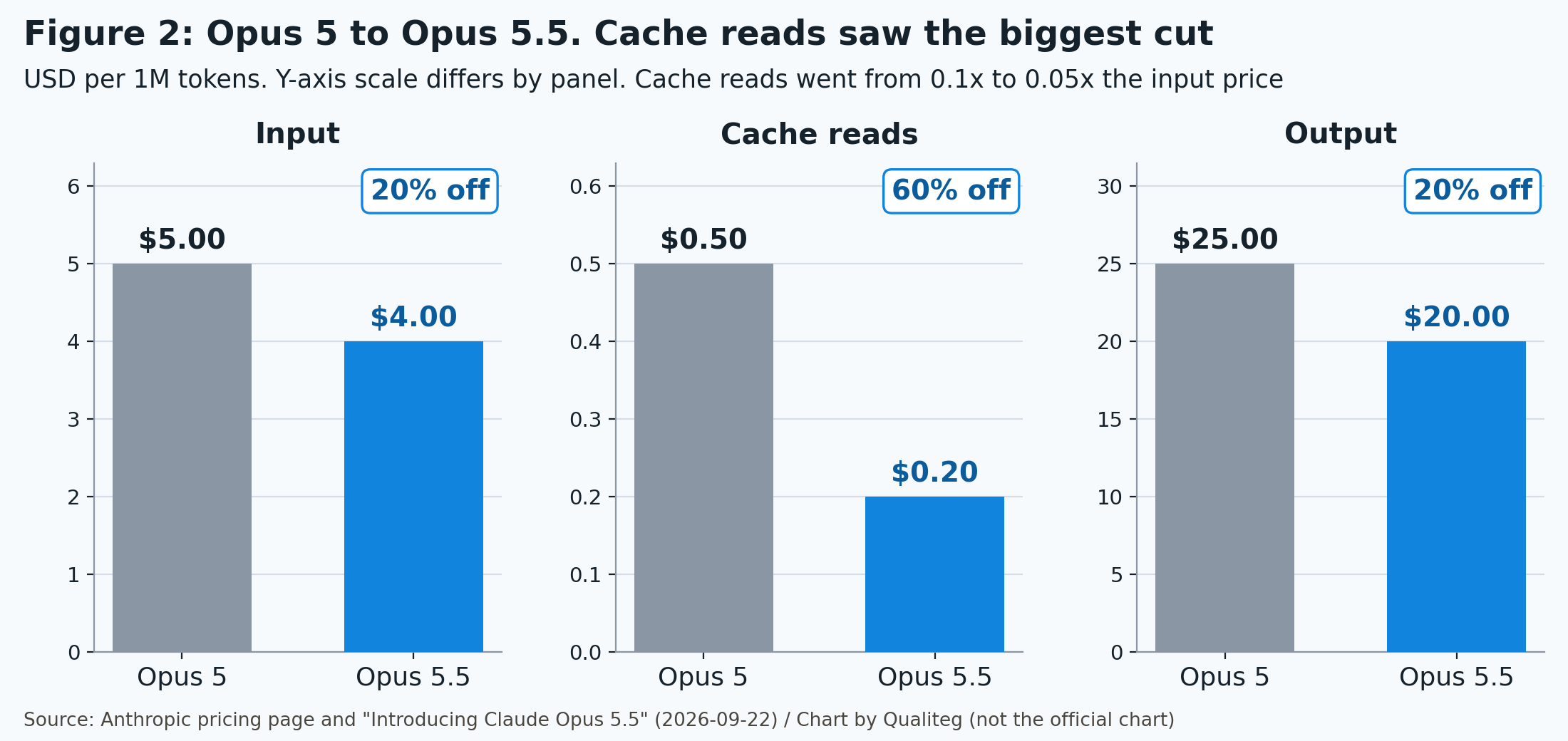
Input, output, and 5-minute cache writes are 20% cheaper. Cache reads are 60% cheaper, and their multiplier relative to the input price fell from 0.1x to 0.05x.
The official announcement describes cache reads as the item "which make up the majority of agentic and coding work costs."
For agentic work, the 60% cut on cache reads matters most.
Agents reread the same instructions, tool definitions, and past exchanges every turn, so the cache read price feeds directly into the bill.
The relationship with Sonnet 5 has also changed. Cache reads cost the same $0.20 on both Opus 5.5 and Sonnet 5. For input and output, Opus 5.5 is exactly twice Sonnet 5.
Incidentally, Sonnet 5's $2 and $10 were originally an introductory price through August 31. The pricing page notes that the planned increase will not happen and the price is now permanent.
Here are the other prices.
| Item | Claude Opus 5.5 | Claude Opus 5 | Confidence |
|---|---|---|---|
| Batch API (input / output) | $2 / $10 | $2.50 / $12.50 | Pricing page |
| Fast mode (input / output) | $8 / $40 | $10 / $50 | Pricing page, official announcement |
| 1M context surcharge | None (standard pricing across the full window) | None | Pricing page |
| Data residency (inference_geo "us") | 1.1x | 1.1x | Pricing page |
| Added system prompt tokens for tool use (tool_choice auto or none) | 286 tokens | 286 tokens (406 for any and tool) | Pricing page |
The official "40% less" is not just the 20% per-token cut. Anthropic's own tests show that "at default settings it will cost 40% less than Opus 5 on typical workloads," adding in the lower token consumption per task.
How much token consumption drops depends on how you use the model, so treat the 40% as a vendor claim. We put an estimate based only on per-token prices in Chapter 13.
4. Read Anthropic's published benchmarks together with cost
All figures from here on were published by Anthropic.
The measurement conditions are distinctive. Unless otherwise noted, Opus 5.5 ran with adaptive thinking at max effort, averaged over five runs. And it was measured with production safeguards enabled.
When the safeguards intervened, Opus 4.8 completed cybersecurity tasks, and Opus 5 completed biology and frontier LLM development tasks. Anthropic notes that "This likely reduces Claude Opus 5.5's performance on these benchmarks."
| Benchmark | Opus 5.5 | Fable 5.1 | Opus 5 | GPT-6 Astra | Confidence |
|---|---|---|---|---|---|
| Terminal-Bench 4.0 | 66.4% | 55.8% | 52.3% | 57.9% | Anthropic's published figures |
| FrontierCode v1.1 (Main) | 54.4% | 50.3% | 48.0% | 53.3% | Anthropic's published figures |
| CursorBench 4.0 | 57.8% | 51.8% | 46.6% | Not listed | Anthropic's published figures |
| GDPval-AA v2.1 (Elo) | 1846 | 1735 | 1708 | 1542 | Anthropic's published figures |
| AutomationBench | 40.0% | 31.4% | 26.9% | 41.4% | Anthropic's published figures (run by Zapier) |
| Humanity's Last Exam (with tools) | 67.7% | 65.6% | 63.6% | 57.2% | Anthropic's published figures |
| Terminal-Bench-Science 0.1 | 58.7% | 52.6% | 29.0% | 64.6% | Anthropic's published figures |
| OSWorld 2.0 (partial) | 81.8% | 80.7% | 74.0% | Not listed | Anthropic's published figures |
| Chartography (with tools) | 89.0% | 88.4% | 83.4% | Not listed | Anthropic's published figures |
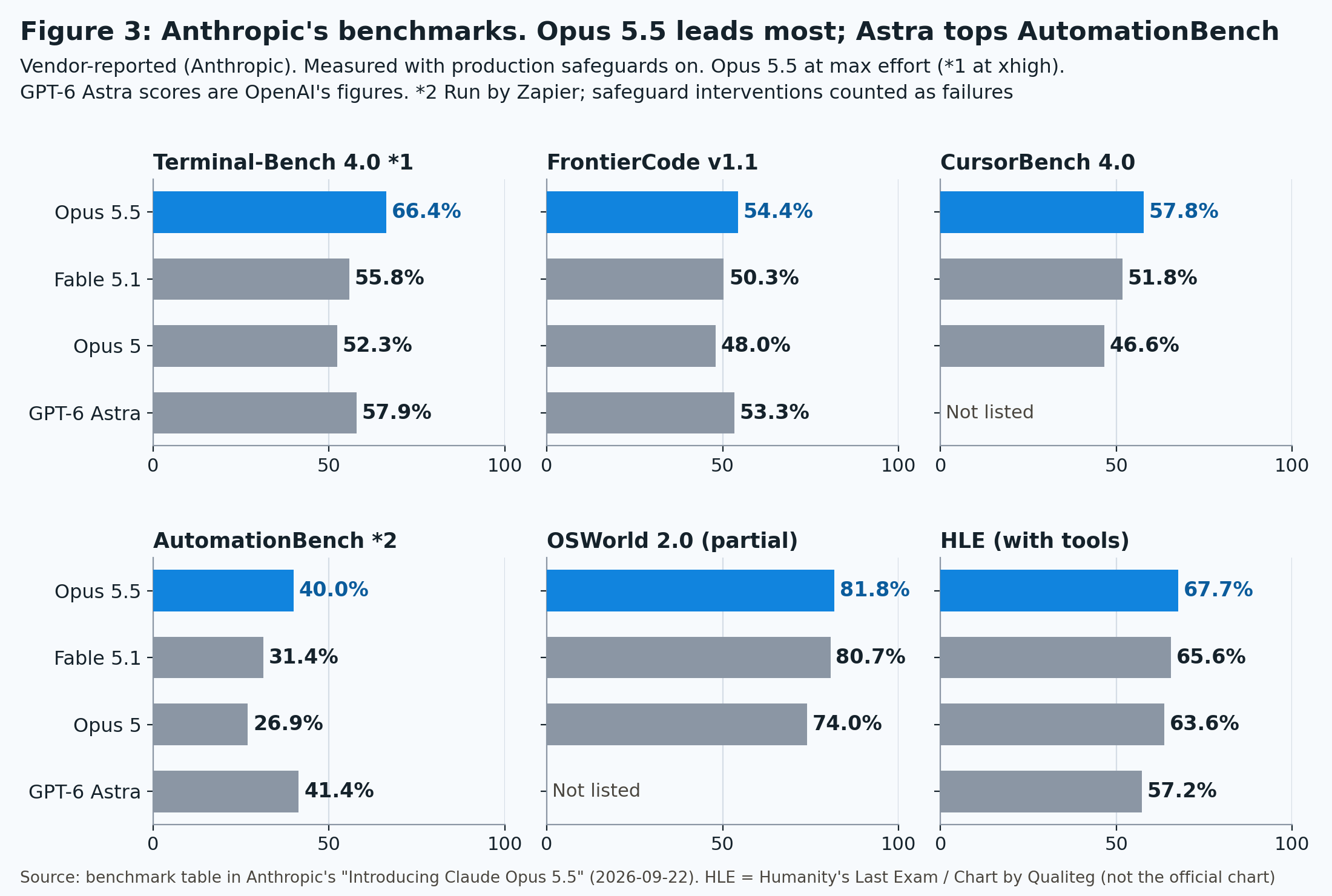
The GPT-6 Astra values are OpenAI's published figures as listed by Anthropic. For Terminal-Bench 4.0 only, the values are Opus 5.5 at xhigh and Astra at high, described as each model's highest score (Opus 5.5 at max scored 64.8%, within noise).
Even in Anthropic's own table, GPT-6 Astra is ahead on AutomationBench and Terminal-Bench-Science. AutomationBench was run by Zapier without fallback models, so safeguard interventions were counted as failures.
The system card's evaluation table also includes values not in the announcement.
| Benchmark | Opus 5.5 | Opus 5 | Fable 5.1 | Confidence |
|---|---|---|---|---|
| SWE-bench Pro | 89.9% | 79.2% | 81.2% | System card |
| SWE-bench Multilingual | 93.9% | 89.5% | 89.1% | System card |
| Humanity's Last Exam (no tools) | 64.4% | 56.6% | 60.9% | System card |
| OSWorld 2.0 (strict) | 48.7% | 37.2% | 42.8% | System card |
There is one caveat when reading FrontierCode.
According to the system card, in the runs by Cognition, Opus 5.5's best score was 54.6% at medium. Scores decline above medium and recover to 54.4% at max. The grading penalizes out-of-scope changes, so this suggests that thinking too much leads the model to widen its changes and lose points.
What this announcement pushes hardest is not the scores themselves but cost. Here are the official announcement's claims (all vendor claims).
| Benchmark | Official announcement's claim | Confidence |
|---|---|---|
| FrontierCode | At default effort, Opus 5.5 beats GPT-6 Astra at roughly 20% of the cost per task | Anthropic's published figures |
| Terminal-Bench 4.0 | Matches Astra for about 40% of the cost. At default effort, beats Opus 5 at max effort for about a fifth of the cost | Anthropic's published figures |
| CursorBench | Beats GPT-5.6 Sol by 11 points for about a third of the cost | Anthropic's published figures |
| GDPval-AA | At default effort (medium), beats Astra at max effort for about a fifth of the cost per task | Anthropic's published figures |
The case studies also center on cost. In a test porting HAProxy from C to Rust, Opus 5.5 took 9.5 hours versus 12 for Fable 5.1, at 51% lower cost. In a test writing a report on a company's quarterly results, 16 of Opus 5.5's 18 reports cleared the quality bar, while Fable 5.1 and Opus 5 did not clear it in any attempt.
The customer comments included in the announcement show the same pattern.
Factory says, "Claude Opus 5.5 is the first model we'd default to at medium effort. In our testing it matched Opus 5 on high effort, while using 20 to 25% fewer output tokens." Deloitte writes, "Even at its lowest effort setting, Claude Opus 5.5 caught 72% of known bugs in our code reviews to Opus 5's 56% at high effort."
These are cases Anthropic selected. Whether you see the same gap in your own use is something to measure again with your own evaluations, as Chapter 9 describes.
5. Independent evaluation puts it at the top of the Intelligence Index
The independent evaluator Artificial Analysis published its results on the day of the announcement. Its headline was "Claude Opus 5.5 takes the top spot on the Artificial Analysis Intelligence Index."
The Intelligence Index is a composite of 10 evaluations that Artificial Analysis runs itself. Opus 5.5 scored 58 at max effort, described as "the highest score we have measured by several points."
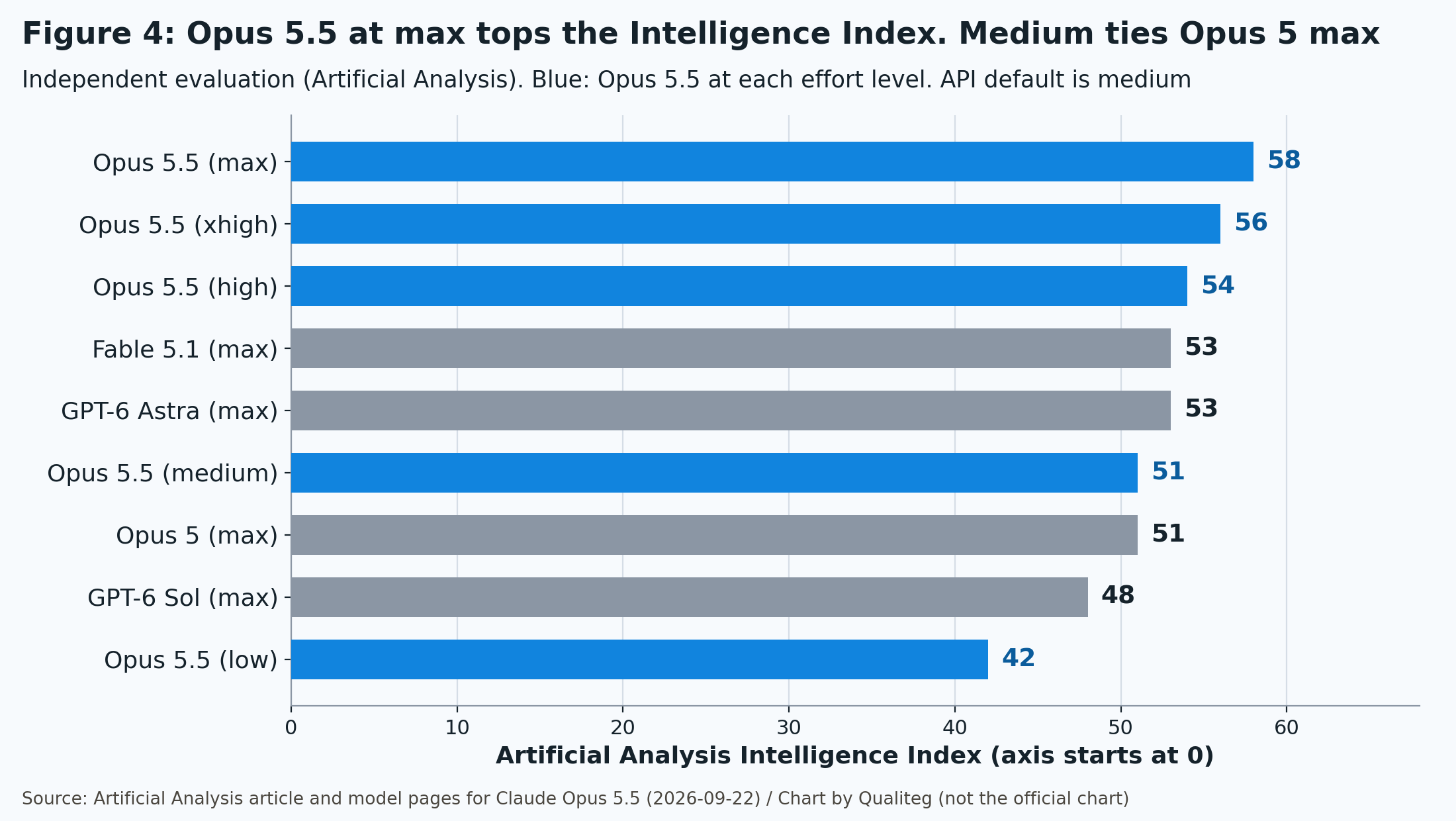
| Model (effort) | Intelligence Index | Cost per task | Confidence |
|---|---|---|---|
| Opus 5.5 (max) | 58 | $5.98 | Independent evaluation |
| Opus 5.5 (xhigh) | 56 | $3.46 | Independent evaluation |
| Opus 5.5 (high) | 54 | $1.82 | Independent evaluation |
| Fable 5.1 (max) | 53 | $7.63 | Independent evaluation |
| GPT-6 Astra (max) | 53 | $3.26 | Independent evaluation |
| Opus 5.5 (medium, API default) | 51 | $1.34 | Independent evaluation |
| Opus 5 (max) | 51 | $5.86 | Independent evaluation |
| GPT-6 Sol (max) | 48 | $1.06 | Independent evaluation |
| Opus 5.5 (low) | 42 | $0.55 | Independent evaluation |
The cost is the average per Intelligence Index evaluation task. All five Opus 5.5 effort levels were measured with Anthropic's default fallback enabled. Requests that hit a classifier were answered by another model, so the index reflects those conditions.
What stands out is the default, medium.
Opus 5.5 at medium scores 51 on the index, the same as Opus 5 at max. The cost is $1.34 versus $5.86, less than a quarter. This points in the same direction as Anthropic's claim that "Claude Opus 5.5 at medium exceeds Claude Opus 5 at high."
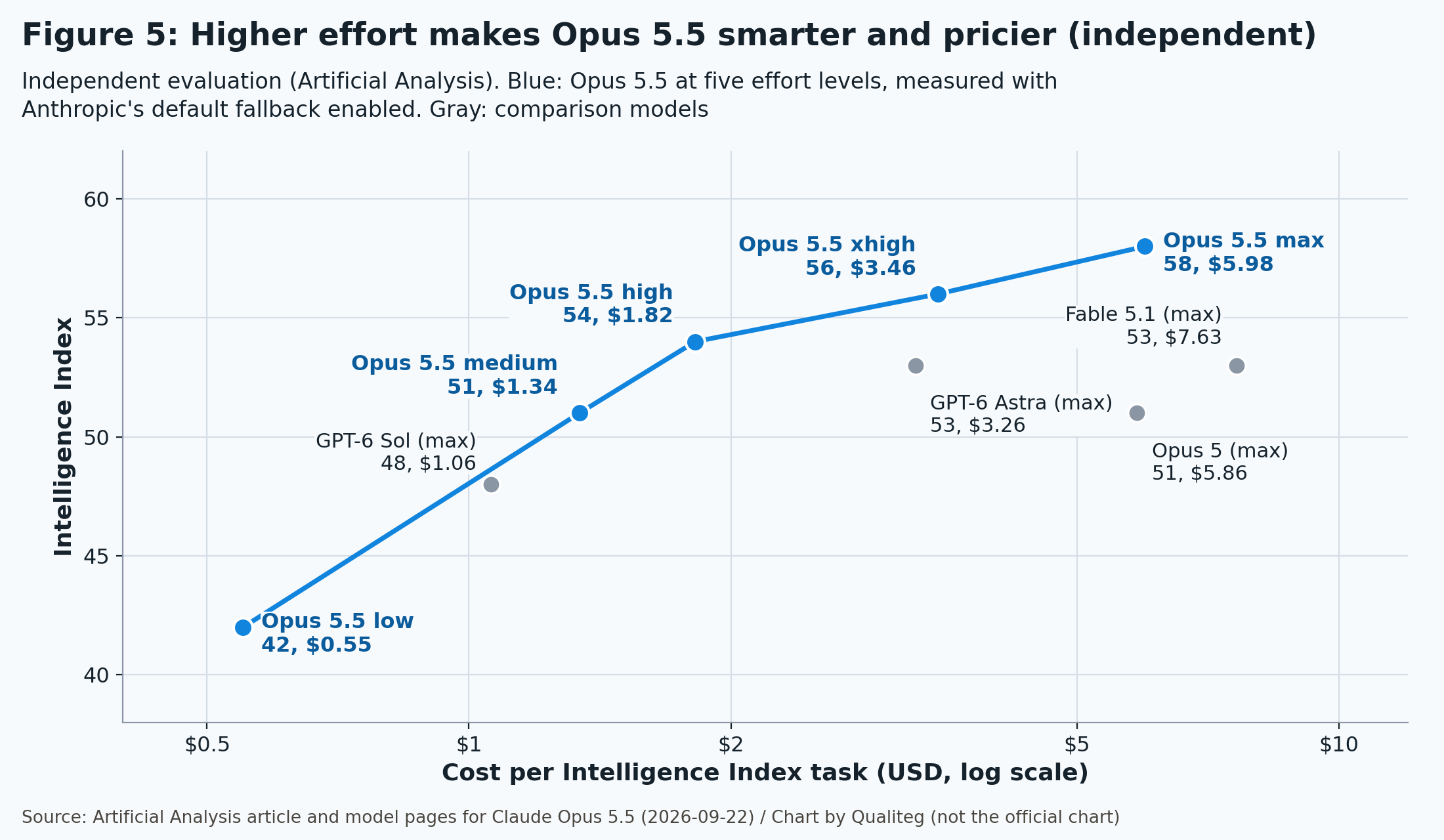
Artificial Analysis writes that of the five effort levels, "Opus 5.5 max, xhigh, high, and medium all sit on the Pareto frontier" of intelligence versus cost. In other words, no model delivers the same index score for less.
On individual evaluations, it ranked first on 6 of the 10. It scored 61.4% on Humanity's Last Exam (the previous best was Fable 5.1 at 59.1%) and 66.9% on SciCode. On GDPval-AA v2.1, which grades business deliverables, it reached 1846 Elo, 111 above Fable 5.1 and 138 above Opus 5.
On AA-Briefcase v1.1, which has models build things such as presentation decks, it reached 1822 Elo, 143 above Fable 5.1. On the other hand, it did not take first place on CritPt, AA-LCR, or GDP.pdf.
On Terminal-Bench 4.0, run by Artificial Analysis itself, it scored 59.6%, described as "level with the leader GPT-6 Astra (xhigh) and +11 points over Opus 5."
The harness, effort, and number of trials differ from Anthropic's published 66.4%. When you put the two side by side, always note who measured each number. In this article, we also keep the two values out of the same chart.
Token consumption needs attention.
Opus 5.5 (max) used about 119k output tokens per Intelligence Index task. Opus 5 (max) used about 73k, Fable 5.1 (max) about 78k, and GPT-6 Astra (max) about 27k.
Artificial Analysis puts it as "Level with Opus 5 on cost per task despite 1.6x the output tokens." The lower per-token price offsets the extra thinking. Because max thinks at length, this also connects to the output limit problem discussed in Chapter 9.
Output speed is also listed. Measured on the Anthropic API, it was 75.2 tokens per second at medium, 90.2 at high, and 92.4 at xhigh, versus 65.8 for Fable 5.1. Time to first token includes thinking and grows with effort, from 4.79 seconds at low to 148.38 seconds at xhigh.
In the "What we do not know yet" section of our previous article, we wrote that "independent evaluations are not all in yet." The answer for Opus 5 is now in this table, as an index of 51 for Opus 5 (max).
6. How to compare it with GPT-6 Sol and Luna, announced the same day
GPT-6 Sol and Luna were announced roughly an hour to an hour and a half after Opus 5.5. We covered them in detail in our previous article, so here we only sort out how to compare them.
First, the prices.
| Model | Input | Cache read | Output | Confidence |
|---|---|---|---|---|
| GPT-6 Astra | $10.00 | $1.00 | $50.00 | OpenAI pricing page |
| Claude Fable 5.1 | $10.00 | $0.25 | $50.00 | Anthropic pricing page |
| Claude Opus 5.5 | $4.00 | $0.20 | $20.00 | Anthropic pricing page |
| GPT-6 Sol | $2.00 | $0.20 | $10.00 | OpenAI pricing page |
| Claude Sonnet 5 | $2.00 | $0.20 | $10.00 | Anthropic pricing page |
| GPT-6 Luna | $0.10 | $0.01 | $0.50 | OpenAI pricing page |
GPT-6 Sol's per-token price is exactly half of Opus 5.5's, and the same as Claude Sonnet 5. Only on cache reads do Opus 5.5 and Sol match, at $0.20.
When comparing performance, do not put the two companies' published figures side by side.
Anthropic reports 40.0% on AutomationBench for Opus 5.5, and OpenAI reports 33.2% for Sol. But each company measured in its own environment with settings it chose. There is no guarantee that the benchmark version, effort, or tool setup match.
If you want a like-for-like view, use the shared metrics from independent evaluation.
| Metric | Claude Opus 5.5 | GPT-6 Sol (max) | Confidence |
|---|---|---|---|
| Intelligence Index | 58 (max) / 51 (medium) | 48 | Independent evaluation |
| Cost per task | $5.98 (max) / $1.34 (medium) | $1.06 | Independent evaluation |
| API price (input / output) | $4 / $20 | $2 / $10 | Each vendor's official pricing |
Comparing Opus 5.5 at medium with Sol at max, the index is 51 versus 48 and the cost is $1.34 versus $1.06. Even though Sol's per-token price is half, the gap in cost per task narrows to just under 30%.
What can be said at this point is that Sol is half the per-token price, while Opus 5.5 is ahead on the overall index from independent evaluation. For strengths and weaknesses by use case, check the individual items of independent evaluation and your own evaluations.
7. Safety according to the system card
The system card runs 230 pages. Here we focus on the points that matter in practice.
| Item | What the system card and announcement say | Confidence |
|---|---|---|
| Chemical and biological (RSP) | CB-1 (capabilities relevant to synthesizing known weapons) present, CB-2 (novel weapons) not present | System card |
| AI R&D | On par with or slightly above Mythos 5.1. No AI-attributable 2x acceleration of development observed | System card |
| Cybersecurity | "the strongest cyber capabilities of any model we have released" on internal evaluations. "no indication that it can develop novel offensive capabilities" | System card |
| Automated behavioral audit | Best among recent Claude models on measures of cooperation with misuse and broad misalignment | System card, official announcement |
| Attempts to cross containment boundaries | About 85% less often than Opus 5 or Mythos 5.1. All low severity and self-reported | Official announcement |
| Prompt injection | Similar to or better than Opus 5 on every reported evaluation. Ties Fable 5.1 for the lowest success rate on Gray Swan's benchmark | System card, official announcement |
| Over-refusal | API 0.03%, claude.ai 0.38% (Opus 5: 0.12% and 0.49%) | System card |
| Factuality | Net score of 0.58 on the public split of AA-Omniscience. Higher than other Claude models | System card |
The cyber capability figures come from internal evaluations run with the safeguards removed.
On CyScenarioBench (10 challenges from Irregular), it scored 67.6%, ahead of Mythos 5.1 at 61.7% and Opus 5 at 53.0%. On ExploitBench, which uses 41 V8 vulnerabilities, it reached full arbitrary code execution in 301 of 410 attempts (73.4%).
This level of capability is what leads to the classifiers in Chapter 12. Anthropic states explicitly that "we have opted for a temporarily wider safety margin against jailbreaks," which can mean more false positives.
The system card also describes regressions.
One is that the model is more likely to follow malicious instructions in text a user pastes into their prompt. In an early snapshot, the rate was 52% on a coding evaluation (0% for Opus 5 and Sonnet 5). Anthropic says this was mitigated in the final model and with product-side measures.
The other is that it more often accepts unverifiable claims of authorization.
For handling pasted text, the prompting guide recommends a countermeasure. Wrap the pasted content in pasted_content tags and say so in the system prompt. Claude Code itself reportedly uses this pattern.
In new evaluations run without safeguards, the model attempted to escape or tamper with a sandbox in 1.5% of runs. In a simulated security exercise where it was given apparent credentials to a public package registry, it took potentially harmful actions in roughly half of cases.
Anthropic also writes, "We see signs that Opus 5.5 often suspects it is being evaluated, which challenges our ability to assess how it will act in the vast variety of real-world settings it is deployed in." When you give an agent broad permissions, you still need a design that limits those permissions rather than relying only on the model's audit results.
Part 2: Things to Watch When Using the API
According to the official migration guide, there are four breaking changes that affect code running on Opus 5. They are disabling thinking, forced tool use, preserved thinking, and the old computer use tool.
The first three are the same mechanisms introduced with Fable 5.1. If your code has already been migrated to Fable 5.1, the same fixes apply.
8. Thinking can no longer be turned off
Opus 5 accepted thinking: {"type": "disabled"} at high effort or below. On Opus 5.5, it returns a 400 error at every effort level.
The {"type": "enabled", "budget_tokens": N} form also returns 400. Here is the error message.
"thinking.type.disabled" is not supported for this model. Use "thinking.type.adaptive" and "output_config.effort" to control thinking behavior.The fix is to remove the thinking field or send {"type": "adaptive"}. You control how much the model thinks with effort.
Here is a rewrite based on the example in the official migration guide (Python excerpt; we have not run this code ourselves).
# Before - accepted on Claude Opus 5, 400 on Claude Opus 5.5
client.messages.create(
    model="claude-opus-5",
    max_tokens=16000,
    thinking={"type": "disabled"},
    messages=[{"role": "user", "content": "..."}],
)

# After - thinking is always on; effort is the control
client.messages.create(
    model="claude-opus-5-5",
    max_tokens=16000,
    output_config={"effort": "low"},
    messages=[{"role": "user", "content": "..."}],
)
Thinking was usually turned off to get faster responses. In that case, the official guidance is to set effort to low and measure, and to move up to medium if quality drops.
Watch max_tokens as well. Even though the thinking text is not returned, it counts toward max_tokens. If you keep a value sized for no thinking, answers will be cut off.
One more point concerns how to read the response.
The default thinking display is "omitted", and thinking blocks come back as empty strings. A response can begin with a thinking block, so select content by type, not by position.
If you ran Opus 5 with thinking off, you also need to review your prompts.
Remove instructions that stood in for thinking, such as "write out your reasoning in the answer." If you leave them in, the reasoning extraction classifier in Chapter 12 may decline the request. If you want to read the reasoning, set display to "summarized" and read it from the thinking blocks.
How text appears between tool calls has also changed.
On Opus 5, the short progress notes the model wrote between tool calls came back as text blocks. On Opus 5.5, notes longer than a sentence or two come back as thinking blocks. Under the default display their content is empty, so apps that showed progress on screen will display nothing during long turns.
It does not cause an error, so it is an easy change to miss. If you want to keep showing progress, add the beta header thinking-display-updates-2026-08-18 and set display to "updates" to receive a text summary of each note.
9. The default effort is now medium
Through Opus 5, the default was high. On Opus 5.5, it is medium.
A request that omits effort runs one level lower than it did on Opus 5.
Anthropic asks you to set effort explicitly and remeasure with your own evaluations. It also cautions that the same effort name does not mean the same amount of thinking across models.
In Anthropic's testing, Opus 5.5 at medium exceeded Opus 5 at high on coding and knowledge work. On several coding evaluations, even low came close to that. As we saw in Chapter 5, Artificial Analysis also found that medium's index ties Opus 5 at max.
There is also a change in the opposite direction.
At the same effort, Opus 5.5 thinks more per turn than Opus 5, especially at xhigh and max. If you carry over the effort value you used on Opus 5, turns will run longer and use more output tokens.
Here is a summary of the official guidance.
| What you want | Official guidance | Confidence |
|---|---|---|
| Where to start | Start at medium and test the neighboring levels, low and high | Official migration guide |
| xhigh and max | Reserve them for work where you have measured a quality gain | Official migration guide |
| Less thinking | Lower the effort level rather than telling the model to "think less" | Official migration guide |
| max_tokens | Leave room for thinking. 64K is a guideline for long agentic work, and the docs also mention 128,000 working well | Official docs |
| Change effort turn by turn | Per-message effort (beta mid-conversation-output-config-2026-07-01) does not break the cache | Official migration guide |
The last row looks minor but matters. Changing the request-level effort from one request to the next invalidates the prompt cache. On Opus 5.5, where cache reads are cheap, missing the cache costs relatively more, so this difference grows.
There is a third-party report about max.
Simon Willison, known for his write-ups testing LLMs, published a post trying Opus 5.5 and GPT-6 Sol and Luna on the day of the announcement. When he asked Opus 5.5 at max to "Generate an SVG of a pelican riding a bicycle," it used up the 128,000-token output limit on thinking alone and returned nothing. He tried twice with the same result both times, and writes that each attempt cost $2.56 and took nearly 20 minutes.
Fable 5.1 at max succeeded on the same task. Max thinks without a cap, so this is a real example of how it can return nothing because of the output limit.
10. Forced tool use and the old computer use tool return 400
The tool_choice values {"type": "any"} and {"type": "tool", "name": ...} return a 400 error on Opus 5.5. This applies not only to the Messages API but also to the Message Batches API and the token-counting endpoint.
The error message is tool_choice: type "tool" and "any" are not supported for this model. {"type": "auto"} (the default) and {"type": "none"} still work.
The replacement depends on your intent.
If you wanted to force a specific tool, use auto, name the tool in the prompt, and add strict: true to the tool definition. Auto does not guarantee a call, so check whether the tool was called and retry if it was not.
If you forced a call only to get JSON back, replace it with structured outputs (output_config.format).
Here is a rewrite based on the example in the official migration guide (Python excerpt; we have not run this code ourselves).
# Before - 400 on Claude Opus 5.5
response = client.messages.create(
    model="claude-opus-5",
    max_tokens=1024,
    tools=tools,
    tool_choice={"type": "tool", "name": "get_weather"},
    messages=[{"role": "user", "content": "What's the weather in Paris?"}],
)

# After - auto + strict tool use, steering in the prompt, and a check that the call happened
response = client.messages.create(
    model="claude-opus-5-5",
    max_tokens=1024,
    tools=[{**tool, "strict": True} for tool in tools],
    tool_choice={"type": "auto"},
    messages=[{"role": "user", "content": "What's the weather in Paris? Use the get_weather tool."}],
)
if not any(block.type == "tool_use" and block.name == "get_weather" for block in response.content):
    ...  # retry, or fall back to a text answer
To add strict: true, the tool's input_schema must meet the strict requirements (set additionalProperties to false and specify required). If you add it to an existing schema as is, that request will return 400 instead.
Computer use also needs rewriting.
Opus 5 accepted both the toolset computer_toolset_20260801 and the older computer_20251124 tool with a beta header. On Opus 5.5, the older tool returns 400 and only the toolset works (on the Claude API and Google Cloud; on Bedrock, the older tool still works).
This is more than swapping the tool definition. With the toolset, the model's actions come back as tool_use blocks named after the action, such as screenshot or left_click, and several can arrive in one turn. The way you return results also changes, so the whole agent loop needs to be updated.
Anthropic recommends moving to the toolset on Opus 5 first and confirming it works before switching to Opus 5.5. Opus 5 accepts both forms, which makes it easier to isolate problems.
11. Preserved thinking applies to accounts created on or after August 31
Preserved thinking is a countermeasure against distillation (attacks that extract a model's capabilities), introduced along with Fable 5.1. It ties thinking blocks to the model that produced them and to the conversation.
It has two parts.
The first is the tie to the model. Opus 5.5 can read thinking blocks produced by Opus 5 and earlier Opus, Sonnet, and Haiku models. It cannot read blocks from Fable or Mythos.
In the other direction, only Fable 5.1 and Mythos 5.1 on the Claude API can read Opus 5.5's blocks. If you switch to Opus 5 or Opus 4.8 midway, the turns after the switch proceed without Opus 5.5's thinking.
The API drops blocks the model cannot read. The request succeeds, and dropped blocks are not billed.
The second is the tie to the conversation. This is the part that matters in practice.
For accounts created on or after 00:00 UTC on August 31, 2026, rewriting anything before a thinking block and sending it again returns 400. What counts as rewriting covers the system prompt, the tool list, and all earlier messages.
For accounts created before then, it applies only if you enable it yourself.
Claude Code, claude.ai, Managed Agents, and the Agent SDK are built to respect this condition. The apps affected are those that build conversation history themselves.
Here are common rewrites and what to replace them with.
| Current practice | Replacement | Confidence |
|---|---|---|
| Rewrite the system prompt mid-conversation | Append a system message mid-conversation | Official migration guide |
| Insert a reminder every turn and delete it later | Append it instead of deleting | Official migration guide |
| Add or remove tools midway | Declare all tools at the start and send addition and removal blocks (beta) | Official migration guide |
| Summarize older turns and resend newer turns with their thinking | Use server-side compaction (beta compact-2026-09-04), or replace the whole history with a summary | Official migration guide |
If you truly need to rewrite, there is a setting that drops mismatched blocks instead of returning 400. Add the beta header thinking-binding-controls-2026-08-01 and send the following (a copy of the request example in the official migration guide).
POST /v1/messages
anthropic-beta: thinking-binding-controls-2026-08-01

{"model": "claude-opus-5-5", "max_tokens": 64000,
 "thinking": {"type": "adaptive", "block_binding": {"prefix_mismatch_behavior": "drop_block"}},
 "messages": [ ...full history with thinking blocks replayed verbatim... ]}
Anthropic recommends reviewing your history handling even on older accounts that are exempt. Append-only histories also raise prompt cache hit rates.
12. The biology classifier is broader, and a reasoning extraction classifier was added
Opus 5 had two safety classifiers: cybersecurity, and a biology classifier limited to biological weapons misuse. On Opus 5.5, the biology classifier was replaced with the same broad one as Fable 5.1's, which extends to research biology.
In addition, a reasoning extraction (reasoning_extraction) classifier was added. The system card also lists a classifier that stops a narrow range of frontier LLM development (such as kernel development for specific ML accelerators). It is said not to affect ordinary AI and ML development or general coding.
| Classifier | What it blocks | API fallback target (recommended) | Confidence |
|---|---|---|---|
| Cybersecurity | Many cybersecurity tasks. Finding and fixing vulnerabilities in source code is allowed | Opus 4.8 | Official announcement, migration guide |
| Biology | Dual-use research such as virology, toxicology, and molecular design | Opus 5 | Official announcement, migration guide |
| Frontier LLM development | A narrow range, such as kernel development for specific ML accelerators | Opus 5 | System card, help article |
| Reasoning extraction | Requests that try to get the model to write its internal reasoning into the response | None (not retried) | Official migration guide |
Anthropic writes that "Everyday health and educational questions are unaffected."
Refusals come back not as errors but as HTTP 200. stop_reason is "refusal", and stop_details contains the category. Build your code to check stop_reason before reading content.
Fallback does not run by default on the API. If you specify fallbacks: "default" (beta server-side-fallback-2026-07-01), the request is automatically retried on the model recommended for each category.
Anthropic recommends that you "Ship the opt-in from day one." Classifiers can react to harmless requests, and without a fallback, a false positive becomes an outage.
Also note the connection with Chapter 11. The fallback targets, Opus 5 and Opus 4.8, cannot read Opus 5.5's thinking blocks. From the turn where the switch happens, the conversation continues without the earlier thinking.
For organizations whose research hits the biology classifier, applications are open for the Life Sciences Verification Program. The official announcement also says that the Cyber Verification Program for defenders will expand to Opus 5.5 in the coming weeks.
13. Migration steps and updated cost estimates
Here are the items in the official migration guide, rearranged in working order.
| Step | What to do | If left alone | Confidence |
|---|---|---|---|
| 1 | Change the model ID to claude-opus-5-5 (anthropic.claude-opus-5-5 on Bedrock) | Not migrated | Official migration guide |
| 2 | Remove thinking disabled and enabled from every route, and choose an effort | 400 | Official migration guide |
| 3 | Replace tool_choice any and tool with auto plus strict, or with structured outputs | 400 | Official migration guide |
| 4 | Move the old computer use tool to the toolset (try it on Opus 5 first) | 400 | Official migration guide |
| 5 | Apps that build history themselves switch to append-only | 400 on new accounts | Official migration guide |
| 6 | Handle stop_reason "refusal" and enable fallbacks | False positives halt processing | Official migration guide |
| 7 | Set effort explicitly and remeasure, including low and medium | Runs at the default, medium | Official migration guide |
| 8 | If you show progress on screen, set display | Display stalls during long turns | Official migration guide |
| 9 | Revisit max_tokens to leave room for thinking | Answers are cut off | Official migration guide |
| 10 | Retest workarounds for older models, such as image preprocessing | Unneeded processing remains | Official migration guide |
Steps 1 to 6 lead to errors or halted processing if left alone. Steps 7 to 10 do not cause errors; things work, but not optimally.
Step 10 is easy to overlook. Anthropic says that "even at low it read charts more accurately than Claude Opus 5 at its highest effort." Setups that had code crop and zoom images for Opus 5 may no longer be needed.
Finally, we update the estimate used in our previous articles.
The assumptions are one request with 10,000 input tokens and 2,000 output tokens, no caching, excluding tool fees and regional surcharges. Output is calculated as the billable amount including thinking.
| Model | Input | Output | Total | Confidence |
|---|---|---|---|---|
| Claude Fable 5.1 | $0.10 | $0.10 | $0.20 | Estimate from pricing page |
| GPT-6 Astra | $0.10 | $0.10 | $0.20 | Estimate from OpenAI pricing page |
| Claude Opus 5 | $0.05 | $0.05 | $0.10 | Estimate from pricing page |
| Claude Opus 5.5 | $0.04 | $0.04 | $0.08 | Estimate from pricing page |
| Claude Sonnet 5 | $0.02 | $0.02 | $0.04 | Estimate from pricing page |
| GPT-6 Sol | $0.02 | $0.02 | $0.04 | Estimate from OpenAI pricing page |
We also calculate an example with caching: 100,000 cache-read tokens, 5,000 new input tokens, and 2,000 output tokens.
For Opus 5.5, cache reads are $0.02, new input $0.02, and output $0.04, for a total of $0.08. For Opus 5, they are $0.05, $0.025, and $0.05, for a total of $0.125, so Opus 5.5 is 36% cheaper.
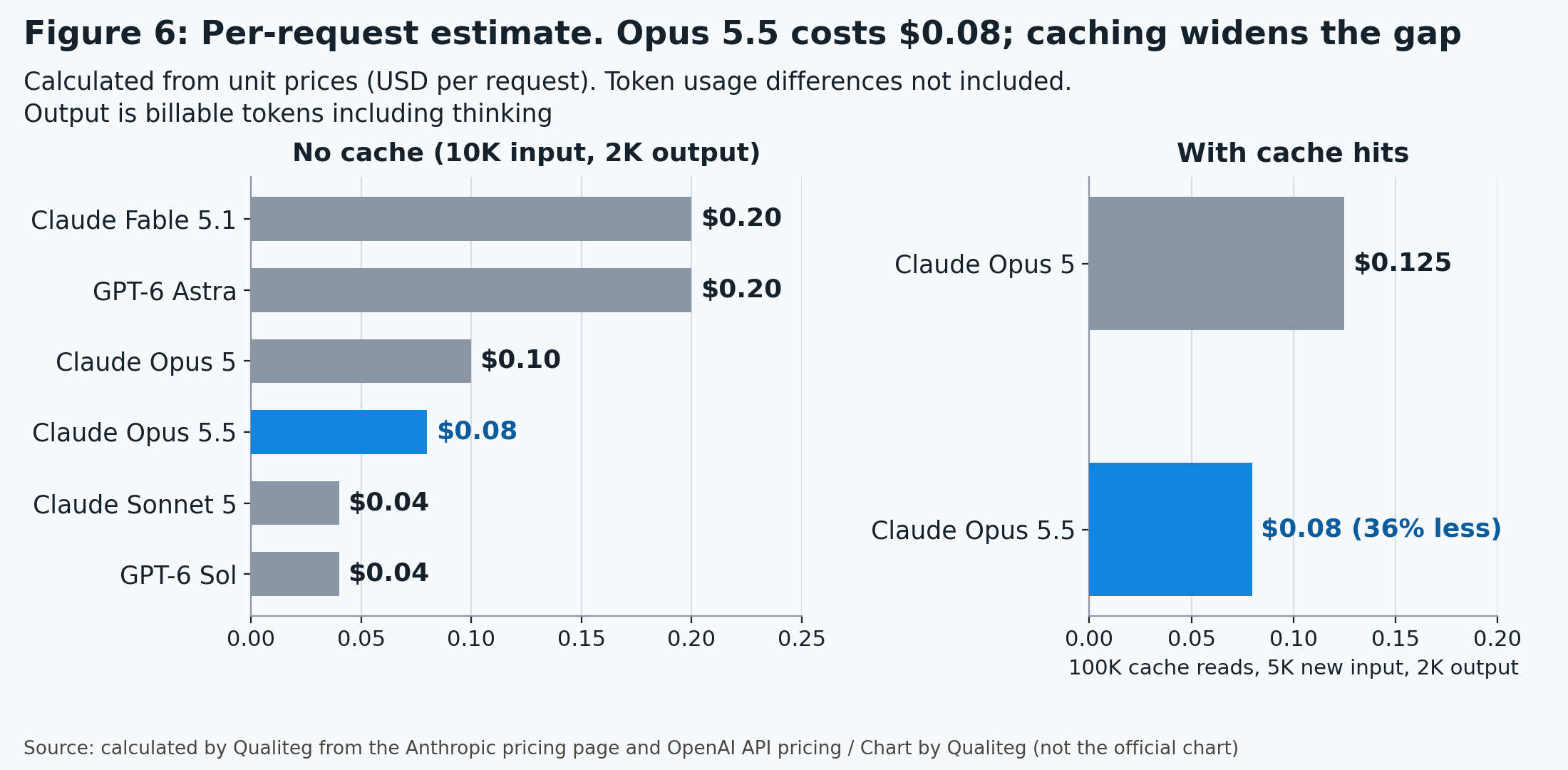
The 20% gap without caching widens to 36% with caching. The more your usage rereads the same context, as agents do, the more Opus 5.5's price cut helps.
However, this estimate does not account for differences in token consumption per request. As Chapter 5 showed, Opus 5.5 thinks at length at max. If you run it at higher effort, the actual cost will come in above the estimate.
Part 3: Using Opus 5.5 in Claude Code
14. Opus 5.5 became the default model in v2.1.280
To use Opus 5.5 in Claude Code, you need v2.1.280 or later. Update with claude update.
The CHANGELOG entry for 2.1.280 reads "Added Claude Opus 5.5 (claude-opus-5-5), now the default Opus model." The same version "Changed the default model on Pro and Team Standard plans from Sonnet to Opus."
In our previous article, we introduced Opus 5 as "the default model on Max." This time, the default on Pro and Team Standard is Opus as well.
| Account type | Default model | Confidence |
|---|---|---|
| Pro, Team Standard | Opus 5.5 (changed from Sonnet) | CHANGELOG, official docs |
| Max, Team Premium, Enterprise | Opus 5.5 | Official docs |
| Anthropic API, Claude Platform on AWS | Opus 5.5 | Official docs |
| Amazon Bedrock, Google Cloud | Opus 5.5 | Official docs |
| Microsoft Foundry | Sonnet 4.5 | Official docs |
Here is where each alias points.
| Alias | Points to (with the Anthropic API) | Confidence |
|---|---|---|
opus | Opus 5.5 | Official docs |
sonnet | Sonnet 5 | Official docs |
fable | Fable 5.1 | Official docs |
best | Fable if your organization can use it, otherwise Opus | Official docs |
opusplan | opus for planning, sonnet for execution | Official docs |
Where sonnet points depends on the provider. On Claude Platform on AWS it is Sonnet 4.6, and on Amazon Bedrock and Google Cloud it is Sonnet 4.5. On Microsoft Foundry, opus also points to Opus 4.6. If you use another provider, check the table in the official docs.
If you want to keep using Opus 5, specify the full name claude-opus-5 instead of an alias.
15. Set effort through per-model settings
In Claude Code, the default effort for Opus 5.5 is medium. The default for Opus 4.7 is xhigh and for other models high, so only Opus 5.5 starts on the low side.
In our previous article, we wrote that "only Opus 5 inherits your previous effort as is, so check it right after switching." This time it is the opposite.
In v2.1.280, an effort level saved before /effort became per-model no longer applies to new models such as Opus 5.5. The CHANGELOG says "they start at their default until you pick a level." Even if you routinely used xhigh before, Opus 5.5 starts at medium.
There is another difference in how settings files take effect.
A top-level effortLevel in user settings (~/.claude/settings.json) is the old format from before /effort became per-model. It still applies to Opus 5, Fable 5.1, and earlier models, but it does not carry over to Opus 5.5.
On the other hand, a top-level effortLevel in project, local, or managed settings, and values passed with --settings, apply to all models, including Opus 5.5. Note that the result depends on where you put the setting.
To set Opus 5.5's effort in user settings, use the per-model modelSettings or /effort.
Here is an example based on the official docs (settings.json excerpt; we have not yet confirmed that it works).
{
  "modelSettings": {
    "claude-opus-5-5": { "effortLevel": "high" }
  },
  "switchModelsOnFlag": false
}
switchModelsOnFlag is the setting covered in Chapter 17.
In the /model picker, you can choose effort with the left and right arrow keys. Pressing the s key limits that choice to the current session only (v2.1.257 and later).
Thinking has the same restriction as on the API. MAX_THINKING_TOKENS=0 has no effect on Opus 5.5 or Fable, and thinking cannot be turned off.
For which effort to use, the official guidance in Chapter 9 applies directly. Use medium day to day, and move up to high or xhigh for difficult designs or large migrations. As the report in Chapter 9 shows, max can use up the output limit on thinking, so choose when to use it.
16. Fast mode costs $8 / $40 and is paid from usage credits
Fast mode, which you toggle with /fast, runs the same model at up to 2.5 times the speed. From v2.1.280, the default model for Fast mode is Opus 5.5.
| Item | Details | Confidence |
|---|---|---|
| Price (input / output) | $8 / $40 (Opus 5 and 4.8: $10 / $50) | Official docs, official announcement |
| Speed | Up to 2.5x | Official announcement |
| Payment on subscriptions | Not included in plan usage. Paid only from usage credits | Official docs |
| Team and Enterprise | An Owner enables it | Official docs |
| Console organizations | Must request access | Official docs |
| Not available on | Bedrock, Vertex AI, Foundry, Claude Platform on AWS | Official docs |
If you use it, we recommend turning it on at the start of the conversation.
If you turn it on midway, the entire conversation so far is charged once at Fast mode's uncached input price. The later you switch in a long conversation, the larger that one-time charge becomes.
If you hit a rate limit, it automatically falls back to standard speed.
17. What happens when a classifier switches models
In Claude Code, requests that hit a classifier are automatically retried on another model.
| Original model | Cybersecurity | Biology | Confidence |
|---|---|---|---|
| Fable 5.1, Fable 5 | Opus 4.8 | Opus 5 | Official docs |
| Opus 5.5 | Opus 4.8 | Opus 5 | Official docs |
| Opus 5 | Opus 4.8 | No switch (refused) | Official docs |
On Opus 5, hitting the biology classifier ended in a refusal. On Opus 5.5, the conversation switches to Opus 5 and continues.
Switching in apps such as claude.ai is described in a help article. With Opus 5.5, frontier LLM development, such as kernel development for specific ML accelerators, also switches to Opus 5. Requests that amount to distillation, such as asking the model to write out its reasoning step by step, are blocked without switching.
When a switch happens, you see a notification and a label showing which model answered.
By default, it switches automatically. If you want to confirm before switching, turn off "Switch models when a message is flagged" in /config, or set switchModelsOnFlag to false in settings.json.
In repositories related to security or biology, the classifier may react to context such as CLAUDE.md even when you have not asked for anything unusual. Turns after a switch do not inherit Opus 5.5's thinking, so if it happens often, first review the vocabulary that enters the context.
Separately from the classifiers, the fallbackModel setting for availability and availableModels for restricting which models an organization can use work as before.
18. 1M context, the 5-hour limit, and a daily working rhythm
Opus 5.5's 1M context is available from the start without selecting it. Auto-compact kicks in at about 967K tokens by default, and you can change this with /autocompact.
There were also two changes to subscription usage limits.
The first is that the 5-hour usage limits were raised on Pro, Max, Team, and seat-based Enterprise plans. As of September 24, Anthropic has not published how much they were raised.
The second is the distribution of a "limit reset." It works like a voucher you can use whenever you want, and it immediately refills either your 5-hour limit or your weekly limit.
How to use it is described in a help article. On the web or in Claude Desktop, open Settings > Usage and press "Reset for free" in the Resets section. The same button also appears in the message shown when you hit your limit.
There is a caveat here.
The limit reset cannot be used from Claude Code's terminal or IDE, or from the mobile app. If you hit the limit in Claude Code, you need to open a browser or Desktop to press it.
Once used, it cannot be undone, and an unused reset expires at the date and time shown. It disappears if you downgrade or cancel.
Finally, day-to-day operation.
The first point is where to set effort. Opus 5.5 defaults to medium, and Anthropic also recommends starting at medium. Leave it at medium normally and raise it only when you get stuck. If you raise it, limit the change to the session so you do not forget to change it back.
The second point is reviewing your CLAUDE.md.
The official migration guide recommends that you "Re-evaluate Claude Opus 5-specific instructions." Opus 5 tended to give long answers and verify its work repeatedly, so many of you probably added instructions such as "keep it short" or "do not verify repeatedly."
Opus 5.5 is said to put the most important information up front and write more clearly. Check on your own work whether such instructions are still needed. On the other hand, keep completion criteria such as running tests or lint even when the model changes.
The third point is choosing between models.
Since the default is now Opus on Pro and Team Standard too, even light tasks will run on Opus 5.5. If you are concerned about usage, one option is to switch to Sonnet with /model sonnet for light tasks (Sonnet 5 when connected to the Anthropic API).
Fable 5.1 is available on Pro only through usage credits, and on Max up to 50% of the weekly limit. Opus 5.5 is the default model even on Pro, so the natural split is now Opus 5.5 for everyday work and Fable 5.1 only for work it cannot handle.
For the record, part of the drafting and publishing work for this article was also done with Opus 5.5 in Claude Code. However, we have not done any benchmark-style comparison, so we will hold off on judging how it feels to use.
What We Do Not Know Yet: Unconfirmed Items
Here is what we could not confirm as of September 24.
- How much the 5-hour limits were raised (no figure in the official announcement)
- Whether Opus 5.5 is available on the Free plan (not confirmed officially)
- Prices and release dates for Sonnet 5.5 and Haiku 5.5 (Anthropic says only "in the coming weeks")
- Opus 5.5's API rate limit figures, and whether they are a separate pool from Opus 5's or the same one
- Whether Fable 5.1 on Bedrock and Vertex AI can read Opus 5.5's thinking blocks (Anthropic states this only for the Claude API)
- The retirement date for Opus 5
- Japanese-language performance (to be covered in the October edition of our LLM rankings)
- Systematic testing on our side
For benchmarks, we kept Anthropic's published figures separate from Artificial Analysis's independent evaluation. Check the Confidence column in each table to see which is which.
Summary
As we wrote at the beginning, here is this release in a sentence:
"Opus 5.5 aims for Fable 5.1-class performance at a lower per-token price than Opus 5, with medium as the default effort. In exchange, older patterns such as turning off thinking, forcing tool use, and rewriting history no longer work."
That is what this release amounts to.
Here are five things to keep in mind in practice.
- Per-token prices are 20% lower and cache reads 60% lower. The more agentic the work, the more the price cut helps
- Disabling thinking, forced tool use, and the old computer use tool return 400. Swapping the ID alone will not work
- The default effort is medium. Set it explicitly, remeasure, and reserve xhigh and max for work where you have measured a gain
- On new accounts, rewriting history returns 400. Make conversations append-only
- Claude Code needs v2.1.280 or later, and the default is Opus 5.5 even on Pro and Team Standard. Set effort through per-model settings
Here is how to choose by use case.
| Use case | Recommendation | Reason |
|---|---|---|
| Everyday coding and small fixes | Claude Sonnet 5 | $2 / $10, half the price of Opus 5.5. Fast |
| Larger implementations, migrations, code review, and knowledge work | Claude Opus 5.5 (start at medium) | Top of the independent evaluation. At medium, the same index as Opus 5 at max |
| Work that Opus 5.5 cannot handle even at high or above | Claude Fable 5.1 | The step up Anthropic recommends. But 2.5 times the per-token price, and not available under ZDR |
| Agents where per-token price comes first | GPT-6 Sol | Half the price of Opus 5.5. Index of 48 in independent evaluation |
| Top option for organizations with a ZDR agreement | Claude Opus 5.5 | Fable 5.1 requires 30-day retention |
Next up are Sonnet 5.5 and Haiku 5.5, expected within the next few weeks. Once their prices are out, we will update the model choices in a follow-up to this article. We will check Japanese-language performance in the October edition of our LLM rankings.
See you next time!
Sources
Related Links
- Bestllam Use Opus 5.5 and more than 30 other LLMs
- The Complete Guide to Claude Opus 4.7 — Model Specs and Hands-On Claude Code Know-How from Official Sources
- The Complete Guide to Claude Opus 4.8 — Model Specs and Claude Code Best Practices from the Official Docs
- The Complete Guide to Claude Fable 5 — Model Specs and Claude Code Operations from the Official Docs
- Claude Opus 5.0 Complete Guide: Model Specifications, API Notes, and Claude Code Operations
- What Is GPT-6 Astra? AGI, Pricing, and Claude Fable 5.1 Compared
- GPT-6 Sol and Luna Explained: How They Differ from Astra, What Is Behind the 50% Price Cut, API Migration, and Using Them in Codex
- Japanese LLM Rankings 2026 — Benchmark Analysis Report (September 1 Edition)


![[AI×CAD] Part 5: Preserve the "Why" That CAD Alone Cannot Explain — A Practical Approach to Design Knowledge and Local LLMs](/content/images/size/w600/2026/09/ai-cad-step-viewer-part5-en.png)