Anthropic Unveils "Mythos" — the Model Too Powerful to Release



The defender-side paradigm shift reflected in Project Glasswing
An extraordinary model has arrived — apparently
On April 7, 2026, Anthropic announced a new AI model: Claude Mythos Preview. (See the official Anthropic announcement / Anthropic's technical write-up)
Anthropic is one of the major U.S. AI companies, alongside OpenAI of ChatGPT fame, and develops the family of generative AI models known as the Claude series.
Normally, a new model announcement is an upgrade story — "faster, smarter" — and everyone gets to try it.
This time, things were quite different.
There will be no public release.
Access is limited to a select group of partners.
The model, the announcement said, will be provided strictly for defensive purposes within the framework of Project Glasswing, a cross-industry initiative launched at the same time.
But if you file this story under "a dangerous AI has appeared," you will miss the more important part.
Let's take our time and look closely!
Just how "extraordinary" is it?
Let's start with the performance numbers. AI model capability is customarily compared using industry-standard benchmarks (think of them as exams), and several representative figures have been published.
- SWE-bench Verified: 93.9% (Anthropic's current strongest model, Claude Opus 4.6, scores 80.8%).
This test has AI fix real software bugs on GitHub, and it is currently the practical benchmark the industry watches most closely. - Terminal-Bench 2.0: 82.0% (vs. 65.4%).
This test measures whether an AI can autonomously carry out multi-step work in a terminal (command line). - GPQA Diamond: 94.6% (vs. 91.3%). This exam poses PhD-level problems in physics, chemistry, and biology — PhD holders in the relevant fields are said to score only around 65–70%.
Details aside, the point is this:
"in coding, autonomous work, and scientific reasoning alike, it clearly surpasses the current strongest model."
That is the fact that matters.
On top of that, what catches the eye is the leap in the cybersecurity domain.
Anthropic itself offers a comparison: in the task of turning Firefox vulnerabilities into working exploits (weaponizing them for attack), Opus 4.6 succeeded only twice across hundreds of attempts.
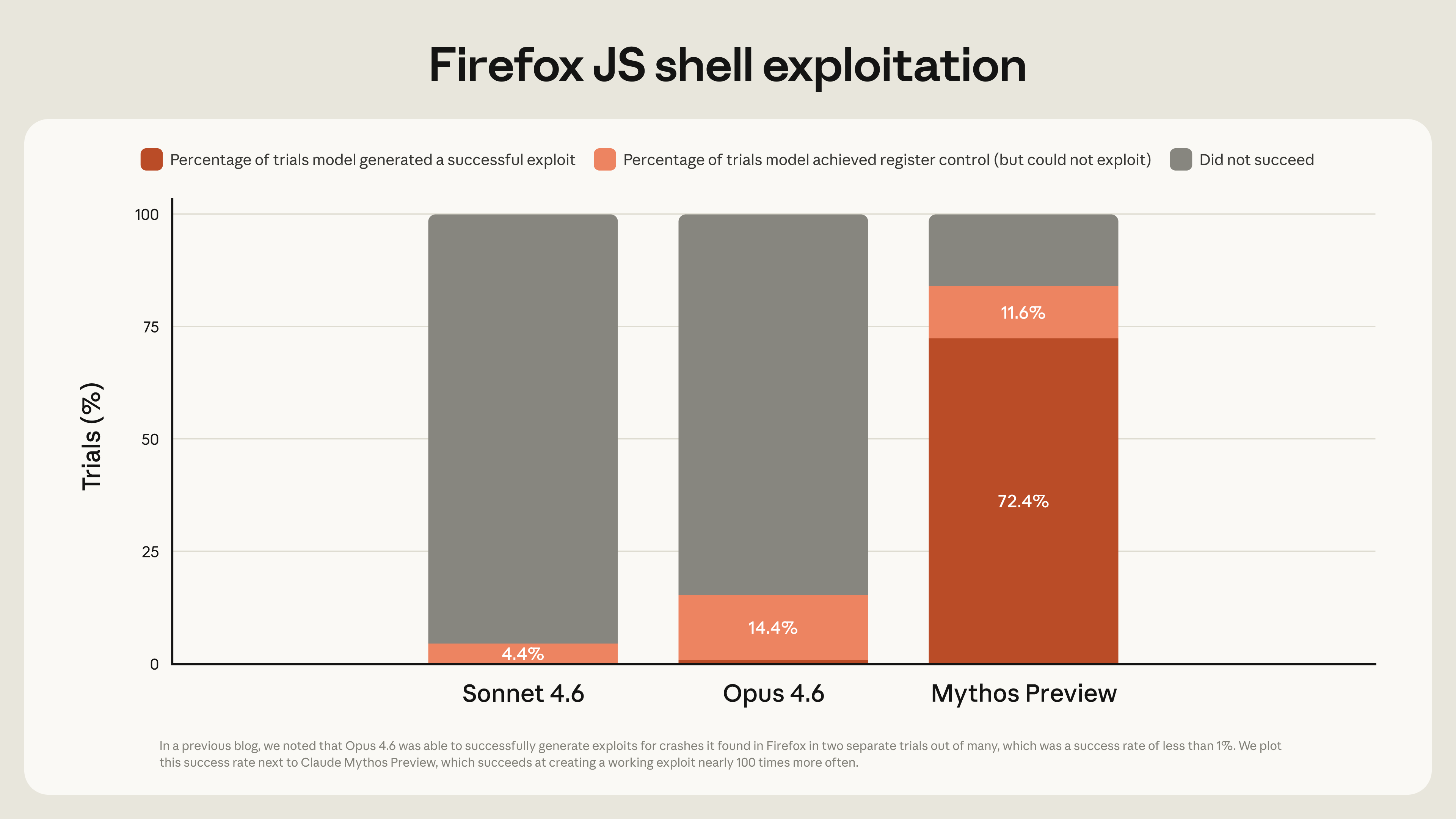
Mythos Preview, by contrast, is reported to have generated 181 exploits from the same set of vulnerabilities, and in 29 cases reached register control (a stage that leads to deeper takeover). On CyberGym, an industry benchmark measuring vulnerability reproduction, it scored 83.1%.
To add some context: until now, AI models could "find vulnerabilities" to some extent, but were poor at "finishing them into attack code that actually runs."
That latter step relied heavily on the experience and intuition of human experts, and the final push never quite landed. Mythos Preview can carry that final push through at a substantial success rate. Put differently, "what only experts could do" has, to a considerable degree, moved inside the model.
There is an even more startling anecdote.
An in-house engineer with no formal security training asked the model to spend "one night" hunting for remote code execution (the class of vulnerability that lets an attacker take over a machine remotely) — and received a working exploit by the next morning.
Work that world-class security researchers used to spend weeks or months on is starting to fall within reach of a non-specialist working overnight.
Anthropic writes that these capabilities were not deliberately trained — they emerged as a byproduct of improvements in code, reasoning, and autonomy.
In other words: this is not a special-purpose cyber model. They built a generally intelligent model, and it turned out to be good at cyberattacks as a consequence.
Given how LLMs have evolved so far, this is not entirely surprising — but there is something formidable about systems that keep getting smarter in every direction, whether or not humans aim them there.
Hence the decision: no public release
Anthropic's conclusion was unambiguous.
This will not be released to the public.
The Project Glasswing technical explainer states that "thousands" of high- and critical-severity vulnerabilities — zero-days — have been found across a wide range of software, including major operating systems and web browsers, and that most of them have not yet been fixed.
A zero-day is an unknown vulnerability that even the software's developer does not know exists.
The name comes from having "zero days" of lead time before countermeasures can be taken. For attackers, these are holes the defenders have not yet noticed — which makes them the most valuable kind. Looking at public zero-day acquisition programs, high-value browser and OS vulnerabilities and exploit chains can command prices in the millions of dollars. Hearing "thousands" of them, then, is a genuinely abnormal order of magnitude.
By Anthropic's account, less than 1% of the reported bugs have actually been fixed (patched) by their developers. Hence the logic: under responsible disclosure (the industry practice of notifying the developer first and publishing only after a patch is ready), the details must stay under wraps.
"Too powerful to release" is a rather bold position for an AI lab to take. Normally, a high-performing new model carries major commercial value, and the industry's natural incentive is to get it into wide use through APIs and products as fast as possible. Restricting access against that current demands a solid rationale. Anthropic has stated its end goal plainly — to eventually deploy Mythos-class models safely at scale — while building the necessary safety measures first, in a separate line (the next Claude Opus).
By design: defenders get it first
This is not just about sealing the model away. Anthropic is deploying the same model, early, to major players on the defensive side.
The core partners are twelve organizations: AWS, Apple, Broadcom, Cisco, CrowdStrike, Google, JPMorgan Chase, the Linux Foundation, Microsoft, Nvidia, and Palo Alto Networks — plus Anthropic itself. Access also extends to more than 40 organizations supporting critical infrastructure. Anthropic simultaneously committed $100 million in usage credits and a $4 million donation to open-source security organizations.
One look at the participant list makes clear this is no mere research announcement. Cloud providers (AWS, Google, Microsoft), endpoint-security majors (CrowdStrike, Palo Alto Networks), a device maker (Apple), semiconductors (Nvidia, Broadcom), network equipment (Cisco), the nonprofit foundation behind Linux, and a financial giant (JPMorgan Chase). Every one of these companies sits somewhere along the paths almost all of us traverse when we use the internet.
Project Glasswing reads less like a research announcement and more like a cross-industry operational framework built for field deployment. The straightforward interpretation is that they intend to run the full flow — discovery, triage (prioritization), disclosure, and remediation — on a common foundation with Mythos at its center.
The paradigm shift that may be coming
The truly weighty part of all this, I think, is not the sheer number of zero-days.
What matters more is that the cycle of finding vulnerabilities, isolating them, and verifying their exploitability may start turning far faster than ever before.
Some background. Cybersecurity operations have long rested on a certain constraint of manpower and time. Finding vulnerabilities takes the labor of skilled security researchers, and a single critical vulnerability can easily take weeks or months to uncover.
Attackers operated under the same constraint, so defenders were left with a reasonable amount of preparation time.
"Attackers probably won't notice this vulnerability for a while yet"
— that implicit assumption had soaked into every corner of operational design.
That assumption may now be breaking down. If AI can automate everything from vulnerability discovery to exploit creation, neither attackers nor defenders can keep operating on the old timeline.
The debate, which used to center on "how do we fix what gets found,"
will shift toward
"how do we operate in a world where vulnerabilities get found in bulk"
.
Concretely, questions like these start to feel very real:
- Is the complete list of software running in your company (the asset inventory) genuinely kept up to date?
- When new vulnerability information comes in, are the criteria for deciding what to address first actually clear?
- When a vulnerability is found at a contracted systems integrator or SaaS vendor, how does word reach your company, and who makes the first call?
- When a flood of alerts arrives, is your operation designed so the team keeps functioning without burning out?
At first glance these look mundane, unrelated to any new technology. But if AI dramatically boosts discovery capability alone, without the organizational design to absorb it, the front line simply drowns in alerts and remediation tasks. "Holding a powerful tool without the operations to use it fully" is a scene we have watched play out many times before.
An initiative with both public-interest and business-strategy dimensions
Let's step back and place Project Glasswing in context.
While the initiative carries a genuinely public-interest goal — defending critical infrastructure — it is also designed to align with Anthropic's medium- to long-term business development.
Anthropic itself states that the ultimate goal is to deploy Mythos-class models safely at scale, and Glasswing is positioned as the stage for accumulating the know-how to get there.
The same page notes a plan to publish lessons learned in roughly 90 days, and signals an intention to eventually broaden availability to partners via the Claude API, Amazon Bedrock, Google Cloud Vertex AI, and Microsoft Foundry.
By deploying early within the limited context of defensive use, they gather data and operational know-how under near-production conditions. Across the full flow — vulnerability discovery, triage, disclosure, remediation support — the soil is being prepared for Mythos to serve as the common foundation. This is a pattern the AI industry has seen again and again: whoever designs "where it gets used" first tends to remain the de facto standard.
This is not something to view cynically; it reads as a textbook case of public interest and business interest coexisting.
Media coverage tends to emphasize the "model too powerful to release" angle, but what was actually announced is a full framework: staged construction of safety measures, a division of responsibility with partners, and a schedule for public reporting.
Rather than a "sealing away," a designed, staged early deployment is closer to the full picture.
Even so, verification is still underway
One more thing worth keeping in cool perspective.
Most of the striking results rest, for now, on Anthropic's own account.
If less than 1% has been fixed, then independent external verification will remain difficult for some time. Anthropic does present consistency data — in a manual review of 198 samples, severity ratings matched exactly in 89% of cases and fell within one level in 98% — but broad third-party verification is not complete.
"Thousands of high- and critical-severity vulnerabilities" is a striking figure, but it calls for some care in reading. The reasonable interpretation is probably something like: "the signal is very strong, but it cannot yet be called fully verified."
Anthropic has promised to publicly report its lessons in 90 days, so we should watch through to that point.
The primary sources carry real weight, and room for verification remains — standing in that middle ground is, for now, the right distance to keep.
In closing: where does the center of the question move?
Back to the original news. On the surface, this looks like a cybersecurity story.
But what it exposed is less a problem in one specific domain than the possibility that AI capability itself is entering a new stage.
Mythos Preview stood out because vulnerability discovery happens to be an easily measurable domain — and the change visible there can spill over into other knowledge work: R&D, business design, executive decision-making.
Put another way, what this event shows is that
AI with capabilities hard to grasp as a simple extension of what came before is already becoming real
— is it not?
And there is little reason to believe this class of capability will stay locked inside one company for long. We should assume it will spread to other companies and other domains, and think from that premise.
That changes how the question should be framed.
Not "how do we use this model?" but
"as AI capable of substituting for or complementing advanced expertise in some domains becomes real, what value does our company actually exist to provide?"
— that is where the center of gravity moves.
This reaches beyond anything the mindset of "streamlining business processes" can cover.
Come to think of it, the domains long imagined as "work AI cannot replace" — complex design judgment, deep specialized knowledge, decision-making over long context, creative problem-solving — are precisely the domains where Mythos Preview has come to the fore.
Scoring 94% on a PhD-level exam; finishing overnight what took seasoned engineers weeks. Faced with these facts,
the question posed to companies is not
"finding the things AI cannot do" — that defensive line of thought — but rather
"taking this level of intelligence as a given, what value can our business and our team still deliver?" — a question one level higher.
That is not a technology debate or a case-study discussion; it is a question of business design itself.
Of course, right now this may still look like "a story about one model called Mythos Preview."
The primary sources are too weighty to dismiss as hype, yet there is still room for verification before treating it as established fact.
But whether you can start thinking about your own company's position while it still looks that way — that, I suspect, is what will quietly matter in the next phase.
If you would like to think through the questions in this piece as they apply to your own company, or work through them with a partner at your side, please feel free to reach out via our contact form!
In our own modest way, Qualiteg would be glad to think it through together with you.