[New AI Business Development] Qualiteg Selection: Business Model Design (1) The Business Model Diagram

![[New AI Business Development] Qualiteg Selection: Business Model Design (1) The Business Model Diagram](/content/images/size/w1200/2025/01/2.png)
Hello to everyone visiting the Qualiteg blog—I'm Michele. In my work on AI-driven new business development and marketing, there are questions I hear from clients again and again. Through this blog, I would like to share my own answers to the challenges that anyone exploring AI-based businesses is likely to face.
"How to Draw a Business Model Diagram for a New Business: Practical Tips You Can Actually Use"
In my new business development consulting work, one question comes up frequently at client companies: "How should I draw a business model diagram?"
To be honest, I struggled with this myself at first, but through many failures and successes I gradually figured out how to draw business model diagrams effectively. In this article, I will share those practical tips.
Why Business Model Diagrams Matter
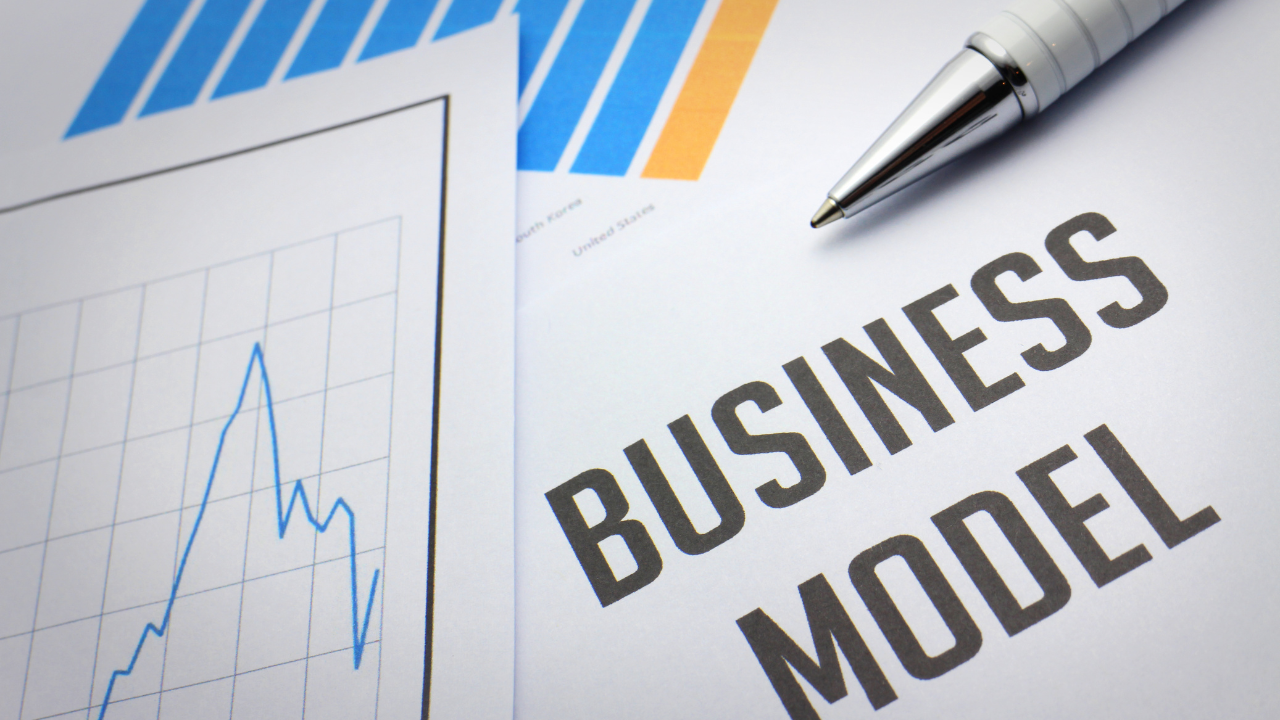
A business model diagram is not just an illustration. It is an essential tool for turning your business idea into a form that can be tested and validated.
You can use it to explain the business to stakeholders when seeking internal approval. It is also helpful for clarifying the picture when you move from idea generation to thinking about monetization.
In our new business development training programs in particular, I see this all the time: when running revenue simulations for a B2B2C business, roughly nine out of ten participants draw a diagram in which their company collects money directly from end users, forgetting the revenue share or fees owed to the B in the middle.
Explaining your business to others is one reason to draw the diagram, but I encourage you to draw one for yourself as well—visualizing the model properly is the best way to truly understand it.
Innovation requires great ideas and the ability to collaborate with external partners. Innovation-Cross, from Qualiteg Inc., is a co-creation support program that thoroughly supports companies in generating innovation.
It covers the entire innovation process, from current-state analysis, strategy formulation, and roadmap creation to execution support. Through a diverse service menu—including idea workshops, hackathon planning, and the use of cutting-edge AI technologies—we chart the innovation path best suited to your company. As a partner that helps you break through the innovation barriers that are "hard to overcome alone" via external collaboration and realize new value creation, we will back your challenge with full force.
Schools of Business Model Diagramming
Since the publication of the Japanese book Business Model 2.0 Zukan (an illustrated compendium of business models), this style has become a common sight.
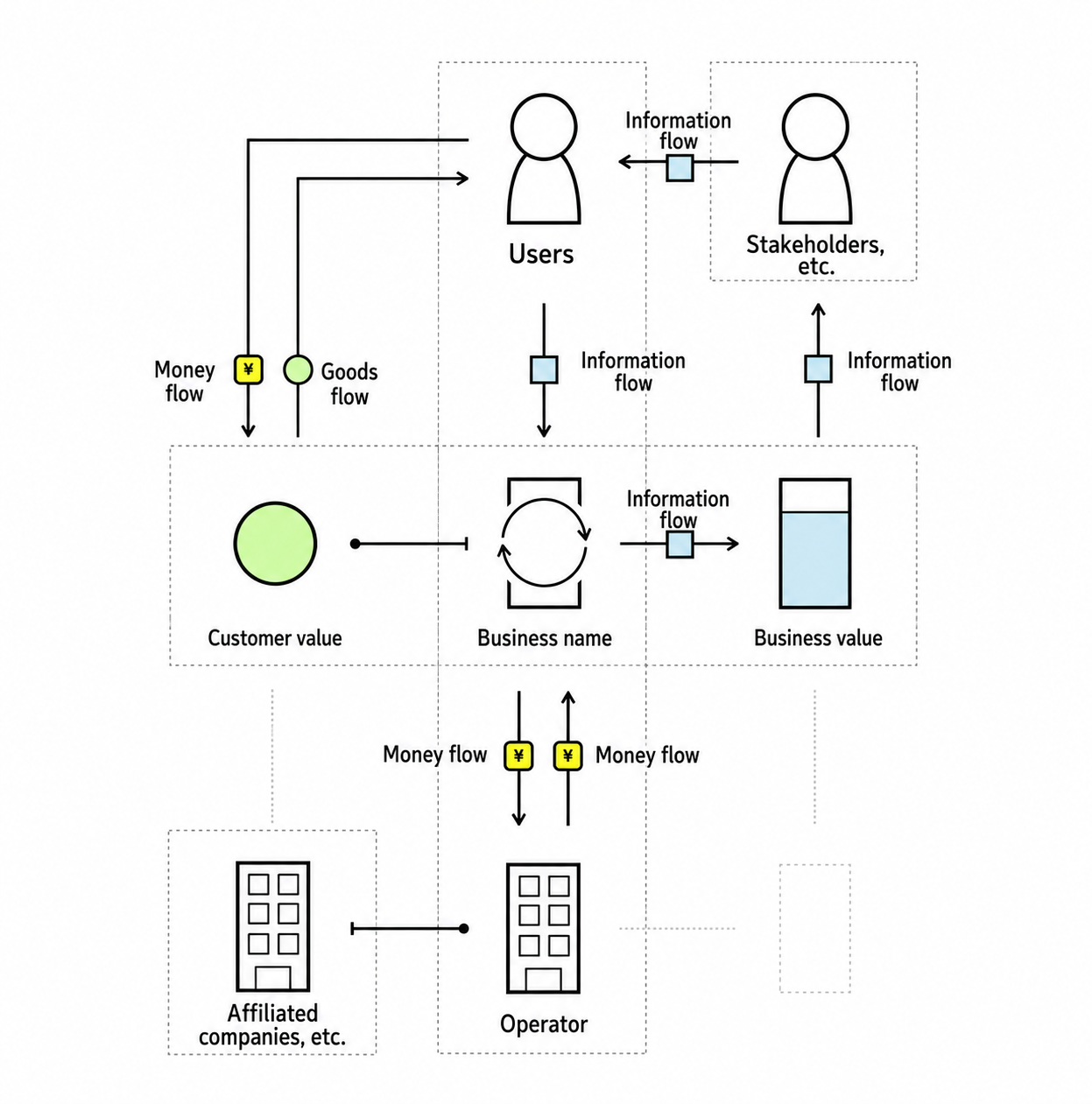
This format uses three tiers—users at the top, the business in the middle, and the operators at the bottom—and it is very well organized. That said, it can feel complex at first glance, and in my personal experience it is not something I see very often in consulting engagements or at operating companies.
A business model diagram needs to show, above all, the actors and the flows of money and information, so my recommendation is to lay it out horizontally to match PowerPoint. The example below compares three patterns side by side, but when including a diagram in a proposal document, a single pattern is of course perfectly fine.
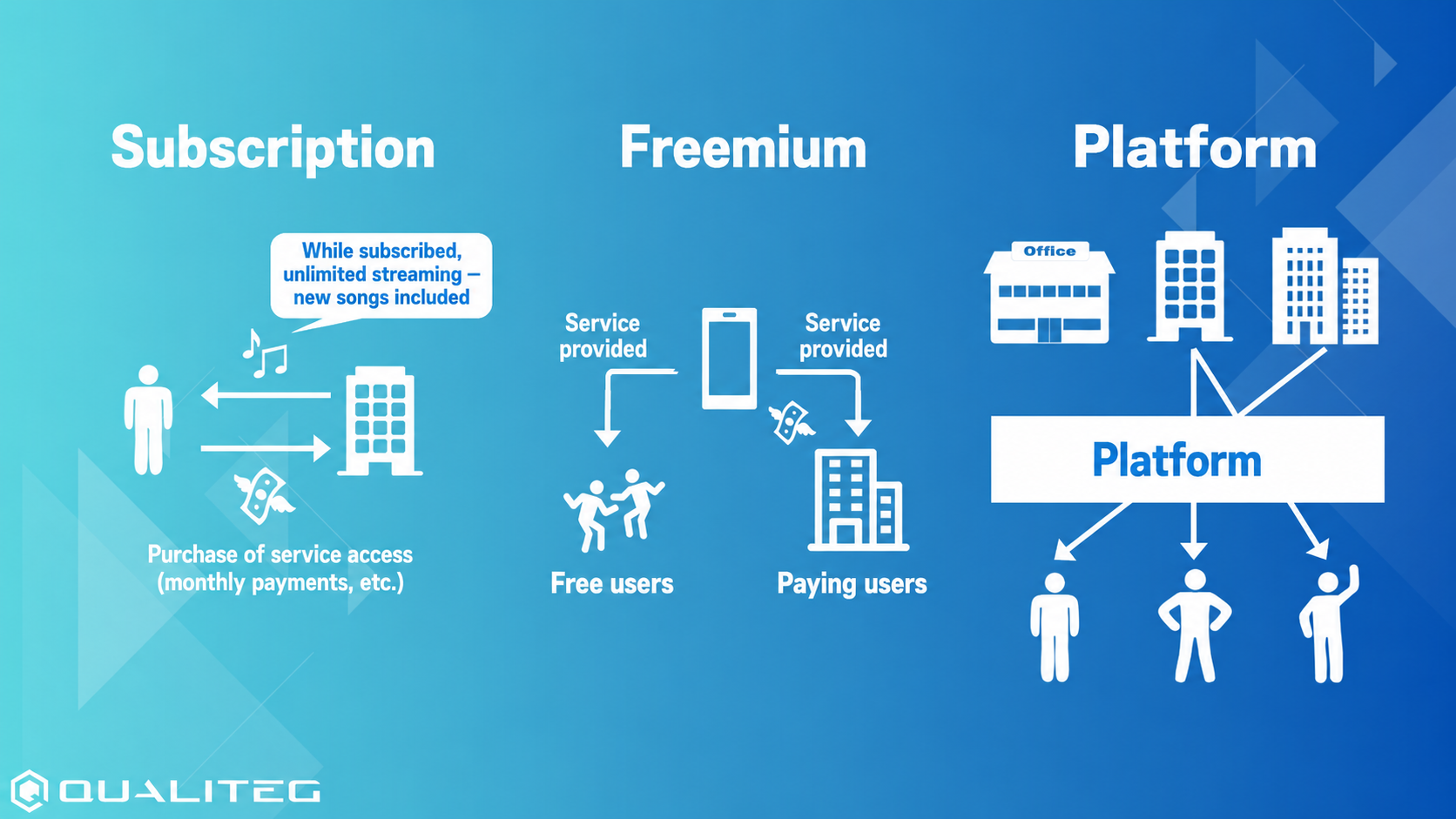
Start by drawing the business model you are considering at that moment, and as you continue developing the business, keep revisiting and updating the diagram.
Repeat this cycle, and a winning business model should come into view.
Thank you very much for reading this column to the end. At Qualiteg, we offer training and consulting on AI technologies and on methods for planning new businesses. If this has sparked your interest, or if you have specific needs, please feel free to reach out to us here via our contact form.

We also run a workshop, popular with participants, for those who want to master the steps of new business creation. The training focuses on having each participant think about the business from an executive's perspective, and the content is designed not only for planning staff but also for their counterparts in engineering, design, and marketing.
navigation