[New AI Business Development] Qualiteg Selection: Business Model Design (2) The Business Model Canvas

![[New AI Business Development] Qualiteg Selection: Business Model Design (2) The Business Model Canvas](/content/images/size/w1200/2026/08/BMC03-en.png)
Hello, and welcome to the Qualiteg blog. I'm Michele. In my work on AI-driven new business development and marketing, there are questions I hear from clients again and again. Through this blog, I'd like to share my own answers to the challenges that anyone considering an AI-powered business is likely to face.
When planning a new business, turning an idea into a concrete business plan is no easy task. In my many years of consulting, I've met plenty of clients who want to trust an idea simply because it feels right intuitively. That instinct matters, but when judging whether an idea is a good one, the question of "can this actually make money?" is critically important.
A tool that helps you quickly grasp the overall picture of a business is the Business Model Canvas.
The Business Model Canvas is used around the world as a powerful tool for visualizing an entire business on a single sheet.
In this article, I'll walk through the Business Model Canvas in detail, from the basics to how to put it to work.

What Is the Business Model Canvas?
The Business Model Canvas is a strategic management tool developed by the Swiss business theorist Alexander Osterwalder. By organizing the key elements of a business into a single sheet made up of nine building blocks, it lets you see the whole business at a glance.
Compared with a traditional, hefty business plan, its simple and visual approach makes it much easier to share and discuss within a team.
Occasionally a client will ask, "My boss hates the Business Model Canvas, so please don't use it." When I ask why, the most common answer is, "It didn't work out for us in the past." But the Business Model Canvas is just a tool—if you learn to use it correctly, it serves you well.
I recommend it for organizing your thinking about a business. That said, if your boss happens to dislike the Business Model Canvas, I suggest using it only for your own analysis and presenting the business model itself in a different format.
Even for personal use, it's an easy-to-understand tool—especially for spotting gaps and omissions—so I encourage you to master it today.
The Nine Building Blocks in Detail
1. Customer Segments
- Who are you delivering value to?
- Which customer groups are you targeting?
This is one of the most important elements. Whether a business succeeds depends on choosing the right customer segments. It's essential to define concrete personas and deeply understand their needs and challenges.
2. Value Propositions
- What customer problem are you solving?
- What value are you delivering?
Clarify what solutions your business can offer for your customers' problems and needs. This is also where you map out how you differentiate from competitors.
3. Channels
- How will you reach your customers?
- How will you deliver your products and services?
Consider how you will connect with customers at each stage—marketing, sales, and delivery. Take both online and offline channels into account.
4. Customer Relationships
- How will you build and maintain relationships with customers?
- What kind of support will you provide?
Define what your customer relationships should look like, from automated self-service to personal, high-touch support.
5. Revenue Streams
- How will you generate revenue?
- How will you set prices?
Choose the best fit from among the many possible revenue models, such as subscriptions, usage-based billing, and advertising revenue.
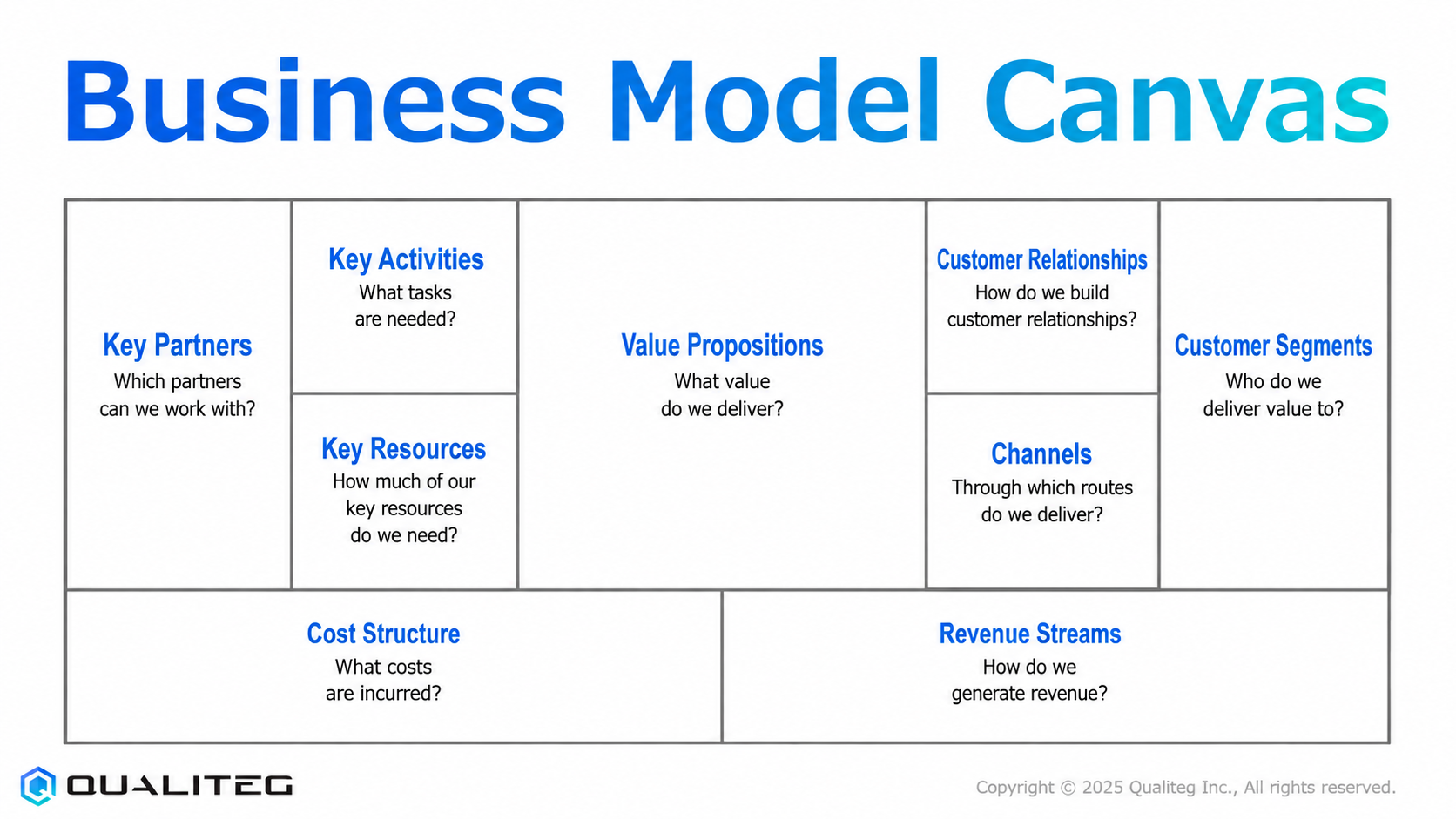
6. Key Resources
- What business resources do you need?
- People, equipment, intellectual property, and more
Identify the resources that are indispensable for running the business. This includes not only physical assets but also people and your brand.

7. Key Activities
- What activities are required?
- What are your core operations?
Clarify the critical activities needed to deliver your value proposition—product development, platform operations, supply chain management, and so on.
8. Key Partnerships
- Who will you work with?
- What external resources do you need?
Consider which partners can complement the parts of the business you can't achieve on your own.
9. Cost Structure
- What are your major costs?
- What is the balance of fixed and variable costs?
Understand the major costs of running the business and check that they are consistent with your revenue model.
Advancing technology, shifting markets, intensifying competition—innovating alone is getting harder for companies every year. Qualiteg's Innovation-Cross is a program that meets this challenge head-on, creating value through collaboration with external partners.
We accurately assess where your company stands today and provide end-to-end support for open innovation, from strategy development through execution. Idea workshops, hackathons, and cutting-edge AI technologies are just some of the approaches we use to accelerate your innovation. Experienced consultants work alongside you, guiding you toward innovative solutions that make the best use of resources both inside and outside your organization.
Tips for Effective Use
Here are some tips for getting the most out of the Business Model Canvas.
- Take an Iterative Approach
Rather than aiming for perfection from the start, it's effective to form hypotheses and test them repeatedly. Update each block flexibly as you incorporate market feedback—from interviews and research—and the outcomes of internal discussions. - Use It as a Team
Bringing in not just leadership but also frontline members leads to a more practical model. Because incorporating different perspectives is so important, I often draw the canvas on a large board posted on the wall where everyone can see it, or run discussions using whiteboard tools such as Mural or Miro. - Combine It with Competitive Analysis
Analyzing competitors' business models with the same framework makes your points of differentiation much clearer. Writing out a first draft of your own upcoming business model cold can feel like a high hurdle. Start by sketching a canvas for your own business, then try one for a competitor, or map a business from another industry with a similar model. Draw several canvases, compare them side by side, and use what you learn to update your own service. (I've kept printed Business Model Canvas templates close at hand for over ten years, jotting one down whenever inspiration strikes—I highly recommend it.)

Conclusion
The Business Model Canvas is a highly effective tool for launching new businesses and rethinking existing ones. As you fill in the nine blocks, you can examine every key element of the business without gaps, and it becomes much easier to build a shared understanding within your team.
That said, it is only a tool—it does not guarantee success. It's important to review it regularly as market conditions change and revise it as needed. Why not start by mapping your current business onto this framework, even before tackling a new venture?
Thank you very much for reading this column to the end. At Qualiteg, we provide training and consulting on AI technology and new business planning. If this has piqued your interest, or if you have a specific request, please feel free to contact us throughour inquiry form.

We also offer a popular workshop for those who want to master the steps of creating a new business. The training focuses on having each participant think about the business from an executive's perspective, and it is designed not only for planning staff but also for their counterpart engineers, designers, and marketers.
navigation