
Why Legitimate Operations Work Becomes a "Usage Policy Violation" in Claude Code — Real-Time Cyber-Safeguard False Positives and How to Handle Them

Hello!
Today we take a detailed look at the "Usage Policy violation" errors that can suddenly appear while using Claude Code —
namely,
the real-time cyber safeguards and their false positives (misdetections)
— covering both their patterns and how to handle them.
Have you ever been stopped in your tracks by a message like this in the middle of deploying to your own server, or during perfectly ordinary infrastructure work?
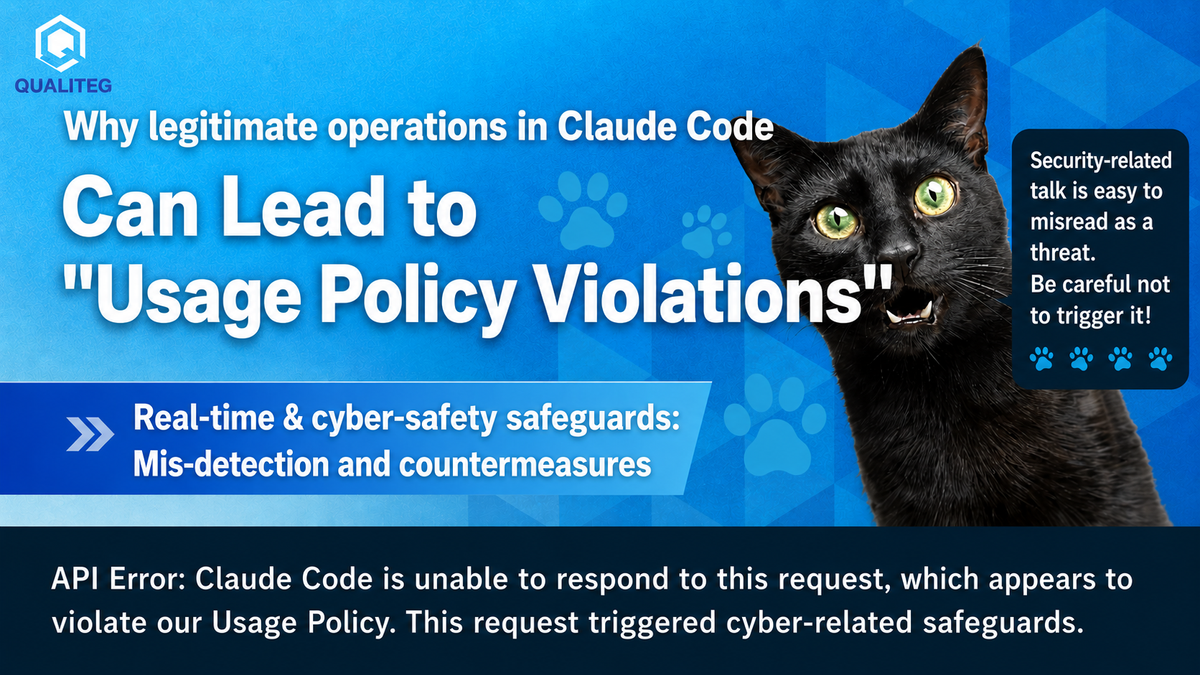
API Error: Claude Code is unable to respond to this request, which appears to violate our Usage Policy. This request triggered cyber-related safeguards.
All you were doing was an SSH deployment to your own server and instructing a commit to your own repository.
Nothing offensive was involved — and yet you got blocked.
If that sounds familiar, please read to the end. Based on public information, we have organized both "why this happens" and "how to work with it."
The conclusions, up front
For those in a hurry, here are the remedies first. Details follow in the second half, but there are essentially three things to do.
- First, split your prompts into shorter pieces so that security terms are not densely packed into a single message.
→ The quick fix to get you through the moment. - If you routinely do security work or infrastructure operations, apply to the CVP (Cyber Verification Program).
→ The lasting mitigation. - If you are still blocked after approval,
check your organization ID, access path, and use-case category, and file an appeal if needed.
By the time you finish this article,
you should be able to stay calm when a block appears.
Let's take a closer look.
What is this, exactly?
Starting with Claude Opus 4.7, made generally available on April 16, 2026,
Anthropic introduced a mechanism called "real-time cyber safeguards" on its top-tier models.
Measured against the Usage Policy, it takes
requests that could be misused for cyberattacks and automatically detects and blocks them on the spot — a defensive layer.
In that release, Anthropic explained that it had added safeguards that automatically detect and block "prohibited or high-risk cybersecurity uses," and Opus 4.7 was the first Claude model to ship with this mechanism in general availability.
The important point here is that this mechanism is not a temporary thing of the past.
Even when migrating to the latest Claude Opus 4.8, announced May 28, 2026, cyber safeguards remain a behavior you must account for。
Opus 4.8 is an upgrade built on 4.7, and Anthropic's migration guide also covers how stop_details is handled when a block occurs, and advises re-checking the cyber safeguards as part of the migration.
Anthropic itself has said of the even higher-tier Mythos-class models that
"models at this capability level require stronger cyber safeguards before general availability"
— meaning the defensive layers are set to be reinforced, not removed.
In other words, this is not a case of "upgrade to 4.8 and the false positives disappear."
It is realistic to assume this behavior is here to stay for the time being.
The two blocked categories
Anthropic classifies what these safeguards block into two broad categories.
- Prohibited use
Activities with almost no legitimate defensive purpose, such as mass data exfiltration or ransomware code development. These are blocked at all times as a rule, and are not eligible for adjustment even under the CVP described below. - High-risk dual use
Activities usable for both offense and defense, such as exploiting vulnerabilities or developing attack tooling. These are blocked by default, but can be relaxed via application if the purpose is legitimately defensive.
The root of the problem is that, as externally observable behavior, the system appears to react strongly to surface-level textual signals.
Since the internal implementation is not public, we cannot say definitively whether it is term-based or classifier-based, or how much context it takes into account.
But at least from the user's side,
the more the vocabulary of offense and defense overlaps in a domain, the more likely you appear to be blocked contrary to your intent
— that is the reality.
Ordinary infrastructure operations and security work end up as collateral false positives.
Indeed, on GitHub issues there are reports of even defensive research inside a legitimate bug-bounty program being blocked. In one case, the model itself judged "this is authorized research producing defensive deliverables" and tried to continue the work, only to be blocked by an API-level filter on the next turn.
It is a telling example of how the model's own judgment can be overridden by a downstream filter.
Patterns: when are false positives most likely?
Following the reports accumulating in the Claude Code GitHub repository and the cases covered in the press, several recurring "shapes" of false positives emerge.
Let's go through them in order.
1. When the "density" of security-related terms is high
From the user's perspective, this is the most common trigger. Terms like SSH, reverse proxy, Basic auth, credentials, and firewall configuration are, individually, perfectly ordinary operations vocabulary. However, when these cluster densely in a single message, the text starts to superficially resemble a description of attack procedures, and appears to become much more likely to be blocked.
A particularly common scenario is writing a work summary or a "handover note for another session." Condensing an entire operational configuration into one message packs together sensitive terms that would otherwise have been spread across many turns.
As a result, the summary of the work can be more likely to get blocked than the work itself — an outcome that has things exactly backwards.
"At the end of a deployment that was working fine, I tried to write a handover note and got blocked."
That is precisely this pattern. Nothing you are doing is dangerous; the sheer density of textual signals alone is what trips the filter.
2. When your field happens to overlap with "dual use"
Press coverage describes multiple cases where work entirely unrelated to attacks got swept up. For example, The Register (April 2026) reported cases such as the following.
- A standard computational structural biology task was judged a violation — with the added "regression" that it had passed on Opus 4.6 but began getting blocked on 4.7.
- The director of a university cybersecurity lab was refused when trying to have the model read lab materials related to his own textbook. "I pay more than $200 a month, and it refuses even basic editing work.
Security educators and researchers can't use it like this," he complained. - Russian-language prompts were blocked repeatedly. One GitHub issue reports more than 40 false positives across 4 sessions, spanning unrelated projects — a psychology book, a web app, infrastructure, and bots.
- There is even the curious reported case of an advertising PDF for a toy (a Hasbro Shrek toy) erroring out because of syntax strings inside the PDF.
The same article reports that AUP-related false-positive reports grew to more than 30 in April 2026. Educators, researchers, security practitioners —
the people whose professions require handling sensitive vocabulary are precisely the ones most likely to get hit
— a structural bias, by all appearances.
3. When behavior varies by account or access path
Some cases cannot be fully explained by the immediately preceding prompt text alone.
On GitHub issues, there are reports such as the same account working on Claude.ai but being blocked in Claude Code、no improvement even after re-authenticating with the correct subscription, and the like.
Since the immediately preceding input does not always explain a block, when one occurs it is worth also checking differences in organization ID, access path (Claude.ai, Claude Code, or the API), model, and client.
Remedies: when you get blocked, and how to avoid it
Here is the heart of the matter.
A false positive never means "you did something wrong." Stay calm and work through the following, in order.
Remedy 1: Change how you write (immediate effect)
The CVP application described below takes several days. If you need to move your current work forward right now, lowering the "density" of your prompt is the fastest remedy. Concretely:
- Do not condense sensitive terms into a single message.
Break the work into its actual steps so the terms disperse naturally. - When writing handover notes or summaries, use neutral wording with a clear stated purpose so it does not read like a list of attack steps.
- For example, instead of stringing together "configure the reverse proxy, Basic auth, and credentials...", write only the essence of the operations, such as "confirm 2 files with git status → add → commit → push." Keep configuration details in documentation inside the repository, and have the other session read them directly if needed.
- Once a session has produced "Claude Code is unable to respond to this request, which appears to violate our Usage Policy.", you can sometimes get through with heuristic measures: end that session there, start a new one, and reduce the density of risky-looking terms in whatever immediately preceded the error.
Remedy 2: Apply to the Cyber Verification Program (CVP) (the lasting fix)
If you are routinely blocked during security work or infrastructure operations, consider applying to the CVP.
This is a free, application-based program for users with legitimate defensive purposes. Its goal is to relax blocking of dual-use tasks and minimize disruption to your work.
The key points of the application:
- The application channel differs by access path. For first-party use via Claude.ai, Claude Code, or the Anthropic API, Settings > Account or Settings > Organization is where you confirm your Organization ID, then fill out the Cyber Use Case Form.
- The application must be submitted by an organization administrator (admin).
- Review results are emailed within roughly 2 business days of applying.
- If you use Claude through an external platform, such as a third-party coding tool, you will likely need to ask that platform whether it supports the CVP.
One caveat: CVP approval only removes blocking of "dual-use" activities; prohibited uses (ransomware development, mass data exfiltration, and the like) will of course remain blocked.
Remedy 3: Still blocked after approval? Check these
"I got through the CVP, but I'm still being blocked" — reports like this are not rare. In that case, check the following two points, in order.
- Are you signed in to the right organization? CVP approval is tied to a specific Organization ID. If you are working in a different organization from the one that was approved — a personal workspace, for example — the approval does not apply. Always match the organization ID in the approval email against the organization ID where the block is occurring.
- Is the activity truly "dual use"? As noted above, activities falling under prohibited use remain blocked regardless of CVP approval.
If neither check resolves it, you can report the false positive via Anthropic's report / appeal form. Officially, this feedback is used to improve the safeguards' accuracy.
Summary: understand this as a design trade-off
Real-time cyber safeguards are a defensive layer introduced on the premise that as models grow more powerful, so does the risk of misuse.
Raise safety, and the price is more false positives.
This is a structural trade-off — which is exactly why user reports keep accumulating on GitHub.
And to repeat: this mechanism began with Opus 4.7, and remains a consideration when migrating to the latest Opus 4.8. It is expected to be strengthened further going forward. (We can only hope false positives decrease.)
When legitimate operations work gets blocked, it does not necessarily mean anything is wrong on your side. What matters is understanding the nature of the safeguards and keeping the several options in mind: how you write your prompts, CVP application, and appeals.
If you use Claude Code in production work, it is now necessary to treat not only model performance but also how you work with these safety mechanisms as part of your operational design.
If you understand the mechanism, you can stay calm when blocked and move forward with one of: workaround, application, or report.
Are you shouldering Claude Code "operational design" all on your own?
Working with safety mechanisms, rate limits, cost, crash recovery — there is not yet an established "right answer" for agent-first development. We have used Claude Code intensively in our own development and systematized what works operationally, along with the pitfalls.
Our engineers, veterans of decades on the front lines of software engineering, have distilled this hands-on knowledge — and we deliver it to you as a package.
See our Claude Code enablement services →See you next time.
References
- Anthropic, "Introducing Claude Opus 4.7": https://www.anthropic.com/news/claude-opus-4-7
- Anthropic, "Introducing Claude Opus 4.8": https://www.anthropic.com/news/claude-opus-4-8
- Anthropic Help, "Real-time cyber safeguards on Claude": https://support.claude.com/en/articles/14604842-real-time-cyber-safeguards-on-claude
- Cyber Use Case Form (CVP application): https://claude.com/form/cyber-use-case
- False-positive report / appeal form: https://claude.com/form/cyber-block-false-positive-report-cvp-rejection-appeal
- Anthropic Usage Policy: https://www.anthropic.com/aup
- The Register, "Claude Opus 4.7 has turned into an overzealous query cop" (April 2026): https://www.theregister.com/software/2026/04/23/claude-opus-47-has-turned-into-an-overzealous-query-cop/
- Claude Code GitHub Issues (many false-positive reports): https://github.com/anthropics/claude-code/issues