[AI-Driven New Business Creation] How Qualiteg Builds Empathy Maps for Understanding Customers

![[AI-Driven New Business Creation] How Qualiteg Builds Empathy Maps for Understanding Customers](https://images.unsplash.com/photo-1505243542579-da5adfe8338f?crop=entropy&cs=tinysrgb&fit=max&fm=jpg&ixid=M3wxMTc3M3wwfDF8c2VhcmNofDJ8fGVtcGF0aHl8ZW58MHx8fHwxNzEzNDM0MDkzfDA&ixlib=rb-4.0.3&q=80&w=1200)
Hello, and welcome to the Qualiteg blog. I'm Michele. In my work on AI-driven new business development and marketing, there are certain questions I hear from clients again and again. Through this blog, I would like to share my own answers to the challenges that people exploring AI-based business initiatives commonly face.
This is a question I often hear from intermediate and advanced practitioners who already have some experience in new business development.
The empathy map is a familiar tool in design thinking, but is it really something you can use in actual new business development?
The answer is: "Yes, you can. Let's work through it together."
Looking at the clients I consult for, the empathy map is used far more often by American companies than by Japanese ones.
Today I would like to explain why it is so rarely used in Japanese companies, and how it can be used effectively.
What is an empathy map in the first place?
Personally, I think the empathy map became much harder to understand the moment it was translated into Japanese as 共感マップ (kyokan map).
In English it is called an "Empathy Map."
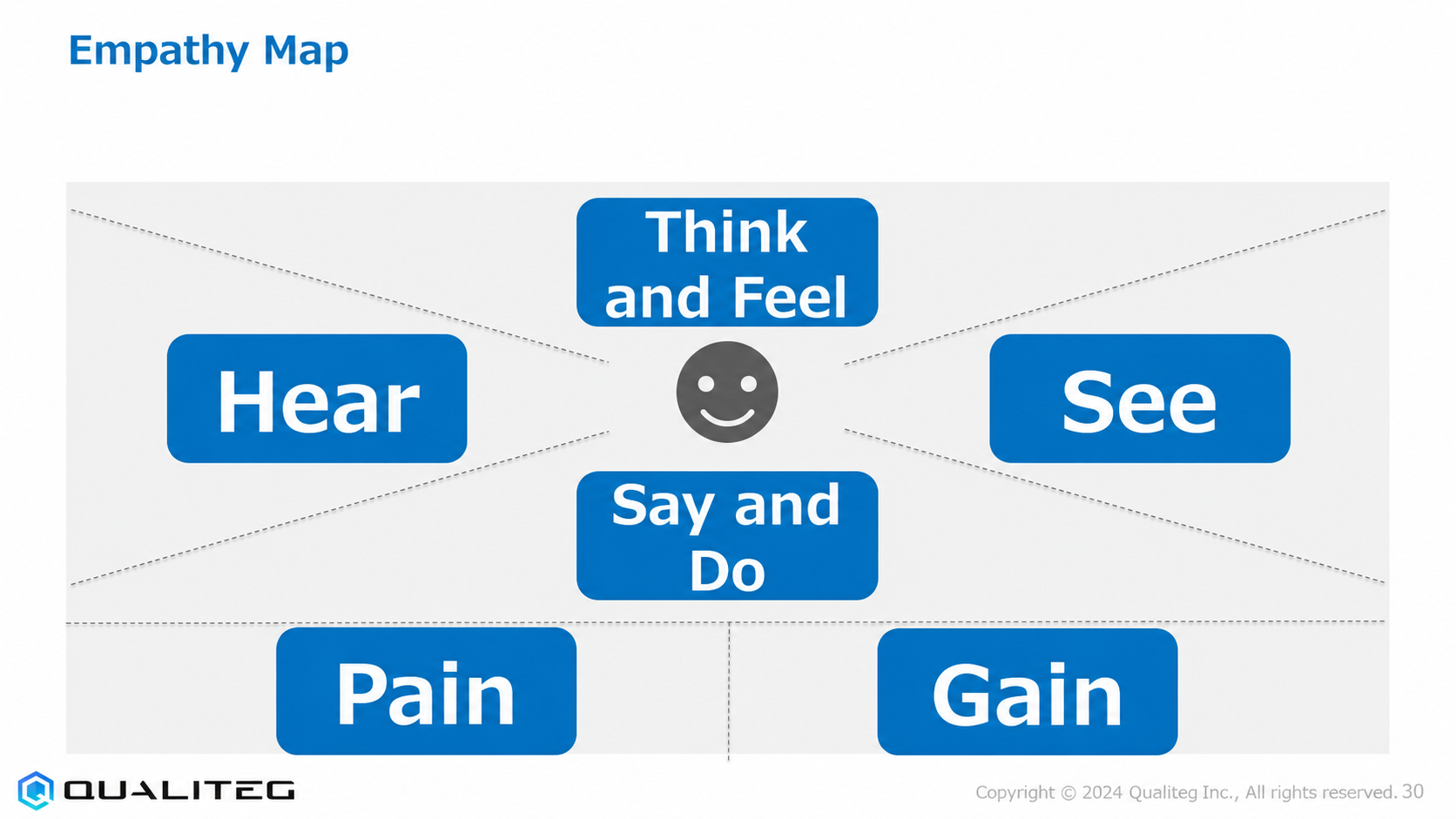
It is a framework associated with design thinking: a visual tool for understanding the behavior, thinking, and emotions of users and customers.
The purpose of the map is to dig deeply into how customers feel about, think about, and experience a product or service.
What is "empathy" (共感)?
The Japanese word 共感 (kyokan) evokes the idea of understanding another person's feelings or situation and resonating or agreeing with them. The Japanese sense of 共感 carries a nuance of "I felt the same way" or "I agree." Some dictionaries even render it as 感情移入, meaning emotional identification.
The English word "empathy," on the other hand, has less to do with agreeing and much more to do with the ability to understand another person's feelings and problems.
As a result, when Japanese practitioners interview target users, they tend to assume, on a subconscious level, that they cannot fill in this map unless they personally agree with and share the user's feelings. That seems to be why so many of them feel uncomfortable with it.
For a native English speaker, the framework simply means:
"I interview people, pick up on how they feel, and write it down, right?"
That is all there is to it. But
those who have worked with the Japanese 共感マップ tend to react with

"Hmm, I don't actually agree with this point this person is making..."
and end up feeling uneasy about it.
For this reason, at Qualiteg we refer to the empathy map by its English name rather than 共感マップ. All you need to do is write it out while imagining the user's various statements, attitudes, behaviors, and emotions. There is no need to force yourself to agree with them.
Creating a sustained flow of innovation rather than a one-off breakthrough: Innovation-Cross from Qualiteg Inc. is a program that supports the construction of a co-creation ecosystem centered on your company. Based on an analysis of your current state, we design mechanisms that effectively connect internal creativity with external resources.
While strengthening your internal capacity for innovation through idea workshops and hackathon planning, we build co-creation relationships with outside partners through open innovation and partner development. Including support for applying cutting-edge AI technology, we create an ecosystem that generates a chain of innovation that would be difficult to sustain on your own. Our experienced consultants optimize the innovation ecosystem surrounding your company and establish a foundation for sustained value creation.
In what order should you fill in an empathy map?
There is a recommended order for filling in an empathy map. This order is Qualiteg's original way of thinking: a method for putting the experiential value into words and then analyzing the pros and cons.
-
Think and Feel
- Write down what the persona thinks and feels: their inner motivations, worries, and true emotions.
-
See
- Describe what the persona sees in their everyday life, their environment and the things around them.
- Be specific: what media do they use, and how do the people around them behave?
-
Hear
- Write down what information the persona hears in their daily environment, what opinions and suggestions they receive from friends, family, and colleagues, and what rumors they have heard that concern them.
-
Say and Do
- Write down what the persona says and how they behave.
- Since this centers on outward-facing behavior and statements, what they post on social media is a typical example.
-
Pains (troubles and sources of stress)
- Write down the main problems the persona faces, the challenges they must take on, and their concerns.
- Writing down sources of stress and negative factors also brings out their individuality and makes the persona easier to understand.
-
Gains (solutions to their pains)
- Write down the persona's desires and needs.
- This is easy to misunderstand when writing: rather than a vague wish such as "I want to be rich someday," imagine and write down concretely what they hope for as a solution to the Pains (problems) in the previous item.
The empathy map is extremely useful whenever you are considering a customer-centric approach, whether in service development, design, or marketing strategy.

If you have never filled in an empathy map before, I encourage you to try it while reviewing these steps.
You will find it easier than usual to imagine how users feel. When considering UI/UX, it becomes easier to picture concrete details such as icon sizes and the specific situations in which customers use the service, and it becomes easier to align the team's understanding, all of which should accelerate development.
For example, suppose you are developing a service whose target users are full-time homemakers, and the user is in a rush, thinking:
I have to go pick up the kids after this. And before that I have to hurry and get dinner ready...!
In such a case, you might make the button icons larger so that they are not missed or tapped by mistake. Empathy maps turn out to be surprisingly useful for UI/UX design as well, so I recommend giving them a try.
Thank you very much for reading this column to the end. At Qualiteg, we provide training and consulting on AI technology and on methods for planning new businesses. If this has caught your interest, or if you have specific requirements, please feel free to reach out throughour contact form.

We also run popular workshops for those who want to master the steps of new business creation. The training focuses on helping each participant think about the business from an executive's perspective, and the content is designed not only for planners but also for their counterparts in engineering, design, and marketing.
We look forward to hearing from you. Please stay tuned for the next column.
navigation