[AI-Driven New Business Creation] Qualiteg's Original Method for Effectively Evaluating Customer Problems
Many companies choose customer problems on a planner's intuition, which often leads them astray. Selection requires a deep grasp of market and user needs and alignment with the business's purpose. Qualiteg recommends choosing problems that fit the purpose agreed with the business owner up front.

![[AI-Driven New Business Creation] Qualiteg's Original Method for Effectively Evaluating Customer Problems](https://images.unsplash.com/photo-1544819679-57b273c027a3?crop=entropy&cs=tinysrgb&fit=max&fm=jpg&ixid=M3wxMTc3M3wwfDF8c2VhcmNofDE0fHxldmFsdWF0aW9ufGVufDB8fHx8MTcxMzcwODA4MXww&ixlib=rb-4.0.3&q=80&w=1200)
Hello, and welcome to the Qualiteg blog. I'm Michele. In my work on AI-driven new business development and marketing, there are certain questions I hear from clients again and again. Through this blog, I would like to share my own answers to the challenges that people exploring AI-based business initiatives commonly face.
Once several customer problems have been identified, a great many people struggle with deciding which of those problems their company's service should actually address.
Should the person in charge decide which customer problem to pursue?
When I ask clients, "How did you decide on the customer problem?", roughly 80 percent answer, "The person in charge went with their intuition."
It would be wonderful if that intuition always turned out to be right. In reality, however, most of these clients tell me that at the briefing for the business owner they were challenged with
"That's just the problem you happened to like, isn't it?"
and were sent back to the drawing board. Very often they come to us asking how they should proceed from there.
The more thoroughly a planner has done their market and user research, the more likely they are to believe that they understand the market and its users better than anyone else. In a sense, that may well be true.
Even so, I would ask you to pause and consider one thing:
Do your target users have a need strong enough that they would actually pay money to solve this problem?
That is the real question.
Qualiteg's approach to deciding on customer problems
So how should you go about selecting a customer problem?
Sustained innovation requires an organizational culture that nurtures it, together with mechanisms for collaborating with outside partners. Innovation-Cross from Qualiteg Inc. is a program that helps companies cultivate a culture of innovation internally and build a framework for co-creation with external partners.
Starting from an analysis of your current situation, we take a range of approaches, from idea workshops that stimulate creativity within the company to hackathons that foster collaboration with outside partners, to lay the groundwork for innovation that is difficult to build on your own. We design both the organizational model needed to generate innovation continuously and the collaboration mechanisms needed to bring in external resources effectively, including support for applying cutting-edge AI technology. Our experienced consultants guide you in building the culture and structure that will fundamentally strengthen your company's capacity to innovate.
Our recommendation is to begin by going back to the purpose of the new business that was agreed upon with the business owner in advance, and to derive your selection criteria from that purpose.
For more detail, please also see
.
Taking the electric bicycle startup used as our example, the purpose of this new business development had been decided as follows:
Under the theme of "creating a new UX," the goal is to bring to market a service that improves the quality of life of our target users: business professionals working in urban areas.
For example, possible directions include a service that helps people stay healthy even at the office or at home, a service that helps them refresh and recover from work fatigue, or a service that supports their career development.
That was the decision.
Forgetting all of this and jumping at whatever problem happens to catch your eye, or whichever one looks easiest for you to solve, is a mistake.
A common slip at this stage goes as follows:
I wanted to rent an electric bicycle and did so, but the battery had very little charge left.
Treating this fact as a customer problem is fine as far as it goes. The trouble starts when, in order to solve it, the planner decides to
"plan a service that shows the remaining battery level of each bicycle."
That is the kind of case I mean.
As a solution to this particular problem, it is not wrong. But go back to the root, and you can see that it has drifted away from what this new business is expected to deliver, namely "creating a new UX", and from its breakdown,
"bringing to market a service that improves the quality of life of our target users, business professionals working in urban areas." Hasn't it?

Extract problems in line with the purpose of the business
What is expected of you as the planner is to "create a new UX."
And what you previously promised the business owner was to "bring to market a service that improves the quality of life of our target users, business professionals working in urban areas." The problems you extract therefore need to be aligned with those commitments.
For example:
"How can users combine electric bicycles with walking and public transit to reach their destination on time?"
or
"How can we make sure that users can find a station even when the bicycle's battery runs out, and that they can see the results of even a short workout and recognize it as helping them lose weight?"
Evaluating customer problems in this way is a good approach.
Thank you very much for reading this column to the end. At Qualiteg, we provide training and consulting on AI technology and on methods for planning new businesses. If this has caught your interest, or if you have specific requirements, please feel free to reach out throughour contact form.

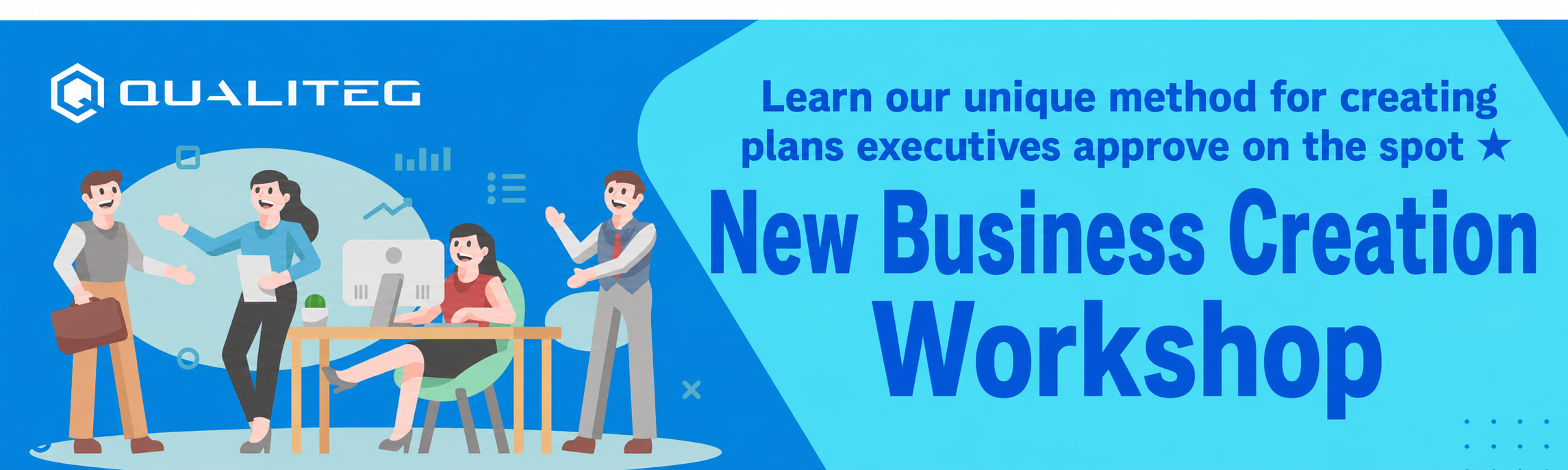
We also run popular workshops for those who want to master the steps of new business creation. The training focuses on helping each participant think about the business from an executive's perspective, and the content is designed not only for planners but also for their counterparts in engineering, design, and marketing.
We look forward to hearing from you. Please stay tuned for the next column.
navigation