[AI-Driven New Business Creation] Why Qualiteg Believes in Using Idea Creation Frameworks

![[AI-Driven New Business Creation] Why Qualiteg Believes in Using Idea Creation Frameworks](https://images.unsplash.com/photo-1508004680771-708b02aabdc0?crop=entropy&cs=tinysrgb&fit=max&fm=jpg&ixid=M3wxMTc3M3wwfDF8c2VhcmNofDJ8fGZyYW1lfGVufDB8fHx8MTcxMzcwMTQ2NHww&ixlib=rb-4.0.3&q=80&w=1200)
Hello to everyone visiting the Qualiteg blog. I'm Michele. In my work on AI-driven new businesses and marketing, there are questions I hear from clients again and again. Through this blog, I would like to offer my own answers to the challenges that anyone considering an AI-based business is likely to face.
A Systematic Approach to Successful Idea Creation
I often hear concerns like "We can't come up with new business ideas" or "Our brainstorming sessions never produce results." From my experience consulting for many companies, the most common failure pattern in idea creation is the "impromptu brainstorm with no preparation." Teams trade off-the-cuff opinions without first clarifying the business objective or the target users, and all too often the session ends without producing any viable ideas.
In this post, I will explain the "Idea Creation Framework" that Qualiteg advocates: a method for succeeding in new business development through a systematic approach rather than by relying on flashes of inspiration.
The First Step in Idea Creation: Defining the Target User
The first step in new business development is to clarify "to whom do we want to offer this product or service?" It is important to design personas, segment your customers, and accurately understand the challenges and needs your target users face.
You need to understand what your target users are thinking and verify the plausibility of your hypothesized challenges and needs.
For this, we often use the empathy map I introduced previously, but before that, you should confirm the target segment that fits your company's business domain—through quantitative research such as surveys and qualitative research such as interviews—and form a detailed picture of who you are targeting.
At this stage, the following research methods are effective.
- Quantitative research (surveys, analysis of market research data)
- Qualitative research (user interviews, focus groups)
- Empathy maps (visualizing user psychology)

Why is target setting so important? Even for a new business, choosing a target that differs greatly from your existing customer base and sales channels reduces marketing efficiency and makes user acquisition difficult. Developing a new service aimed at the user base that already uses your existing services is therefore one efficient approach to launching a new business.
The reason is that even when a new business is your own, if the target users and sales channels are different, it tends to be hard to acquire users after launch. That is why we consider offering a new service to the users who already rely on your company's leading services to be one sound method of new business development, and why we recommend this approach.
Innovation is realized through practice, not through armchair theory. Qualiteg's Innovation-Cross is a co-creation support program that insists on "practice." Beyond strategy formulation based on an analysis of your current situation, we provide support focused on what comes next: "execution." Through concrete actions—idea workshops, hackathon planning, applied AI technology, and more—we bring together knowledge from inside and outside your company to give shape to innovation that is "hard to achieve alone."
Experienced specialist consultants work on-site with you, providing hands-on support for the practical work of open innovation and partner development. We bridge theory and practice, turning innovative ideas into concrete results. We drive innovation that goes beyond "thinking" to "doing."
At this point, it is also important to revisit the user problems, challenges, and needs uncovered in your preliminary research. In design thinking, the "How Might We" framework is sometimes used as a way to open up the questions.
Expressed in a way that feels natural in Japanese, it is a framework of the form
"How might we achieve <what> for <whom>?" (Japanese: 「どうすれば我々は、<誰>の為に、<何>を実現できるのだろうか?」)
For example:
"How might we provide interns who hope to join the company with training that is practical and lets them experience our corporate culture firsthand?"
How Might We is effective for giving concrete shape to questions of this kind and generating a large number of ideas.
There are many other idea-generation frameworks as well—brainstorming techniques that let you contribute without worrying about your boss or colleagues, Osborn's Checklist for surfacing unexpected ideas, and more—and I plan to introduce a variety of them going forward.
Combining Diverse Idea-Generation Techniques
Once the question is settled, you move on to the idea-generation phase. For effective ideation, we recommend combining several techniques:
- Brainwriting: A technique in which participants jot down their thoughts individually and then share them. It draws out everyone's opinions without anyone having to worry about their boss or colleagues.
- Osborn's Checklist: A technique for developing ideas from nine perspectives such as "magnify," "minify," and "combine."
- SCAMPER: Expands ideas through seven thinking patterns: Substitute, Combine, Adapt, Modify, Put to other uses, Eliminate, and Reverse.
- Forced Association: A technique that deliberately links unrelated fields or concepts to produce novel ideas.
Summary: Keys to Successful Idea Creation
To succeed at creating ideas for a new business, a systematic approach based on "frameworks" rather than "inspiration" is essential. By clarifying your target users, formulating concrete questions, and combining a variety of ideation techniques, you can generate business ideas that are both feasible and innovative.
I will continue to introduce a range of methods and case studies related to design thinking and new business development, so please stay tuned.
Thank you for reading this column to the end. At Qualiteg, we provide training and consulting on AI technology and on how to plan new businesses. If this has piqued your interest, or if you have specific requirements in mind, please feel free to reach out through the inquiry form here.

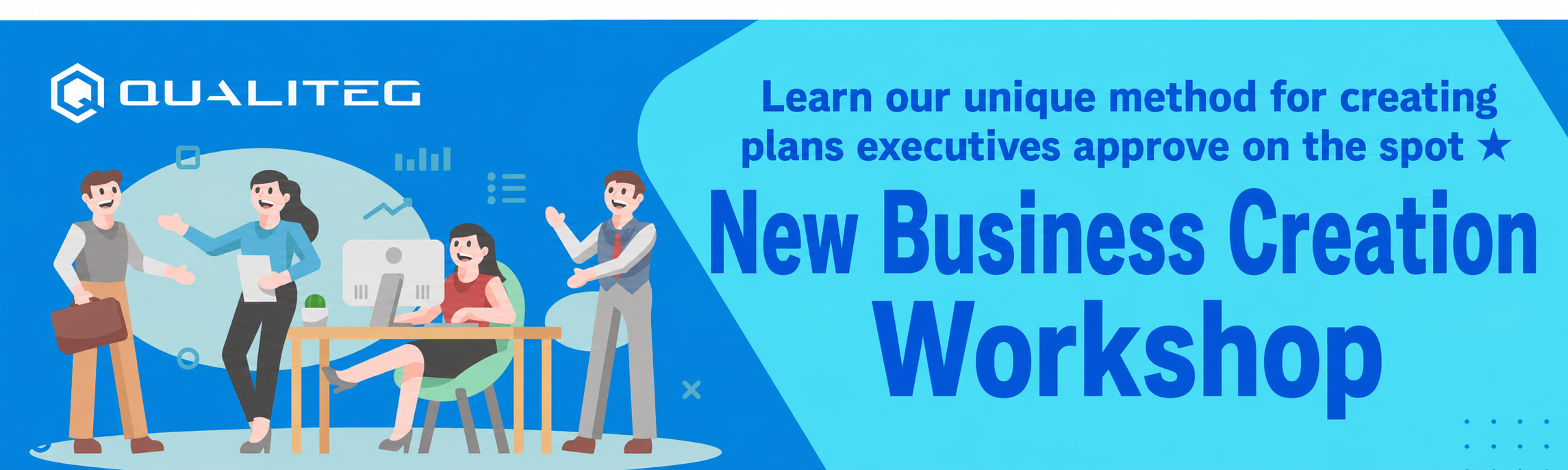
We also run popular workshops for those who want to master the steps of new-business creation. The training focuses on having each participant think about the business from an executive's point of view, and the content is suitable not only for planning staff but also for their counterparts in engineering, design, and marketing.
We sincerely look forward to hearing from you. Please stay tuned for the next column.
navigation