How to Build AI Lipsync, Part 5 (First Half): Transformer Implementation and Practical Technology Choices

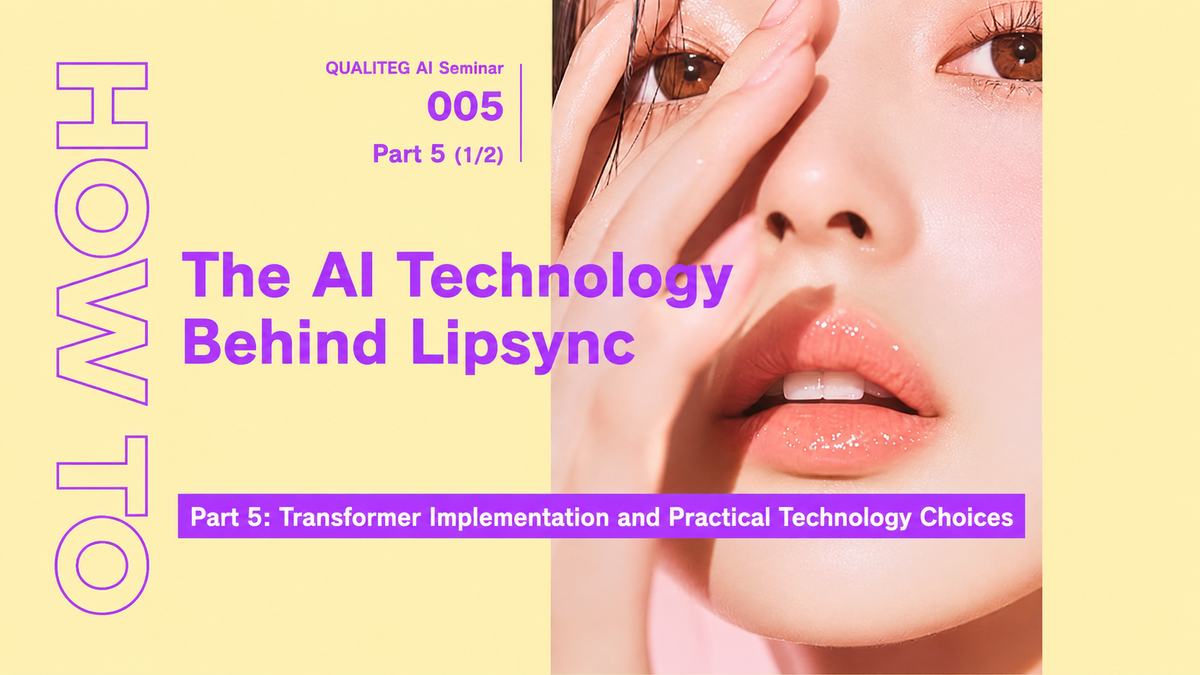
Hello! Our lipsync technology series is finally entering its home stretch.
Last time (Part 4), we took a detailed look at the LSTM training process and its limits. While we saw the LSTM's strength of learning effectively even from limited data, it also became clear that it struggles with long-range dependencies. We then introduced the Transformer's Self-Attention mechanism — an innovative approach that can reference information at every position simultaneously — as the way to solve this problem.
In this fifth installment,
we start with the concrete Transformer network design and lay out its implementation challenges. (First half*)
We then introduce a hybrid approach that combines the strengths of LSTM and Transformer, offer guidance for technology choices in real product development, and finally touch on the next challenge: extending to emotional expression. (Second half*)
*Because the Transformer's inner workings are intricate, Part 5 is split into a first half and a second half.
1. Transformer-Based Network Design
1.1 Overall Architecture
Let's dive right into the structure of a Transformer-based lipsync conversion network.
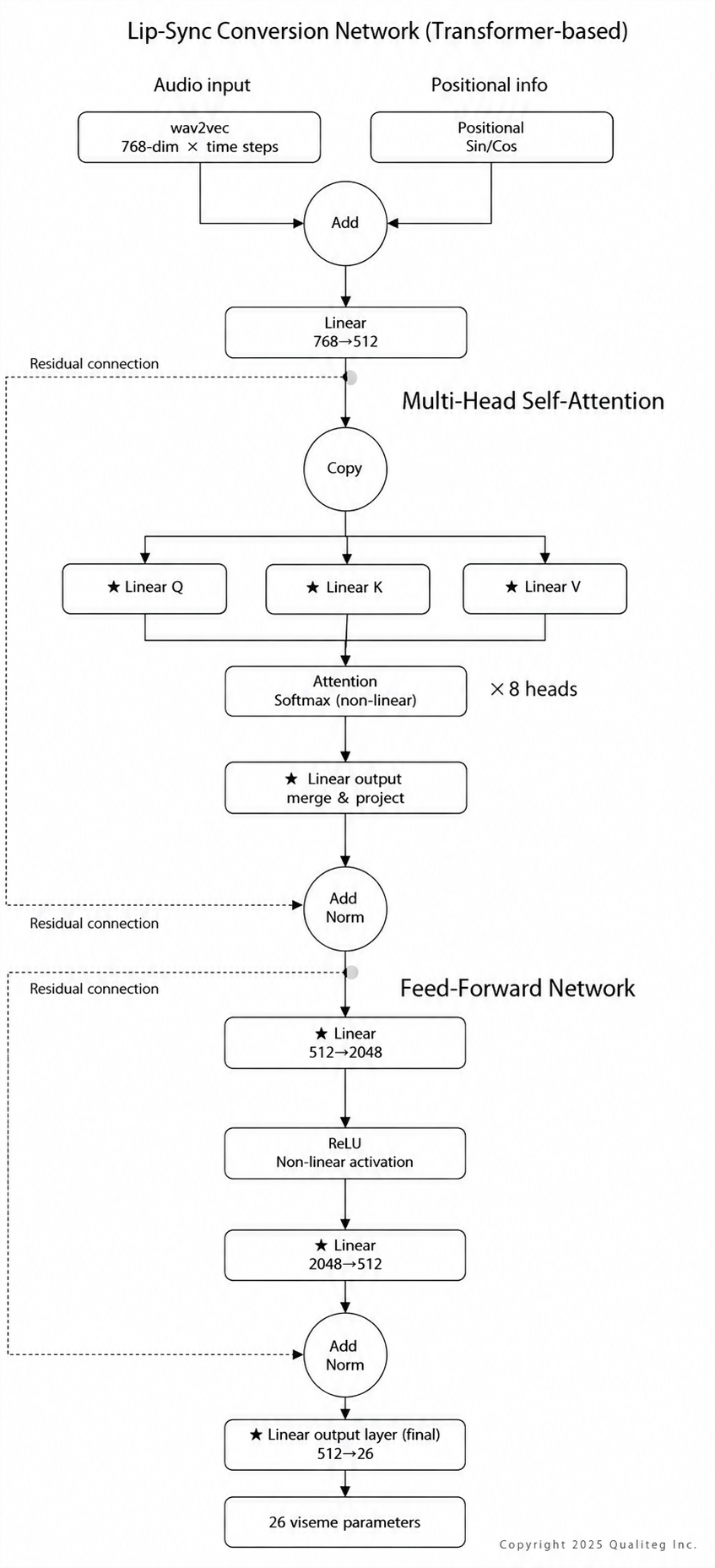
Compared with the LSTM-based network, the input (wav2vec features) and the output of 26 mouth-shape parameters* are the same, but the processing in between is fundamentally different.
The biggest difference is that while the LSTM processes the sequence step by step, the Transformer processes all time steps in parallel*. This makes it possible to directly learn relationships between distant positions, such as the beginning and end of a sentence.
1.2 The Role of Each Layer
Positional encoding: embedding order information
The Transformer's first distinctive element is positional encoding. Self-Attention treats every element the same way regardless of position, so on its own it cannot tell "こんにちは" (konnichiwa) apart from "はちにんこ" (the same characters in scrambled order). We therefore need to add position information unique to each position.
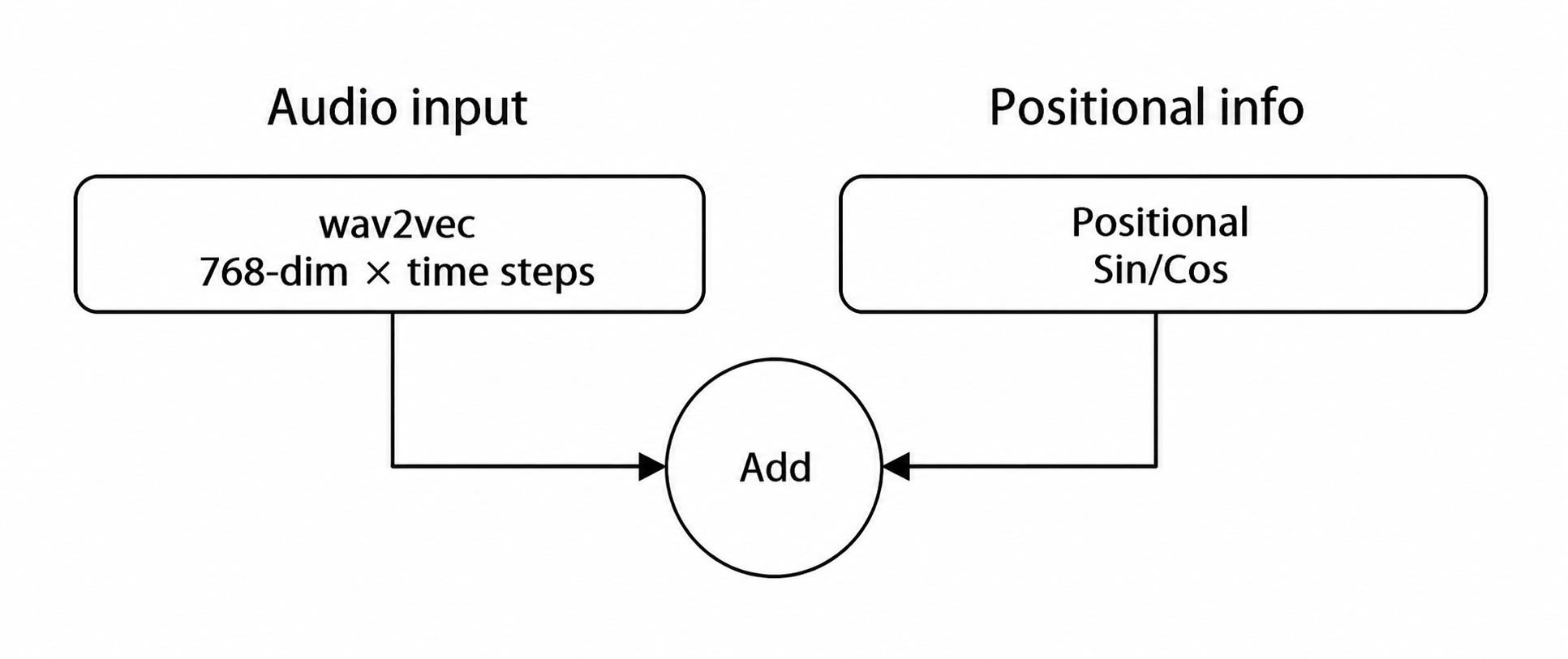
Positional encoding uses periodic functions built from sine and cosine waves. For a position p and dimension i, it is computed by
PE(p,2i) = sin(p / 10000^(2i / d_model))
PE(p,2i+1) = cos(p / 10000^(2i / d_model))
the formulas above. This approach gives each position a unique representation while also preserving the relative relationships between positions.
About the positional-encoding formulas
PE(p,2i) = sin(p / 10000^(2i / d_model))
PE(p,2i+1) = cos(p / 10000^(2i / d_model))
The formulas alone may look intimidating, but the key point is that positions are distinguished by wave patterns.
- Why combine sine and cosine waves
By overlaying waves with different periods, both short-distance and long-distance differences can be expressed.
For example, positions 2 and 3 are easy to tell apart using the high-frequency waves, while the difference between positions 10 and 100 shows up in the low-frequency waves. - Why use 10000
It is the base value used to scale the waves exponentially.
Because the frequencies spread out on a logarithmic scale, positions can be represented uniquely for sequences of any length. - Relative relationships are preserved too
Thanks to the periodic nature of sin/cos, the difference between p and q is embedded as a phase difference, so the model can naturally learn information such as "these two are three steps apart."
The Multi-Head Self-Attention layer: a mechanism for seeing the whole picture
Now, this is unquestionably the core.
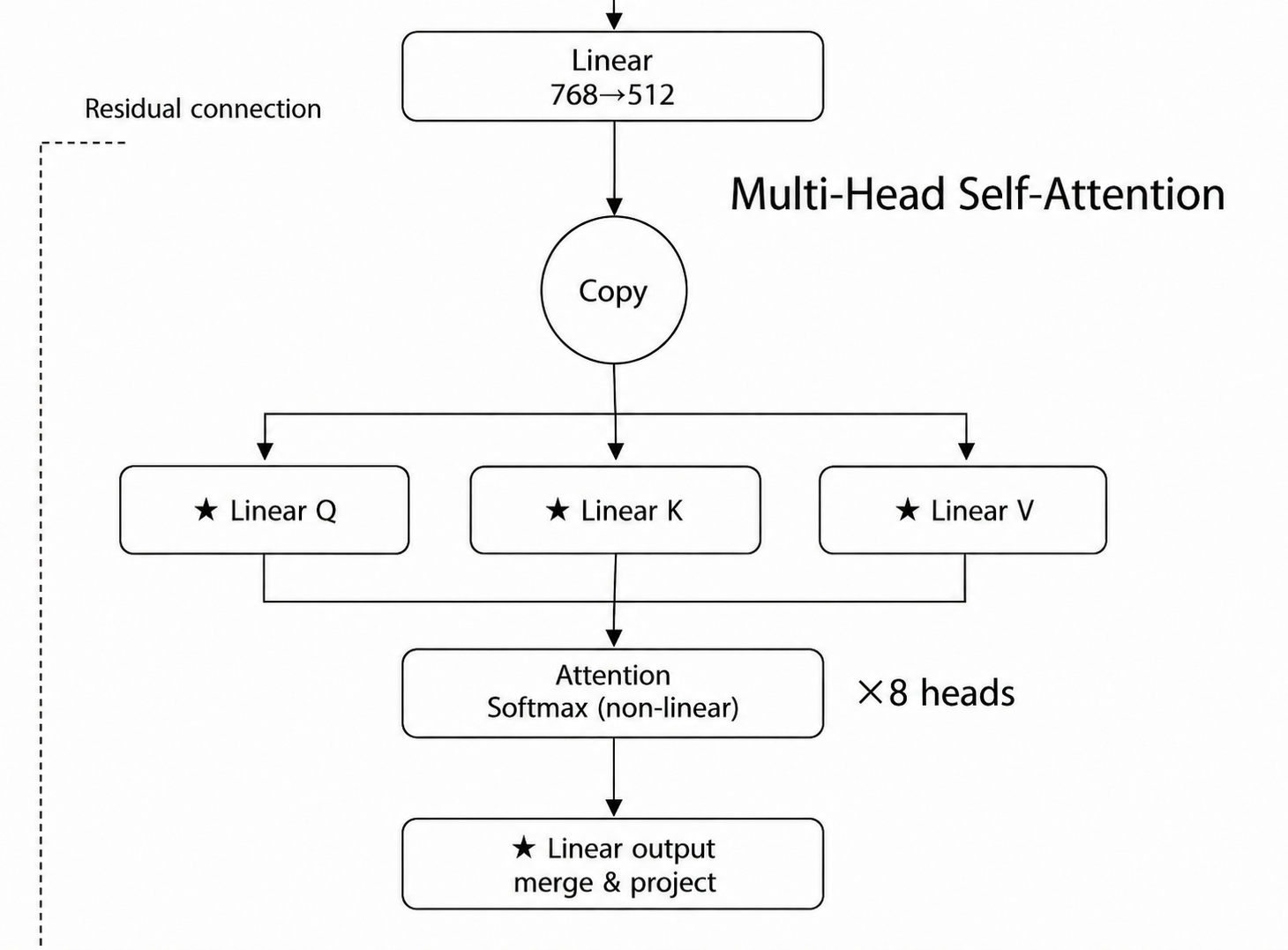
The Multi-Head Self-Attention layer — the heart of the Transformer — consists of eight independent attention heads. Each head learns the relationships between phonemes from a different angle.
For example, one head might focus on relationships between adjacent phonemes, while another focuses on phonemes that share the same place of articulation (such as た (ta) and だ (da)). Yet another head might focus on the relationship between the beginning and end of a sentence, capturing the overall tone.
The outputs of the eight heads* are ultimately merged, enabling a multifaceted understanding of the relationships between phonemes. It is like eight experts each analyzing from their own viewpoint and then combining their findings into a single judgment.
That said, this can be hard to picture, so let's take a closer look.
How does Multi-Head Attention actually work?
As shown in the figure above, our Transformer for lipsync training has eight independent attention heads*, each of which looks at the relationships between phonemes from a different perspective.
In other words, the model learns the relationship between sounds and mouth shapes from eight "different perspectives."
So what are these eight perspectives? Let's look at a concrete example.
- Head 1: adjacencyEmphasizes the connections between neighboring phonemes, such as こ (ko) → ん (n)Learns smooth transitions of mouth movement
- Head 2: same place of articulationた (ta) and だ (da) (same tongue position)ま (ma) and ば (ba) (both use the lips)Learns relationships between phonemes with similar mouth shapes
- Head 3: vowel relationshipsFocuses on the vowel segments あ, い, う, え, お (a, i, u, e, o)Learns patterns of mouth opening
- Head 4: sentence beginning and endThe relationship between sentence start and end (intonation)Captures the overall tone of the utterance
- Head 5: accent positionDetects emphasized phonemesIdentifies where mouth movements become larger
- Head 6: silence and pausesPositions of punctuation and breathsLearns the timing for closing the mouth
- Head 7: consonant clustersConsonant sequences such as "str" and "spl"Complex combinations of mouth movements
- Head 8: long-range prosodyThe rising intonation of questionsRhythm patterns across the whole sentence
(*The eight perspectives above are just one example. In actual training, a wide variety of perspectives emerges through trial and error.)
Why do we need as many as eight perspectives?
As noted above, it is because doing
"something like eight experts analyzing from their own viewpoints and combining their results into a judgment"
promises a more sophisticated level of lipsync.
In short:
- A single expert (one head) can only look from one perspective
- Eight experts (eight heads) can analyze from multiple perspectives at once
- The eight analysis results are ultimately combined to produce a more accurate mouth shape
That is what it comes down to — and it enables natural lipsync that simultaneously accounts for complex factors such as context, intonation, and rhythm, not just the bare sequence of phonemes.

Expert 1, "the adjacency appraiser"
Watches how neighboring sounds connect, like the transition from こ (ko) to ん (n). Rather like a nursery teacher observing children walking hand in hand.
Expert 2, "the twin-spotter of sounds"
Excels at finding sounds with the same tongue position, like た (ta) and だ (da). A bit like a maternity-ward nurse who can tell twins apart.
Expert 3, "the vowel tuner"
Focuses on the vowels あいうえお (a, i, u, e, o). Adjusts how far the mouth opens, the way a piano tuner adjusts pitch.
Expert 4, "the story editor"
Looks at the relationship between the beginning and end of a sentence. Like an editor weighing a novel's opening against its ending.
Expert 5, "the conductor of dynamics"
Detects accent positions. Decides where the mouth opens wide, the way a conductor shapes loud and soft.
Expert 6, "the master of pauses"
Finds punctuation and breaths. A specialist who understands the aesthetics of silence, like the timing of a rakugo storyteller.
Expert 7, "the tongue-twister analyst"
Handles consonant clusters like "str" and "spl." Something like a coach who trains announcers' diction.
Expert 8, "the intonation musician"
Senses the melody of the whole sentence, such as the rising tone of a question. Grasps the flow of sound the way a composer writes a melody.
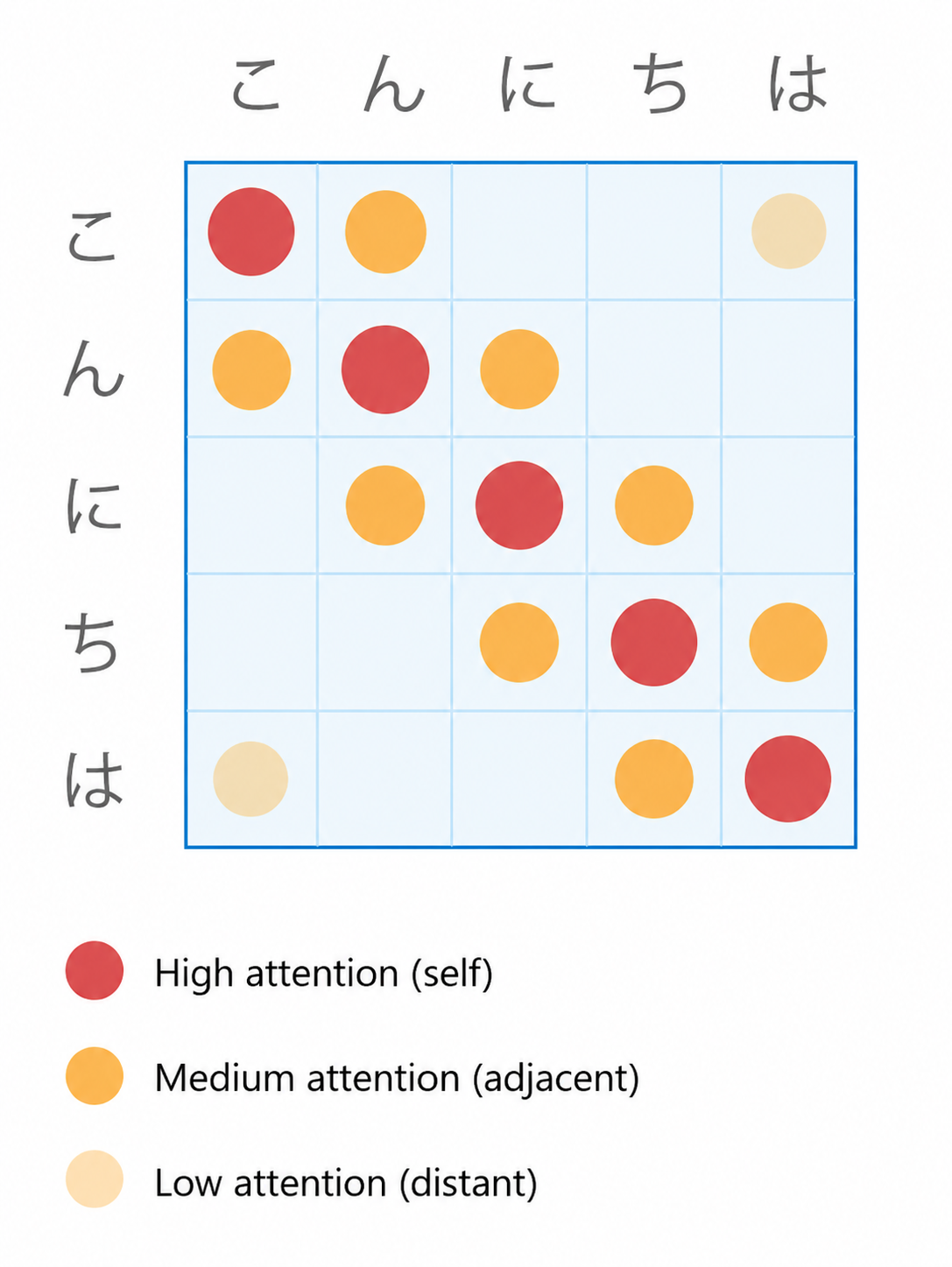
What is the attention matrix?
The attention matrix is a table that quantifies how much each element attends to (references) every other element.Each row (per Query) is normalized with Softmax into a probability distribution that sums to 1 (in general the matrix is not symmetric).
In the context of lipsync, it expresses how much each phoneme consults the other phonemes when deciding its mouth shape.
For example, with the five phonemes* of "こんにちは" (konnichiwa), it expresses the strength of association as a number for every one of the 5 × 5 = 25 combinations.
*The actual training input is not "phonemes" but continuous feature frames such as wav2vec.For example, the matrix below represents the following:
- A 5×5 grid: the relationships among the phonemes こ (ko), ん (n), に (ni), ち (chi), and は (wa)
- Red circles (dark): self-attention on the diagonal (each phoneme attending to itself)
- Orange circles (medium): attention between adjacent phonemes
- Pale orange circles: attention between distant phonemes, such as the beginning and end of the sentence
That is what each mark stands for.
The cast of actual Transformer training: Q, K, and V
Now, let's focus on this part.
What are the Q, K, and V shown here?
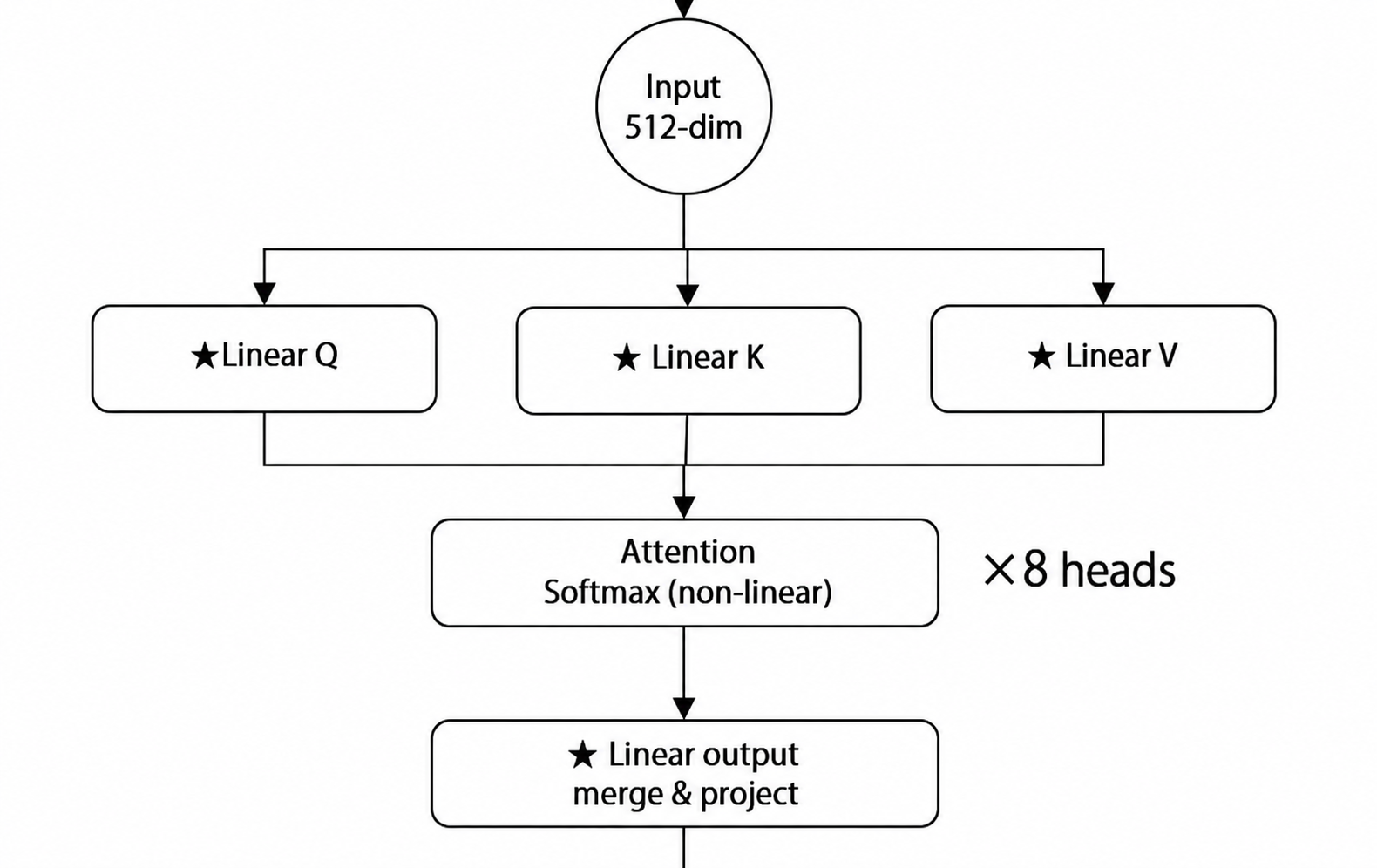
Self-AttentionHere, the input data is transformed into three distinct roles.
- Q (Query)
The role that asks, "Who am I most closely related to?"
= "who is looking" (the questioner) - K (Key)
The role that responds, "These are my characteristics."
= "who is being looked at" (the matching target) - V (Value)
The role that offers, "This is the actual information I hold."
= "what gets received" (the actual information)
All three are produced from the same input, but different weight matrices (Linear layers) transform each into a different representation.
In implementation terms, with sequence length T and per-head dimensions d_k and d_v, Q, K ∈ ℝT×d_k and V ∈ ℝT×d_v. They are generated by multiplying the input vectors X ∈ ℝT×d_model by learnable projection matrices W_Q, W_K, and W_V; in the multi-head case, they are further split per head for processing.Let's think it through with the "こんにちは" (konnichiwa) example. As introduced earlier, head 1 is the one that learns the adjacency relationships between sounds.
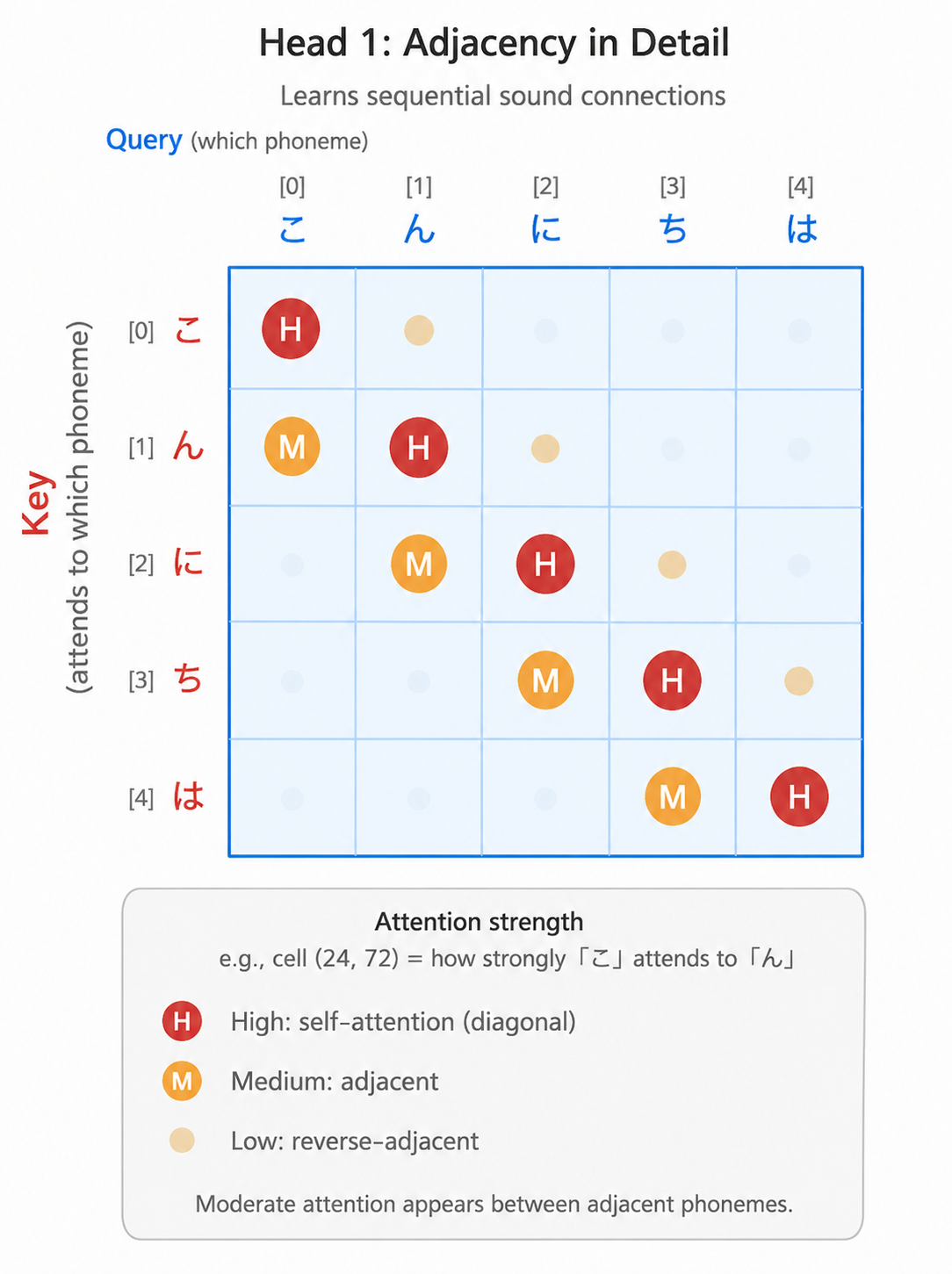
Here, Q (Query) and K (Key) can be thought of as follows:
- Query axis (horizontal, blue): which phoneme is doing the attending
- Key axis (vertical, red): which phoneme is being attended to
"Who" is looking at "whom" — that is the relationship being expressed, where
- Query: the one looking (the subject)
- Key: the one being looked at (the object)
. For example, in the figure above, the part where Query "ん" (n) attends to Key "に" (ni) looks like the following.
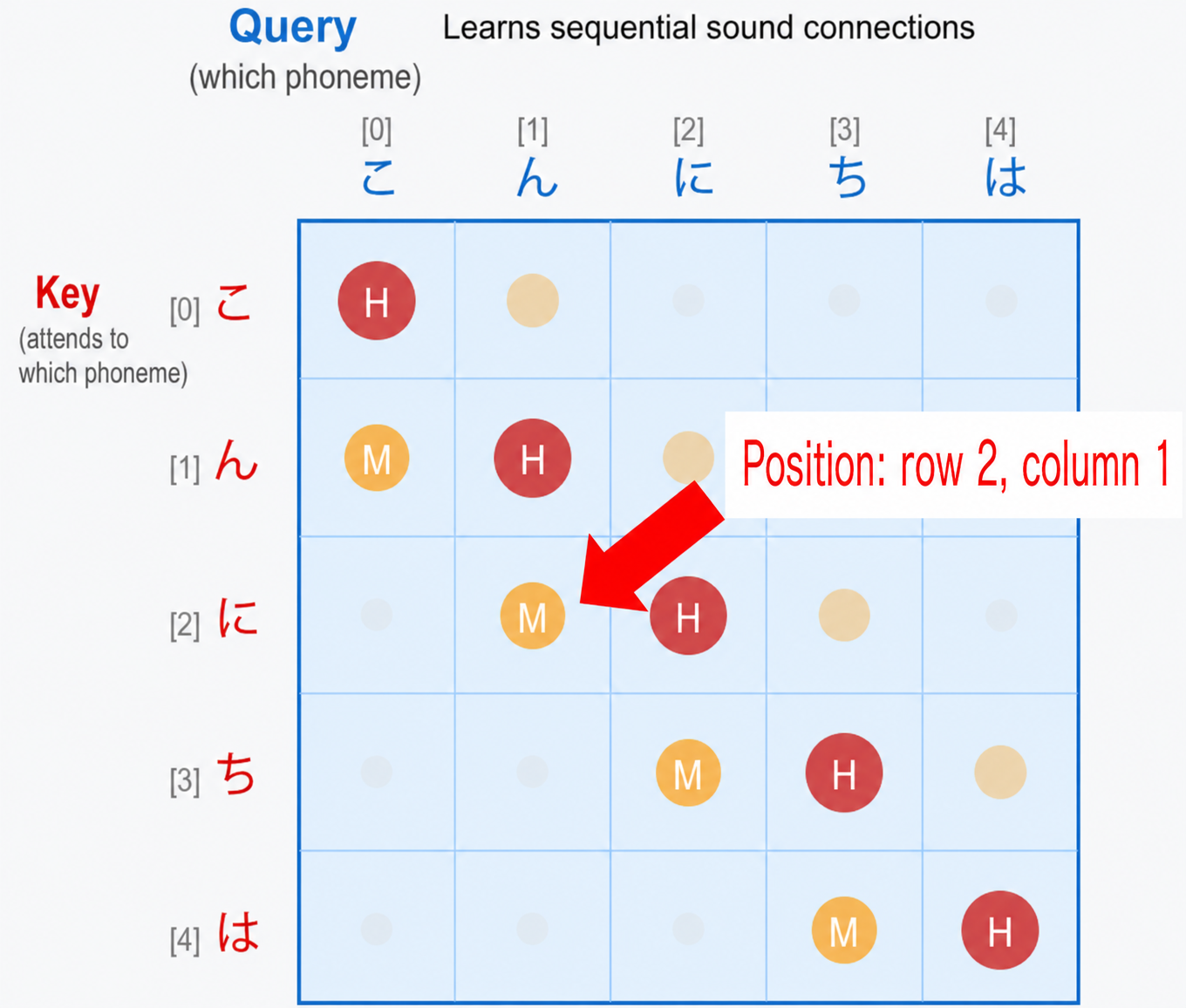
Let's walk through this Query–Key attention computation as a concrete process.
STEP 1. Compute attention scores from Query and Key
- How much does ん (n) look at に (ni)? → attention 70%
- How much does ん (n) look at は (wa)? → attention 10%
STEP 2. Next, use those attention scores to retrieve the Values with weights
- Receive the information (Value) of に (ni) with a weight of 70%
- Receive the information (Value) of は (wa) with a weight of 10%
STEP 3. Combine the weighted information
- The result becomes the new representation of ん (n)
In other words, it looks something like this:
Query ん (n): "Whose information should I consult to decide the next mouth shape?"
Key: "Check the relevance"
- に (ni) → the next sound, so it's important! (70%)
- こ (ko) → the previous sound, so somewhat important (20%)
- は (wa) → far away, so not very important (10%)
Value: "the actual mouth-shape information"
- mouth-shape info of に (ni) × 70%
- mouth-shape info of こ (ko) × 20%
- mouth-shape info of は (wa) × 10%
↓
Combine these to decide the optimal mouth shape for ん (n)
Now, why do Key and Value need to be separate in the first place?
Because if Key and Value were the same, the "relevance judgment" and the "information retrieved" would be identical (which is obvious when you think about it).
In other words, by keeping them separate, the model can learn
- Key: features used for judging relevance
- Value: the rich information actually being conveyed
independently of each other.
This is what makes the attention mechanism more flexible and expressive.
Q, K, V: The Three Elements of Postal Delivery
Q (Query) is "the person looking for an addressee." It asks, "I want to deliver this letter — who will receive it?"
K (Key) is "the address plate." It announces, "This is where I live!"
V (Value) is "the actual package" — the precious contents you want delivered.
What the actual attention matrix expresses
This part is genuinely hard to grasp, so at the risk of repeating ourselves, let's go back to the attention matrix from earlier.
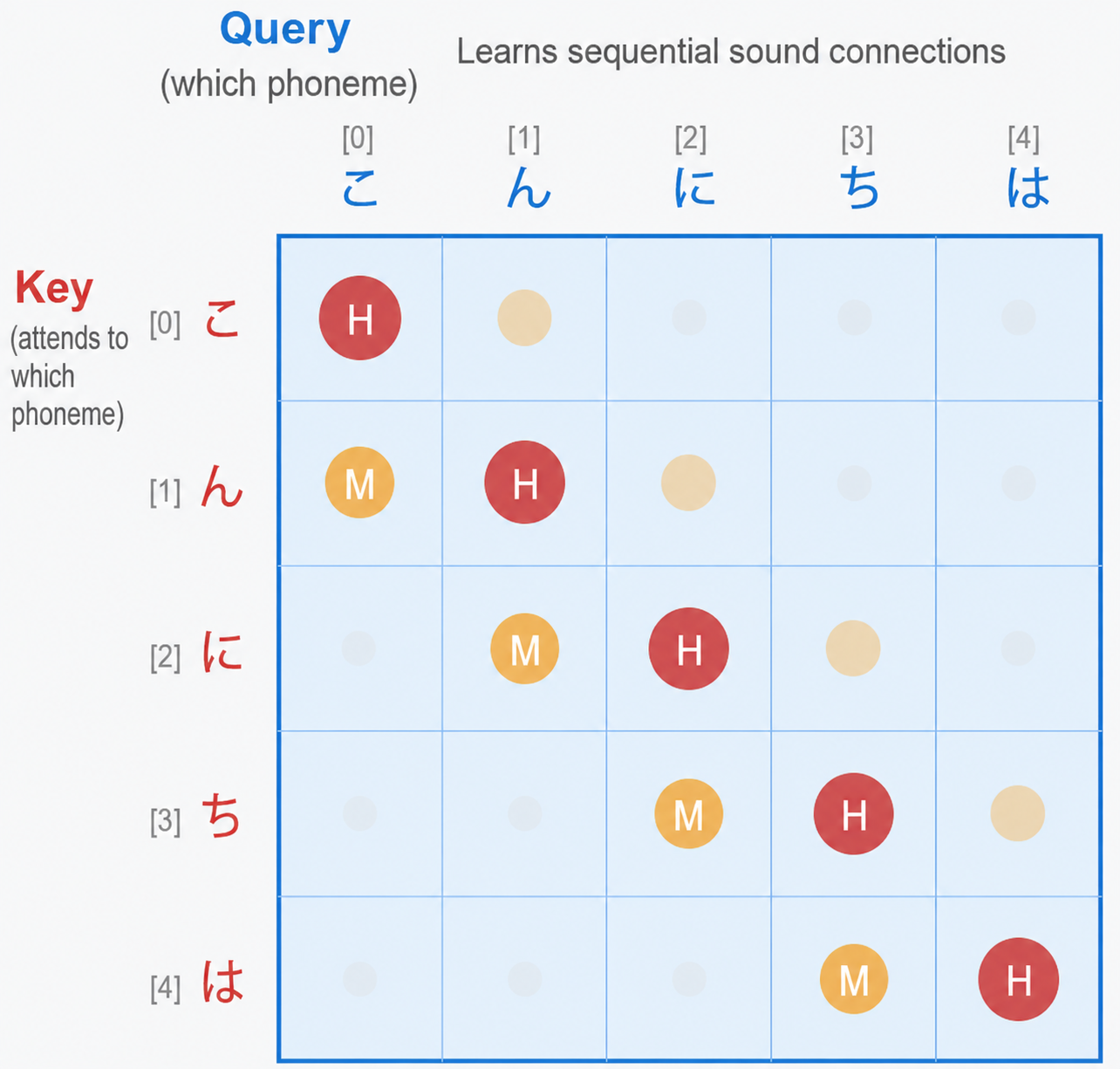
So what is this matrix, in terms of the actual computation? It is a visualization of the dot product of Q and K — that is, of the attention scores computed from it.
Attention Score = Q × K^T / √d_k
(d_k: the Key dimension of each head)
In this matrix,
- Horizontal axis (Query): how much each phoneme, as the "questioner," looks at the others
- Vertical axis (Key): how much each phoneme, as the "target," is looked at by the others
- Each cell value: the strength of association (attention) for that phoneme pair
That is how it reads.
This time, take the relationship between ん (n) and に (ni): the cell at coordinates (1, 2) — ん on the horizontal axis × に on the vertical axis —
- the Query of "ん" and the Key of "に" — the cell expresses their similarity
- A larger value = the information of に (ni) matters more when processing ん (n)
- In proportion to this attention score, the Value of "に" (the actual information) is retrieved
.
At the risk of belaboring the point, let me explain once more why splitting into K, Q, and V is necessary.
If only a single representation were used, the "relevance judgment" and the "information conveyed" would be one and the same (as noted earlier).
By separating them:
- Q–K pairs: can learn which elements relate to which (the attention patterns)
- V: can hold the rich information to actually convey, kept separately
For example, even if the phonetic similarity (K) between ん (n) and に (ni) is low, their sequential importance (the learned Q–K result) can be high, and the mouth-shape information received from に (V) can carry yet other characteristics. Complex relationships like this become expressible.
From the matrix to the actual processing
Reviewing the network diagram below once more:
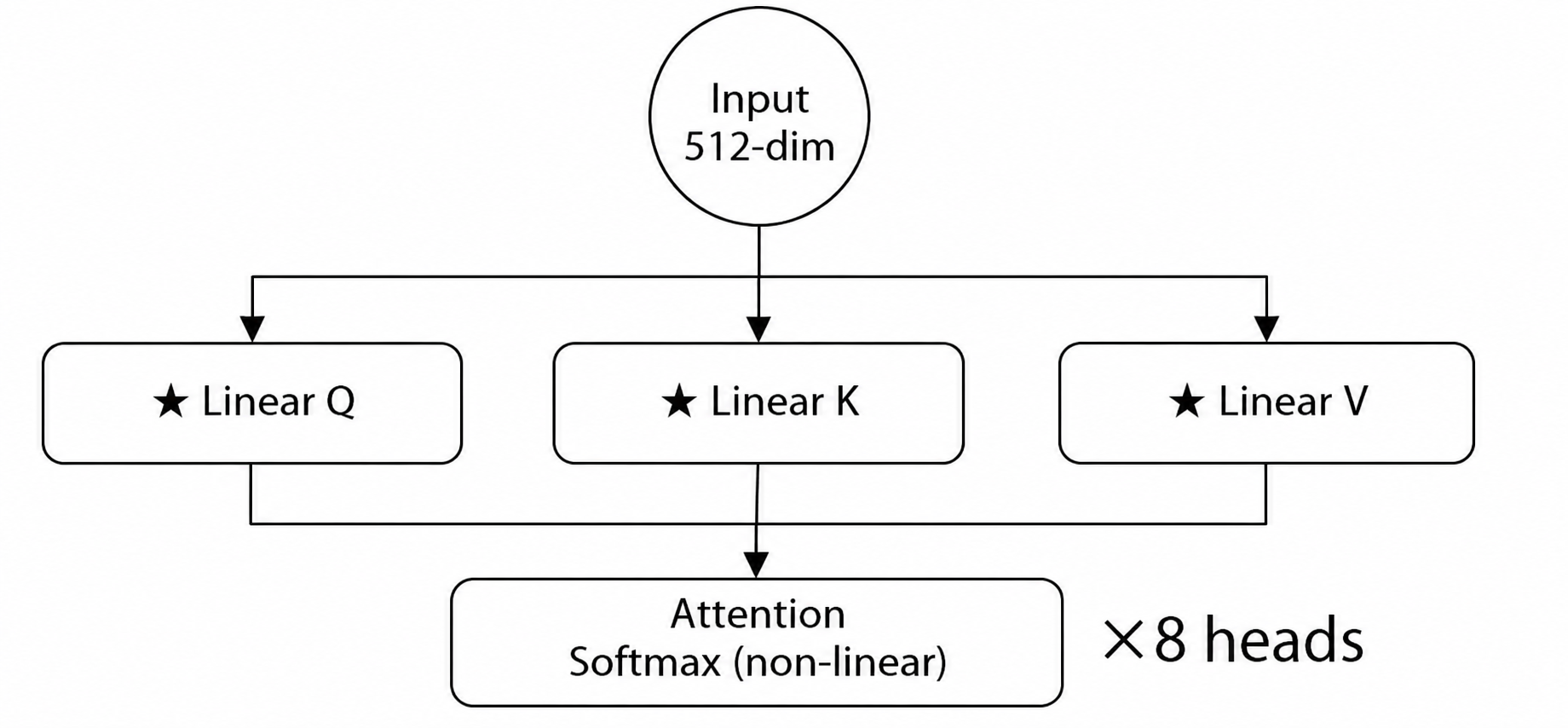
- Attention computation: build the matrix with Q × K^T
- Normalization: Softmax makes each row sum to 1 (a probability distribution)
- Information retrieval: take a weighted average of V using the attention as weights
- Result: a new, context-aware representation of each phoneme
In short, this matrix is the blueprint for "which phoneme references how much of which phoneme's information," and the actual information (the Values) is combined according to this blueprint.
Eight different perspectives and their attention matrices
So far we have looked at the example of head 1. To close this section, let's visualize the matrices of all eight perspectives.
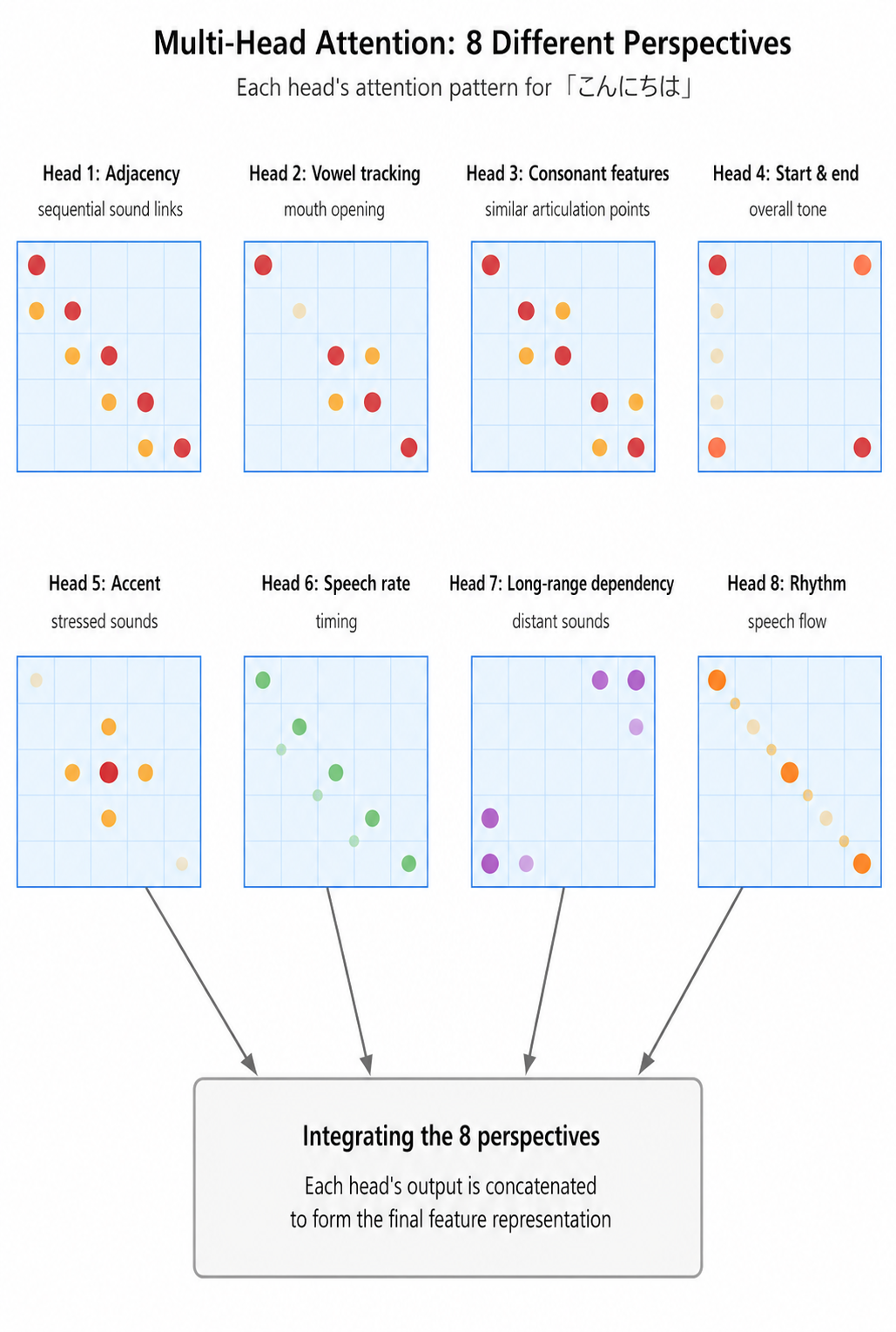
Characteristics of each head
The heads are as follows:
- Head 1 (adjacency): attends to the diagonal and to adjacent phonemes
- Head 2 (vowel tracking): attends to vowel segments and matching vowels (the "i" sound in に (ni) and ち (chi))
- Head 3 (consonant features): attends to identical consonants (ん and ん) and similar consonants
- Head 4 (sentence start/end): emphasizes the relationship between the beginning and the end
- Head 5 (accent): attends around the emphasized sound (に)
- Head 6 (speech rate): patterns of even timing adjustment
- Head 7 (long-range dependencies): relationships between distant phonemes
- Head 8 (rhythm): wave-like rhythm patterns
In each matrix, color and size express the degree of attention:
- Large, dark circles = strong attention
- Small, pale circles = weak attention
- Different colors = different kinds of attention
These are ultimately integrated to generate natural lipsync.
Computing the Actual Attention Matrix: Completing the Recipe
Integrating the Eight Heads: An Orchestral Performance
Coming up next
In the second half, we will clarify the role of the feed-forward layer and the structural differences from LSTM, and then focus on the implementation challenges the Transformer faces.
See you next time!