[AI-Driven New Business Creation] The Five Steps of Idea Generation, as Qualiteg Sees Them
For clients who struggle with idea generation, we explain five steps: set a clear objective, then move through idea creation, deepening, service design, business model design, and evaluation. The process verifies that ideas can stand as a real business, aligned with the agreed objective.

![[AI-Driven New Business Creation] The Five Steps of Idea Generation, as Qualiteg Sees Them](https://images.unsplash.com/photo-1496053512767-4fdda61b3c49?crop=entropy&cs=tinysrgb&fit=max&fm=jpg&ixid=M3wxMTc3M3wwfDF8c2VhcmNofDE0fHxzdGVwfGVufDB8fHx8MTcxMzcwMDkxNnww&ixlib=rb-4.0.3&q=80&w=1200)
Hello to everyone visiting the Qualiteg blog. I'm Michele. In my work on AI-driven new business development and marketing, there are questions I hear from clients again and again. Through this blog, I'd like to offer my own answers to the challenges that anyone considering an AI-based business is likely to face.
"You say 'idea generation,' but I don't know where to begin."
A great many clients come to us with exactly this concern. Today, I'll walk through the five steps of idea generation, including techniques beyond the usual brainstorming.
Many people tell me, "I have great ideas; I'm an idea person." But I'd ask you to hold back the urge to start generating ideas right away, and first
clarify what you are generating ideas for
by setting a clear objective.
"Well, obviously, we're generating ideas in order to create a new business."
I can almost hear that response, but let's go back to "the purpose of launching the new business, as agreed in advance with the business owner."
Taking the electric bicycle startup that we use as an example throughout this blog, the objective of this new business development effort is
"Creating a new UX," with the goal of "bringing to market a service that improves the quality of life of our target users: businesspeople working in urban areas."
So keep this firmly in mind: this is the goal of creating the new business, and everything you do should stay anchored to it.
True innovation is impossible without the people who drive it. Innovation-Cross from Qualiteg is a program that supports the development of innovation talent within companies while creating value through co-creation. Through idea workshops and hackathon planning, it draws out employees' creativity and collaborative strength, and through hands-on practice in open innovation and partner development, it builds the skills needed for external collaboration.
Based on an analysis of your company's current state, we formulate a strategy for creating innovation that would be "difficult to achieve alone," and foster the growth of your people through the process of executing it. Our experienced specialist consultants design a virtuous cycle of innovative value creation and talent development, building your company's capacity for sustained innovation. What we create together is a future for both value and people.
The Five Steps of Idea Generation as Proposed by Qualiteg
Generating ideas is not the end of the story. All too often, after a large number of ideas have been generated, the decision ends up being made by the department head's say-so.
Sometimes that approach works out fine. Unfortunately, though, what I frequently see in my consulting work is a new business theme that had been progressing nicely getting sent back to square one after time has passed, because the fiscal year changed, the manager changed, and opinions changed along with them.
To avoid running into that wall, at Qualiteg we recommend generating ideas through the following five steps.
- Idea creation (divergence)
- Idea deepening (convergence)
- Service design
- Business model design
- Idea evaluation (convergence)

The first step is the one everyone has been waiting for: "idea creation."
In this phase, what matters is simply producing as many ideas as possible. A great many people rely on brainstorming and are unaware of other techniques; I'll cover those in detail in the next column.
Whatever the technique, in this phase concentrate on "freely producing a large number of ideas." Involving many people across departments, not only planners but also designers, engineers, and others, brings diversity that leads to a broader range of ideas.
These days, generative AI is also frequently used to generate ideas, and we recommend this approach as well.
Once you have plenty of ideas, the next step is "idea deepening." At the point when ideas are first generated, most of them are little more than keywords and give no concrete picture of what the service would be, so we recommend deepening them to add specificity.
After deepening the ideas, the next step is "service design." Here you consider what kind of service each idea should become. Examine technical feasibility and any issues that surface as you think through building the service, including whether there is real user need, and shape the service concept to the point where you can describe a simple use case.
Once the service concept has taken shape, move on to "business model design." Even an idea that seems to meet a real need cannot become a business if it cannot be monetized.
In this phase, consider the essential value you provide to customers, how your company delivers that value, revenue sources and cost structure, and also whether partner companies will be needed for service development or market entry.
The final step is "idea evaluation." Some people decide which idea to adopt by reading the mood of the business owner. Instead, to define and assess in advance the potential success of a service you are about to bring to market, use evaluation criteria to rank the ideas and make your decision.
If the evaluation criteria are clear and the judgment is made rationally, you can greatly reduce the chance of having the whole thing overturned later.
Thank you very much for reading this column to the end. At Qualiteg, we provide training and consulting on AI technology and on methods for planning new businesses. If you're interested, or have specific requirements, please feel free to reach out viaour contact form.

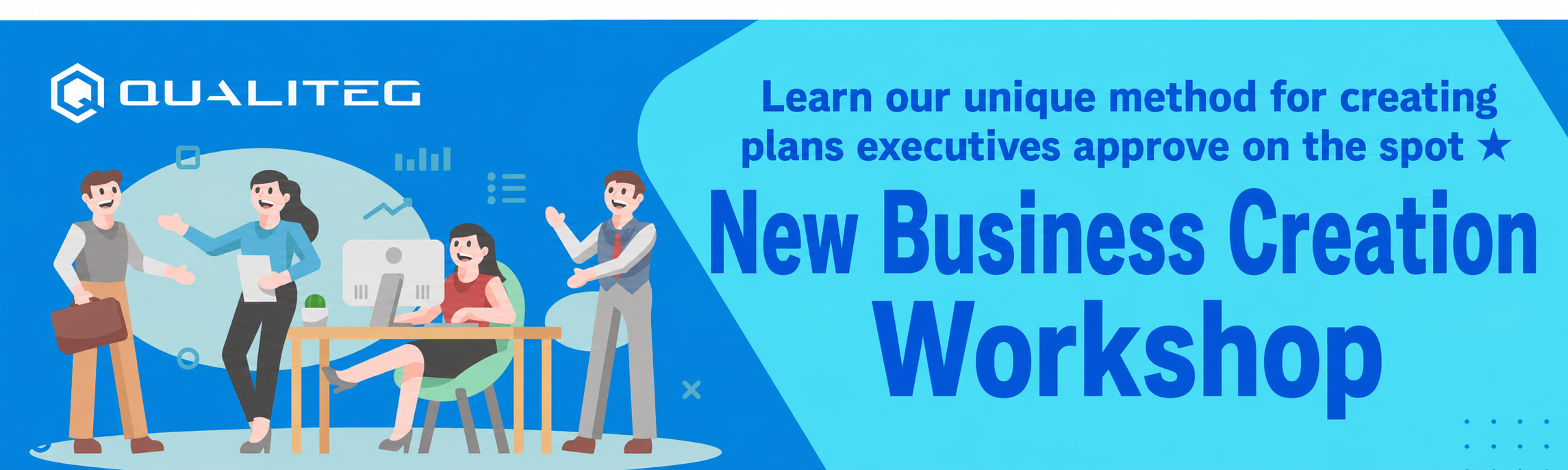
We also run a popular workshop for those who want to master the steps of new business creation. The training focuses on having each participant think about the business from an executive's perspective, and the content is designed not only for planners but also for their counterparts in engineering, design, and marketing.
We look forward to hearing from you. And please look out for the next column.
navigation