[AI-Driven New Business Creation] Qualiteg's Original Method for Evaluating and Selecting Business Ideas

![[AI-Driven New Business Creation] Qualiteg's Original Method for Evaluating and Selecting Business Ideas](https://images.unsplash.com/photo-1589561253831-b8421dd58261?crop=entropy&cs=tinysrgb&fit=max&fm=jpg&ixid=M3wxMTc3M3wwfDF8c2VhcmNofDE4fHxJREVBfGVufDB8fHx8MTc0MjEzMzEyNXww&ixlib=rb-4.0.3&q=80&w=1200)
Hello, and welcome to the Qualiteg blog. I'm Michele. In my work on AI-driven new business development and marketing, there are questions I hear from clients again and again. Through this blog, I would like to share my own answers to the challenges that anyone considering an AI-powered business is likely to face.
Evaluating and Selecting Business Ideas with AI | Qualiteg's Original Approach
Launching a new business starts with generating ideas, but it is the evaluation and selection process that follows which truly holds the key to success. At Qualiteg, we have developed our own evaluation and selection method that makes active use of AI, allowing us to examine business ideas from a more objective, multi-faceted perspective. In this article, I would like to introduce our practical approach.
A Basic Framework for AI-Powered Idea Evaluation
Our idea evaluation process consists of the following two stages.
1. Quantitative Analysis with a Multi-Dimensional Evaluation Matrix
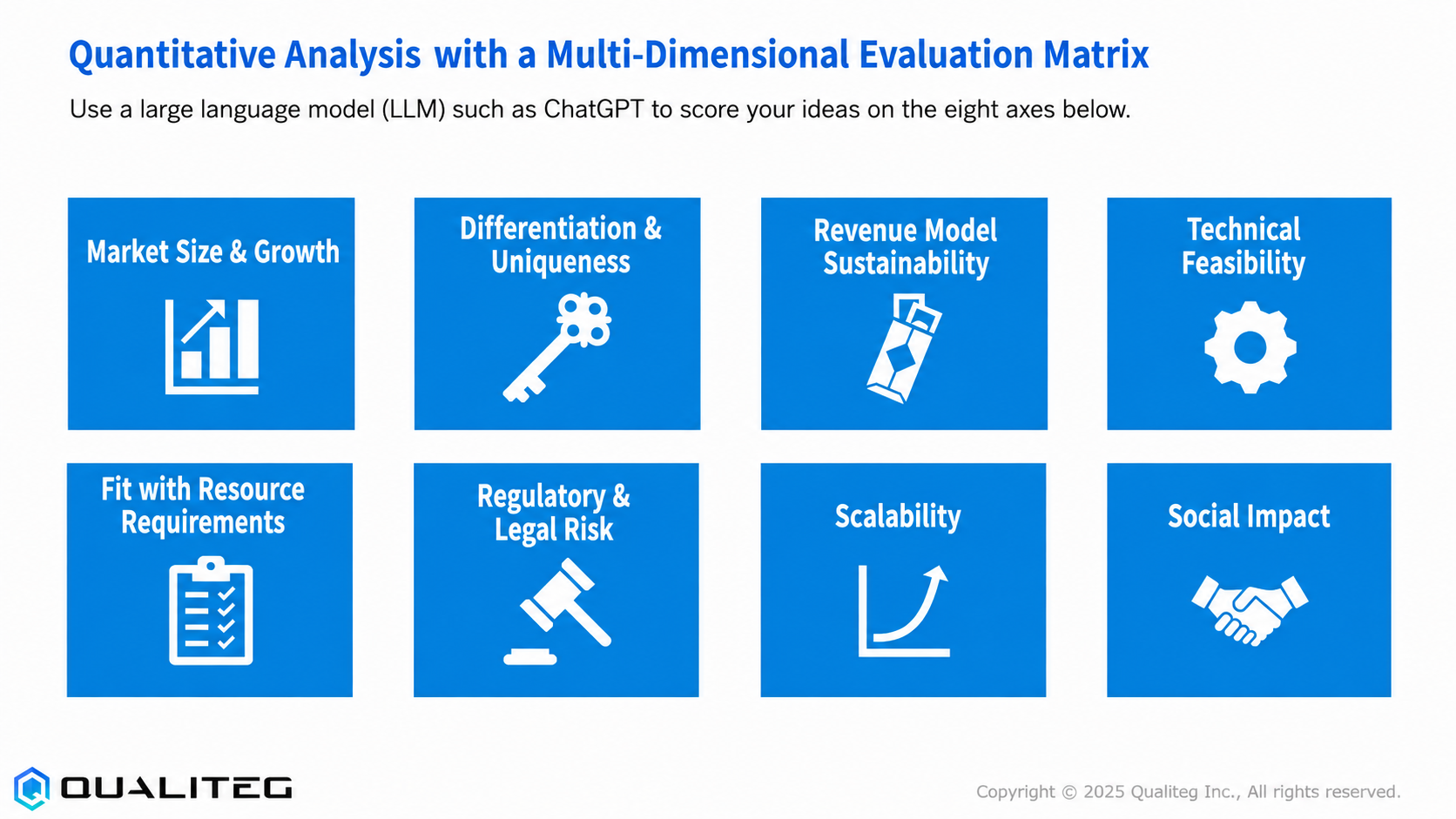
First, for each idea that has been generated, we use large language models (LLMs) such as ChatGPT to score the idea along the following eight evaluation axes.
- Market size and growth potential (out of 5 points)
- Differentiation and uniqueness (out of 5 points)
- Sustainability of the revenue model (out of 5 points)
- Technical feasibility (out of 5 points)
- Fit with resource requirements (out of 5 points)
- Regulatory and legal risk (out of 5 points)
- Scalability (out of 5 points)
- Social impact (out of 5 points)
As a consultant, I am always looking for ways to save time, and querying many different LLMs one by one to compare their answers feels like a waste of it. That is why I use our own ChatStream, which I can strongly recommend.
As an example, let's consider a case where a railway company has come up with 20 ideas for AI-driven operational improvements.

- Dynamic train schedule optimization driven by passenger-volume prediction AI
- Automated track and overhead-line inspection using image recognition AI
- Predictive maintenance of rolling stock through abnormal-sound detection AI
- Multilingual in-station guidance system powered by natural language processing AI
- Digital commuter passes linked with facial recognition
- Timetable revision optimization based on passenger movement pattern analysis
- Operational risk prediction system combining weather data and AI
- Track condition assessment system using drones and AI during disasters
- Real-time congestion prediction and guidance inside stations
- AI voice assistants supporting station staff operations
- Power usage optimization system based on machine learning
- AI chatbots handling passenger inquiries
- Security system detecting suspicious objects via image recognition
- Support for new route and service development through passenger data analysis
- AI-driven optimization of crew work schedules
- Demand forecasting and inventory management support for in-station retail
- Crew training simulator combining VR/AR and AI
- More efficient maintenance work through smart maintenance
- Automatic transcription and translation of station announcements via speech recognition
- Automatic extraction of service improvement points from customer reviews and social media analysis
We have the model output not just a score, but the score and rationale for each evaluation axis. For market size and growth potential, for example, you get a concrete assessment such as "4.5/5: with the aging of society, the target market is expected to grow by more than 30% over the next ten years."
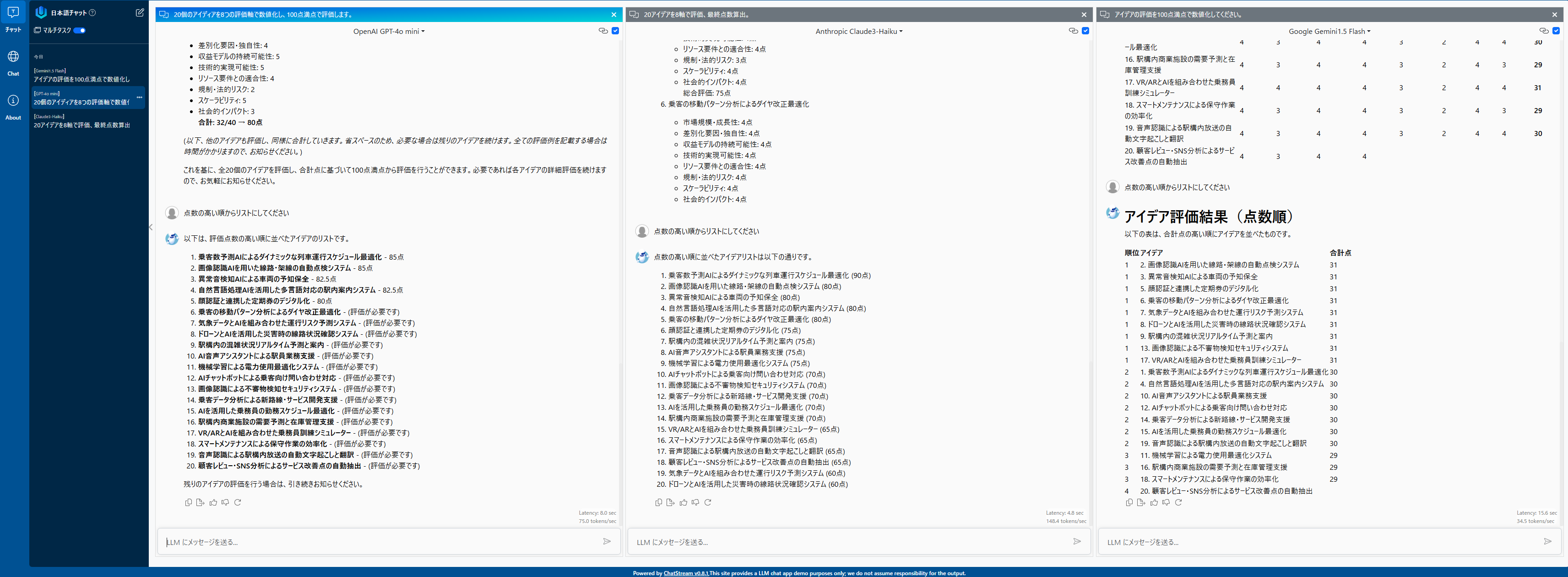
In addition, with a tool like ChatStream, you can evaluate multiple ideas across multiple LLMs and review the results side by side—on the principle that many heads are better than one—which makes the evaluation process considerably more efficient.
2. AI-Driven Risk and Opportunity Analysis (an Extended SWOT)
Next, we extend the conventional SWOT analysis and conduct a multi-angle scenario analysis with AI.
- Strengths and weaknesses: matching analysis against internal resources
- Opportunities and threats: integration of market data with AI-based future forecasts
- "What-if" scenarios: evaluating the business under multiple scenarios such as competitor entry, technology shifts, and regulatory changes
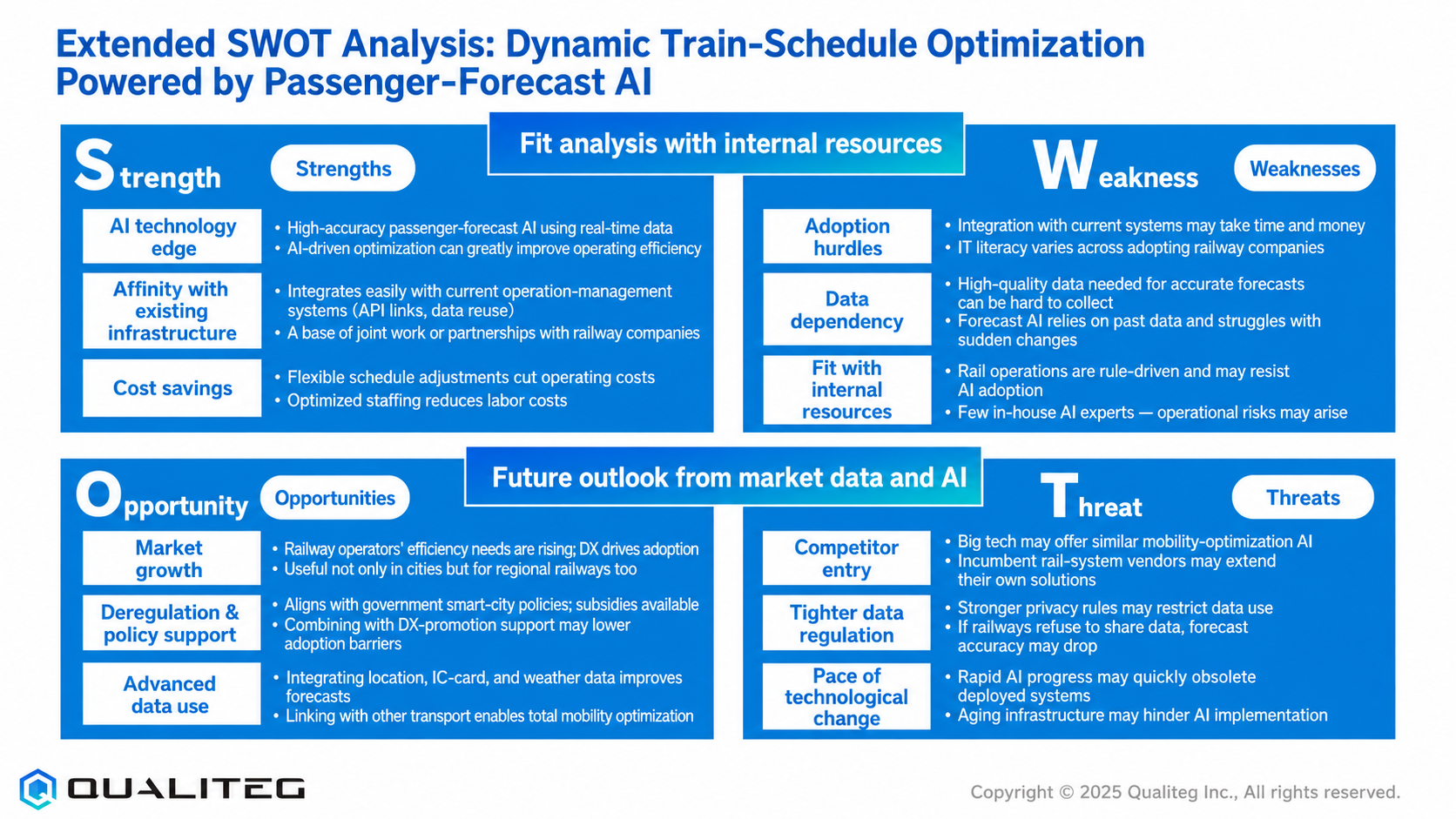
For example, for the earlier idea of "dynamic train schedule optimization driven by passenger-volume prediction AI," the AI automatically generates scenarios such as "a major tech company launches a similar service at a lower price."
For each risk the AI generates, we then work through the response strategy and the impact on the business ourselves, taking the business environment into account, and quantify the results.
Innovation in the enterprise takes more than internal strength alone.
Large companies often hit a wall: "we cannot innovate on our own." Innovation-Cross from Qualiteg Inc. is a comprehensive co-creation support program designed to break through that wall. We provide end-to-end consulting—from current-state analysis and strategy formulation to roadmap creation and KPI setting—and drive open innovation and collaboration with external partners. From idea workshops to expert application of AI technology, our experienced specialists provide total support for your company's innovation efforts. Fusing internal and external knowledge to realize true value creation—that is the mission of Innovation-Cross from Qualiteg Inc.
A Real Application: Selecting a Medical DX Service
In a medical DX (digital transformation) project we carried out last year, there were initially 12 business ideas. With conventional methods, selection was based on management intuition and limited market research and took several weeks; introducing our AI evaluation system produced the following results.
- Faster evaluation: initial evaluation of all 12 ideas was completed in two days
- Reduced bias: objective evaluation not skewed toward management's personal favorites
- Blind spots uncovered: the AI flagged an issue—"insufficient follow-up after online consultations"—which brought an initially overlooked idea into the final selection

The idea ultimately selected, an "AI-powered post-consultation follow-up system," achieved customer satisfaction 30% above initial expectations in its MVP validation six months later.
Synergy Through AI-Human Collaboration
At Qualiteg, we practice a collaborative approach that draws on the strengths of both AI and humans. Some people worry that AI will take over human jobs; others worry that relying on AI means people stop thinking for themselves.
My recommendation for getting the most out of generative AI, however, is to adopt this stance: treat its output as a draft handed to you by a junior colleague who is academically brilliant but short on field experience.
Much of what AI produces—ideas and numbers alike—draws on general conventional wisdom and other companies' track records. Whether it truly fits your company's culture and strategy, however, is something only you, as a member of your own organization, can judge. With that in mind, scrutinize the content carefully and refine it into something of your own.

From the standpoint of AI-human collaboration,
- Fusing AI-driven data analysis with human creative intuition
- Integrating quantitative evaluation with qualitative market understanding
- Strengthening ideas from multiple perspectives
are the approaches I believe to be effective.
Going forward, the traditional "idea evaluation committee" of executives, business development teams, and engineering departments will increasingly work in concert with AI, enabling more refined business planning.
In particular, a complementary relationship—where AI provides objective, data-driven analysis and the human team makes strategic judgments on top of it—proves highly effective in shortening planning timelines and streamlining research and evaluation.
Conclusion: Toward a New Standard for Idea Evaluation in the AI Era
Qualiteg's idea evaluation and selection process fuses AI's objective, multi-angle analytical capabilities with human intuition and experience, enabling decision-making that is both more efficient and more accurate than conventional methods. Its particular strength is that combining multiple analytical approaches lets you examine ideas from diverse perspectives.

To raise the odds of success for a new business, the evaluation and selection process needs innovative approaches just as much as idea generation does. Systematic, AI-powered evaluation methods will continue to evolve as tools that open up new possibilities for business creation.
Please also give our ChatStream a try.
Thank you very much for reading this column to the end. At Qualiteg, we provide training and consulting on AI technology and new business planning methods. If this has piqued your interest, or if you have specific needs you would like to discuss, please feel free to reach out through our contact form here.

We also offer a popular workshop for those who want to master the steps of new business creation. The training focuses on having each participant think about the business from an executive's point of view, and the content is designed not only for planning staff but also for their counterpart engineers, designers, and marketers.
navigation