[AI New Business Development] Qualiteg's Original Method for Designing Acceptance Evaluation Interviews

![[AI New Business Development] Qualiteg's Original Method for Designing Acceptance Evaluation Interviews](/content/images/size/w1200/2025/03/1.png)
Hello to everyone visiting the Qualiteg blog. I'm Michele. In my work on AI-driven new business development and marketing, there are questions I hear from clients again and again. Through this blog, I would like to share my own answers to the challenges that anyone considering an AI-based business is likely to face.
Acceptance evaluation interviews are a vital technique for assessing how a new product or service will be received by its target market.
In my new business development consulting, I meet all kinds of clients: some skip acceptance evaluation entirely, some cherry-pick only the answers that suit them, and some interview people who are not target users at all and then get upset at the results.
A particularly common pattern is the client who interviews multiple people but reports back only the ones who praised the planned service, claiming that "everyone says they want it." Another is interviewing insiders (colleagues at work) and pressing on with questions like "But it would be fine if we just did XX, right?" until they get a polite compliment.
Acceptance evaluation is a test you run in advance so that you do not fail badly when you later launch the commercial service. Negative opinions at this stage must be accepted honestly as valuable input for improvement. Designing this process effectively therefore requires a clear plan and strategy, so below I will walk through the steps for designing an effective acceptance evaluation interview. I hope you will read on.
Qualiteg offers Innovation-Cross, a co-creation support program designed to maximize a company's capacity for innovation.
We provide end-to-end support—from strategy formulation to execution—for creating new value by leveraging outstanding ideas and technologies from inside and outside your organization. Our strengths lie in precise strategy development grounded in current-state analysis and in practical support through a diverse service menu. With idea workshops, hackathon planning, and the use of cutting-edge AI technologies, our experienced consultants accelerate your innovation initiatives. We clarify the path to value creation through external collaboration and guide you to solid results.
1. Clarify Your Objectives
Before conducting acceptance evaluation interviews, it is essential to define specifically what you want to achieve. Clarify whether you want to learn how people react to a particular feature of the product or to assess overall market acceptance. The clearer the objective, the more specific and effective your interview questions will be.
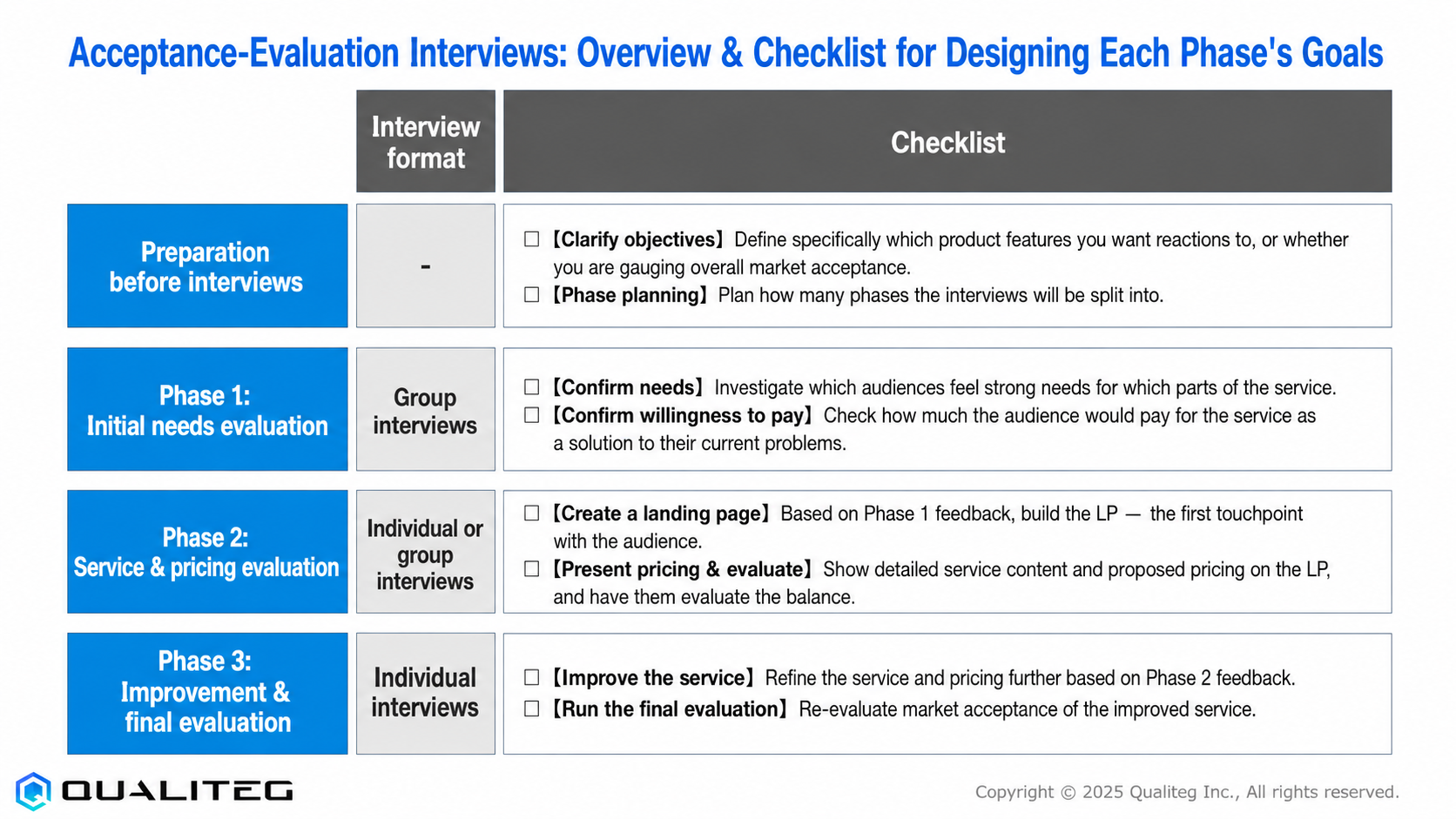
You also need to think about the big picture: how many phases of interviews you will run. Acceptance evaluation interviews are rarely a one-time exercise. The usual approach is iterative: refine the issues uncovered in this round, interview again as phase two, extract and refine the issues raised there, and interview again as phase three.
It is also very important to design the overall program—how many phases to run and what to verify in each. For example, in the early phase you might ask whether there seems to be a need and whether people would actually pay to use the service; in phase two you might build a landing page, show pricing, and iterate on the balance of service content, specifications, and price.
We have included a checklist here—please feel free to use it. The interview format listed starts with group interviews followed by individual ones, but please adjust as appropriate for your objectives, timeline, and budget.
2. Select Your Target Audience

Identify the specific market or customer segment your product or service is aimed at. Accurately understanding your target audience lets you collect more relevant data and improves the precision of your analysis.
Very often, clients end up interviewing people inside their own company—because the overall schedule has slipped, the questionnaire took too long to prepare, they do not want to pay incentives, they do not want to reveal the service to outsiders, or outsourcing to a research firm takes time. In my experience, roughly 60% of clients settle for interviewing internal colleagues.
But think about it: who is more loyal to your service—someone who knows nothing about your company or its services, or your own employees?
The vast majority of people who will actually buy your service are outside your company. It is best to interview external participants who will properly honor confidentiality obligations and who match the target users you have defined.
3. Decide on the Interview Format

Interviews can be conducted individually (one-on-one) or in groups (focus groups). Choose the most appropriate format based on the type and depth of information you want to collect. Individual interviews are well suited to obtaining specific, detailed information, while focus groups are effective for gathering a diversity of opinions.
Here is how I recommend combining the two formats. An individual interview typically requires about 60 to 90 minutes, and a session with five or six participants at once takes about 90 to 120 minutes.
It is quite common to reserve a full hour with someone only to find that the appeal of the service does not resonate with them at all. So I recommend first running about three focus group sessions with five or six participants each—lightly interviewing 15 to 18 people in total.
With that many people, trends start to emerge: what kinds of people are interested in your service, and, within that, which segments might pay how much for which use cases. Also check whether participants use similar or competing services.
Once the general trends are visible, individual interviews let you dig deeper. If you run about six individual interviews in total, choose four or five participants who responded positively.
In addition, interview one or two heavy users of competing services who were not particularly positive about yours. This reveals your weaknesses before launch, and it is important to learn what improvements would make them want to switch to your service.
4. Design the Questions

Prepare specific, clear questions aligned with the objectives of the interview.
A good way to start is to draft an outline using an LLM such as ChatGPT.
As a consultant I am all about saving time, and comparing answers across many different LLMs feels like time wasted, so I use our ownChatStream—and I can highly recommend it!
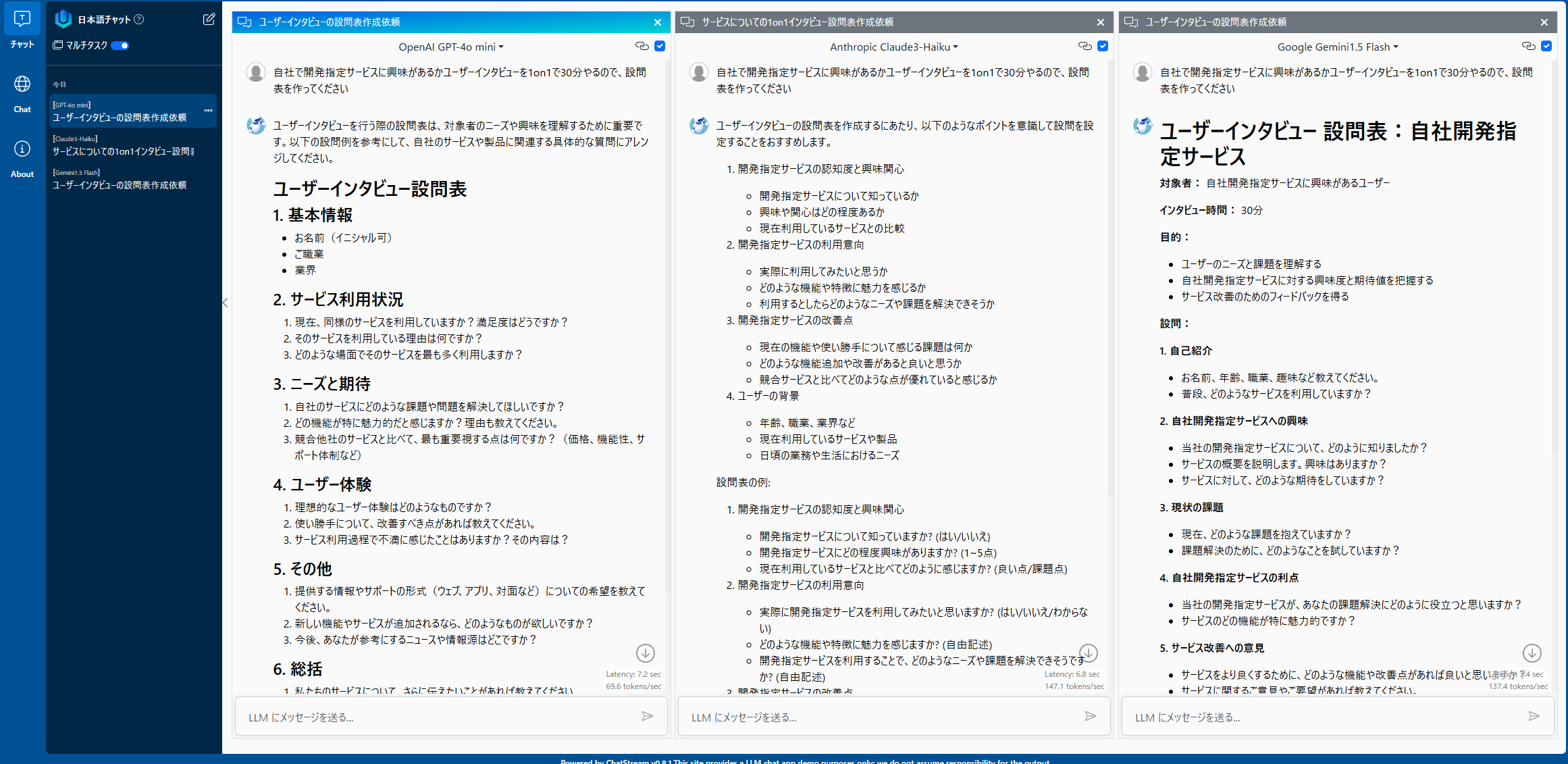
Each model thinks through the problem and produces its own answer, so pick out the parts you like and build your question sheet from them.
In the introduction to your questions, briefly explain the product or service. It is also important to use neutral, non-leading wording. Favor open-ended questions to encourage participants to give broad, expansive answers.
Many people prepare 30 questions for an interview slot of only 30 minutes. As the interviewer, I understand the urge to ask a lot, but what you really need to hear is not just the answer—it is the background behind it, the reason the person answered that way. That is why I recommend budgeting five to seven minutes of response time per question.
Prompts such as "Why is that?", "What led you to feel that way?", and "Could you share a specific experience of your own?" can keep the conversation going for a good five minutes even after a short answer. Do give it a try.
5. Run a Pilot Test
Test an early version of the interview with a small group to evaluate how well the questions are understood and how smoothly the session flows. This lets you make any necessary corrections.
For a pilot test in the sense of interview practice, it is fine to use people from inside your company. However, colleagues on the same project or in the same department often know too much to be useful practice partners, so I recommend piloting with people from other departments or from back-office functions.
You can also use AI and run the test against an LLM. Using a voice-enabled version and giving it a persona before interviewing it is good moderator training as well, and I recommend it.
6. Collect and Analyze the Data

Many clients are worn out just from conducting the full round of interviews, but interviews are only information gathering—what matters is how you analyze that information.
Extract useful insights from the data you have collected. For group interviews, a common approach is a spreadsheet with the questions in columns, the five participants' names in rows, and notes filled into the cells.
For individual interviews, notes are often taken in a document such as Word.
Then write every keyword that came up onto sticky notes (an online tool is fine), and once everything is written out, group related items together and analyze them.
Feeding the interview video into AI transcription software to turn it into text, or feeding the transcript straight into an LLM to extract keywords, saves a great deal of time.
For grouping, it is fine to discuss as a team—"this one belongs in this category"—but you can also ask an LLM to read the words and group them for you.
There is one rule I ask you to follow absolutely: do not use what the AI produces as-is!
Use the AI's output as a base for discussion and your own thinking, and organize the information while recalling the nuances that only you, who were there in the room, can bring. This is not just about tidying the data—setting aside dedicated time after the sessions helps you revisit the interviews and organize your own thinking.
Many clients try to report a clipped fragment of one participant's favorable comment after the interviews. One person's positive opinion matters, but the data should also be used to see the overall picture and the trends. Do grasp the whole. It will not hurt to have it in hand when the business owner questions you later.
7. Report and Apply the Results

Organize the information you have collected and prepare a report for stakeholders.
The report matters, but for project members who are not the reporting audience—developers, designers, and so on—I recommend having them join the interviews or watch the full recordings.
Anything summarized by someone else inevitably carries that person's perspective, interpretation, and intent. To let team members experience the material flat and unfiltered, and to help them take ownership of it, having them participate is the better option.
In my experience, when engineers, designers, and other stakeholders all sit in on the interviews together—rather than the planner alone reporting the findings back to the project—the sense of personal ownership across the team is much stronger. That makes later alignment and team building toward commercialization much easier, so I recommend it.
For reports to senior executives, on the other hand, you cannot ask them to watch every video, so you will present an executive summary as a digest. In that case, it works well to structure the report around the gap between your initial hypotheses and the results, why participants answered the way they did, and the users' own voices.
One thing that is easy to forget is sharing the interviewees' context and basic profile information. If you add related information—what backgrounds the interviewees had, and why that explains the answers you received—you will have assembled material that allows the business owner to make a properly informed decision.
Thank you very much for reading this column to the end. At Qualiteg, we provide training and consulting on AI technology and on methods for planning new businesses. If this has caught your interest, or if you have specific needs, please feel free to contact usherevia our inquiry form.

We also run a popular workshop for those who want to master the steps of new business creation. The training focuses on having each participant think about the business from an executive's point of view, and the content is designed not only for planners but also for their counterparts—engineers, designers, and marketers.
navigation