From a Nation That Builds AI to a Nation That Wins with AI — Redesigning Japan's AI Investment Strategy (Part 2)

— Where to take position in the age of the SaaS shake-up
Hello! This is Qualiteg Consulting!
Over the past few years, we have seen a steady increase in consultations and discussions on the theme of "Japan's AI strategy."
Since the arrival of generative AI, everyone from executives to front-line engineers has been searching, each from their own vantage point, for answers to "where should our company place its bets?" and "which way should the country go?"
In this series, we wanted to sit down with that question properly, so we wrote it as a two-part piece.
Part 1 examined three themes — domestic LLMs, data center investment, and data sovereignty — and the possibility that Japan's AI investment is not necessarily heading toward a "win by being used" structure. Lining up the total investment figures and the players' moves reveals our current position: a subtle mismatch between the direction of the rallying cry and where the money actually flows.
In Part 2, we take that premise and widen the lens to the software industry as a whole. If AI changes the rules of competition in the application layer itself, then where Japan should place its bets must change too. Let's survey the tectonic shifts underway in the global SaaS industry, and then think together about where Japan should take position.
Chapter 5: What is happening in the software industry
The software stock plunge — what got priced in?
From late January 2026 onward, a large-scale sell-off swept through North American software and data stocks.According to Reuters, the S&P 500 software and services index fell sharply, with the sector shedding close to $1 trillion (roughly 150 trillion yen) in market capitalization. The IGV ETF, which tracks North American software names, recorded a year-to-date decline of around 20%, and sector valuations compressed to levels not seen since the mid-2010s.
The reported backdrop was a resurgence of the view that generative AI could erode the revenue structure of the application layer. Not a macroeconomic shock, not an isolated scandal — what accelerated the selling was wariness about structural change in the software industry itself.
Three distinctions are worth keeping straight here.
First, the market has begun to price this in. Outside a handful of large names, SaaS revenue multiples have been pushed to punishing levels, and a bifurcation is underway in which the winners pull up the average. VC investment, after roughly halving from its 2021 peak, has plateaued, while deal counts have dropped sharply — a clear picture of "large sums concentrating in a few promising companies while the rest dry up."
Second, whether reality moves that fast remains unconfirmed. Short-term stock prices are prone to swinging on narratives. Whether this valuation adjustment is structural or temporary is something we will have to watch unfold.
Third, what matters is not that the future is settled, but that a change in the conditions of competition has begun to be widely recognized. As discussed below, the assumptions of SaaS are being shaken along multiple dimensions: pricing models, UI, and vertical integration.

What "SaaS is Dead" actually means
In late 2024, remarks by the CEO of a major tech company were summarized as "SaaS is dead" and spread widely.IDC has published an analysis organizing this theme. Of course, SaaS companies will not vanish overnight. But the change this phrase symbolizes runs deep.
Pressure to change the business model. IDC's FutureScape predictions hold that by 2028, 70% of software vendors will face pressure to migrate from seat-based (per-user) pricing to consumption-based or outcome-based pricing (see also this CIO.com explainer).
Why? Seat-based pricing sets the price by "how many people use the software." But once AI agents start processing tasks in place of humans, the question "how many people use it?" loses explanatory power. So the basis of pricing may shift toward "how much was processed" (consumption) or "how much was achieved" (outcomes).
For SaaS companies, this is not a mere price revision — it forces a fundamental restructuring of the revenue model. The appeal of seat-based pricing was predictability: user count times monthly price gives you next month's revenue with considerable accuracy. Outcome-based pricing makes revenue far more variable, shaking the "predictable recurring revenue" that was SaaS's greatest charm. That predictability was one of the main reasons investors awarded SaaS names high multiples — so if it goes away, a structural decline in valuations is understandable.
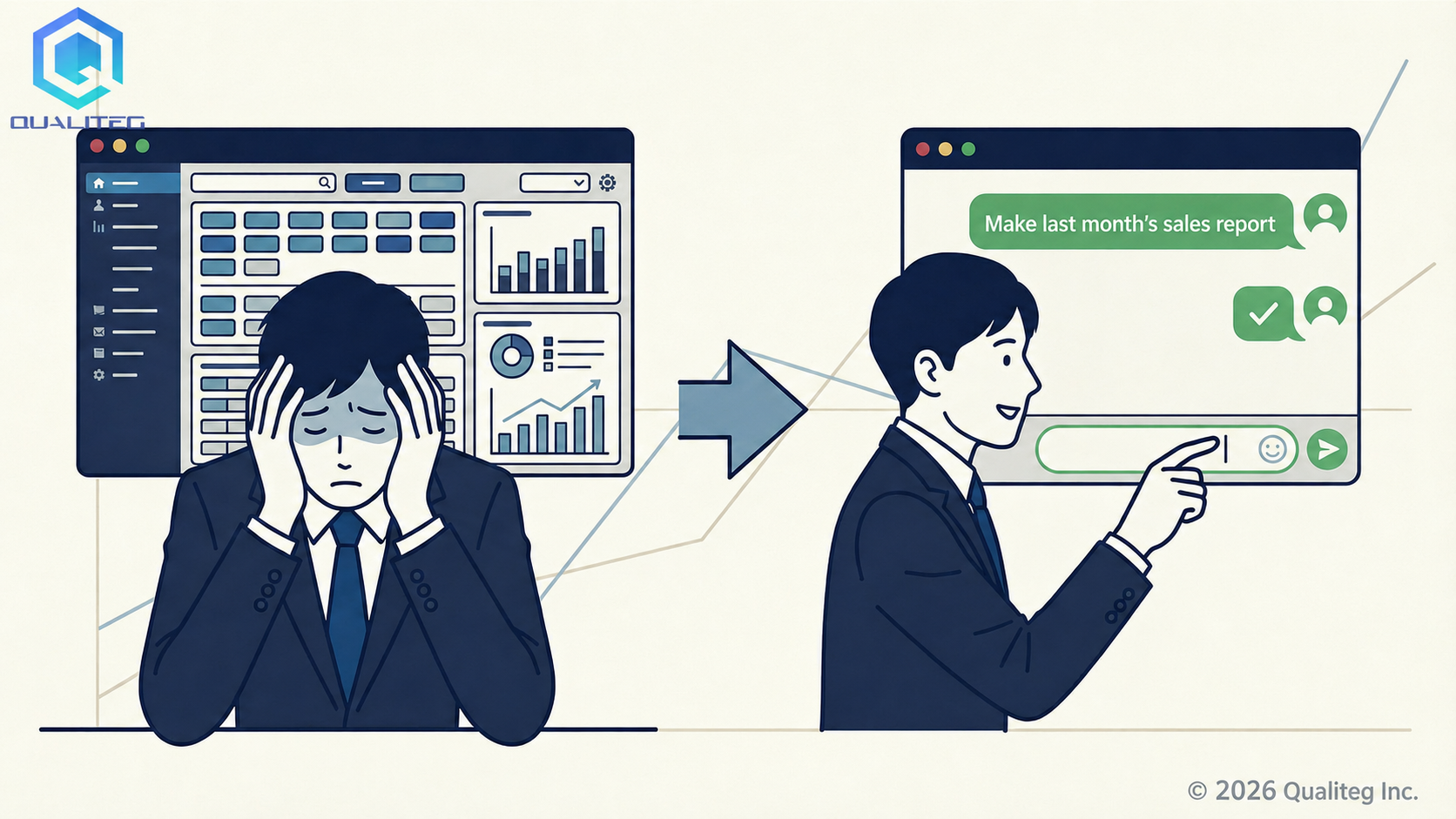
The thinning of the interface "moat." A view spreading through the industry holds that "the fact that millions of people memorized a SaaS UI was itself the biggest moat — and the moment the interface becomes natural language, that moat disappears."
Think about it. A substantial part of Salesforce's competitive advantage derives from the fact that millions of salespeople know how to use Salesforce. Switch to another CRM, and everyone has to relearn a new UI. That "learning cost" has functioned as a de facto switching cost.
But as the interface shifts toward natural-language instructions, UI-derived differences in user experience tend to shrink. If the cost of learning the UI falls, so does the cost of switching. Barriers to entry built over years could be nullified. Whether this comes to pass is still unknown — but the market beginning to price in that possibility in earnest is a fair reading of the moves in early 2026.
Foundation-model companies have come down into the app layer
There is another development we cannot overlook.
Through 2024 and the first half of 2025, the dominant narrative was "AI strengthens existing SaaS." Every software company told earnings calls about "productivity gains from embedded AI," and investors liked what they heard. But from late 2025 into 2026, that narrative quietly flipped.
Several factors are cited behind the turn. AI-agent startups began shipping genuinely practical products. Open-source models — DeepSeek chief among them — demonstrated that competitive performance can be achieved even at low cost (Reuters: A year on from DeepSeek shock). And the decisive factor: foundation-model companies themselves began advancing into the application layer.
OpenAI offers GPTs and Canvas. Anthropic has rolled out application-layer products one after another: Artifacts, Computer Use, MCP, Claude Code. Desktop agents for non-engineers — tools that autonomously operate browsers, drive Excel, and manage files — have appeared as well.
Why does this happen? Because a business built on foundation models alone is hard to differentiate. Performance gaps between models narrow over time, and price competition looms. So the play is to build high-value application layers on top of the model and burrow deep into users' workflows to create switching costs.
Call it "the temptation of vertical integration" — a pattern the tech industry has repeated many times. Chipmakers build operating systems, OS makers build apps, app makers build clouds. You could say the same thing is simply happening in AI.
For players whose plan was "foreign foundation models are fine — our job is to build apps on top," this is an uncomfortable situation. They intended to add value in the upper layer, and now they are being eroded from below.
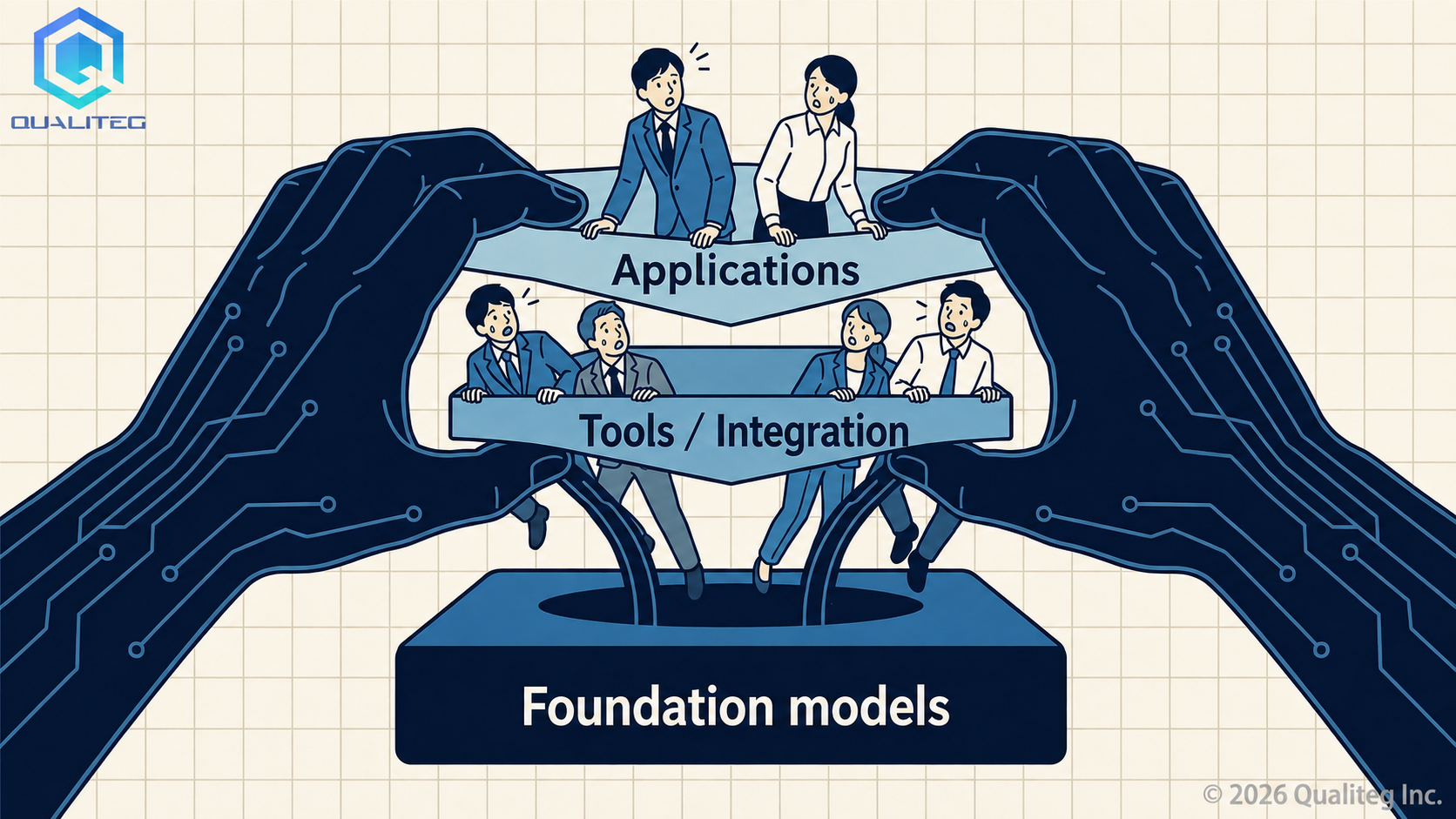
So where, in this environment, are the defensible positions?
Chapter 6: Where are the structurally defensible positions?
Look for domains where AI vendors doing it themselves creates conflicts of interest
However far foundation-model companies evolve, there are domains where the vendor doing it itself readily creates a conflict of interest — because for certain services, not belonging to any particular AI vendor is the essential value.
Survey the market through that lens, and several candidate areas emerge where independent players may have an opening.
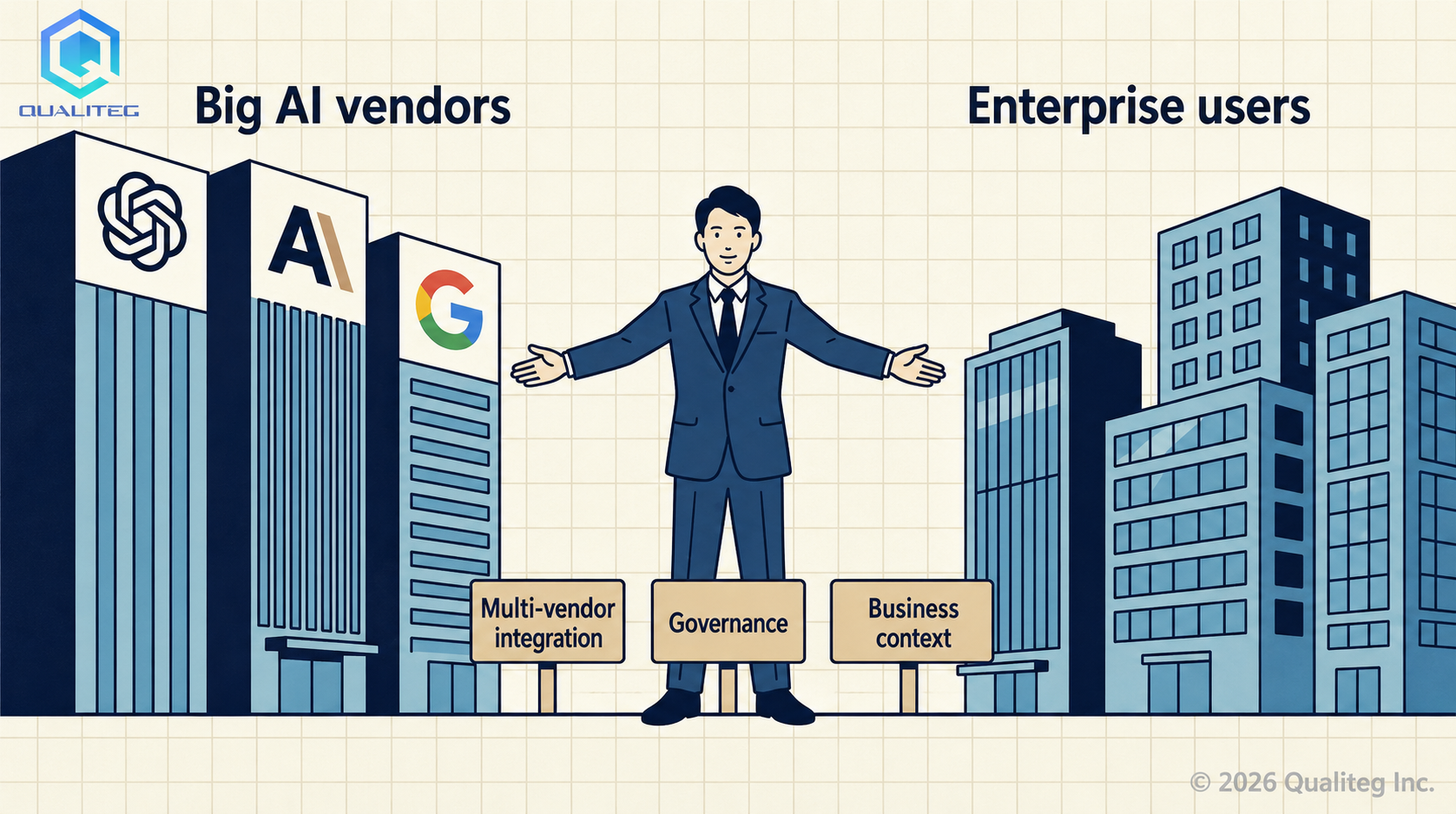
Multi-vendor integration. OpenAI will not recommend Anthropic's models, and Google will not help you use OpenAI alongside its own. Yet for companies, it is often more rational to pick the best model for each task. What's more, in the LLM world the leading model for each use case changes fairly often. Coding, long-context processing, reasoning, multilingual support — the best model differs along each axis, and the leaderboard being redrawn within months is not unusual.
Suppose a company uses model A for legal document review, model B for internal knowledge search, and model C for code generation. A foundation that lets it swap models without touching the application layer reduces vendor lock-in risk. Precisely because each AI giant has a conflict of interest here, this kind of vendor-neutral integration layer holds structural room for independent players.
Data control and governance. This connects directly to the data-sovereignty discussion in Part 1. Entrusting the monitoring of an LLM's inputs and outputs to the very company that provides the LLM is like asking someone to be both referee and player.
Especially in heavily regulated sectors — finance, healthcare, government — there will be durable demand for mechanisms that allow independent verification that input and output data are properly controlled, whichever LLM is in use. Concretely: mechanisms that mask sensitive information before it reaches the LLM, and model-agnostic audit logging. This is fundamentally different in conception from "protect the data by using a domestic model." It controls the flow of the data itself, not the nationality of the model — a security layer that sits outside the model.
Connection to business context. However smart general-purpose AI agents become, they do not know an individual company's approval workflows, internal rules, or industry-specific regulations. "Expenditures over 10 million yen need a department head's approval; over 50 million, an executive's." "This ad copy must be checked against pharmaceutical-advertising regulations." Business context like this varies endlessly by company and by industry.
Ask an AI agent to "review this contract," and it will do the legal checks quite accurately. But judgments like "how does this clause sit against our past dealing practices?" or "given the power balance with this counterparty, how hard can we push?" require deep knowledge of that company's context. Approval rules, signing authority, past internal decisions — designing how these constraints are fed to the agent is the "last mile" that only players with deep operational understanding can fill.
What these three have in common is that each can only be provided by standing on the side of the companies that use AI, not on the side of the AI vendors. The further the AI giants advance, the more the value of the position "standing between the AI giants and the enterprise" — rather than "substituting for the AI giants" — may actually rise.
Of course, no one can say this is certainly right. AI vendors might cover these domains themselves, or enterprises might settle into operating patterns that need no such intermediate layer. But at least on the structure visible today, it is a direction worth serious consideration.
The restructuring pressure on the SaaS model — and what comes after
Let's take the "SaaS is Dead" argument one step further.
Suppose the current SaaS model does contract substantially — what comes next? Several scenarios suggest themselves.
One is "AI agents executing tasks directly." Instead of users operating software, they tell an AI agent the goal, and the agent combines various tools and data sources to return a result. In this case, the traditional SaaS "screen" becomes unnecessary, and APIs and data pipelines grow in importance instead.
Another is "consolidation into platforms" — a world where every business tool rides as a plugin on platforms operated by a handful of AI giants.
In either scenario, what matters is the distinctiveness of your data and workflows. However smart AI becomes, a company's proprietary data and business processes are invisible from outside. Players who hold access to that data and those processes get to stand on the receiving end of AI's progress. Conversely, SaaS companies that merely provide generic functionality, with no proprietary data or workflows, face a high risk of being displaced by AI agents.
Chapter 7: Where does Japan's path to winning lie?
Is "we can't build it" really a weakness?
As Part 1 showed, with capital differing by orders of magnitude, it is realistically difficult for Japan to beat the U.S. and China in the foundation-model development race. But is "not being able to build it" a fatal weakness? Perhaps not.
It is an oft-cited story, but the Toyota Production System changed the world's auto industry not by overwhelming rivals with engine performance, but by differentiating on the design of how the same engines were used — production processes, quality control, supply chains. Through production-system design like "just-in-time" and "kaizen," it extracted overwhelmingly higher quality and efficiency from the same parts. Cars and AI differ in many conditions, so easy analogies deserve caution. But the underlying frame — that "the competition to build the tool" and "the competition over what to solve with the tool" are different things — is instructive. In semiconductor history, too, Japan was overtaken by South Korean and Taiwanese players in chip manufacturing, yet still holds high market share in manufacturing equipment and materials.
If a similar positioning is possible in AI, it may lie not in "building models" but in building the foundations and tools for mastering them.
The possibility of becoming an "AI use-case pioneer"
It is often said that Japan has an abundance of problems AI ought to solve. A hyper-aging society and labor shortage. Quality control and automation in manufacturing. Efficiency in healthcare and elder care. Safety management in construction. Logistics optimization. Digitization of government. Areas like anomaly detection and work-standard verification on factory floors, record-keeping and care planning in elder-care settings, and safety-document checks and regulation matching on construction sites are domains where implementation know-how is likely to accumulate in Japan first.
These workplaces also hold decades of accumulated data and know-how, along with an urgent motive: "we are short-staffed, so we have no choice but to adopt AI." Not "we'd like to try AI" but "operations will not run without AI" — that level of urgency.
The severity of the shrinking workforce stands out when you look at the population projections from the National Institute of Population and Social Security Research (2023 estimates). The working-age population is projected to fall substantially over the next 20 years — with a range depending on the assumptions, but on the order of tens of millions. That means society cannot function without raising productivity, and as an incentive for AI adoption it could hardly be stronger.
Japan's advantage may lie not on the model-supply side but on the implementation side — running AI in constraint-heavy, real-world settings. That said, having problems and having the capability to solve them with AI are different things. An abundance of problems with insufficient implementation capability is treasure left to rot.
What does building implementation capability require? First, people who can design AI adoption — who understand how models work and can architect their integration with business processes. Next, a foundation for using LLMs safely across multiple vendors. Then mechanisms for data control and governance, and the sharing and horizontal rollout of success patterns. Which is exactly why investment priorities are in question: allocate budget to homegrown foundation-model development, or to "a foundation that can master any model" and the people to run it? Which yields more per yen spent is a question well worth thinking through.
Exporting the way of using it
Aging and labor shortage are challenges that will surface rapidly across all of Asia. South Korea, China, Thailand, Vietnam — each will face demographic structures resembling Japan's within 20 to 30 years. If Japan can accumulate AI implementation know-how now, that know-how itself becomes an exportable intellectual asset.
Foreign-built models, Japanese-style usage. Packaging "Japanese-style AI utilization" is, at the very least, a scenario worth considering.
How to weave AI into manufacturing quality control. How to optimize elder-care operations with AI. How to strengthen construction-site safety with AI. Domain-specific implementation know-how like this does not arise from merely owning a foundation model. It requires field data, operational knowledge, and the design capability to connect them to AI.
This is not an argument to "abandon foundation models entirely." There are domains, such as defense and intelligence, where domestic models are indispensable, and continued R&D has value of its own. Experience developing a 100B-parameter model deepens understanding of how models work internally, which feeds back into skills on the usage side. But the debate over where to place the center of gravity in resource allocation deserves far more airtime.
Chapter 8: In closing
Across these two installments, we have written some fairly blunt things.
The revenue structure of domestic LLMs. The contradiction between SIers' layered subcontracting and person-month billing. The reality of data center demand and GPU demand that "never becomes a surface." The order-of-magnitude gap with U.S. investment. The leaps in the data-sovereignty debate. The tectonic shifts in SaaS and the massive market-cap correction. Foundation-model companies advancing into the app layer.
Not all of it was comfortable reading, perhaps.
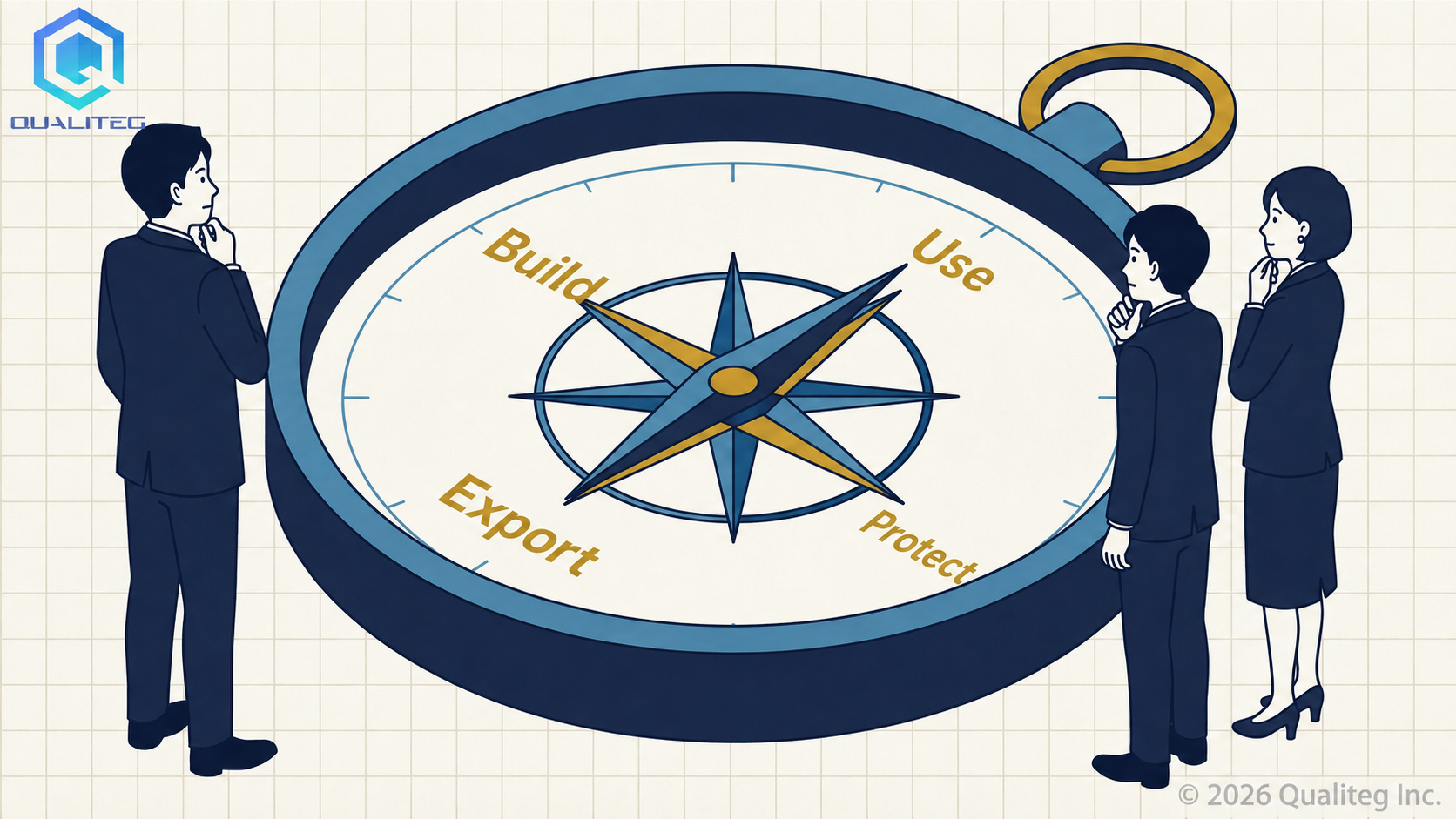
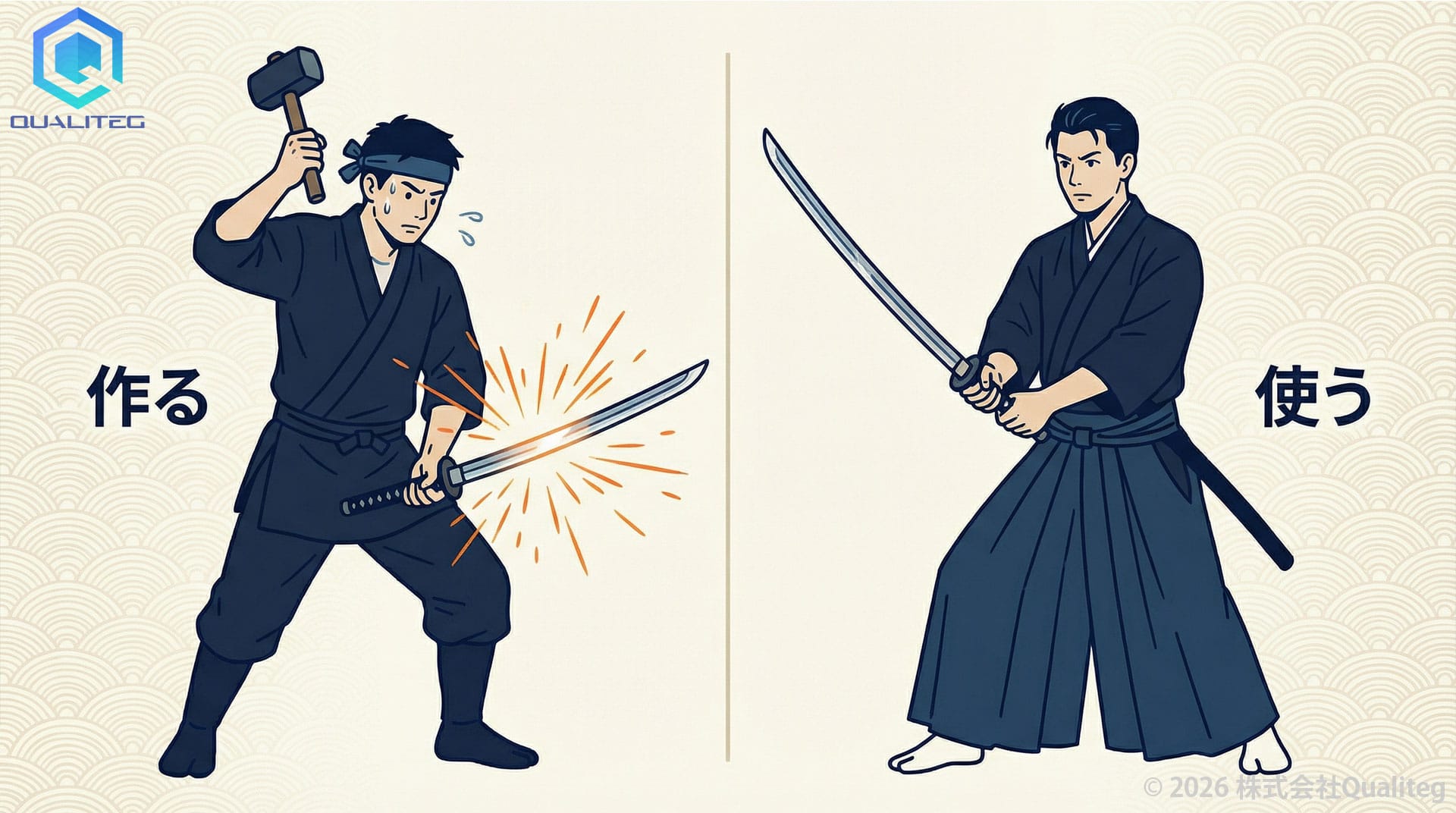
But look at it another way: Japan has the problems, the data, and the front lines. In the contest of forging swords, the odds may be against us — but as a wielder of swords, there is still plenty we can do.
Sharpen the ability to wield, or insist on the ability to forge? That choice, we suspect, will matter a great deal over the next several years.
From the structures traced across these two articles, if there is one set of things a company should consider first, it is this: avoid designs premised on a single model; put business design and a governance framework in place before model selection; and invest more heavily in a foundation that can master any model — and the people to run it — than in developing models of your own. We do not claim this is the only right answer, but it deserves a place on the table.

The three focal points presented here — multi-vendor integration, data control and governance, and connection to business context — are, in our view, unavoidable strategic essentials for companies seeking to convert AI into durable competitive advantage amid a structural shift in which foundation-model evolution and application-layer restructuring advance in parallel.
Since our founding, Qualiteg has engaged this question consistently from both sides — advanced AI R&D and business implementation — supporting clients' decision-making with technology and strategy working in tandem.
In-house, we develop and operate an enterprise LLM platform that makes more than 20 LLMs switchable from a single foundation, Bestllam®; a solution that audits LLM inputs and outputs to detect and block data leakage, LLM-Audit™; and a technology that detects and anonymizes sensitive information at high speed and precision, PII-Fi™. Each was designed as a foundation we can provide precisely because we stand independent, belonging to no particular AI vendor.
At the same time, team members with experience in business development and technology strategy at global consulting firms and multinational companies deliver business consulting and AI technology consulting — covering everything from strategy formulation through technical validation, implementation, and adoption on the ground. By seating engineers at the table from the strategy-drawing stage, we aim for grounded designs that hold technical feasibility and business rationality together.
How do you put AI to work in your business? For every company wrestling with that question, we would be glad to work alongside you on both the strategy and the technology.
If you would like to talk or set up a discussion, please feel free to reach out via our contact form.