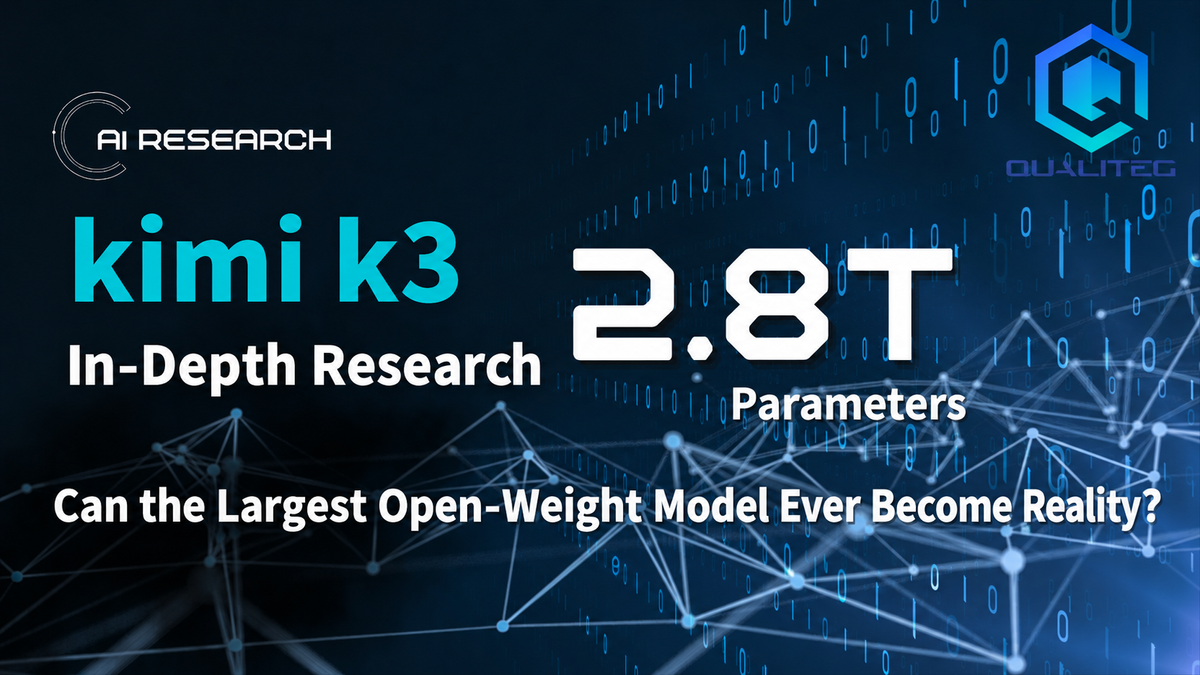
Kimi K3 Deep Dive — 2.8T Parameters: Will the "Largest Open Weights in History" Materialize?

Hello!
On July 16, 2026, Moonshot AI of Beijing, China announced its new flagship model Kimi K3 and began offering it via its API and web services.
The sheer scale of 2.8 trillion total parameters, a 1-million-token context, and the declaration that
"it will become the largest open-weight model in history"
have set the AI community abuzz.
In our article this past May, "When Will a Mythos-Level Open Model Arrive?," we predicted when open models would catch up to the closed frontier.
Kimi K3 is one of the latest "answers" to that very question as of today.
On the other hand, as of July 20 — the day this article is being written — neither the model weights nor the technical report has been released yet。
That said, on X and other corners of social media, comments such as
"the guardrails are on the loose side — it handles prompts that Fable 5 would refuse"
and "it's easier to work with than Fable 5, which falls back to Opus 4.8 at the drop of a hat"
can be spotted here and there; against
the strong-guardrail policy of US-made models, a Chinese-made model with weaker guardrails may just hold the hidden potential to ultimately win users over.
That said, in this article we'll set aside the social-media chatter and instead cross-check primary sources (Moonshot's official blog, official API documentation, GitHub) against English-language press coverage and analyses from independent evaluation organizations, sorting out the full picture of Kimi K3 while distinguishing "officially announced," "independently evaluated," and "unconfirmed."
Part 1: What Is Kimi K3?
How the Release Unfolded
Kimi K3 was announced on July 16, 2026, and became available through the following channels the same day.
- Kimi.com(chat UI)
- Kimi Work(workspace product)
- Kimi Code(coding agent)
- Kimi API(OpenAI SDK compatible)
It was also added to the third-party API aggregator OpenRouter the same day — an API-first launch in the style of "make it available via API and web first, weights later."
The official blog explicitly states, "we will make the full model weights public by July 27, 2026 at the latest," and explains that the delay is "to ensure a smooth rollout with our inference partners."
Quick Reference: Basic Specs
| Item | Details | Confidence |
|---|---|---|
| Total parameters | 2.8 trillion (MoE) | Official announcement (weights unreleased, so internal configuration cannot be independently verified) |
| MoE configuration | 16 of 896 experts activated (approx. 1.8%) | Official announcement |
| Active parameters | Some analyses put it at ~50B (A50B) | Unconfirmed (not officially disclosed) |
| Context length | 1 million tokens | Official announcement and API documentation |
| Multimodal | Native vision (image and video understanding) | Official announcement plus third-party hands-on verification |
| Thinking mode | Always on. Currently 'max' only on the official Kimi API; low/high/max selectable in Kimi Code | Official documentation |
| New mechanisms | Kimi Delta Attention (KDA) / Attention Residuals (AttnRes) | Official announcement (efficiency figures are vendor claims) |
| Quantization | MXFP4 weights / MXFP8 activations | Official announcement |
| API pricing | $3.00 input / $15.00 output (per million tokens) | Official pricing page |
| Weight release | Scheduled by July 27, 2026. Distribution file format unconfirmed (awaiting the model card) | Official commitment (unreleased as of 7/20) |
| License | Reported as "Modified MIT" | Unconfirmed (no primary source) |
Part 2: Architecture — An Extremely "Sparse" 2.8 Trillion Parameters
An MoE That Uses Only 16 Experts out of 896
Kimi K3 is a sparse MoE (Mixture of Experts) model built on a framework Moonshot calls "Stable LatentMoE." What stands out is its low activation rate: of the 896 experts, only 16 (about 1.8%) are activated per token.
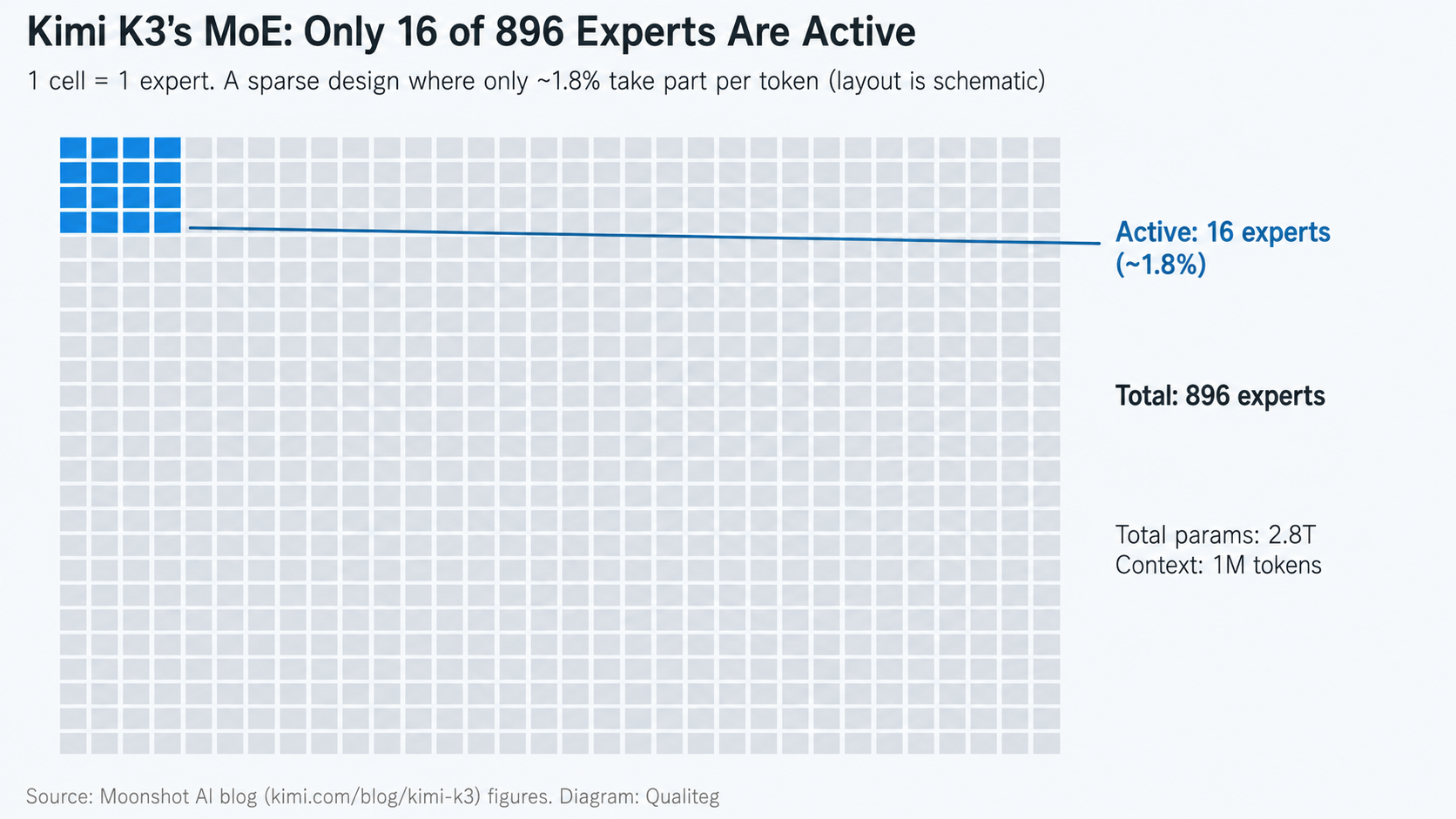
The 2.8-trillion total parameter figure is rounded up in marketing as "the world's first open 3T-class model," but only a small fraction of it actually runs at inference time.
This
"open only the shelves you need in a vast warehouse of knowledge"
design aims to reconcile scale with inference cost.
Note that Latent.Space describes the active parameter count per token as "A50B" (roughly 50 billion), but Moonshot has not stated it officially, so this number is unconfirmed. Once the weights are released, it may become verifiable from the config files or model card.
Two Homegrown Innovations: KDA and AttnRes
The architectural highlights are two new mechanisms Moonshot developed in-house.
- Kimi Delta Attention (KDA)
A hybrid linear attention mechanism, claimed to deliver up to 6.3x faster decoding at 1-million-token-class context lengths - Attention Residuals (AttnRes)
A mechanism that replaces conventional residual connections. Roughly 25% better training efficiency at under 2% additional cost is the claim.
Both are intriguing numbers, but at this point they are vendor claims originating from official announcements on X; with no technical report published, no third party has reproduced them.
Native Vision and an Always-On Thinking Mode
K3 is a natively multimodal model that handles text, images, and video.
On the vision side, noted AI blogger Simon Willison actually tested it and confirmed "Vision works well" — one of the few independent, hands-on data points. In his single test he also observed the thinking mode consuming 13,241 reasoning tokens (one example, not a typical value for the model in general).
The thinking mode is always on, and the reasoning_effort you can specify on the official Kimi API is currently limited to 'max'. Kimi Code, on the other hand, officially offers a choice of low/high/max — worth remembering that the options differ by channel.
Part 3: Benchmarks — Read "Self-Reported" and "Independent" Separately
When reading Kimi K3's benchmark numbers, the most important thing is distinguishing which figures are Moonshot's self-reported ones and which come from independent evaluations.
For independent comparative evaluations we have Arena.AI (blind voting) and Artificial Analysis (an evaluation organization); separately, Simon Willison has published an API hands-on.
Independent Evaluation #1: First Place in the Frontend Code Arena
This one was perhaps the biggest surprise.
In Arena.AI's Frontend Code Arena, which is decided by blind user voting, Kimi K3 took first place with 1,679 points as of the announcement (July 16).
That score surpasses even Claude Fable 5, and from the previous-generation Kimi K2.6's 18th place it shot up 17 ranks in one leap. Because it is blind voting, self-report bias is unlikely to creep in, though noise from early vote counts and prompt skew remains. Even so, it is one of the strongest external signals to date of the model's frontend generation capability.
Independent Evaluation #2: Artificial Analysis — "Opus 4.8 / GPT-5.5 Class"
On evaluation firm Artificial Analysis's Intelligence Index it scores 57, which — to borrow the firm's own phrasing — positions it as "comparable to Claude Opus 4.8 and GPT-5.5,
but not reaching Claude Fable 5 or GPT-5.6 Sol."
On the same firm's GDPval-AA v2 (an Elo evaluation on real-world work tasks), it also ranks third, right behind the two frontier leaders.
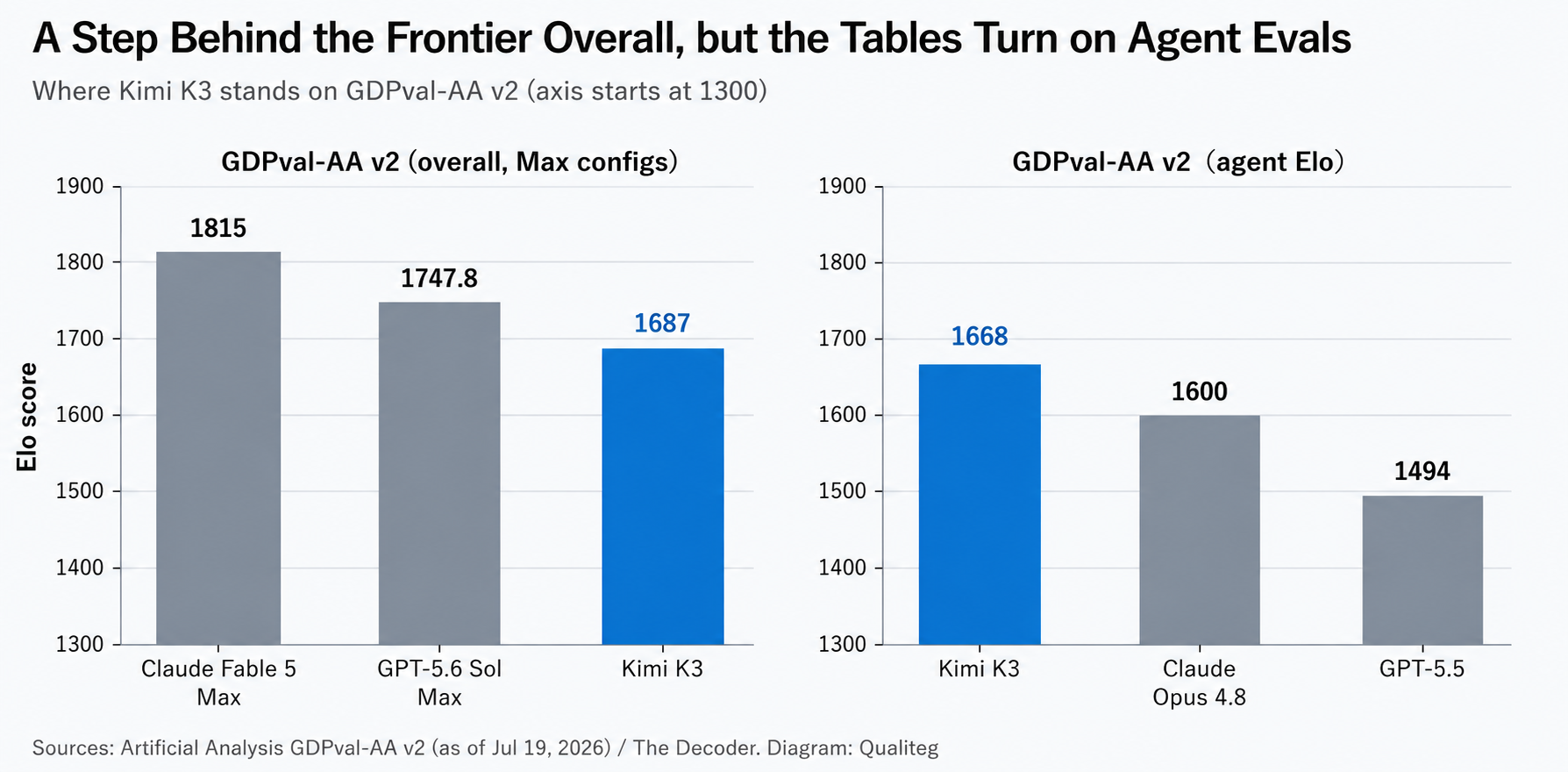
What deserves attention here is the agentic Elo in the right panel.
On GDPval-AA v2's agentic Elo, K3 (1,668) beats Claude Opus 4.8 (1,600) and GPT-5.5 (1,494) according to reports (The Decoder and others), which is consistent with Moonshot's own claim that it "trails Fable 5 / GPT-5.6 Sol overall, but surpasses Opus 4.8 / GPT-5.5 in coding and agentic work."
That said, not every independent evaluation is positive.
On Artificial Analysis's AA-Omniscience, while accuracy improved from K2.6's 33% to 46%, the hallucination rate rose from 39% to 51%, the firm reports.
Gains in knowledge and reasoning do not automatically translate into more cautious or more factual answers — a point worth remembering as input for enterprise adoption decisions.
Also, in the analysis Artificial Analysis published on July 17, Kimi K3 placed just behind Fable 5 on the firm's private agentic evaluation AA-Briefcase as well, at second place (Elo 1,547).
We use the 1,547 that the evaluator itself published in its analysis, rather than the 1,527 reported by VentureBeat (Elo is recomputed dynamically, so it drifts somewhat over time).
Position in Aggregate Rankings (For Reference)
On the benchmark aggregator BenchLM.ai, it sat in 4th place with an overall score of 80.96 as of our July 19 survey.
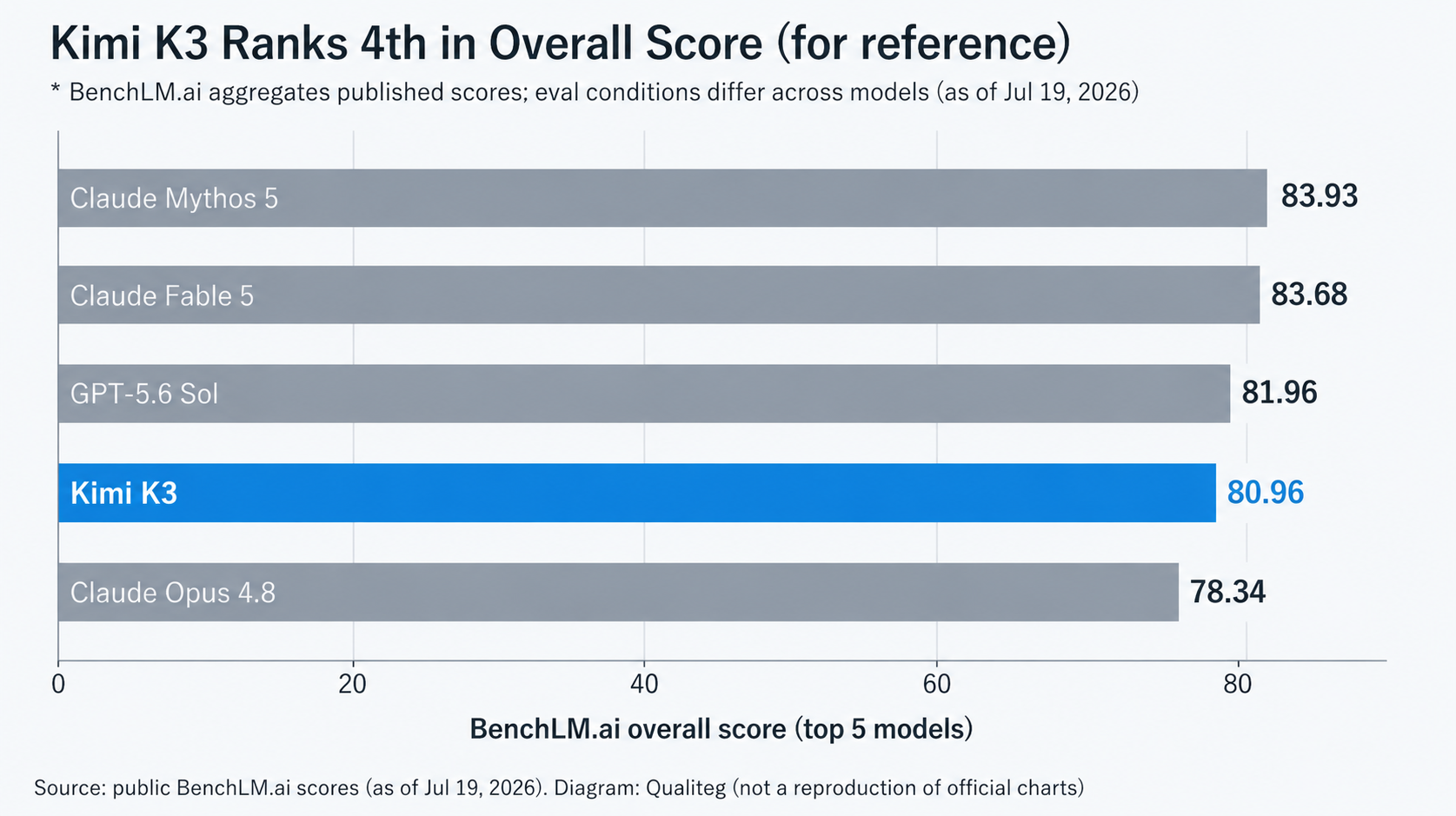
That said, BenchLM is not an evaluation body that runs every model itself under identical conditions; it is a service that aggregates multiple published scores.
Because the available benchmarks and evaluation conditions differ from model to model, "4th overall" is best treated as a reference value for getting a sense of direction.
Highlights from Moonshot's Official Evaluations
Among Moonshot's official numbers, the agentic web-browsing benchmark BrowseComp comes in at 91.2.
That figure is under the company's evaluation setup, which applies context compression upon reaching 300K tokens; without compression it is explicitly stated as 90.4.
External aggregations, moreover, place it just behind GPT-5.6 Sol (92.2), so it is not an unconditional "SOTA."
Meanwhile, independent evaluations by Arena.AI and Artificial Analysis are already underway via the API. At this stage, the accurate framing is: "the externally observable performance has some corroboration, but the model's internal specifications and the reproduction conditions of the official benchmarks cannot yet be verified."
Part 4: API Pricing — Cheaper Than the Closed Top Tier, but a Big Hike Within the Kimi Line
The API pricing is primary information confirmed on the official pricing page.
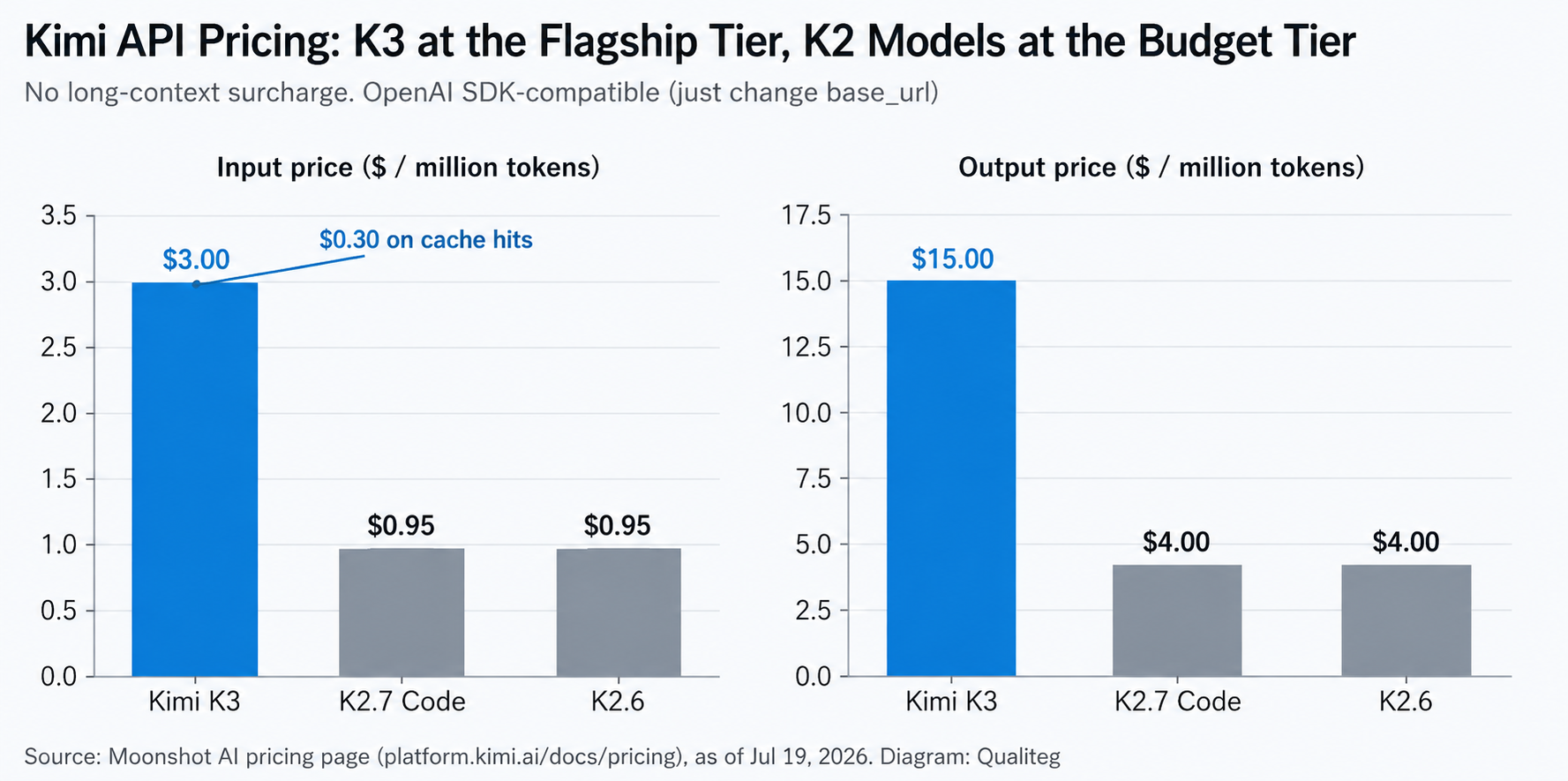
- Kimi K3: $3.00 input / $15.00 output (per million tokens), with cache-hit input at $0.30
- K2.7 Code (coding-focused) / K2.6 (general-purpose): $0.95 input / $4.00 output each
- No surcharge for long context. You can use the OpenAI SDK, and calling it is just a matter of swapping the
base_url, API key, and model name
English-language coverage has described this as "Claude Sonnet-class pricing."
Indeed, K3's $3/$15 matches Claude Sonnet 5's standard pricing effective September 1, 2026 (though Sonnet 5 is offered at an introductory $2/$10 through August 31, so as of July 20, K3 works out 50% more expensive on both input and output).
Within the Kimi lineup, it is a substantial hike from K2.6's $0.95/$4, and Simon Willison likewise notes that Moonshot has "stepped into a higher price tier for a Chinese AI lab."
Moonshot also claims that its distributed inference architecture called Mooncake achieves "a 90%+ cache hit rate on coding workloads"; if that is close to reality, effective costs for agentic use would come down considerably (this figure, too, is a vendor claim).
Part 5: "Open Weights" Is Still Only a Promise
This is the single most important point in this article.
As of July 20, 2026, Kimi K3 is not an "open-weight model" but a "model that is scheduled to become open-weight."
Checking Moonshot's official GitHub organization, there is still no model repository for Kimi K3, and the pinned model repository remains Kimi-K2.5. There is no model card on Hugging Face either.
On quantization, the official tech blog explicitly specifies MXFP4 weights / MXFP8 activations, which counts as primary information; whether the files distributed on Hugging Face will be MXFP4 as-is, however, is unconfirmed since the model card has not been published.
The technical report is likewise "to be released in the future."
There is one more practically important caveat:
"the weights being released" and "being able to run it yourself" are separate problems.
Moonshot recommends super-node configurations with 64 or more accelerators as the deployment target for K3.
Even quantized, this is a 2.8-trillion-parameter-class model; self-hosting the full model is out of reach not just at home but probably in office environments too. For the time being, think of it as something for specialized data centers and large-scale inference providers.
Multiple reports put the license at "Modified MIT," but with no model card in existence, it cannot be confirmed against a primary source (unconfirmed).
If released as scheduled, it would overtake DeepSeek v4 Pro (1.6 trillion parameters) to become the largest open-weight model in history.
Part 6: Agentic Capabilities — K3's Main Battleground
What Moonshot pitches hardest for K3 is agentic use.
- BrowseComp (agentic web browsing): 91.2 (under Moonshot's evaluation conditions; external aggregations place it just behind GPT-5.6 Sol)
- 2nd place on AA-Briefcase (Artificial Analysis's agentic evaluation)
- Beats Opus 4.8 and GPT-5.5 on the GDPval-AA v2 agentic Elo
- Kimi Code — offered as its coding-agent product line
- The API supports tool calling, and migrating from the OpenAI SDK is easy
In Kimi Code, a new plan structure — Starter / Explorer / Expert / Master — was introduced on July 20. K3 itself is available on all plans, and the 1M context requires Explorer or above (existing Moderato / Allegretto subscribers keep the terms of their old plans).
Caveats for Production Adoption
There are also constraints that the official documentation and blog themselves acknowledge.
- Full re-sending of thinking history is required
Unless you return assistant messages verbatim — including the thinking from past turns — quality can become unstable - Excessive autonomous judgment
The official docs explicitly note that, given ambiguous instructions, it may make unexpected decisions on the user's behalf - Sampling settings are fixed, and the web-search feature is not recommended for production use for the time being
Part 7: What's New Since the K2 Generation
The changes from the previous generation sum up as follows.
- A leap in scale
— a massive expansion to 2.8 trillion total parameters from the previous flagship K2/K2.5 on GitHub - Homegrown new mechanisms
— introduces KDA and AttnRes, with an extremely sparse Stable LatentMoE design at roughly 1.8% activation - A jump in capability
From K2.6's 18th place to 1st place with K3 in the Frontend Code Arena - Native vision
— image and video understanding as standard - Always-on thinking mode
- Product-line reorganization
— a three-tier structure: K3 (flagship) / K2.7 Code (coding-focused) / K2.6 (general-purpose budget tier)
Comparisons with K2.6 are partly verifiable through the Arena.AI and Artificial Analysis evaluations (18th place → 1st in the Frontend Code Arena, 33% → 46% accuracy on AA-Omniscience, and so on). However, cross-generation comparisons under identical conditions — including K2 and K2.5 — remain limited, and details including the architecture and training methods await the technical report.
Part 8: What We Still Don't Know
Let's also organize what remains unannounced or unconfirmed at this point.
- Training data scale, training token count, and training methods (pre-training corpus, RL/post-training setup) → undisclosed in both primary and secondary sources
- Active parameter count → "~50B (A50B)" is an analyst's notation, not officially disclosed
- Technical report / paper → unpublished (only an official statement that one is forthcoming)
- Hugging Face model card and distribution file format → nonexistent (weights unreleased)
- Exact license terms: "Modified MIT" is mentioned only at the level of press reports
Once the July 27 weight-release deadline passes, check three things: (1) whether the weights were actually released, (2) whether the evaluation conditions behind the official scores are disclosed in enough detail in the technical report to allow retesting under equivalent conditions, and (3) the license terms. We plan to cover any follow-up news in detail on this blog.
Conclusion
To sum up Kimi K3 in one line:
「an ultra-large-scale, "open-weights-to-be" MoE that falls one step short of the frontier's very top (Claude Fable 5 / GPT-5.6 Sol) overall, yet is positioned to aim at or above the Opus 4.8 / GPT-5.5 class in coding and agentic work」
.
The independent result of first place in the blind-voted Frontend Code Arena carries real weight as corroboration of its ability; on the other hand, for the model's internal specifications and the reproduction conditions of the official benchmarks, we must wait for the weight release scheduled by July 27 and the technical report to come. Whether the "largest open weights in history" billing becomes real — the answer starts arriving in about a week.
In our May article "When Will a Mythos-Level Open Model Arrive?," we predicted when open models would catch up to the frontier based on the slope of benchmark trends.
If K3 releases its weights as planned, "the weights of a model in the same league as Opus 4.8 on Artificial Analysis's overall index" will be obtainable in the summer of 2026 — meaning the trend we sketched in that article is running along the upper edge of our projected band.
However, for the cybersecurity capabilities that were the centerpiece of that article (CyberGym and the AISI real-environment tests), no evaluation data for K3 exists yet. The reckoning with our line that "capability attainment and the decision to release are separate problems" will have to wait for independent evaluations after the weights are out — and we intend to revisit it then.
Coming Up Next
Next time, we plan to cover Qwen's officially announced next flagship, Qwen3.8. With 2.4 trillion total parameters and an open-weight release planned, it is another ultra-large open-series model standing right alongside Kimi K3. Just as with Kimi K3, we'll dig in with thorough, primary-source-based research — stay tuned.
See you next time!
References (Primary and Key Sources)
- Moonshot AI official blog: Kimi K3 Tech Blog
- Kimi API official documentation: K3 Quickstart
- Kimi API official pricing page
- Kimi Code What's New (new plan structure)
- Moonshot AI official GitHub
- Moonshot AI official X (source of the KDA / AttnRes efficiency figures)
- Artificial Analysis: Kimi K3 analysis (Intelligence Index / GDPval-AA v2 / AA-Briefcase / AA-Omniscience)
- Simon Willison: Kimi K3 hands-on
- Tom's Hardware: Moonshot releases 2.8-trillion-parameter Kimi K3
- VentureBeat: China's Moonshot AI releases Kimi K3
- Arena.AI official X: Frontend Code Arena results
- OpenRouter: moonshotai/kimi-k3
- Latent.Space: Kimi K3 analysis
- BenchLM.ai: Kimi K3
- Alibaba Qwen official X: Qwen3.8 announcement (source for the preview above)
- Bloomberg: Alibaba's Qwen unveils preview of flagship AI model
* This article is based on research as of July 20, 2026. All charts were drawn by Qualiteg from published figures and are not reproductions of official charts.