
LLM-Audit: The Front Lines of LLM Attacks and Defenses



Introduction
With the rapid evolution of artificial intelligence, large language models (LLMs) have become indispensable tools for many companies and organizations. Their range of applications—natural language processing, code generation, data analysis, and more—expands daily, driving innovation across a wide range of fields, from streamlining business processes to supporting creative tasks. As this transformative technology spreads, however, new security risks are emerging, and companies find themselves needing to take appropriate countermeasures.
In this article, we introduce LLM-Audit, the LLM security solution developed by our company. LLM-Audit is a comprehensive security and safety solution that thoroughly audits an LLM's inputs and outputs to minimize security risk.
It provides advanced protection against LLM-specific vulnerabilities that conventional security measures struggle to address, as well as against challenges unique to Japanese-language environments.
Video
You can also watch the content of this article in the video below.
Why LLM security matters
When LLM security management falls short, companies can face serious consequences.
The greatest concern is the risk of information leakage. LLMs are trained on vast amounts of data, and without appropriate safeguards, confidential or personal information can unintentionally leak to the outside.
The spread of misinformation or biased content generated by an LLM can also severely damage a company's reputation. Beyond that, improper use of an LLM or inappropriate output can escalate into legal problems. These issues are not merely temporary setbacks; they can affect a company's credibility and competitiveness over the long term.
Particularly noteworthy are reports of successful jailbreaks—circumventing a system's constraints—against some LLM systems.
For example, cases have been reported in which cleverly crafted prompts allowed ChatGPT's built-in restrictions to be bypassed, causing it to generate inappropriate content. This vividly illustrates how important—and how difficult—LLM security is. Simple filtering and restrictions cannot keep up with such sophisticated attacks, and more refined security measures are required.
The rise of open-source LLMs and why LLM security matters even more
Moreover, the recent rise of open-source LLMs has made the security landscape more complex. Many companies are beginning to use models fine-tuned with their own domain knowledge, which introduces new risks. By their nature, open-source models tend to have their vulnerabilities exposed publicly, making them attractive targets for attackers. When using open-source models, therefore, security measures at least as rigorous as those for closed commercial models—if not more so—are essential.
The Japanese alignment problem in multilingual models: LLM defenses are built to an English standard, leaving Japanese as a weak spot
As multilingual LLMs spread worldwide, a serious alignment problem has emerged that Japanese users cannot afford to ignore.
Alignment refers to bringing an LLM's goals and behavior into agreement with human intentions and values. Ideally, an LLM should make consistent ethical judgments and respond appropriately regardless of language or culture, but in reality, significant challenges remain.
Especially pronounced is the cross-lingual alignment gap, where a model's behavior differs dramatically depending on the language.
This problem manifests as a marked safety gap between English and other languages, particularly in open models. In content filtering, for example, cases have been reported where sexual content and violent expressions that are properly filtered in English pass straight through in Japanese. This is not just a technical issue; it raises the risk that Japanese users will be exposed to inappropriate content.
Serious problems also arise in ethical judgment. Unethical requests and instructions that are reliably refused in English are sometimes accepted and carried out in Japanese. This suggests the model does not sufficiently understand Japanese context and cultural background. Detection accuracy for hate speech and discriminatory expressions likewise drops markedly in Japanese compared with English.
There are challenges from a privacy standpoint as well. Models that handle personal information carefully in English tend to disclose it far more readily in Japanese. This means the privacy of Japanese users may not be adequately protected.
Furthermore, when it comes to culturally sensitive topics and taboos specific to Japan, models can show less care than they do in English. These problems are likely the result of multilingual models that, despite claiming multilingual support, are in practice trained and aligned with a heavy English bias.
This cross-lingual alignment gap can seriously undermine the safety and reliability of LLMs. Japanese users face the risk of being unintentionally exposed to inappropriate content or having their privacy violated. For companies, too, the risk of unexpected problems when using LLMs in Japanese-language environments is growing.
LLM-Audit: guardrails for Japanese input and output
Addressing these challenges requires LLMs that properly understand Japanese-specific expressions and context and can make judgments accordingly. Since today's multilingual models cannot fully achieve this on their own, guardrails specialized for the Japanese alignment problem need to be placed outside the LLM. LLM-Audit is a solution optimized for Japanese-language environments, developed precisely to meet this challenge.
Major attacks on LLMs and how to defend against them
Attacks on LLMs evolve daily and take many forms. One of the most common is prompt injection: an attack that attempts to manipulate an LLM's behavior with cleverly crafted prompts. Attackers aim to bypass the LLM's rules, impersonate specific people or organizations, leak confidential information, or execute malicious code. In systems that use retrieval-augmented generation (RAG) in particular, more complex attack techniques have been reported, including search query manipulation, context poisoning, and injection of fake metadata.
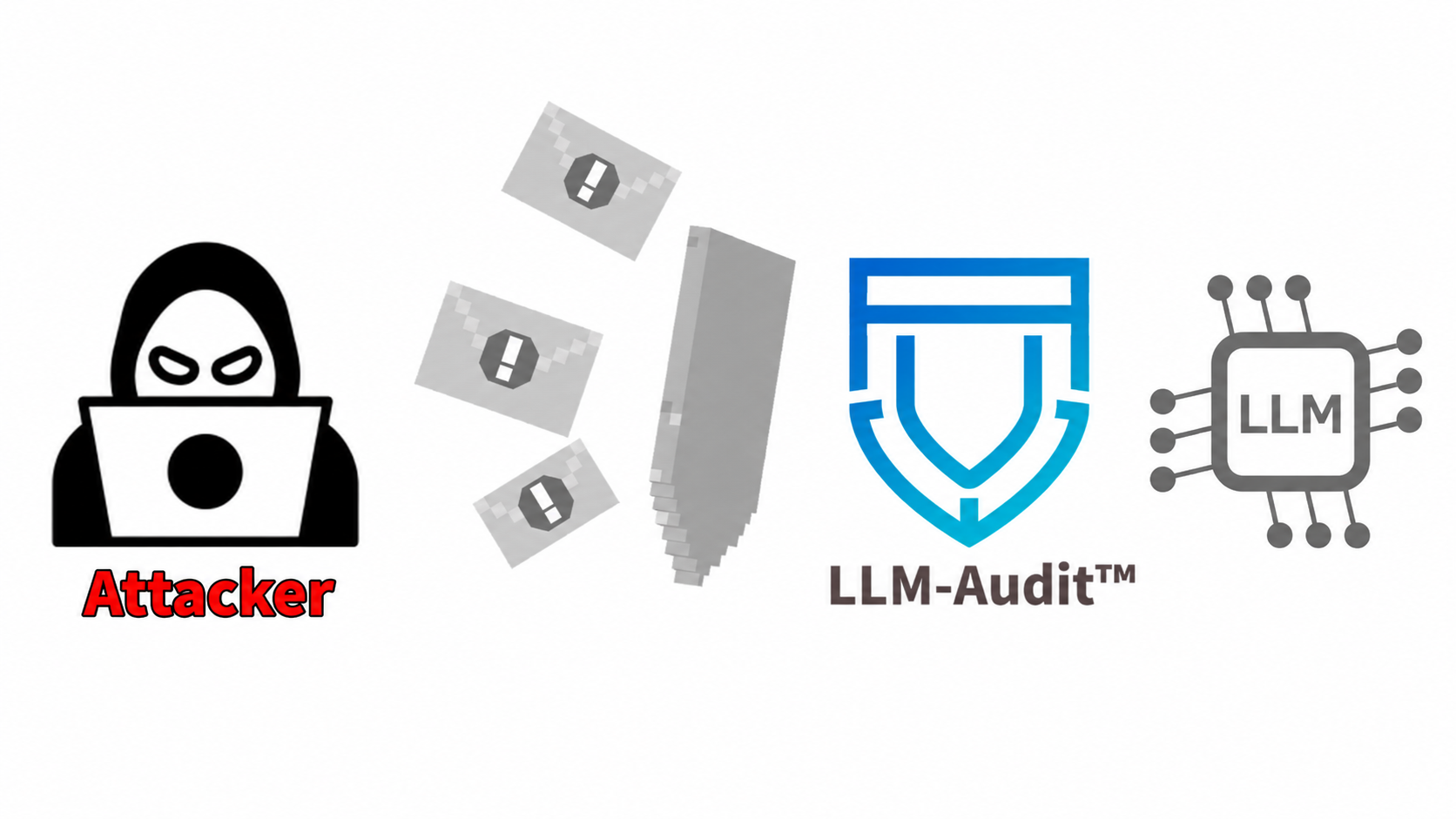
Attacks that induce inappropriate output from an LLM are another serious problem. These include attempts to elicit threats, violent content, solicitation of illegal activity, sexually explicit material, and output on sensitive topics such as politics and religion. Such attacks can severely damage the credibility of services built on LLMs.
There are also model denial-of-service attacks aimed at exhausting system resources: attempts to cripple an LLM system by flooding it with extremely long texts or excessively complex tasks.
Personal information in inputs, while not a direct attack, is also a significant security risk. Users may enter personal information unintentionally, or attackers may deliberately enter someone else's. If this information is not handled properly, it can lead to privacy violations and data leaks.
Attacks exploiting multilingual input are drawing attention as well. When an LLM's multilingual support is incomplete, prompts in insufficiently tested languages can trigger unexpected model behavior. This is closely related to the Japanese alignment problem described above.
Competitor-related input can also threaten LLM systems built for a specific purpose. For example, an LLM designed to provide information about one company's products might be fed inputs crafted to make it promote a competitor, subverting the system's purpose.
On top of these, there are more technically sophisticated attacks, such as feeding the system invisible Unicode characters to trigger unintended behavior.
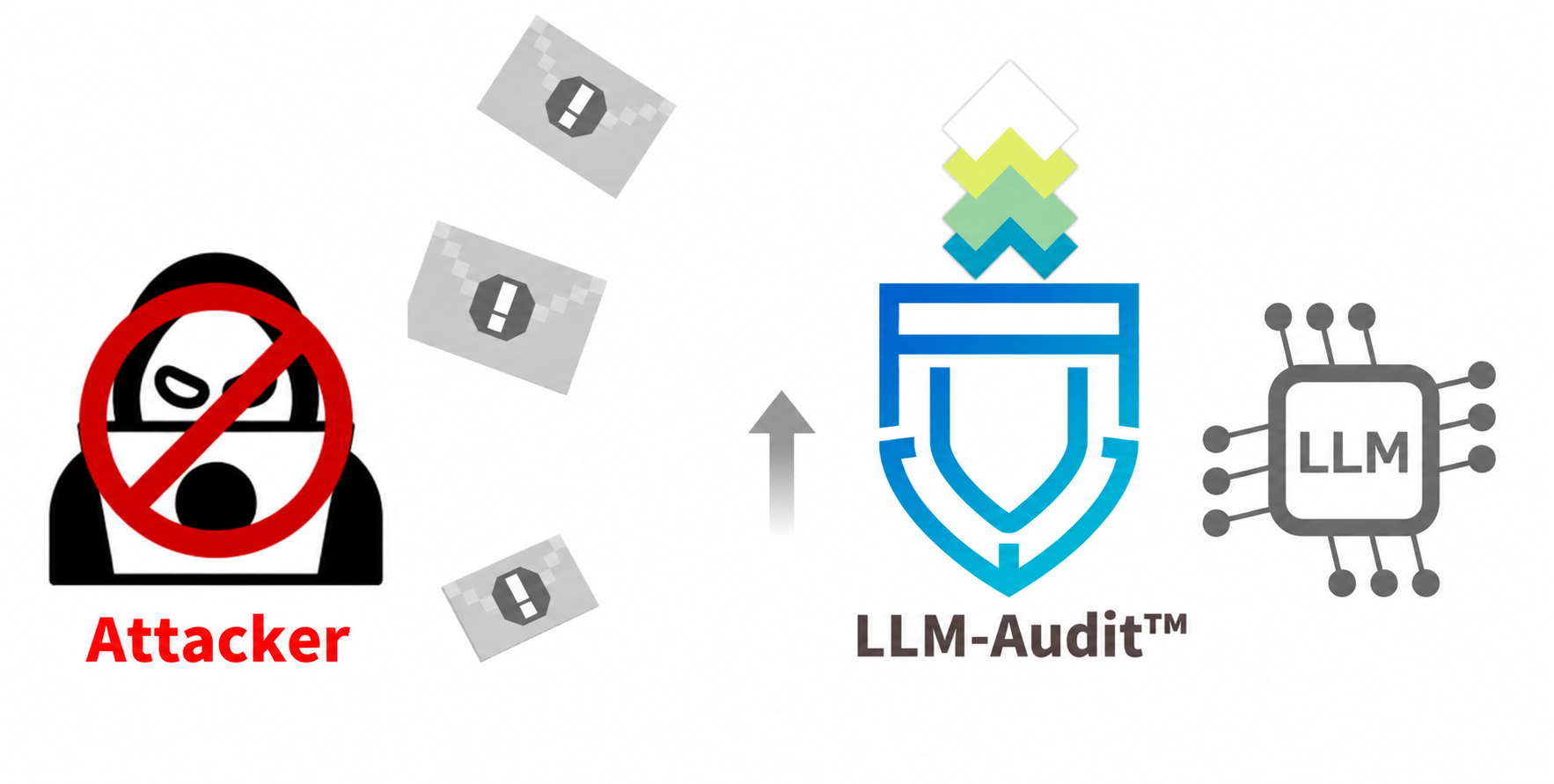
Countering each of these diverse attacks individually is extremely difficult, but LLM-Audit addresses them comprehensively. Its flexible policy configuration makes it possible to detect and block many kinds of attacks, and its design allows rapid updates so it can respond to the latest threats as new attack techniques are discovered.
In addition to rigorous checks at the input stage, LLM-Audit also audits outputs. This creates a second line of defense that blocks inappropriate output even if an attack succeeds. It further incorporates measures specialized for Japanese-language environments, addressing language-specific vulnerabilities.
In this way, LLM-Audit functions not as a mere defensive tool but as a solution that comprehensively supports the safe and effective use of LLMs. By adopting LLM-Audit, companies can build a robust defense against the latest security threats and harness the power of LLMs with confidence.
Features and capabilities of LLM-Audit
LLM-Audit is a comprehensive solution for ensuring the safety and reliability of LLMs. Its defining characteristics are advanced support for Japanese-language environments, a simple deployment process, and flexible customizability.
Support for Japanese prompts and outputs
First, let us look more closely at its support for Japanese-language environments.
LLM-Audit was developed by native Japanese-speaking engineers, enabling security measures grounded in a deep understanding of Japanese-specific expressions, context, and cultural background.
A major strength is its risk detection engine trained on Japanese text. This engine understands the subtle nuances and implications of Japanese and can identify potential threats with greater accuracy. It is a direct answer to the Japanese alignment problem described above.
Why Qualiteg's LLM-Audit performs so well in Japanese-language environments
The secret lies in the following four strengths.
The first strength is battle-tested experience from operating our own LLM services. Through the day-to-day operation of its LLM services, Qualiteg has accumulated real attack patterns and the countermeasures that work against them. This hands-on experience yields insights that theory alone cannot provide, and it feeds directly into the development of more practical, more effective security measures.
The second strength is the continuous construction of a risk dataset specialized for Japanese. Qualiteg keeps expanding this dataset with the latest attack examples, starting with jailbreak attempts captured against our own services. This continuously updated Japanese risk dataset underpins the high detection accuracy against the latest threats.
The third strength is deep expertise in Japanese natural language processing (NLP). The ability to understand and accurately analyze the complex structures and ambiguities specific to Japanese is one of Qualiteg's great strengths. Drawing on this expertise, we train and operate well-balanced detectors tailored to the characteristics and requirements of each dataset.
The fourth and final strength is an optimized service delivery environment that integrates these technologies to achieve low latency and high throughput. Advanced optimization techniques honed through building LLM inference environments, including GPU clusters, support this performance.
Thanks to these strengths, Qualiteg's LLM-Audit is trained on real Japanese attack data and delivers high-performance risk detection optimized for Japanese-language environments. It can catch sophisticated, highly toxic Japanese prompts that English-centric audit systems—or detectors trained only on public datasets—would miss.
As LLM adoption accelerates, security solutions specialized for Japanese-language environments will only grow in importance. As a pioneer in this space, Qualiteg's LLM-Audit supports companies in using AI safely and effectively.
Another major feature of LLM-Audit is how easy it is to deploy.
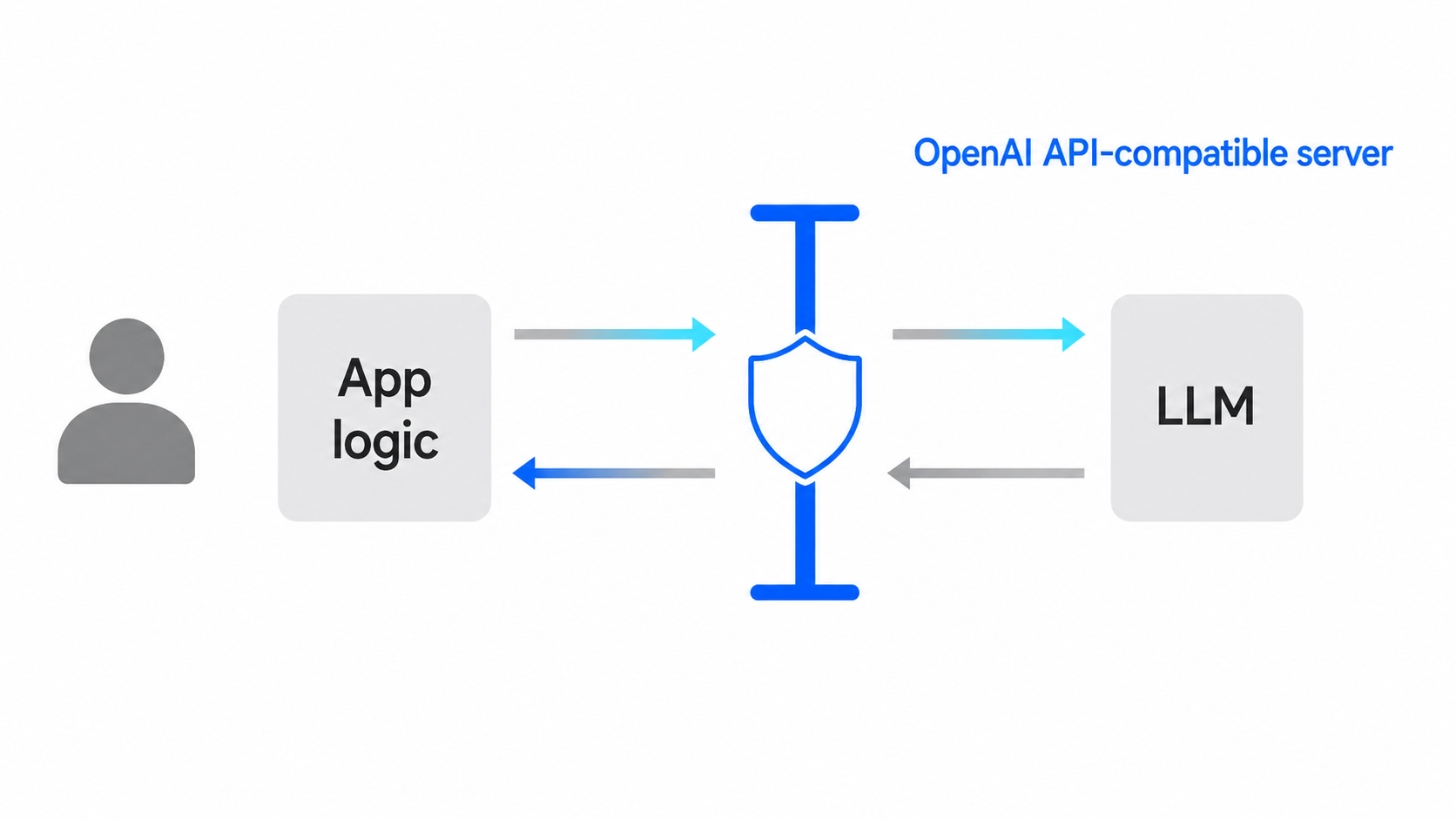
Deployable at zero integration cost — OpenAI API-compatible server
Because it functions as an OpenAI-compatible server, LLM-Audit can be integrated easily without major changes to your existing LLM system. Concretely, by wrapping the LLM you currently use with LLM-Audit, you gain advanced security and safety capabilities with almost no changes to your application logic. This dramatically lowers the technical barriers to adoption and enables rapid security hardening.
LLM-Audit is also highly flexible and can be customized to each organization's specific needs and challenges. For example, you can configure fine-grained settings such as protection for industry-specific confidential information and terminology, or output controls based on organizational policy.
This makes it possible to build an optimal security environment regardless of your organization's size or industry.
Key capabilities
LLM-Audit's capabilities fall into two broad categories: input auditing and output auditing.
Working together, these capabilities deliver comprehensive security for LLM usage.
Input auditing begins with content filtering.
Protection against inappropriate inputs and outputs
This capability analyzes text entering the system in detail, detecting and blocking overt threats, violent content, solicitation of illegal activity, and the like. It can also identify sensitive topics such as politics and religion and handle them appropriately according to your organization's policy.
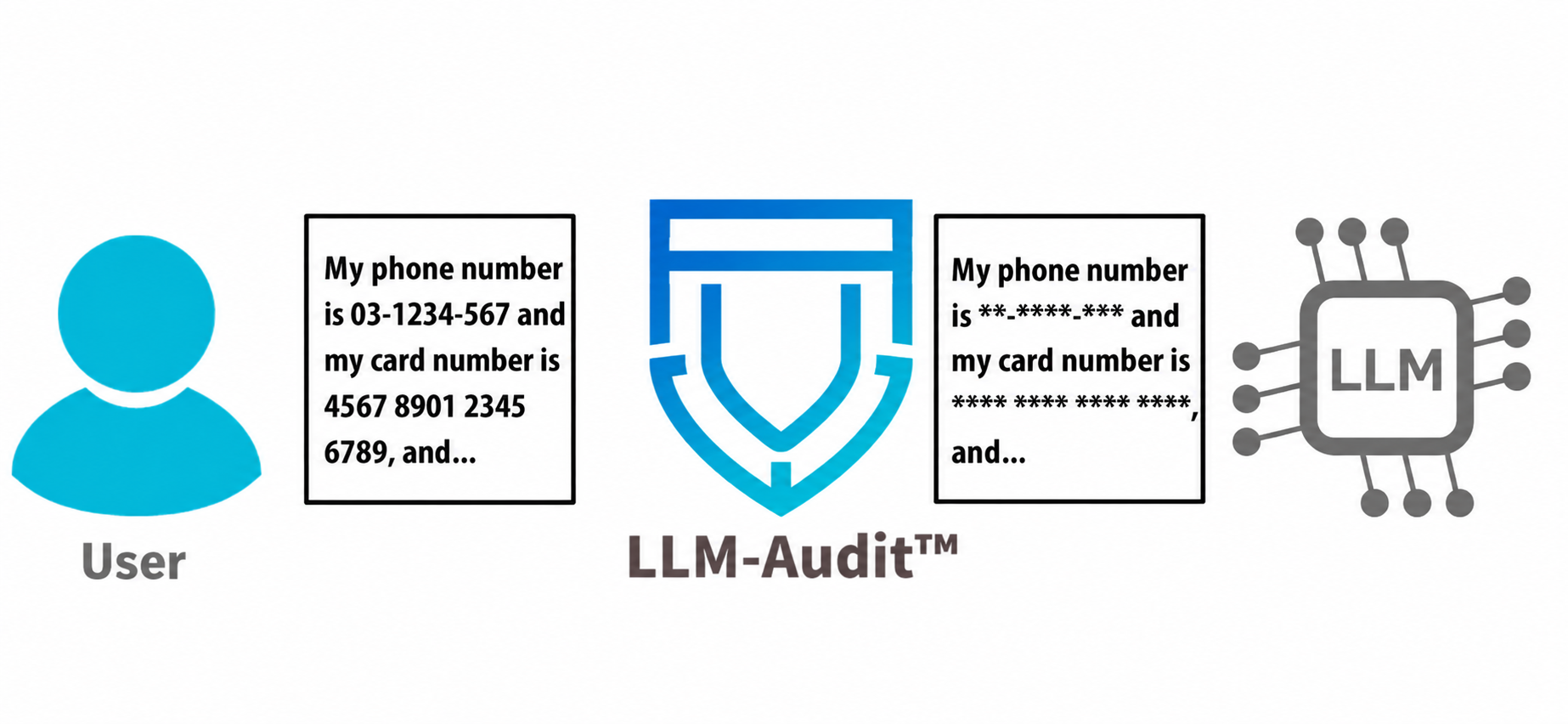
Detection and protection of personal information
Detecting and protecting personal information is another key element of input auditing. LLM-Audit uses advanced natural language processing to accurately detect personally identifiable information in text. Detected information is masked or removed as appropriate, in line with your organization's privacy policy. This prevents unintended leaks of personal information and inappropriate learning by the LLM.
Prompt injection detection
Prompt injection detection is another of LLM-Audit's important capabilities. Using advanced detection algorithms, it identifies malicious prompt patterns and effectively blocks attempts to circumvent system constraints or manipulate the LLM.
Input validity checks
Input validity checking is important for maintaining system stability and performance. This capability closely inspects the length and complexity of input text, along with the characters and words used, filtering out inputs that could place excessive load on the system or that are potentially dangerous.
Conversation topic classification
LLM-Audit can also control inputs at the level of individual words or topics. This allows flexible restrictions on organization-specific confidential information or particular subject areas.
Output auditing is equally important. Safety checks analyze the content an LLM generates and detect harmful material such as violence, hate speech, and inappropriate sexual content. This prevents the LLM from unintentionally generating inappropriate content and preserves the credibility of your service.
Consistency checks
Consistency checking verifies that the LLM's output does not contradict its input. It judges whether the LLM's answers follow the context and whether they avoid contradicting earlier information—essential for delivering consistent, high-quality responses to users.
Hallucination detection
Hallucination detection is one of LLM-Audit's most innovative capabilities. Without requiring external databases or resources, it assesses the likelihood of hallucinations—nonexistent or factually incorrect information—from the LLM's output itself. This substantially improves the reliability of the information an LLM provides.
The personal information leak prevention capability checks whether the output contains personal information that may have been present in the LLM's training data. This strengthens privacy protection and minimizes legal risk.
These LLM-Audit capabilities are updated regularly so they can always respond to the latest threats. When new attack techniques or vulnerabilities are discovered, countermeasures can be deployed quickly. Custom detectors and new filtering capabilities can also be added, allowing flexible adaptation to your organization's evolving needs.
With this comprehensive set of capabilities, LLM-Audit can be expected to dramatically reduce security incidents, protect the credibility of companies using LLMs, and improve user satisfaction. LLM-Audit is not just a security tool; it is a critical foundation for organizations to use AI technology safely and effectively.
Related consulting services
In addition to providing LLM-Audit, we offer a comprehensive set of related consulting services. These services support a strategic approach that helps organizations get the most out of LLMs while keeping security risks to a minimum.
Risk assessment
First, we assess your organization's specific LLM usage and its risks. This is a process of analyzing in detail how your organization uses LLMs and what risks accompany that use. The assessment comprehensively examines current LLM usage patterns, data flows, the state of existing security measures, and potential vulnerabilities. Along the way, organization-specific challenges and industry-specific risks are also identified.
Vulnerability assessment of existing prompts
Next, we conduct a vulnerability assessment of your existing prompts. This process analyzes the prompts and input patterns your organization currently uses in detail and identifies potential security risks. The assessment surfaces potential prompt injection attacks and other avenues of abuse in advance, so countermeasures can be put in place.
Based on the results of these assessments, we propose a customized security solution. The proposal covers optimal LLM-Audit configuration, additional security measures aligned with your organization's policies, and a long-term security strategy—all finely tuned to your organization's size, industry, and specific needs.
Operational support and LLM security training
After LLM-Audit is deployed, we continue to provide ongoing support, including operational support and training plan development. Operational support provides the technical assistance needed to keep the system performing at its best and helps you respond quickly to new threats and challenges. Training plans are designed to help your employees use LLM-Audit effectively and raise their security awareness.
Security audits
We also provide regular security audit and reporting services. These continuously evaluate your organization's LLM usage and the effectiveness of its security measures, and recommend improvements as needed. This regular evaluation helps your organization stay adapted to an ever-changing threat landscape.
We also offer a special consulting package for organizations using—or considering—open-source LLMs. Open-source LLMs come with their own challenges and risks that call for a specialized approach. This package provides comprehensive guidance on selecting, customizing, hardening, and operating open-source models.
Through these consulting services, we work with organizations to find and put into practice ways to maximize the power of LLMs while minimizing risk. LLM technology is evolving rapidly, and the security challenges that come with it change by the day. Our expert team stays on top of the latest technology trends and threat intelligence, and continues to deliver the best solutions for each client organization.
In this way, LLM-Audit and its related consulting services form a total solution that comprehensively supports your organization's AI strategy, covering everything from adoption to operation and continuous improvement. We hope to serve as a partner that opens up the future of AI safely, together with our client organizations.
Contact us
As LLMs see wider business adoption, attacks against them are intensifying.
At the same time, attacks on LLMs differ from conventional web security threats, and both the knowledge and the defenses against them are still immature.
Qualiteg Inc. offers LLM-Audit™, an LLM defense solution built on the experience and insights gained through developing and operating LLM services.
It powerfully blocks malicious input prompts and audits inappropriate LLM output, delivering safety and peace of mind for your LLMs.
If you are interested in LLM security or LLM-Audit™, please contact us below.
For LLM security consulting or a product demo, please also feel free to reach out via our contact form.
References
LLM-Audit product site