Defending Corporate Information in the LLM Era: The New Challenge of PII Security

Introduction
Why PII Security Matters Now
We live in an era in which large language models (LLMs) have permeated every corner of business. Generative AI tools such as ChatGPT, Claude, and Gemini are no longer experimental technology—they have become indispensable infrastructure for daily work. Behind this convenience, however, corporate personally identifiable information (PII) is exposed to unprecedented threats.
A new risk that traditional security measures never anticipated—"information leakage to AI"—has emerged, forcing companies to fundamentally rethink their information defense strategies.
What Is PII? Redefining It for the Generative AI and LLM Era
The Traditional Definition of PII
Personally identifiable information (PII) refers to information that can identify a specific individual, either on its own or in combination with other information.
Traditionally, for example, the main targets were the following kinds of information
- Direct identifiers: name, address, phone number, email address, My Number (Japan's individual number)
- Indirect identifiers: date of birth, occupation, employer, IP address
- Sensitive information: medical records, financial information, biometric data
The Expanded Concept of PII in the LLM Era
With the arrival of LLMs, however, the concept of PII has expanded dramatically.
Thanks to AI's advanced analytical capabilities, individuals can now be inferred even from information that appears, at first glance, to have nothing to do with them.
In other words, information like the following has effectively become de facto PII as well
- Behavioral patterns: writing style, vocabulary choices, thought patterns
- Combinations of metadata: posting times, device information, fragments of location data
- Relationship information: who you work with, which projects you are involved in
How Individuals Are Identified from Behavioral Patterns
For example, think about the posts you write on social media every day. Even a simple greeting like the Japanese "おはよう" ("good morning") varies from person to person: some write the casual "おはよ〜", others the polite "おはようございます!", and others sprinkle in lots of emoji. People also differ in their favorite turns of phrase, their punctuation habits, and how they break up paragraphs.
AI learns these subtle characteristics at scale and has become capable of inferring that "the person who writes this way is very likely the same person seen elsewhere".
It is unsettling, but even if you hide your name, there is a real possibility of being identified as "you" from your writing style alone.
Identification Through Combinations of Metadata
Metadata is "data about data"—the information that accompanies your posts and activities. Each item may be trivial on its own, but combined, they become powerful clues.
For example, each of these three facts—"often posts around 7 a.m.", "posts from an iPhone", "occasionally posts from around Shinjuku"—applies to many people. Combine them, however, and the number of matching people drops sharply; combine them with still more information, and the chance of arriving at one specific individual rises.
Inference from Relationship Information
The names of your coworkers, the projects you participate in, the cafe you frequent—information that does not look like personal data at first glance is nevertheless an important clue for AI.
For example, from fragments such as "I work with Yamada-san on the ABC project", "Wednesday meetings are at such-and-such cafe", and "I recently started studying machine learning", an AI can infer that "this person is likely an engineer in their 30s working in the technical division of company X", and by cross-referencing with other information, it can end up identifying the individual.
Malicious AI crawlers can trawl your social media in this way, and even the casual information we post every day can, depending on how it is combined, become a powerful clue for identifying individuals. So we need to exercise the utmost care not only with workplace information but also with what we share as individuals.
Even without malice involved, when you are interviewed by a media outlet, your organizational affiliation and job title are continuously collected by sales automation SaaS platforms and accumulated as sales intelligence. You should be aware that a modern, cloud-based "who's who" directory is being compiled without your knowledge. These directories are now being integrated with high-performance AI, and in the near future they are expected to be used as sales tools targeting you.
In this way, what we have long recognized as "personal information" is being redefined by the advent of AI. This is the new privacy-protection challenge of the generative AI and LLM era.
New Risks Lurking in Everyday Corporate Life: You May Be Leaking Data Without Realizing It
So far, we have seen how greatly the concept of personally identifiable information (PII) has expanded in the generative AI and LLM era. Leaving a detailed discussion of precautions for personal posting on social media and blogs for another occasion, this time I would like to focus on the more pressing problem confronting each of us who works at a company.
Which AI tools did you use at work today?
Perhaps you asked ChatGPT to summarize meeting minutes. Perhaps you had Claude translate an email into English. Perhaps you had Gemini draft an outline for a presentation. These tools are astonishingly convenient and have become essential to our work.
But pause for a moment and think.
What information did you send to the AI at that moment?
Part of a contract containing a customer's name? An internal org chart? A new product's development code name? Sales data? Employee evaluations? We send this information to servers somewhere in the world with the casual mindset of "just a small productivity boost".
"But surely the major AI services are safe, right?"
You might think so.
It is true that the major AI service providers implement advanced security measures. But that is not where the problem lies.
The possibility that the data you send may be used as training data for the AI—do you truly understand it? Have you read all the terms of service and fully grasped how your data is handled?
What makes this even more serious is that new generative AI services appear every day. Image generation AI, video editing AI, code generation AI, proofreading AI... Every time we find a service that looks useful, we casually create an account and upload our data.
But do all of those services meet the security standards your company requires?
Do you know in which country's servers your data is stored? Is the company operating the service trustworthy? What if the service gets hacked? What if the operator suddenly shuts the service down? What happens to the data you uploaded?
The Pitfalls Hidden in Generative AI Tools: Unconscious Data Leakage
The Reality of AI Tools Woven into Daily Work
Monday morning, 9 a.m. Tanaka-san (a pseudonym) in the marketing department needed to compile the results of last week's customer survey. Analyzing more than 1,000 free-text responses is grueling work. So Tanaka-san opened ChatGPT, as usual.
"Analyze these survey results and summarize the main opinions into five points."
He pasted the data copied straight from the Excel file into ChatGPT and hit Enter. Just 30 seconds later, a beautifully organized analysis appeared. "AI really is convenient," Tanaka-san thought, satisfied.
But Tanaka-san had not noticed that the survey data contained the respondents' email addresses, ages, regions of residence, and purchase histories. The free-text fields even included employer names and family details that respondents had written in themselves.
The Moment "Just a Little" Becomes Fatal
Yamada-san in the accounting department needed to translate an English invoice into Japanese. Because Google Translate struggled with the technical terms, she decided to use the paid version of DeepL for higher-accuracy translation.
She uploaded the invoice PDF as-is. The translation quality was indeed superb, with the technical terms rendered accurately. But that invoice contained the business partner's bank account information, transaction amounts, and even the model number of an unannounced new product.
"It's only a translation, so it's fine"—Yamada-san, thinking this, did not grasp the gravity of having sent her company's critical transaction information to an external service.
The Sweet Trap of Convenient New Services
Suzuki-san (a pseudonym), an engineer in the development department, decided to try a newly trending AI code review tool to streamline code reviews. GitHub Copilot is well known, but this new service was billed as even more capable.
When he uploaded part of the company's source code, it did indeed return sharp improvement suggestions. Impressed, Suzuki-san proposed that the whole team adopt the tool.
But what if the company running that service was actually a startup with inadequate security, got hacked two months later, and the uploaded source code leaked onto the dark web...? The proprietary algorithms that are the source of Suzuki-san's company's competitiveness could end up in the hands of competitors.
The Dangerous Comfort of "Everyone Is Using It"
Sato-san (a pseudonym) in the HR department was buried in the task of compiling interview evaluation sheets. She needed to digitize a large volume of handwritten notes and organize the evaluations. A colleague recommended an AI transcription service—"it's incredibly handy"—so she gave it a try.
Just photograph the handwritten notes and upload them, and neatly formatted text data is generated. Her productivity improved dramatically.
But those evaluation sheets contained the applicants' names, contact details, current employers, desired salaries, and even the interviewers' candid evaluation comments. If this information leaked, it would not only violate the applicants' privacy but also expose the company's hiring strategy.
The True Cost Hidden in Free Tools
Takahashi-san (a pseudonym) in the sales department was using a free AI presentation builder to create customer-facing slide decks. Rich templates, polished designs. "This much for free—fantastic!" he thought.
But "free" always has a reason. Reading the service's terms of use closely, he found this in small print
"Uploaded content may be analyzed for the purpose of improving the service."
The customer lists, sales strategies, price tables, and competitive analyses Takahashi-san uploaded... all of it accumulates in the service operator's database, and could potentially be used for other purposes.
Cascading Risks That Spread Across Departments
What is even more frightening is that these risks do not stop at the individual level.
The customer data Tanaka-san leaked becomes a matter of trust not just for the marketing department but for the entire company. The transaction information Yamada-san exposed affects management strategy well beyond the accounting department. Suzuki-san's source code leak threatens not just the development department but the company's competitiveness itself.
One person's slip can plunge the whole company into crisis—that is the defining characteristic of risk in the generative AI era.
Why Do We Let Our Guard Down?
So why do even employees who are normally security-conscious become defenseless when it comes to generative AI tools?
1. The Trap of Thinking of It as a "Tool" Because we perceive generative AI merely as a convenient tool, our awareness that we are "transmitting" data fades. We end up sending data to cloud services with the same casualness as using Word or Excel.
2. Judgment Dulled by Overwhelming Convenience It is simply too convenient, so we use it before considering the risks. The psychology of "if it makes my work this much easier, a little risk is..." takes over.
3. Overconfidence That "Big Companies Mean Safety" There is an overconfidence that services from major companies like Google, Microsoft, or OpenAI must be safe. But data handling policies differ from company to company and do not necessarily satisfy your organization's security requirements.
4. The Difficulty of Visualizing the Risk Data leakage is invisible. Unlike physically losing a USB drive, a digital data leak carries no tangible sensation, which makes it hard to feel a sense of danger.
The Decision Companies Now Face
In this situation, how should companies respond?
"Ban the use of generative AI outright"—that is not realistic.
The productivity gains that generative AI delivers cannot be ignored, and while competitors put it to use, choosing to abstain means falling behind.
Yet "leave it to each employee's judgment" is far too dangerous. As we have just seen, critical data can leak without any malice—indeed, out of sheer enthusiasm for improving one's work.
So what should be done?
What companies need is a mechanism that secures data safety while still enjoying the benefits of generative AI. One that automatically detects and protects PII and confidential information even when employees are not thinking about it. That is the kind of solution now required.
To the Front Lines of Data Defense
Choosing LLM Audit PII Protector
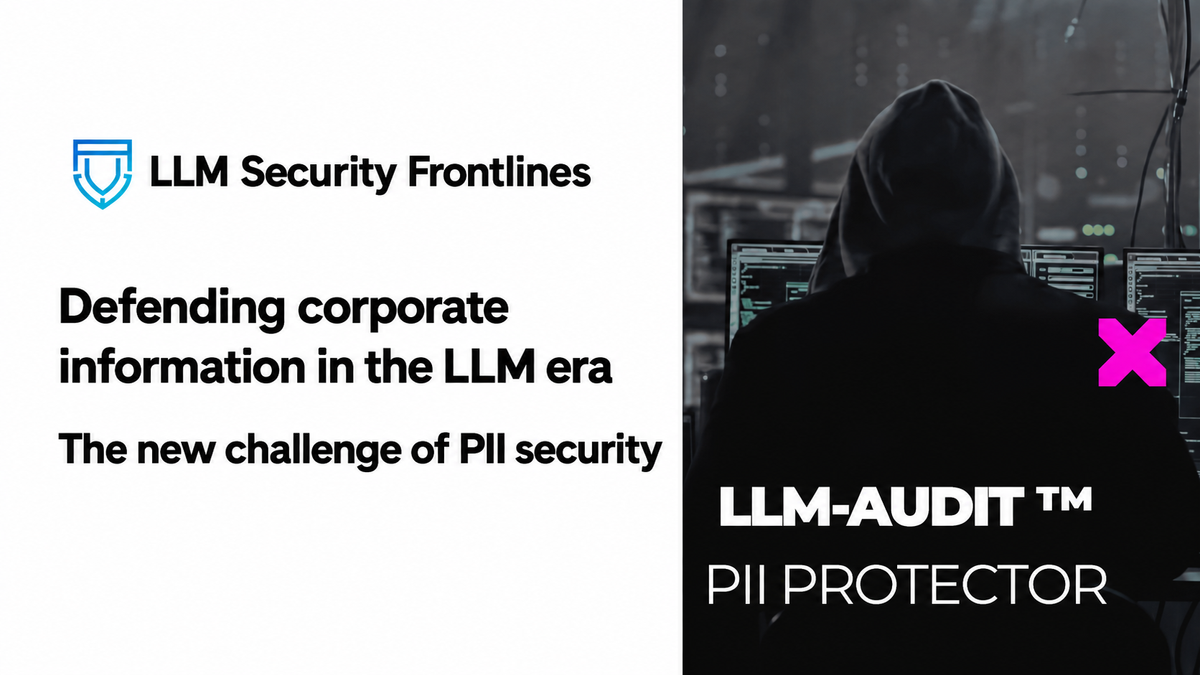
Developed precisely to answer this challenge is our "LLM Audit™ PII Protector". It is part of our integrated LLM security audit solution "LLM Audit™", and PII Protector can also be used on its own.
This solution monitors the data employees send when using generative AI tools in real time and automatically checks whether it contains PII or confidential information. If dangerous data is detected, it blocks the transmission and suggests an appropriate way to handle it.
Not mere prohibition or restriction, but a mechanism for using generative AI safely—that is what LLM Audit PII Protector aims to be.
What PII Is Most Likely to Leak Through LLM Use?
Personal Information That Is Easy to Overlook
When employees use LLMs, they frequently fail to notice that the following kinds of information are included
Customer-related information
- Customer names, contact person names
- Contact details (phone numbers, email addresses)
- Transaction histories, purchasing data
Internal company information
- Employee names, employee IDs
- Department names, job titles
- Extension numbers, company mobile numbers
Business partner information
- Company names, contact person details
- Contract terms, transaction amounts
- Project codes
Other confidential information
- My Number (Japan's individual number), driver's license numbers
- Bank account information
- Company-specific technical information (API keys, internal processing codes, etc.)
Dangerous Usage Patterns That Actually Happen
Example 1: "Analyze this customer list and tell me the purchasing trends"
-> Personal information for hundreds of people is sent to the LLM service

Example 2: "Summarize the key points of the following contract"
-> Business partner details, contract terms, and contact names leak externally

Example 3: "Organize these meeting notes and write up the minutes"
-> Participants' statements and decisions are stored on an external service
Why Companies Should Strengthen PII Protection for Generative AI
1. Loss of Trust from Information Leaks
If customers' or business partners' personal information leaks, a company's credibility suffers severely. In Japan in particular, society scrutinizes the handling of personal information closely, and a single leak can inflict fatal damage.
2. Risk of Violating Personal Data Protection Law
Japan's Act on the Protection of Personal Information, as amended in 2022, mandates the appropriate management of personal data. Sending personal information to LLM services without authorization can constitute a legal violation.
3. Loss of Competitive Advantage
As business data and customer information accumulate on the LLM service provider's side, companies risk losing their proprietary know-how and competitive edge.
Our Solution: LLM Audit™ PII-Protector
An Ultra-High-Accuracy PII Detection Engine Specialized for Japanese
Our LLM Audit PII-Protector delivers high-precision PII detection optimized for the Japanese business environment.
[Key Features]
- Full Japanese language support
- Handles mixed kanji, hiragana, katakana, and alphanumerics
- High-accuracy detection of personal names including honorifics (様, さん, 氏, 殿)
- Absorbs full-width/half-width character variations
- Context-aware detection
- "担当の田中" ("Tanaka, the person in charge") → detected as a personal name
- "メール送信" ("send email") → excluded as a general term
- Recognizes combinations with job titles and department names
- Support for Japan-specific PII
- My Number (Japan's 12-digit individual number)
- Japanese phone number formats (landline, mobile, toll-free)
- Addresses with postal codes
- Dates in both Japanese and Western calendar formats
Examples of Detectable PII Categories
Personal information
- Names (separate surname/given name, full names, katakana notation, English notation)
- Phone numbers (03-1234-5678, 090-1234-5678, 0120-123-456)
- Email addresses (corporate domains, free email, carrier email)
Organizational and business information
- Company names (all corporate forms: 株式会社, 有限会社, NPO corporations, etc.)
- Department names, job titles
- Project codes, contract numbers, order numbers
- Employee IDs, customer IDs
Financial and credential information
- My Number, basic pension numbers
- Driver's license numbers, passport numbers
- Bank account numbers, credit card numbers
Technical information
- URLs, IP addresses
- API keys, access tokens
- Database connection strings
In addition, we can build fast, high-accuracy dedicated recognizers for information unique to your business domain and your company's own sensitive data.
Practical Protection Features
1. Real-Time Detection and Warnings
Input: "田中太郎様(090-1234-5678)の契約内容を確認してください"
       ("Please review the contract details for Taro Tanaka (090-1234-5678)")
Warning: "2 items of personal information detected. Please review before sending."
2. Automatic Anonymization Options
Blocking all PII transmission outright would grind work to a halt, so you can select and operate an anonymization method suited to your organization's security policy and use case
- Replacement:
田中太郎 (Taro Tanaka) → <PERSON NAME> - Partial masking:
田中太郎 (Taro Tanaka) → 田●●● - Full masking:
田中太郎 (Taro Tanaka) → ●●●● - Hashing:
田中太郎 (Taro Tanaka) → PERSON_a1b2c3d4 - Dummy data:
田中太郎 (Taro Tanaka) → 山田花子 (Hanako Yamada, a dummy name)
3. Per-Department Customization
- Sales: priority protection of customer information
- HR: strict management of employee information
- Engineering: enhanced detection of API keys and passwords
- Monitoring, Logging, and Reporting
Supports logging of detected PII categories and anonymization results (with encryption), alerts, and reporting
Operational Flow
1. Phased Rollout
- Phase 1: pilot operation in the IT department
- Phase 2: rollout to high-risk departments such as sales and HR
- Phase 3: company-wide deployment
2. Employee Awareness
- Regular training on the importance of PII
- Monthly reports on detected PII shared internally
- Internal sharing of best practices
- Updating employee endpoints (CA certificate distribution via AD or similar, installing the dedicated plugin, depending on your environment)
3. Continuous Improvement
- Analysis of PII leakage trends
- Addition of new PII patterns
- Analysis and reduction of false positives
- Development of company-specific recognizers
- Optimization of processing speed; analysis of accuracy/speed trade-offs
Conclusion
In the LLM era, protecting PII is one of the most critical challenges facing companies. As employees use LLMs daily, the key is how naturally PII can be protected along the way.
Our LLM Audit PII-Protector powerfully supports corporate PII protection with a high-accuracy detection engine specialized for Japanese and a set of practical protection features. Securing safety without sacrificing the convenience of LLMs—achieving both is the shape of information defense that companies will need going forward.
To request detailed materials or a demo, please contact us via the contact form or reach out to our sales representatives.
Please note that this article is intended to provide general information and does not constitute legal or technical advice for any specific situation.