Qualiteg Selection, Idea Creation #4: How to Use Osborn's Checklist


Hello to everyone visiting the Qualiteg blog — I'm Michele. Working on AI-driven new business development and marketing, I often receive similar questions from clients. Through this blog, I would like to share my own answers to the challenges that anyone considering AI-powered business ventures is likely to face.
Accelerating New Business Idea Generation: How to Use Osborn's Checklist
Launching new businesses is central to a company's growth and continued competitiveness. Generating truly innovative ideas, however, is no easy task. This is where "Osborn's Checklist" comes in. Mastering this powerful tool can dramatically accelerate idea generation for new businesses.
In this article, we take a detailed look at Osborn's Checklist, from the basics to practical usage and its application to new business creation.
What Is Osborn's Checklist?
Osborn's Checklist is a creative thinking method devised in 1953 by Alex F. Osborn, a pioneer of the advertising industry. It consists of nine questions (or perspectives) for re-examining existing concepts and products from various angles to generate new ideas.

The Nine Perspectives of Osborn's Checklist
(1) Put to Other Uses — Can it be used in other ways?
(2) Adapt — Can it be adapted?
(3) Modify — Can it be modified?
(4) Magnify — Can it be magnified?
(5) Minify — Can it be minified?
(6) Substitute — Can something be substituted?
(7) Rearrange — Can it be rearranged?
(8) Reverse — Can it be reversed?
(9) Combine — Can it be combined with something else?
"Transformation is hard to achieve on our own." "We don't know how to move forward with external collaboration." "Innovative ideas keep getting buried inside the company." Qualiteg's Innovation-Cross provides concrete solutions to these common corporate challenges.
We thoroughly analyze your company's current state and formulate a strategy for creating innovation through external collaboration, supporting execution with a clear roadmap and KPIs. Through diverse approaches — idea workshops, hackathon planning, AI technology adoption, and more — we bring together knowledge from inside and outside the company to realize true innovation. Our experienced consultants work alongside you, removing barriers to innovation one by one and opening the path to new value creation.
Each Perspective in Detail, with Examples
(1) Put to Other Uses — Can it be used in other ways?
Explore ways to apply existing products or services to unexpected uses or markets.
Example: using a smartphone as an in-vehicle computer.
(2) Adapt — Can it be adapted?
Apply ideas from other fields or industries to your own products or services.
Example: adapting automotive production line systems to the restaurant business to build an efficient cooking process.
(3) Modify — Can it be modified?
Change existing elements to create new value.
Example: changing a conventional flat-rate subscription into a usage-based variable pricing model.
(4) Magnify — Can it be magnified?
Enlarge or strengthen part of a product or service to create new appeal.
Example: dramatically enlarging a smartwatch display to deliver a new user experience.
(5) Minify — Can it be minified?
Make a product or service smaller or simpler to uncover new demand.
Example: making large home appliances compact and developing a product line for small residences.
(6) Substitute — Can something be substituted?
Replace existing elements with something else to create new value.
Example: replacing plastic parts with biodegradable materials to develop environmentally friendly products.
(7) Rearrange — Can it be rearranged?
Change the order or arrangement of existing elements to create new functions or appeal.
Example: redesigning a conventional office layout to create spaces that encourage collaboration.
(8) Reverse — Can it be reversed?
Invert existing concepts or methods to gain a new perspective.
Example: building a business model where, instead of consumers buying products, the company buys used products back from consumers.
(9) Combine — Can it be combined with something else?
Combine different elements or concepts to create new value.
Example: combining a fitness tracker with payment functionality to develop a healthcare insurance service whose premiums vary with physical activity.
Using Osborn's Checklist for New Business Creation
(1) Combine it with brainstorming
Using Osborn's Checklist during team brainstorming sessions helps generate more diverse and innovative ideas. Working through each perspective as a step, in order, enables comprehensive ideation.
(2) Re-examine existing businesses
Reviewing your existing businesses and products against Osborn's Checklist can reveal new business opportunities and hints for product improvement.
(3) Connect it with market analysis
By mapping the results of market trend and customer needs analysis onto each perspective of Osborn's Checklist, you can generate new business ideas with higher feasibility.
(4) Run innovation workshops
Holding regular innovation workshops built around Osborn's Checklist strengthens creative thinking across the entire organization.
(5) Leverage cross-functional teams
Forming teams with members from different departments and specialties, and holding discussions using Osborn's Checklist, enables idea generation from multiple perspectives.
Tips for Using Osborn's Checklist Effectively
(1) Suspend judgment
During ideation, suspend judgments about feasibility and profitability to encourage free thinking.
(2) Prioritize quantity
Value quantity over quality, and aim to produce as many ideas as possible.
(3) Encourage unusual combinations
Understand — and encourage — the fact that combinations of seemingly unrelated elements are precisely where innovative ideas come from.
(4) Use visualization tools
Use visualization tools such as mind maps and idea boards to make it easier to see how ideas relate to and build on one another.
(5) Review regularly
Regularly revisit the ideas you have generated to explore further improvements and possible combinations.
Evaluating and Selecting New Business Ideas
After generating a large number of ideas with Osborn's Checklist, you need to evaluate them properly and select the ones with the highest feasibility.
(1) Initial screening
- Marketability: potential market size and growth
- Technical feasibility: availability of required technology and development prospects
- Business fit: alignment with your company's strengths and strategy
(2) Detailed evaluation
- Financial perspective: projected profitability, initial investment, payback period
- Risk analysis: market risk, technical risk, regulatory risk, and more
- Competitive advantage: differentiators against competitors
(3) Prototyping and testing
For the selected ideas, build simple prototypes and gather feedback from potential customers.
(4) Building the business model
For promising ideas, build a detailed business model and clarify the revenue structure and required resources.
(5) Final selection
Hold a final selection meeting with management to decide which ideas to pursue as new businesses.

Roadmap to Launching a New Business
Here is the roadmap for turning ideas generated with Osborn's Checklist into an actual new business.
(1) Concept validation phase
- Conduct market research
- Dig deeper into customer needs
- Analyze competitors
- Create a Proof of Concept
(2) Business planning phase
- Detailed market analysis
- Build the revenue model
- Identify required resources
- Develop the financial plan
- Draft the risk management plan
(3) Development phase
- Detailed design of the product/service
- Develop prototypes
- Conduct user testing
- Improve based on feedback
(4) Pilot rollout phase
- Pilot rollout in a limited market
- Analyze customer response
- Optimize operational processes
- Validate profitability
(5) Full rollout phase
- Expand to the full market
- Fully execute the marketing strategy
- Scale up sales and service delivery
- Continuous improvement and innovation
Success Stories Built on Osborn's Checklist
(1) 3M's Post-it Notes
A success born from the "Put to Other Uses" perspective: a weak adhesive was repurposed as a note product that sticks to paper and peels off cleanly.
(2) Amazon's AWS (Amazon Web Services)
From the "Put to Other Uses" and "Magnify" perspectives, Amazon turned its internal IT infrastructure into a cloud service offered externally.
(3) Nike's Nike+
From the "Combine" perspective, Nike fused sportswear with technology to create a service that records and analyzes exercise data.
Summary
Osborn's Checklist is an extremely powerful tool for generating new business ideas. By re-examining existing concepts and products through nine perspectives, you greatly expand the potential for innovative ideas to emerge.
However, beyond simply using the tool, it is important to embed it in your organizational culture and build mechanisms that generate innovation continuously. Equally essential is a process for properly evaluating the ideas you generate, then selecting and nurturing the most feasible ones.
Starting from Osborn's Checklist and steadily working through each stage — market analysis, prototyping, business model construction, and so on — you can expect to establish successful new businesses. When the whole organization understands this process and practices it continuously, it leads to sustained innovation and corporate growth.
Creating new businesses demands a willingness to face uncertainty and keep taking on challenges without fear of failure. By using Osborn's Checklist and embedding creative thinking in your organization, you can build an innovative corporate culture that continuously creates new value.
Thank you very much for reading this column to the end. At Qualiteg, we provide training and consulting on AI technology and new business planning methods. If this has piqued your interest, or if you have specific needs, please feel free to contact us via this inquiry form.

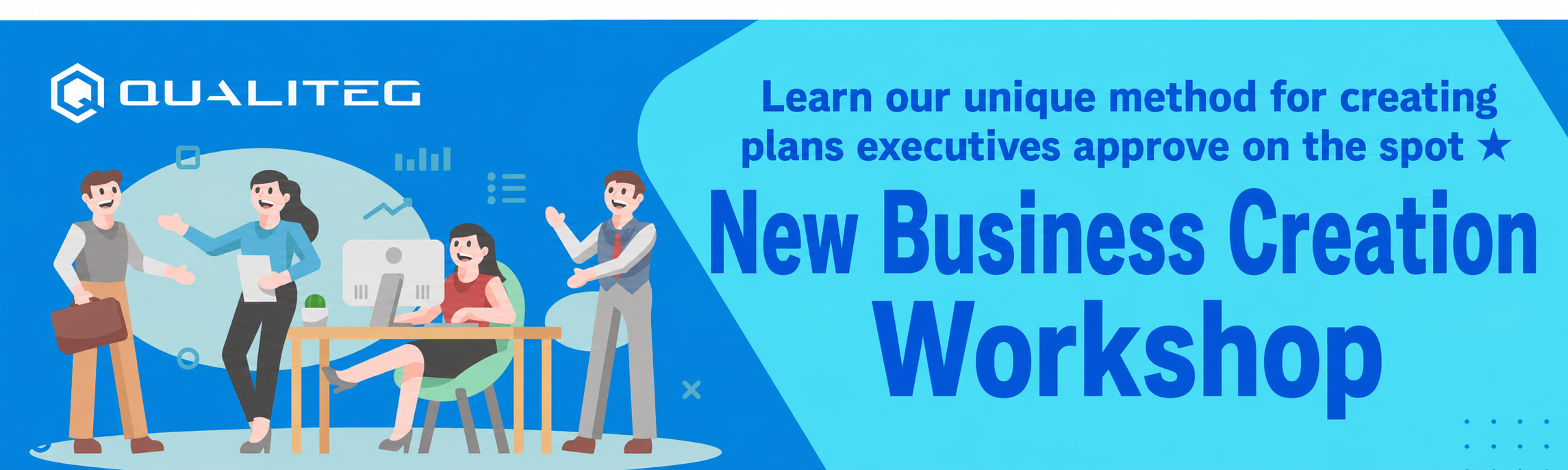
We also offer a popular workshop for those who want to master the steps of new business creation. The training focuses on having each participant think about the business from an executive's perspective, and the content is designed not only for planners but also for their counterpart engineers, designers, and marketers.
We sincerely look forward to hearing from you. And please look forward to the next column.
navigation