[AI-Driven New Business Creation] Qualiteg's Original Method for Defining Target Personas
Creating a persona is often a first-time experience even for corporate planners in new business training. Personas are essential to service design and marketing strategy: they must reflect real customers and clarify their behavior, motivations, and challenges.

![[AI-Driven New Business Creation] Qualiteg's Original Method for Defining Target Personas](https://images.unsplash.com/photo-1556761175-5973dc0f32e7?crop=entropy&cs=tinysrgb&fit=max&fm=jpg&ixid=M3wxMTc3M3wwfDF8c2VhcmNofDN8fHRhcmdldCUyMHVzZXJ8ZW58MHx8fHwxNzEzMDQyMjgzfDA&ixlib=rb-4.0.3&q=80&w=1200)
Hello to everyone visiting the Qualiteg blog. I'm Michele. In my work on AI-driven new business development and marketing, there are certain questions I hear from clients again and again. Through this blog, I would like to offer my own answers to the challenges that anyone considering an AI-based business is likely to face.
I often deliver new business development training for clients at publicly listed companies, and when we analyze the post-training surveys, I frequently hear comments like:
"Creating a persona for the first time was a real learning experience."
Some clients even tell me, "Honestly, it's embarrassing that even our own planning staff have never created a persona." When that happens, I reassure them:
"There is no need to feel that way at all."
After all, most of these people are planning staff at large companies. They usually join a project as the successor to a service that has been handed down over the years, and by the time they take over, the target users have already been decided.
It would not be an exaggeration to say that even planners at large companies rarely get the chance to define users from scratch for a brand-new offering. I hope this article helps you pick up at least some knowledge about how to build personas.
The cardinal sin of persona creation
The one thing you must never do is create what I call a "fantasy persona."

Because a persona is a fictional character who uses your company's product or service, most people end up dreaming up a conveniently agreeable person who happens to love the very service they are planning. That is a mistake.
It is truly pointless. A persona is an important asset used in service design, UX exploration, and marketing strategy. It needs to be a profile that represents your ideal customer, and it needs to make clear that person's behavior patterns, motivations, challenges, and the particular "trigger" that makes them willing to pay.
In other words, the persona is meant to be the shared anchor for the entire development team. If you give it a character setting that could never exist in reality, then not only the UX and UI but also the specifications and go-to-market strategy will all end up wildly off the mark.
Today is the day to graduate from "personas built on fantasy."
Otherwise, your business lead will simply say, "You just made up someone who happens to agree with you, didn't you?"
Qualiteg's Innovation-Cross is not merely a service provider but a strategic partner that drives innovation together with your company. From analyzing your current situation to formulating strategy and supporting execution, we walk alongside your innovation efforts with a long-term perspective.

Through diverse approaches such as ideation workshops, hackathon planning, and the use of cutting-edge AI technology, we realize the kind of innovation that is "hard to achieve alone" through collaboration with outside partners. Our experienced consultants develop a deep understanding of your vision and business environment, then drive innovative value creation by optimally combining internal and external resources. Rather than one-off consulting, we deliver sustained growth and stronger competitiveness through an ongoing partnership. Thinking together, creating together, growing together: that is our promise.
Defining a character for your persona
So how should you go about defining a character to build your persona?

Ideally, you will already have conducted quantitative research such as surveys before creating the persona. If you have not, use data from general survey research or your own interview studies as the source material for the persona.
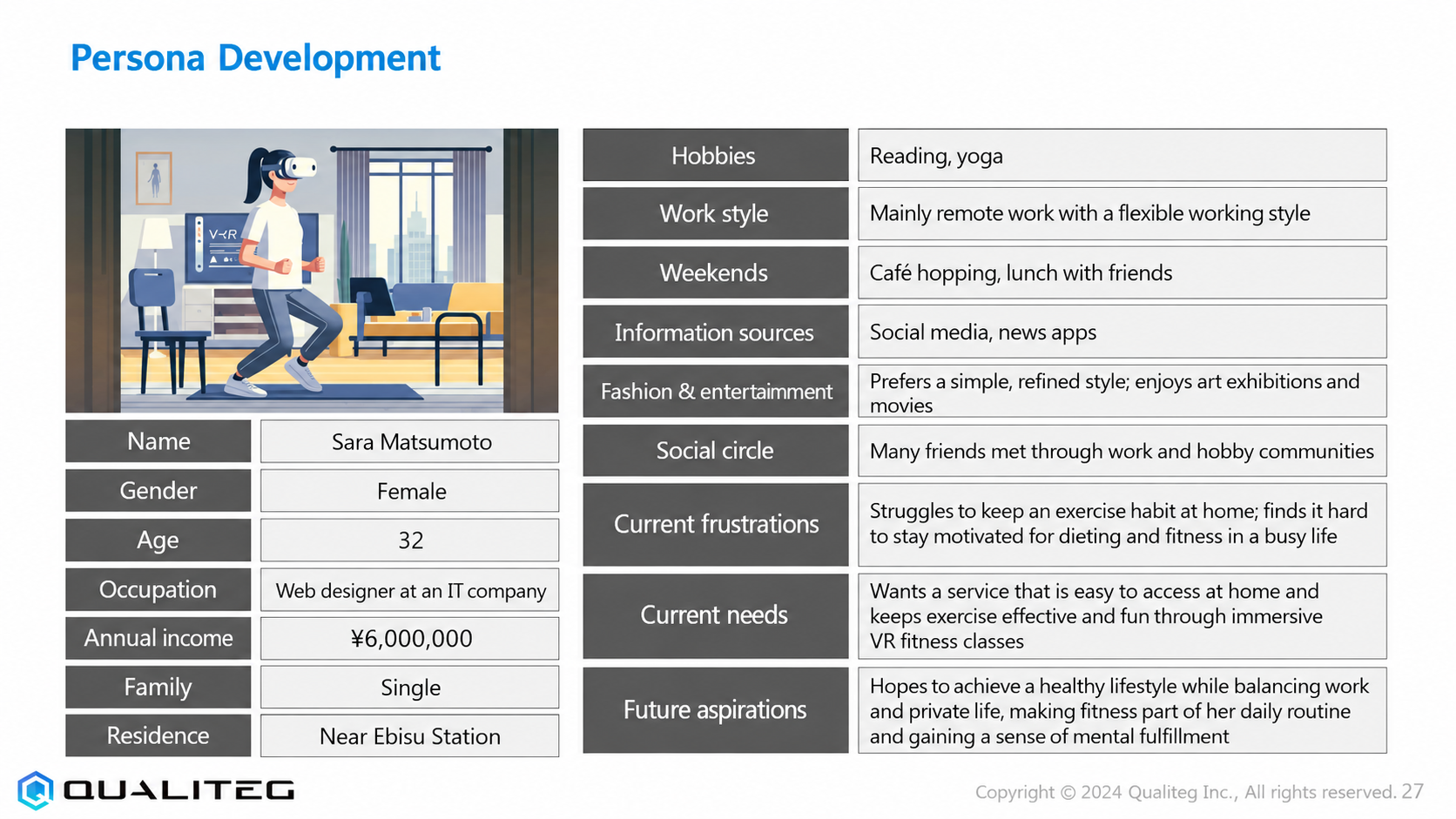
From the data you have collected, create a representative customer profile: the persona. Give this persona a concrete profile, including a name, age, occupation, and family composition.
So that the persona's values come through, also write down details such as the nearest train station to their home, their working style, how they spend their days off, and what is currently troubling them.
In this way, the persona becomes a concrete embodiment of the target customer for your product or service, and serves as the foundation for making development and marketing strategy more customer-centric and effective. It is important that the details of the profile are built on real customer data and reflect the behavior and needs of actual customers.
Another key point when creating a persona: I recommend giving them a distinctive personality rather than making them a bland, generic figure.
When you keep thinking in terms of the mass market, you often end up with a bland, run-of-the-mill persona. But the persona you create here is a "valued customer you will be with for as long as the service exists," so put enough affection into it that the whole team can call the persona by name and say, "That's just the kind of person they are."
If you flesh out the persona to the point where you can talk about them as a real person, the way you might describe a friend from your school days to a colleague at work, it becomes much easier to picture the service that person would love, and that is what makes creating a persona worthwhile.
Writing persona scenarios
Once the persona's profile is complete, the next step is to write the persona's scenarios. Describe in concrete terms the problems and challenges the persona faces in daily life: specifically, what frustrates them about competing services, what they weigh most heavily when choosing a service, how they discovered the service and came to purchase it, and at what times and in what situations they use it.
I recommend building these scenarios by picking out the most memorable details from each of the people you spoke with in exploratory interviews and merging them into the persona. This gives the persona the lived-in feel of a real, existing person.
How to validate and refine your persona
Nine out of ten people create a persona, feel satisfied, and stop there. Please remember that a persona needs to be actively used after it is created.
First, share the persona you have created with the development and marketing teams and gather their feedback. Compare it against real customer data to verify how realistic the persona is. I know all too well that the more heart you have put into a persona, the more you want to respond to others' feedback with, "No, that's not it. The persona I have in mind is..."

However, the whole purpose of creating a persona is to accurately reflect your real target customers so that it can serve service development and marketing strategy. So if you think something is off, discuss it thoroughly and keep talking until everyone is satisfied.
And do not stop at the initial team discussion. Keep updating the persona through subsequent interview studies, surveys, and post-launch research on your loyal users, and continue to pursue a "realistic picture of the customer" at all times.
Thank you very much for reading this column to the end. At Qualiteg, we provide training and consulting on AI technology and new business planning methods. If this has piqued your interest, or if you have specific requests, please feel free to contact us via the inquiry form here.

We also run popular workshops for those who want to master the steps of new business creation. The training focuses on having each participant think about the business from an executive's perspective, and the content is designed not only for planning staff but also for their counterparts in engineering, design, and marketing.
We sincerely look forward to hearing from you. Please stay tuned for the next column.
navigation