[AI-Driven New Business Creation] Qualiteg's Approach to Setting Goals in New Business Development
Goal setting for new business development takes five steps: 1) clarify the mission and vision via MVV analysis, 2) define approval criteria, 3) research competitors, 4) set quantitative goals, and 5) compile a new business direction sheet. Together they enable clear goals and effective development.

![[AI-Driven New Business Creation] Qualiteg's Approach to Setting Goals in New Business Development](https://images.unsplash.com/photo-1543351611-58f69d7c1781?crop=entropy&cs=tinysrgb&fit=max&fm=jpg&ixid=M3wxMTc3M3wwfDF8c2VhcmNofDI1fHxnb2FsfGVufDB8fHx8MTcxMzAxNzk4NHww&ixlib=rb-4.0.3&q=80&w=1200)
Hello, and welcome to the Qualiteg blog. I'm Michele. In my work on AI-driven new businesses and marketing, there are questions I hear from clients again and again. Through this blog, I would like to share my own answers to the challenges that anyone considering an AI-based business is likely to face.
Five Steps for Setting Goals in New Business Development
Goal setting for new business development is best approached in five steps. In this phase, you define the foundations for driving the new business forward: the goals, the plan, and so on.
This is the phase in which you conduct desk research and, if possible, qualitative interviews and other studies, shape a few hypotheses about problems and target customers, and set your goals.
Step 1: MVV Analysis
The very first thing Qualiteg recommends is to start with an MVV analysis.
MVV stands for Mission, Vision, and Values: the purpose, philosophy, and guiding principles each company defines for itself. The mission, first of all, describes why the organization exists and what it aims to accomplish.
In other words, creating a new business within a company has to be consistent with that company's purpose. You need to clarify why your company exists, what it aims to achieve through its business, and what its values and standards are, and then think about a new business that meets them.
We often hear from client companies that they planned a new business based on a spur-of-the-moment idea, only to give up when an executive asked "Why do we need to be the ones doing this?" and they had no answer. This is exactly why. You will need to answer whether the new business is worth doing at your company, so start by understanding your company's MVV.
True innovation balances short-term results with long-term sustainability. Innovation-Cross from Qualiteg Inc. is a co-creation support program that achieves this difficult balance. Based on an analysis of your company's current state, we formulate a strategy that combines quick-impact measures with the construction of a long-term foundation for innovation.
While generating short-term results through idea workshops and hackathon programs, we establish a long-term innovation ecosystem, one that is "hard to build alone," through open innovation and partner development. Our experienced consultants, including support for leveraging state-of-the-art AI technology, design mechanisms for innovation that deliver both immediate results and future sustainability. Through the power of co-creation, we realize today's success and tomorrow's possibilities at the same time.
Step 2: Define the Criteria for New Business Approval
Why are you planning a new business right now? When we ask this of people at our client companies, many are actually stuck for an answer. The most honest reply we hear is often "Because an executive told me to plan a new business," but when we follow up with "And why is that?" the conversation frequently stops there.
When someone above you says "plan a new business," answering "yes" is of course necessary, but what is it for? Is it to grow the company's revenue? To build a new business pillar? Because a competitor has launched something and you want to enter the market immediately? To communicate social contribution from an SDGs perspective? To send a clear message to students in order to strengthen recruiting? The reasons vary widely.
To get a new business plan approved by your executives, first clarify what this new business is for and what needs to be achieved for it to count as a success (that is, what would earn approval to commercialize the new idea).

Step 3: Survey Competing Services
Once the direction of your new business is decided, the next step is competitive research. Frankly, many clients ask us why they need to look at other companies when they are exploring a new business.
I hold dear the saying "innovation begins with imitation." Many people declare that a completely new idea is a blue ocean, but in many cases nobody is in that business simply because there is no market for it.
Even for a new business, adjacent use cases exist. Customers will be choosing and paying for your service in place of some existing desire or something they were already paying for, so you need to identify what that "something" is.
Even where there is no direct substitute use case, there are often examples that can serve as references for how money flows in a business model or for how a technology can be applied. So rather than rushing into idea generation, I recommend settling in and, if possible, spending a solid two weeks on thorough research.
Step 4: Define Quantitative Goals
Here, for the direction decided in Steps 1 through 3, set numerical targets for what kind of impact, and how much of it, you want to have on your company, the market, and society.
For example, if the purpose is to strengthen recruiting, a quantitative goal could be "XX students applied and expressed a wish to work on this business during interviews." If the purpose is to expand your sales channels, the goal could be "XX press releases issued by partner companies announcing services that incorporate ours."

What matters is deciding in advance what this new business is for, and what measurable criteria, in what quantities, will count as having achieved it.
Among our clients, middle managers in particular often say, "I don't want to set numerical targets up front, because it's a problem if we don't hit them." (On the other hand, many people on the front line set quite aggressive targets.)
At Qualiteg, we strongly advise setting numerical targets at this stage. The reason (although it of course depends on the client company's culture) is that, to be honest, in many companies once a new business succeeds, people suddenly appear claiming "that was my doing," and unfortunately we have seen many people have their achievements taken from them.
That is why we believe you need to have a mechanism in place from the outset that proves you were the one who planned it and that it succeeded (that is, it met the numerical targets set in advance). This is the reasoning behind our advice.
Step 5: Compile the New Business Direction Sheet
Once you reach Step 5, the goal of goal setting is almost within reach.

Compile what you have researched so far, along with the criteria your company will use to approve commercialization, into a document.
The reason you need to document it here is that you will use this document to obtain approval from your executives: "Is it acceptable to explore the new business with this approach?"
If you secure approval for the approach at this point, you will no longer receive vague rejections of your proposal later on, such as "This isn't what I had in mind."
There is another benefit: even if the proposal you bring in is turned down, the decision will be made accurately against the criteria set here ("part XXX differs from what we intended," for example) and the reasons will be clear, so the points to improve going forward become clear as well. Be sure to build consensus with your executives at this stage.
I will cover the details of each of Steps 1 through 5 in separate blog posts, but this is the overall flow of goal setting. What did you think?
Thank you very much for reading this column to the end. At Qualiteg, we provide training and consulting on AI technology and on methods for planning new businesses. If you are interested, or if you have a specific request, please feel free to contact us through the inquiry form here.

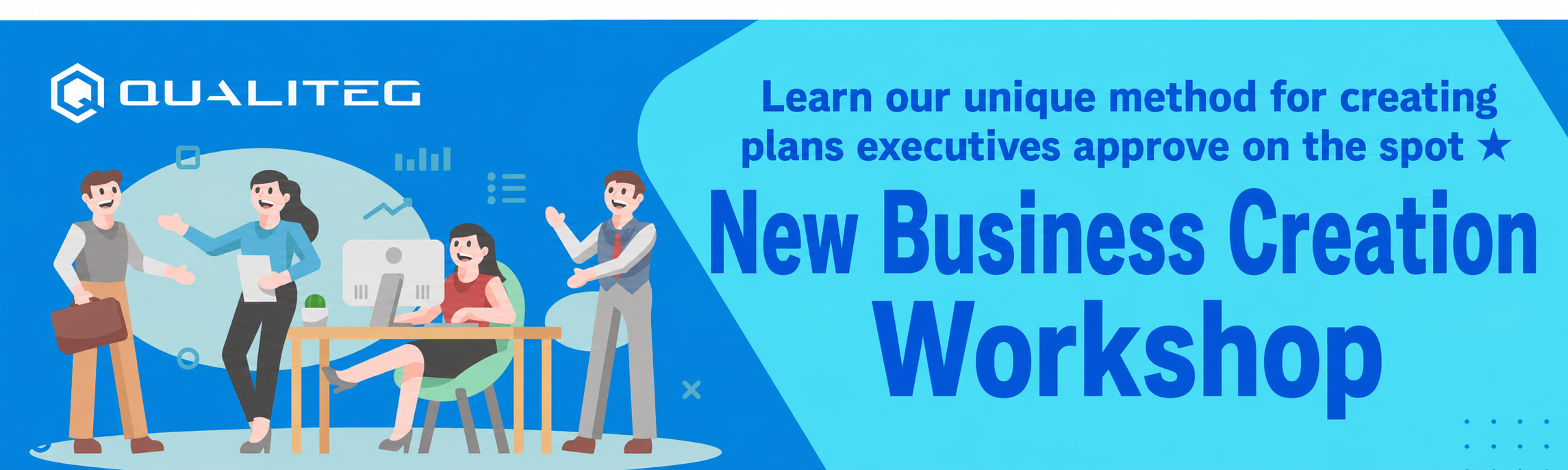
We also offer a popular workshop for those who want to master the steps of new business creation. The training focuses on having each participant think about a business from an executive's point of view, and the content is designed not only for planning staff but also for their counterparts in engineering, design, and marketing.
We sincerely look forward to hearing from you. Please stay tuned for the next column.
navigation