[AI-Driven New Business Creation] Qualiteg's Original 7 Steps for Hypothesis Exploration and Customer Understanding
In new business development, clients are often unfamiliar with "hypothesis exploration." Before thinking up a business idea, you need customer problem hypothesis exploration to grasp your target users' real problems. This shapes service ideas the market truly wants and raises the odds of success.

![[AI-Driven New Business Creation] Qualiteg's Original 7 Steps for Hypothesis Exploration and Customer Understanding](https://images.unsplash.com/photo-1623252055581-a3ef2ffcefe7?crop=entropy&cs=tinysrgb&fit=max&fm=jpg&ixid=M3wxMTc3M3wwfDF8c2VhcmNofDN8fG1pbGVzdG9uZXxlbnwwfHx8fDE3MTMwNDI0NTV8MA&ixlib=rb-4.0.3&q=80&w=1200)
Hello, and thank you for visiting the Qualiteg blog. I'm Michele. In my work on AI-driven new business development and marketing, there are questions I hear from clients again and again. Through this blog, I'd like to share my own answers to the challenges that anyone considering an AI-based business is likely to face.
When I talk with clients about the need for "hypothesis-exploration interviews," a surprising number of them respond, "This is the first time I've heard the term hypothesis exploration!"
In new business development, before you think about what kind of service to build, you first need to confirm what problems your target users actually have. That is the phase we call "customer problem hypothesis exploration."
Today, I'd like to explain concretely how you should approach this "customer problem hypothesis exploration" and "customer understanding."
To begin with, whose "problem" should the "problem" be?
At Qualiteg, we strongly recommend taking the step of "exploring hypotheses about customer problems." The reason is that when most people come up with new business ideas, they do so in the spirit of "Oh, wouldn't it be nice if something like this existed?" — and that is a real mistake. (If you're reading this and just felt a twinge of recognition, you're not alone.)
In fact, even senior people at consulting firms often come to me with concerns like this:
When we consult on new businesses, the starting point tends to be the personal frustrations of the client's contact person — things like "writing daily reports is a hassle." So even when we take that into a DX study, we end up with small-scale proposals. Even if we push the consulting engagement as far as we can, there's no real business viability, so it ends at the PoC stage and never leads to the next step, like a study toward commercialization. What should we do?
That is a question I hear quite often.

To put it bluntly, my answer is usually this: is that a problem someone would actually pay money to solve? If not, it won't become a business. In most cases, that is exactly where things stand.
Even if you, as the planner, started out feeling "this problem really resonates with me," I would want to ask you one thing:
"How much would you personally be willing to pay, reliably, every month, to have that problem solved?"
That is the question.
Those who typically fail at new business planning — and those who hire well-known consulting firms, spend a fortune, end up with a lineup of small ideas, and ultimately never reach commercialization — have a problem right here, in the initial "problem definition."
The source of a company's competitiveness lies in its intellectual assets. Qualiteg's Innovation-Cross is a program that strengthens and expands a company's intellectual assets through co-creation.
Through an analysis of the current state, we visualize the company's intellectual assets and formulate a strategy to maximize their value. In idea workshops we turn internal tacit knowledge into explicit knowledge, while through open innovation and partner development we bring in knowledge and technologies from outside that would be difficult to acquire on your own, expanding your intellectual asset portfolio. Including the use of cutting-edge AI technology, our experienced consultants realize innovative value creation by optimally combining your intellectual assets with external resources. Through the fusion and creation of knowledge, we help establish a sustainable competitive advantage for your company.
The New Business Development Method Qualiteg Recommends
In the new business development method Qualiteg recommends, we regard leveraging your existing sales channels as the very first step in leveraging your company's assets. Accordingly, the style we advocate is: ”Plan a different service aimed at the target users of your existing service.” That is the approach we recommend.
To borrow an example from a certain fast-food chain, it is the familiar "cross-sell" strategy of "Would you like fries with that?"
If the target customers are the same, the same sales team can keep performing after the service is introduced, and there is no need to maintain two websites, one for B2B and one for B2C.

So, once the target users are decided, how should you proceed with hypothesis exploration and customer understanding?
The Seven Steps Qualiteg Proposes
In this Discover phase — the phase where customer problem hypothesis exploration and customer understanding are required — Qualiteg believes the work should proceed through the following seven steps.
- Research design and preparation for customer problem hypothesis exploration
- Conducting customer problem hypothesis-exploration interviews
- Reviewing interview results and drawing out insights
- Developing personas based on the interviews
- Building empathy maps based on the interviews
- Defining customer problems based on the interviews
- Evaluating and comparing customer problems
I will walk through how to carry out each of these steps in an upcoming post.
Thank you very much for reading this column to the end. At Qualiteg, we provide training and consulting on AI technology and on methods for planning new businesses. If this has caught your interest, or if you have specific requests, please feel free to reach out via our contact form here.

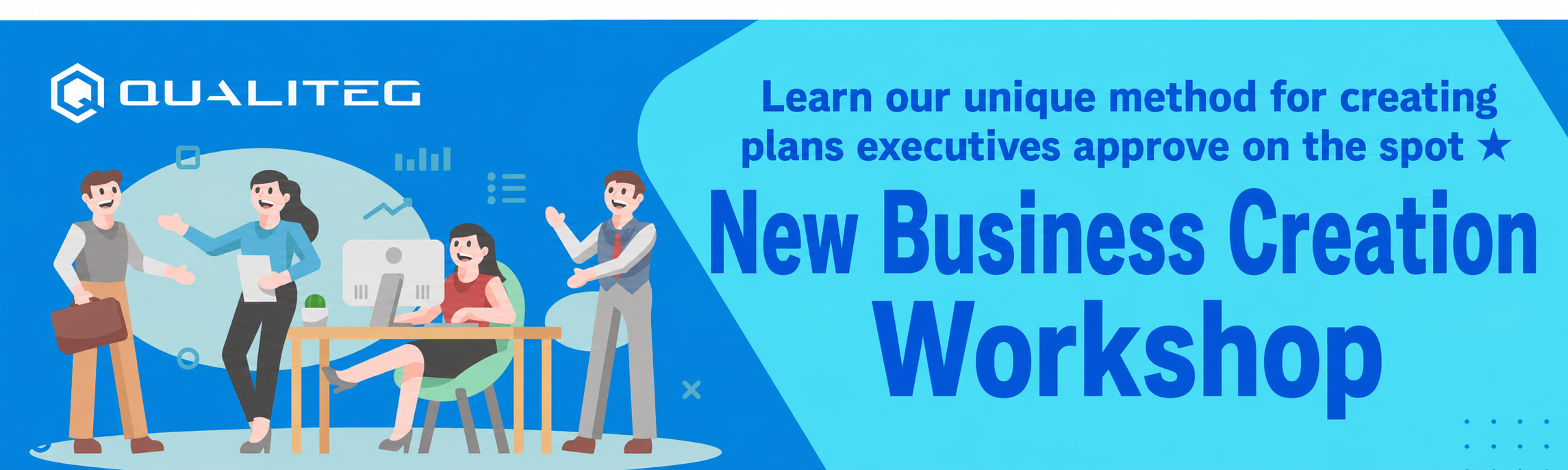
We also run a well-received workshop for those who want to master the steps of new business creation. The training focuses on having each participant think about the business from an executive's perspective, and the content is designed not only for planning staff but also for their counterparts — engineers, designers, and marketers.
We look forward to hearing from you. Please stay tuned for the next column.
navigation