What Sets ngrok and WireCanal Apart? The Developers Compare Pricing, Operations, and MCP Design
An honest comparison from the developers of WireCanal, a Japan-based service built on the same reverse tunnel approach as ngrok. The differences come down to three: pricing philosophy, where operations run, and where permissions live when connecting to AI.

Hello!
This is the Qualiteg Product Development Team!
"Is there a Japan-based tunnel service that can serve as an alternative to ngrok?"
Many of you have likely arrived at this article after searching for exactly that.
This article answers that question head-on, from the developer's side.
Let us be clear from the start: the service introduced here, WireCanal , is developed and operated by our company (Qualiteg Inc.), a Japanese corporation, with its relay infrastructure running on servers in Japan — atunnel service.
Since this is an article in which we compare our own product, listing only the points that flatter us would earn no one's trust. Where the two are the same, we say so; where ngrok is the better fit, we say that too.
To state the conclusion up front:
the basic tunneling mechanism is the same as ngrok's。
There are three differences.
The pricing philosophy (a USD-denominated structure with fixed allotments and usage-based elements, versus a flat JPY rate with no overage billing) · the shape of operations and contracting (domestic relay infrastructure and a Japanese-language, JPY-denominated contract with a Japanese corporation) · and where permissions live when connecting to AI (the authoritative permission ledger stays on the company's side)
If none of these three matter for your use case, there is no need to force a switch. Let us look, in order, at what is the same and what is different.
The Mechanism Is the Same, So There Is Almost Nothing to Relearn
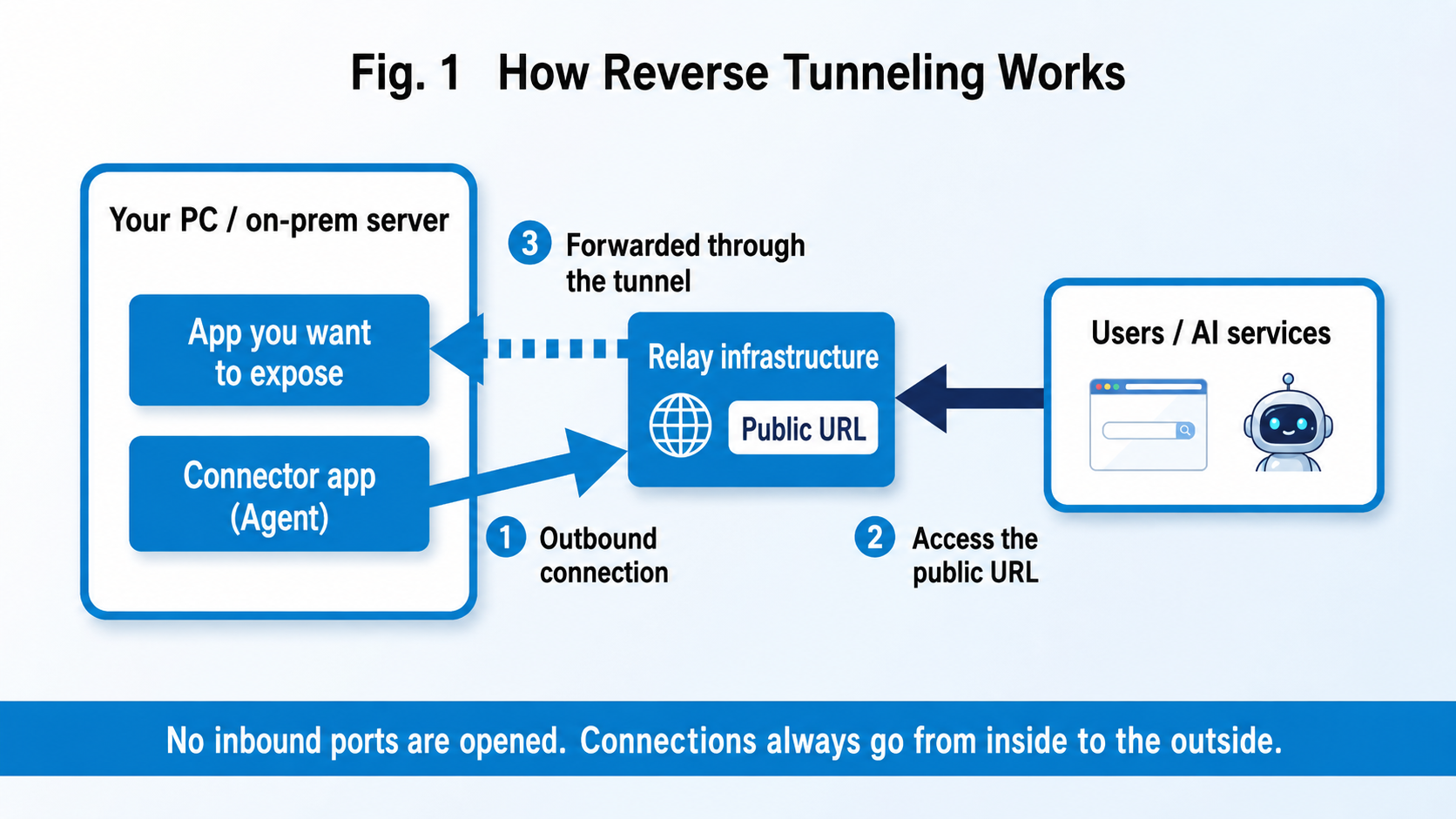
The reverse tunnel approach that ngrok made widely known works like this: place a small program (WireCanal calls it the Agent) on your PC or an internal server, and it connects outward, from the inside, to a relay server to establish a tunnel. A public URL is created on the outside, and access arriving there flows through the tunnel back to your machine.
The advantage of this approach is that no inbound port needs to be opened on the firewall.
WireCanal is built on the same idea (Figure 1). Run a command to install the Agent, create a public route called a canal, and specify a local port as the forwarding target. If you have used ngrok, there is essentially nothing conceptual to relearn.
Note that today's ngrok has broadened its product scope with cloud-side endpoints and more, but this article compares the basic configuration: publishing local and internal services using an Agent.
So what this article should address is not "which one is superior," but how the design beyond that point differs.
Difference 1: Pricing Is a Flat Rate in JPY, Tax Included
ngrok offers plans such as Free, Hobbyist, and Pay-as-you-go (as of August 2026, confirmed on the official site). First, a comparison of the structures.
| Aspect | ngrok (official site, as of August 2026) | WireCanal |
|---|---|---|
| Plan structure | Free / Hobbyist ($10/month, fixed) / Pay-as-you-go ($20/month allotment + usage-based overage) | Free ¥0 / Lite ¥1,580 / Pro ¥3,580 / Premium ¥11,800 (all flat monthly rates, tax included) |
| When the allotment is exceeded | Hobbyist: endpoints suspended until the end of the billing period / Pay-as-you-go: overage billed additionally | No additional billing. On Free, speeds may be adjusted beyond the guideline of 10GB/month |
| Currency and billing | USD (varies with exchange rates) | JPY, tax included (invoice payment available for Enterprise) |
Pay-as-you-go, intended for production use, includes a $20 monthly allotment, with additional charges beyond it based on transfer volume, request counts, endpoint uptime, and so on. Paying for what you use is a rational design, but the bill for a month when usage grows is hard to predict in advance, and being USD-denominated, it also moves with exchange rates.
WireCanal made every plan a flat monthly rate in JPY, tax included. The differences between plans are as follows.
| Plan | Monthly (tax incl., monthly billing) | Main differences |
|---|---|---|
| Free | ¥0 | 1 canal · HTTPS/MCP publishing · 8 types of access protection |
| Lite | ¥1,580 | Persistent public hostname · reserve your preferred subdomain |
| Pro | ¥3,580 | 3 canals · TCP (RDP/SSH/DB, etc.) |
| Premium | ¥11,800 | 20 canals · 1Gbps (best effort) · custom domains · API |
With annual billing, the monthly equivalents become Lite ¥1,280, Pro ¥2,980, and Premium ¥9,980.
There is no additional billing based on transfer volume.
The Free plan has a guideline of 10GB per month, and speeds may be adjusted when it is exceeded. Paid plans have no monthly transfer cap for normal use, but to keep usage fair and maintain the network, extreme high-volume traffic may be subject to speed limiting or similar measures.
To be candid, a flat rate is not always the better deal. Depending on your scale and use case, ngrok's Free, Hobbyist, or Pay-as-you-go plans may work out cheaper. The value of flat-rate pricing lies in knowing the bill in advance, and it matters more the more your organization relies on approval workflows and budget planning.
Difference 2: Runs in a Domestic Region, with Contracts, Billing, and Support Completed in Japanese and in JPY
WireCanal's relay infrastructure is deployed in a domestic (Japan) region. Contracts and support are provided in Japanese by our company, a Japanese business, and billing is in JPY. Here too, a table to organize the comparison.
| Aspect | ngrok | WireCanal |
|---|---|---|
| Points of presence | 8 locations worldwide (including Tokyo) · region-pinned routing available | Operated in a domestic (Japan) region |
| Contract and support language | English | Japanese (Japanese corporation) |
| Billing | USD | JPY, tax included. Invoice payment available for Enterprise |
Note that ngrok also has a Tokyo point of presence (PoP) and a mechanism for region-pinned routing. So this is not a simple "has a domestic route or not" comparison. What sets WireCanal apart is that operating the relay infrastructure on servers in Japan is an explicit part of the service design, packaged together with a contract with a Japanese corporation, Japanese-language support, and JPY billing.
For organizations where "requests to use overseas SaaS rarely get approved internally" or "accounting is a headache without a JPY invoice," this is not a matter of feature superiority — it is the deciding factor in whether adoption is possible at all.
To be honest here as well: a domestic region does not mean it is always faster than overseas services. Actual latency varies with your location, destination, and route. Conversely, if your primary goal is to serve users around the world, or to use the service the same way from overseas offices, ngrok or Cloudflare — with their global points of presence — are the better fit.
Difference 3: The "Permission Ledger" for What AI May See Lives on the Company's Side
This is the part we thought through most carefully.
MCP (Model Context Protocol) is spreading as the way to let generative AI operate internal systems. In practice, the question then becomes: which of your internal system's capabilities do you let the AI touch? An internal MCP server typically hosts everything from read-only tools to tools that update and delete.
The idea of controlling MCP at the gateway when connecting to external AI is not ours alone. Here is what can be confirmed in each vendor's official documentation.
| Service | What the gateway can do (from each vendor's official docs) |
|---|---|
| ngrok | Source restrictions via Traffic Policy · required Authorization headers · rate limiting, etc. |
| Cloudflare | MCP Server Portals let you select which tools to expose per portal |
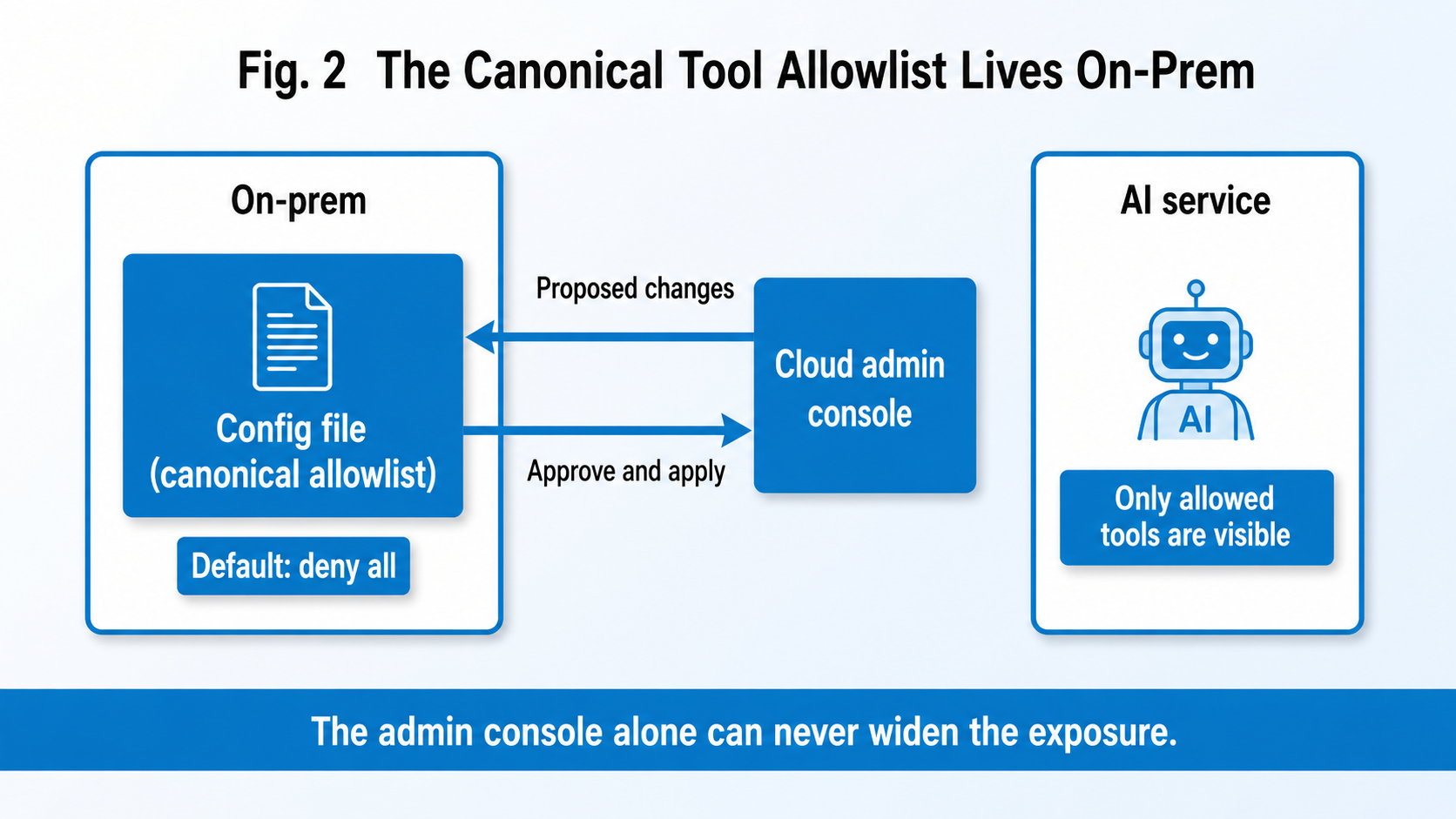
| WireCanal | Per-tool permissions (default: deny all), plus the authoritative permission ledger lives in a configuration file on the company's side. The cloud console can go only as far as proposing changes |
What makes WireCanal different is that, in addition to per-tool permissions themselves, the authoritative copy of that permission ledger lives ina configuration file on the company's side (Figure 2).
wirecanal.json(the tool permission section, excerpt)
{
  "tools": {
    "default": "deny",
    "allow": ["execute_sql_query", "get_database_stats"]
  }
}
The default denies everything, and only the tools written in this allow list are visible to the AI. Tools that are not permitted do not even appear in the tool listing (tools/list). The cloud console can go only as far as proposing changes; applying them requires an approval action on the company's side. In other words, ordinary console operations alone cannot widen the exposure scope without in-house approval.
One more thing: the Agent connects only to the forwarding targets registered in its configuration file, and does not accept instructions from the cloud side to change targets dynamically. The Agent itself is restricted so that the tunnel's exit cannot become a general-purpose relay toward arbitrary internal destinations.
The procedure for actually connecting a self-built MCP server to web-based ChatGPT and Claude is published, with screenshots, in a series on this blog. Links are at the end of this article.
When Staying with ngrok Is the Right Call
As you can tell from reading this far, WireCanal suits those who want to operate domestically, with predictable pricing, while governing what is exposed to AI. Organized by use case, it looks like this.
| Use case | Suitable choice |
|---|---|
| Serving users around the world · primary use from overseas offices | Global services such as ngrok or Cloudflare |
| You already have configuration assets such as ngrok Traffic Policy | Continue with ngrok |
| Personal testing with very little transfer volume | Either ngrok Free or WireCanal Free works; choose by preference |
| JPY billing, Japanese-language contracts, and domestic relay infrastructure are requirements | WireCanal |
| You want to publish MCP while governing which tools AI can see | WireCanal (the authoritative permission ledger stays on the company's side) |
Choose your tools by use case. If there is no compelling reason to switch, staying put is itself a sound decision.
How Far You Can Go for Free
WireCanal's free plan hasno time limit、and requires no credit card registration。
With one canal, everything is available: HTTPS publishing, MCP publishing (OAuth integration with ChatGPT, Claude, and others), and all 8 types of access protection including IP restrictions, BASIC authentication, Bearer tokens, and time-window publishing.
The public hostname does not disappear as long as it is in use. While the Agent's connection is alive, its expiration is extended automatically, and it expires 72 hours after the last connection (it can be recreated after expiration). When you find yourself wanting to choose the name yourself, or to keep the same name even while disconnected, that is the time to consider Lite or above.
We recommend starting by publishing one of your own web apps or an MCP server and seeing how it feels to use.WireCanal is free to start (wirecanal.com)。
Summary: Same Approach, Different Placement
ngrok and WireCanal stand on the same foundation: the reverse tunnel. The differences come down to three points — how you pay (a USD-denominated structure with fixed allotments and usage-based elements, versus a flat JPY rate with no overage billing), the shape of operations and contracting (domestic relay infrastructure with a Japanese-language, JPY-denominated contract with a Japanese corporation, versus using a global service), and keeping the authoritative AI tool permission ledger on the company's side.
A tunnel service, once woven into your operations, is a tool you live with for a long time. Choose not just by the checkmarks on a feature table, but by whether these three placements fit your organization — and you will not regret it later.
See you next time.
References (Primary Sources)
- ngrok pricing plans (official site) * Confirmed against the content as of August 2026
- ngrok's official MCP gateway guide (ngrok Docs)
- ngrok points of presence (ngrok Docs)
- Cloudflare MCP Server Portals (Cloudflare Docs)
- WireCanal plan and feature comparison table (wirecanal.com)
- WireCanal's guide to MCP and AI integration (wirecanal.com)