
The Complete Guide to Subscription Business, Part 1: Never Get Lost in "ARPU This" and "Churn That" Again

Why the subscription model is changing the world—and will the rise of AI spell the end of SaaS?
Hello!
This is Qualiteg Consulting.
Working with clients every day as new-business strategy consultants, we have noticed a sharp recent rise in inquiries about SaaS businesses. What is interesting is the diversity of motivations behind them. Some companies simply want to improve their revenue model, while others say,
"Through the shift to SaaS, we want to be seen as a digital-native company too"
—and quite a few traditional large enterprises hold this very aspiration.
The term SaaS began to take real hold in the Japanese business scene in the early 2010s. Roughly 15 years on, SaaS is now treated almost as a badge of a forward-thinking company.
First, a note on the name: in Japanese, SaaS is pronounced サーズ (sāzu).
(サース (sāsu) is not wrong either—both are fine.)
And then there are the others:
MRR, ARR, ARPU, churn rate, NRR, Rule of 40...
We often see new-business managers sitting in executive meetings where these buzzwords fly back and forth—bewildered, yet anxious not to be left behind.

At the same time, the rapid evolution of AI agents since 2024 raises a new question. In an era where AI executes tasks autonomously and generates functionality on demand, the SaaS model itself—"renting" features for a fixed monthly fee—may turn out to be transitional. That possibility cannot be ignored.
So, starting today, we are launching a five-part series that thoroughly explains the SaaS business. We begin by sorting out the essence of the SaaS business model and how all those specialized terms relate to one another, then move on to customer acquisition strategy, the mechanics of growth, and the metrics investors watch. In the final installment, we confront the fundamental question: will SaaS come to an end in the age of AI?
We will break the jargon down into forms you can actually use in the field. Precisely because we are entering an era where AI agents are commonplace, understanding SaaS now is worth your while—that is our conviction. So let's dive together into the deep world of subscription business.
SaaS Woven into Everyday Life
Let's start by looking at our own daily lives.
Netflix, Spotify, Amazon Prime, Microsoft 365, Adobe Creative Cloud—before we knew it, our daily lives became surrounded by subscription services.What was once taken for granted as something to "own" is now
something we "use for a set period of time"—the era has changed.
This shift was revolutionary not only for consumers but for companies as well.
Instead of selling a product once and moving on, you build an ongoing relationship with customers and earn stable revenue every month. It is like laying a water line instead of digging a well.
Yet many companies that attempt the subscription model fail.
"Customers keep growing, but losses keep mounting"

"Cancellations won't stop"

"No one can see when we'll turn a profit"
The root cause of these struggles is
a failure to understand the mechanisms and metrics unique to subscription businesses.
In this blog series, we will carefully explain, one step at a time, everything you should know before starting a subscription business—written so that even beginners can follow along. We break down the jargon too, so read on with confidence.
Chapter 1: Understanding the Essence of Subscription Business
What Is a Subscription, Anyway?
What Is a Subscription, Anyway?
The word "subscription" translates into Japanese as 定期購読 (periodical subscription) or 会費制 (membership system). It originally referred to newspaper and magazine subscriptions, but it has since come to mean any business model in which paying a recurring fee grants ongoing access to a service.
The company that revolutionarily brought this model into the software industry was Salesforce, founded in 1999. Founder Marc Benioff was an engineer who came from Oracle, where enormous license fees and complex implementation processes were the norm—and he sensed a deep contradiction in that. "Why can't small and midsize companies use software as good as what large enterprises use?" That question became the starting point of the SaaS revolution.

Under the slogan "No Software," Benioff overturned the conventional wisdom of the day—buying packaged software for hundreds of thousands of yen and installing it on your own servers—and realized a world where anyone with a browser could use CRM software for a monthly fee.
This was the beginning of SaaS (Software as a Service) and the origin of today's subscription economy.
Incidentally, we are Salesforce customers ourselves.
Now, let's compare this with the traditional "one-time sale" business using a concrete example. When you buy a television for 100,000 yen, you pay once and use it until it breaks. Your relationship with the manufacturer essentially ends at purchase, and the manufacturer's revenue is locked in at the point of sale.
With a subscription like Netflix, on the other hand, you keep paying 990 yen a month and can use the service until you cancel. New content is added constantly, and the relationship with the provider continues.
The difference looks simple, but it brings a revolutionary change to the structure of the business. In one-time sales, what mattered was how much you could sell; in subscriptions, what matters is how long customers keep using you. The model Salesforce proved was later adopted by Adobe, Microsoft, and now companies around the world as a standard business model.
Why Companies Choose the Subscription Model
Companies adopt the subscription model for several reasons. First, revenue predictability improves dramatically. With 10,000 members paying 1,000 yen a month, you can expect roughly 10 million yen in revenue next month as well. With one-time sales you never know whether this month will sell or not, but with subscriptions, financial planning becomes easier and investment decisions become sharper.
It also enables continuous relationship-building with customers. Rather than selling once and moving on, you get ongoing opportunities to improve the service and raise customer satisfaction—folding in customer feedback to make the service better and better.
That was a groundbreaking change, one that was difficult to achieve in the one-time-sale world.
From an investor's perspective, too, the subscription model is attractive. Companies with predictable, stable revenue are valued highly. Even at the same 1 billion yen in annual revenue, it is not unusual for a subscription company's valuation to be three to five times higher than that of a one-time-sale company.
Moreover, there are abundant opportunities for upselling and cross-selling to existing customers.
Upselling means moving customers to a higher-tier plan. For example, a Zoom free-plan user upgrades to a paid plan to remove the 40-minute limit, or a basic-plan user upgrades to a business plan to use recording or webinar features.
Meanwhile, cross-selling refers to having customers purchase related additional services—for example, selling Teams or extra OneDrive storage to customers already using Word and Excel through Microsoft 365.
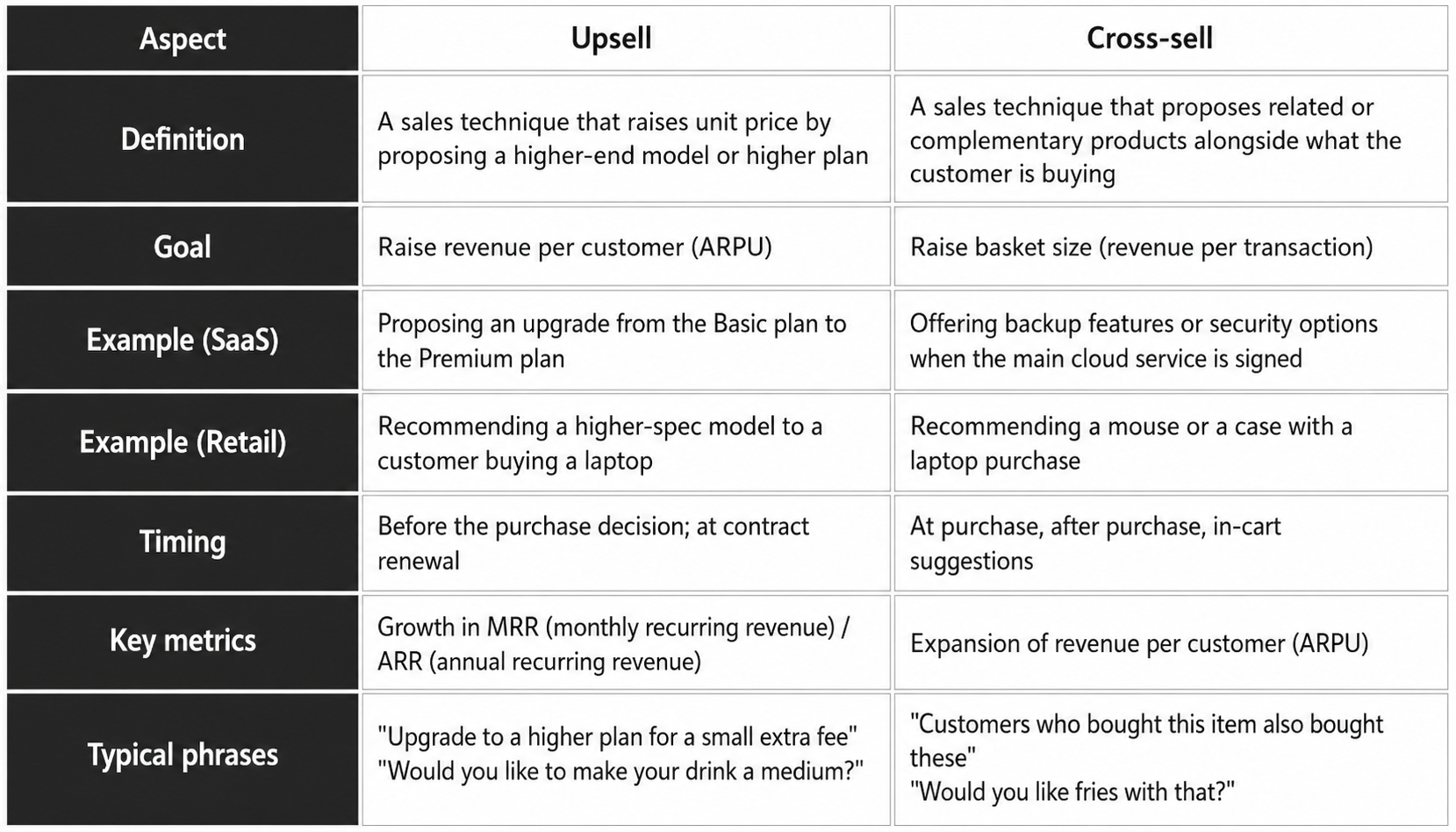

Acquiring a new customer is said to cost five to ten times as much as selling more to an existing one. Because the relationship with existing customers continues in a subscription model, it becomes natural to propose upsells and cross-sells at the right moments—offers grounded in actual usage, such as "you seem to be using this feature a lot lately; the higher plan would make it even more efficient."
The continuous accumulation of customer usage data is another major advantage. You gain valuable insights: which features are used most, which customers are likely to churn, and when upsells tend to succeed. Leveraging this data dramatically accelerates the pace of service improvement.
The Revolutionary Concept of LTV (Customer Lifetime Value)
The single most important concept for understanding subscription business is
LTV (Lifetime Value)
.
It means the total revenue a single customer brings to a company from the day they start using the service until the day they cancel.
There are two ways to calculate LTV: a simple one and a precise one. The simple method multiplies the monthly fee by the average number of months a customer stays. For example, a 5,000-yen-per-month service with an average retention of 24 months yields an LTV of 120,000 yen.

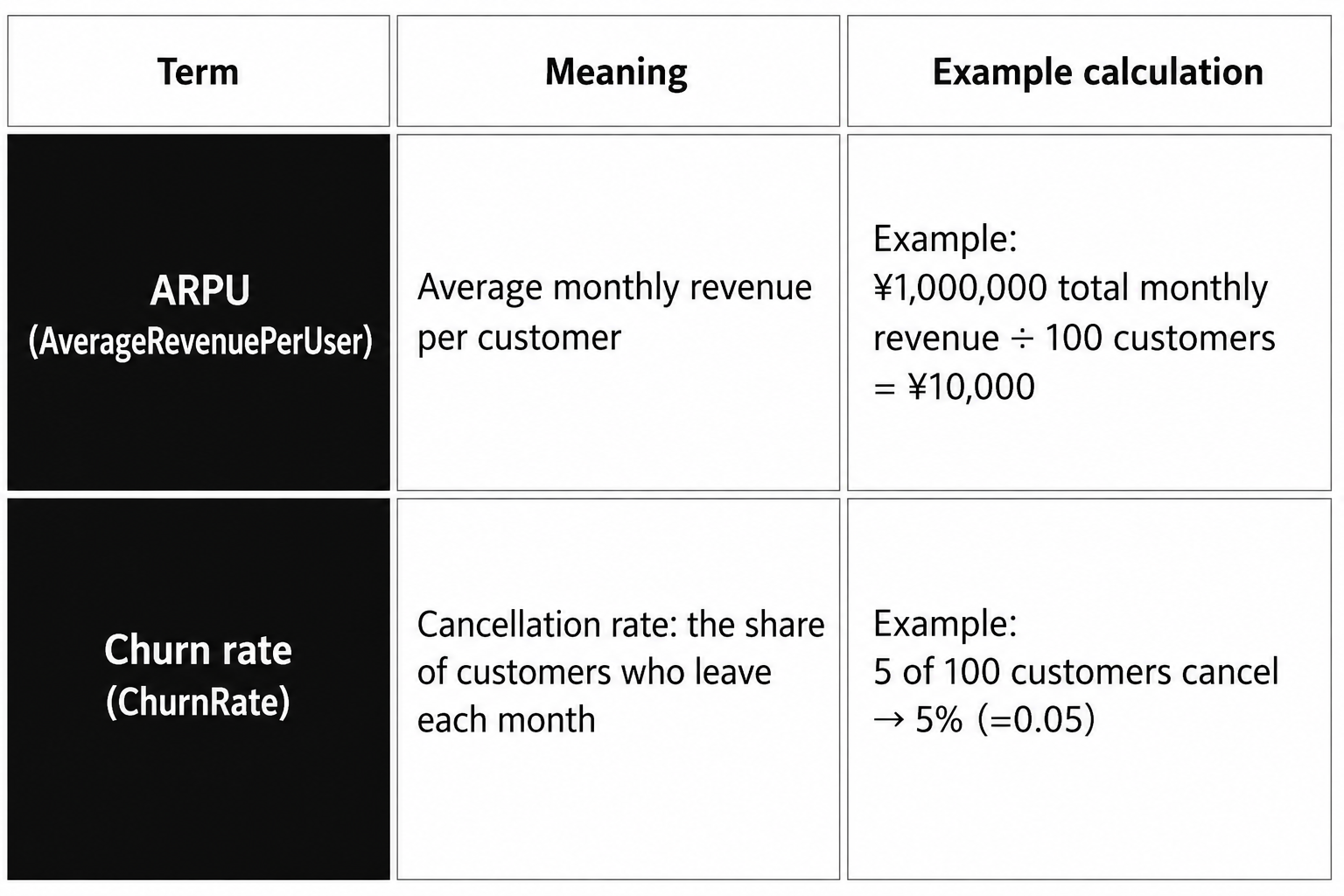
For a more precise LTV calculation, you divide ARPU (average monthly revenue per user) by the churn rate (monthly cancellation rate).

With an ARPU of 5,000 yen and a monthly churn rate of 5%, LTV comes to 100,000 yen. This method reflects the actual dynamics of the business more accurately.
What makes the concept of LTV revolutionary is that it values customers by their worth over time, not by immediate sales.
For example, even if the first month runs at a loss while you recoup advertising costs, a customer who stays for two years becomes highly profitable. LTV made it possible to design a business with this long-term perspective.
In traditional retail, you bought inventory, added a margin, sold it, and the difference was your profit—a very simple, easy-to-understand model. In a subscription business, however, spending 100,000 yen to acquire a customer might return 300,000 yen if that customer stays for three years. This notion of profitability across a time axis vastly expanded the possibilities of business.
Unit Economics: The Yardstick of Business Health
Unit economics is the metric that expresses "profitability per customer."
Simply put, it is the balance between the cost of acquiring one customer and the revenue that customer generates—arguably the single most important yardstick for measuring the health of a subscription business.
Unit economics is
calculated by dividing LTV by CAC (Customer Acquisition Cost).


What matters here is
LTV > 3 × CAC
—the golden rule. In other words, each customer should generate at least three times the cost of acquiring them.
Let's look at this through a concrete business example.
An Example SaaS with LTV = 200,000 Yen
Consider
a SaaS service priced at 10,000 yen per month with an average retention of 20 months (LTV = 200,000 yen).
Case 1: CAC (Customer Acquisition Cost) = 200,000 yen (ratio 1.0)
It costs 200,000 yen to acquire one customer, and the revenue from that customer is also 200,000 yen.
In other words, the profit is zero.
In this state, acquiring customers earns you nothing—it is volunteer management.
Every yen you spend on advertising simply evaporates, so the business is not sustainable.
Case 2: CAC (Customer Acquisition Cost) = 100,000 yen (ratio 2.0)
Acquiring one customer costs 100,000 yen, against an LTV of 200,000 yen.
At first glance you might think, "We're making 100,000 yen in profit!"
—but in reality, you still need to subtract the following operating costs from that amount.
- Server and cloud costs
- Customer support staffing
- Office and tool expenses
- Development, sales, and administrative costs
After subtracting these, very little profit remains in most cases.
The business is barely in the black, with no surplus left to invest in growth.
Case 3: CAC = 60,000-70,000 yen (ratio around 3.0)
With an LTV of 200,000 yen and a CAC of 60,000 yen,
LTV / CAC = 3.33 — and this is the ideal state (the golden rule).
- Per customer, about 140,000 yen in gross profit remains
- You can channel that profit into new feature development, hiring, and stronger marketing—that is, growth investment
This structure—LTV at three or more times CAC—
is the threshold at which a SaaS can grow scalably.
| Metric | Value | Notes |
| Monthly fee | 10,000 yen | Monthly fee of the SaaS plan |
| Average retention (months) | 20 months | Equivalent to a 5% churn rate |
| LTV | 10,000 × 20 = 200,000 yen | Customer lifetime value |
| CAC | 60,000 yen | Advertising, sales, and marketing costs |
| Unit economics | 200,000 ÷ 60,000 = 3.33 | OK! (above 3) |
In real businesses, the LTV/CAC ratio fluctuates constantly. Trying a new marketing channel may push CAC up; improving the product may push LTV up. What matters is monitoring this ratio continuously and keeping it at three or above.
Chapter 2: Two Paths to Customer Acquisition — Advertising and Organic
The Customer Acquisition Landscape
In a subscription business, how you acquire customers is your lifeline. No matter how wonderful your service is, it means nothing if customers never learn it exists.
Customer acquisition methods fall broadly into two categories: paid channels and organic (free) channels.
Paid channels—that is, advertising—are ways of acquiring customers by paying for them. Typical examples include Google Ads, Facebook Ads, Instagram Ads, and YouTube Ads. They deliver immediate results: run an ad today and you can acquire customers today. And because increasing the budget increases acquisitions, they are easy to scale.
Organic channels, on the other hand, acquire customers without paid spend: SEO (search engine optimization), word of mouth, social media publishing, content marketing, and so on. They take time, but once they gain momentum they deliver customers steadily and can dramatically lower your CAC.
Most successful subscription businesses combine both skillfully. In the early days, use advertising to acquire customers quickly and validate hypotheses, while laying the groundwork for organic channels at the same time. Then gradually raise the organic share—this is the classic strategy.
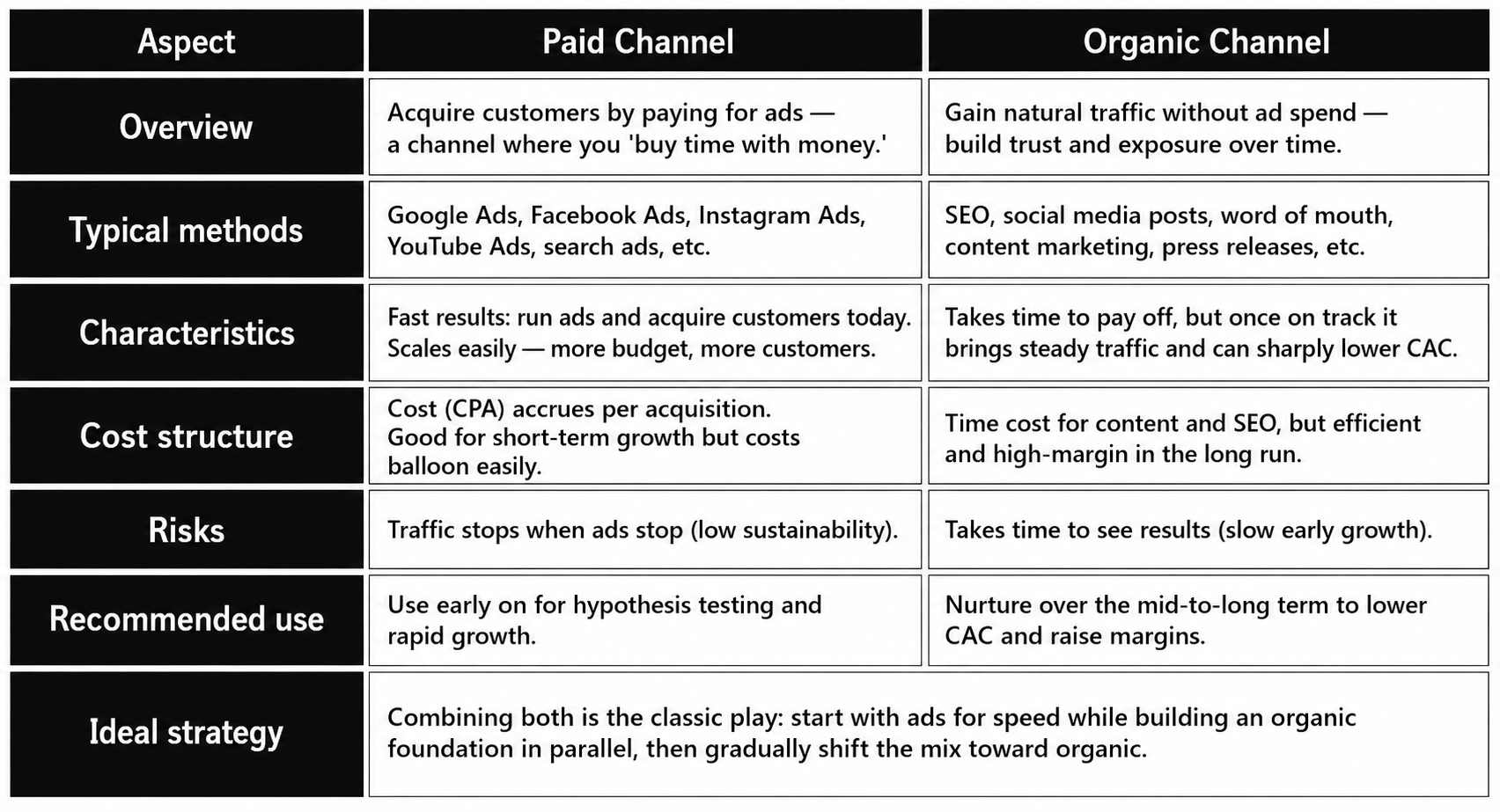
Incidentally, you may have noticed "CPA" quietly appearing in the chart above. If it cost 5,000 yen to acquire one customer through Google Ads, for instance, we say CPA = 5,000 yen.
In other words, CPA indicates the cost of a specific part of your overall customer acquisition activity—Google Ads in this case. CAC, by contrast, represents what it cost to acquire one customer—all costs included—on average. So while the two look similar, they take different vantage points.
Paid Channels (Advertising): How They Work and How to Use Them
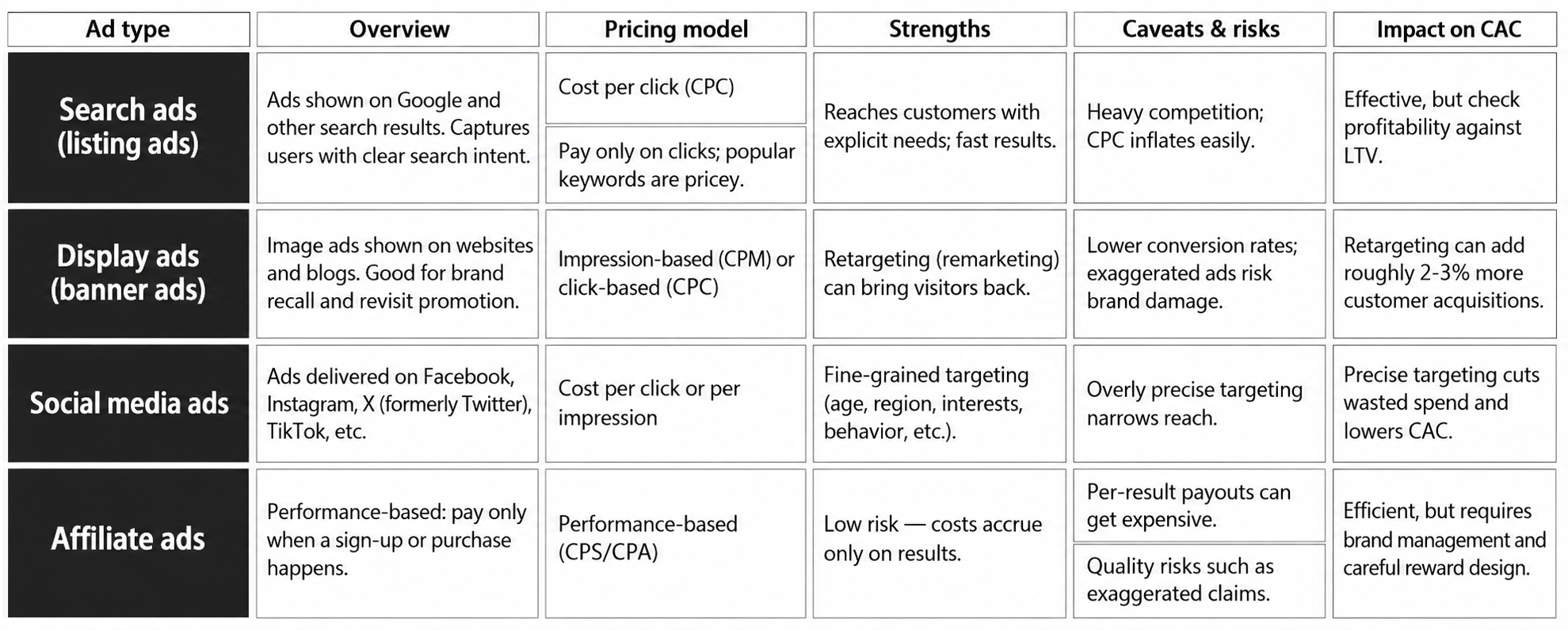
Search ads (search-linked listing ads) are among the most effective forms of advertising. These are the ads shown at the top of the results when you search Google for, say, "accounting software." They work because someone searching for "accounting software" is precisely a high-intent prospect who is looking for accounting software.
Search ads are priced on a pay-per-click model (CPC: Cost Per Click). You pay nothing when the ad is merely displayed—charges apply only when it is clicked. The more popular the keyword, the higher the cost per click; for keywords like "credit card" or "career change," a single click can cost several thousand yen.
For example, if you spend 1,000,000 yen a month on ads at an average of 200 yen per click, you get 5,000 clicks. If 2% of those visitors sign up, you acquire 100 new customers—an acquisition cost of 10,000 yen per customer. Whether that number is good or bad has to be judged against your LTV.
Display ads (banner ads) are image ads displayed while people browse websites. You have probably seen ads beside or beneath articles while reading news sites or blogs—those are display ads.
What makes display ads distinctive is retargeting (remarketing). You can show ads again—on other sites—to people who once visited your service's website but did not sign up, prompting them to remember: "Oh right, I was curious about that service." Statistically, only around 2-3% of first-time visitors purchase or register, but retargeting often captures an additional 2-3%.
Social media ads are ads delivered on platforms such as Facebook, Instagram, X (formerly Twitter), TikTok, and LinkedIn. Their greatest strength is detailed targeting: not just age, gender, and location, but interests, behavioral history, and even life events such as "recently married" or "recently moved."
For example, when advertising a household budgeting app, targeting conditions like "ages 25-35," "female," "married," "has children," and "interested in saving money" let you deliver ads precisely to the people who need the service. This cuts wasted ad spend and lowers CAC.
Affiliate advertising is performance-based: you pay affiliates (the people who publish your ads) only when an actual conversion (signup or purchase) occurs. It looks low-risk, but payouts are generally high—several thousand to tens of thousands of yen per conversion—and low-quality affiliates running exaggerated ads can damage your brand image, so careful management is required.
Building Organic Channels: Methods and Long-Term Strategy
Now let's look at the methods for building organic channels.
SEO (Search Engine Optimization) is by now one of the best-known terms in the field: the practice of optimizing your website so that it ranks high in Google and other search results.
If you rank first in the regular (non-ad) results for a search like "best project management tools," thousands to tens of thousands of prospects will visit your site every month—for free.
The beauty of SEO is that once you rank highly, the effect persists. Stop your ads and their effect vanishes immediately, but SEO accumulates as an asset. That said, it usually takes three to six months to see results, and sometimes more than a year for highly competitive keywords.
To succeed at SEO, keyword selection comes first. Research what terms people are searching for, how large the search volume is, and how strong the competition is. Then you must provide the information those searchers are seeking—in more depth and more clearly than your competitors do.
For example, if you aim to rank for "project management methods," merely listing methods is not enough. You need to comprehensively provide what searchers truly want: real case studies, common failures and countermeasures, best practices by industry, downloadable templates, and more.
Content marketing acquires customers by offering valuable content—blog posts, videos, podcasts, whitepapers, webinars. Its advantage is that it builds trust with customers. Rather than opening with "please use our service," you first provide valuable information for free. Readers come to feel "this company is trustworthy" and "they really know their field," and decide to give the service a try—that is the ideal flow.
That said, content marketing demands consistency. It is not one article a month and done; you need to publish two or three high-quality pieces every week. And beyond creating content, the distribution strategy for getting it to the right people matters just as much. Through SEO, social media, email marketing, contributed articles on other media, and more, you spread your content across a variety of channels.
Social media marketing means publishing on Twitter, Instagram, LinkedIn, TikTok, and the like, and converting followers into customers. It is important to choose the platform to fit your target: LinkedIn for B2B, TikTok for younger audiences, Instagram when visuals matter most.
The key in social media marketing is not to be constantly selling. An ideal balance is roughly 80% useful information and 20% introducing your own service. Value dialogue with your followers, reply to comments courteously, and answer questions sincerely. This steady groundwork builds trust in—and affection for—your brand.
Referrals and word of mouth—existing customers bringing in new ones—are the most efficient acquisition method of all. Referred customers check all three boxes: extremely low CAC (just the referral incentive), high conversion rates (the recommendation comes from someone they trust), and high LTV (it is your most satisfied customers who refer others).
To encourage referrals, delivering an excellent customer experience is the non-negotiable starting point. On top of that, you offer a referral program. Dropbox, for example, achieved explosive growth with its "invite a friend and you both get extra storage" scheme.
Investment Allocation by Channel and Portfolio Strategy
The optimal channel mix changes with the growth stage of a subscription business. In the early phase (monthly revenue from zero to 1 million yen), lean on advertising to validate hypotheses quickly. With ads, you can start today and see results tomorrow: which messages resonate, which targets respond, what your CVR looks like—crucial lessons arrive in a short time. Meanwhile, start laying the groundwork for SEO and content marketing.
In the growth phase (monthly revenue of 1 million to 10 million yen), keep acquiring customers steadily through ads while cultivating organic channels in earnest. Channel diversification also matters at this stage: relying solely on Google Ads leaves you exposed to sudden CAC deterioration when competitors enter or click prices rise.
In the mature phase (monthly revenue above 10 million yen), aim for organic channels to become your mainstay. You still use ads at this stage, but only for strategic purposes—testing new marketing initiatives or capturing peak-season demand.
The table below shows each channel's characteristics and the relationship between CAC and LTV.
| Channel | Initial investment | Ongoing cost | CAC | LTV | LTV/CAC ratio | Speed | Scalability |
|---|---|---|---|---|---|---|---|
| Google Ads | Low | High | 20,000 yen | 60,000 yen | 3.0 | High | High |
| Facebook Ads | Low | High | 25,000 yen | 55,000 yen | 2.2 | High | High |
| SEO | High | Medium | 2,500 yen | 65,000 yen | 26.0 | Low | Medium |
| Content | Medium | High | 5,000 yen | 70,000 yen | 14.0 | Low | Medium |
| Referral program | Low | Low | 3,000 yen | 80,000 yen | 26.7 | Medium | Low |
| Social media | Low | Medium | 8,000 yen | 60,000 yen | 7.5 | Low | Medium |
Note
This table is strictly an "idealized model." The per-channel CAC, LTV, and LTV/CAC ratios shown here assume favorable conditions in order to convey the big picture clearly. In actual businesses, results vary widely even within the same channel. LTV shifts with customer attributes and retention periods, and acquisition cost (CAC) can be a completely different number depending on the precision of your ad operations and the structure of your sales process. Industry, region, and revenue scale also significantly change cost structures and response rates.
As the table shows, SEO and referral programs have overwhelmingly high LTV/CAC ratios. Next in line would be content marketing, roughly speaking. However, these channels share the drawbacks of slow results and limited scalability.
Advertising, by contrast, excels in speed and scalability but costs more. That is exactly why combining multiple channels is essential.
Conclusion
In this article, we covered the foundational concepts and mechanics of subscription business: from the SaaS revolution that Salesforce's Marc Benioff sparked, to the revolutionary idea of designing a business around LTV (lifetime value)—value over time rather than immediate sales—to the golden rule of unit economics that LTV should be at least three times CAC. We hope the essential structure of subscription business has come into focus.
We also looked in detail at the two paths of customer acquisition: advertising (paid channels), with its speed and scalability, and SEO and referral programs (organic channels), which take time but are overwhelmingly efficient. Combining these channels strategically, according to your growth stage, is the key to sustainable growth.
Coming Up Next
In Part 2, we dig into the key metrics that measure the growth and health of a subscription business—from fundamental growth metrics like MRR and ARR, to the churn rate that decides whether a business lives or dies, to the secret of the "negative churn" that top-tier companies achieve. We will explore the essential meaning hidden behind the numbers.
We will also cover the science of onboarding—where the first 30 days decide the outcome—how to create the magic moment when a customer feels "this really helps!" (activation), and the paradigm shift from traditional reactive support to proactive customer success. Understanding these metrics and methods will reveal why so many companies fall into the trap of "customers keep growing but losses keep mounting"—and how to escape it.
 Qualiteg コンサルティング
About Our Services
Thank you very much for reading to the end. At Qualiteg, we provide training and consulting on AI-driven business transformation and on planning new businesses (including subscription and SaaS businesses), with strategy consultants from global consulting firms on our team.
If this has piqued your interest, or if you have specific requests, please feel free to reach out through the contact form here.

We also offer a well-received workshop for those who want hands-on experience with the steps of creating a new business. The training focuses on having each participant think about the business from an executive's perspective, and the content is designed not only for planning staff but also for their counterpart engineers, designers, and marketers. If you are interested, please do not hesitate to contact us.
See you next time!