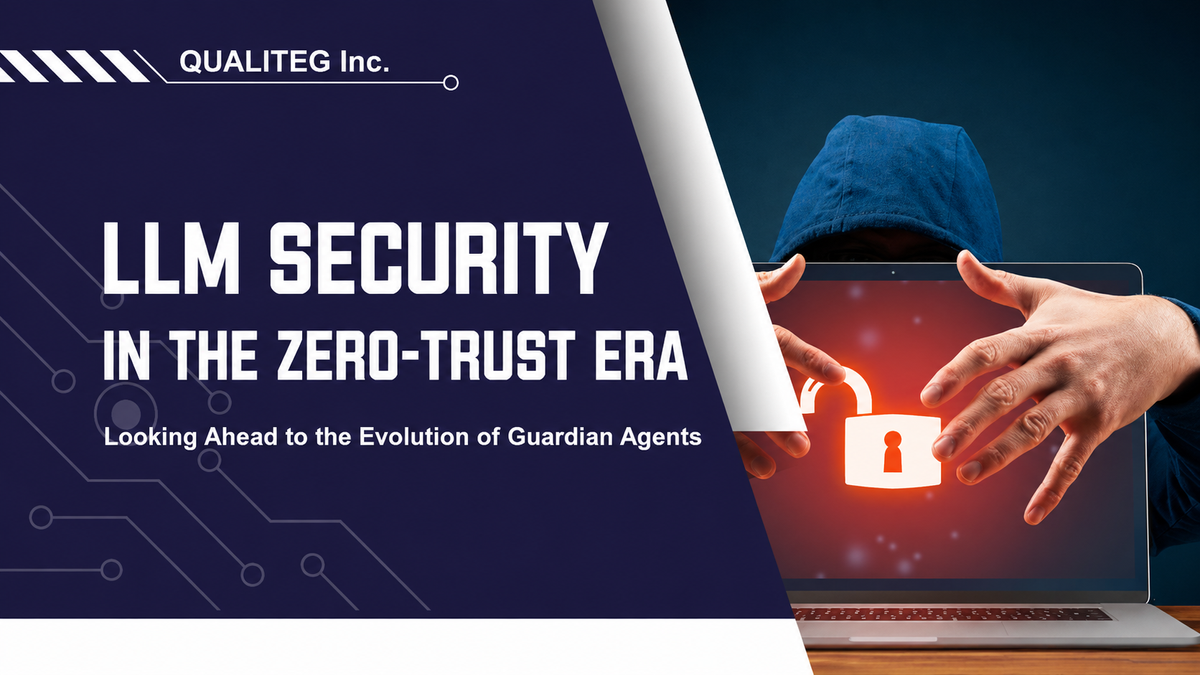
The Complete Guide to LLM Security in the Zero Trust Era: Looking Ahead to Guardian Agents

Hello!
Today we take a close look at "Zero Trust," a new way of thinking about security, and at AI security centered on LLMs.
Introduction
Three Paradigm Shifts Are Happening at Once
Right now, three major transformations are underway in corporate IT environments.
The first is a shift in security models: "from perimeter defense to Zero Trust."
The second is "the explosive spread of LLMs" and the new risks it has created.
And the third is "the arrival of the AI agent era" and, along with it, the emergence of a new concept called the "guardian agent."
These may look like separate developments, but they are in fact closely connected. In this article, we explain how these three transformations tie together and what measures companies should take.
Table of Contents
- Introduction: Three Paradigm Shifts Are Happening at Once
- The First Shift: A New Security Philosophy Called Zero Trust
- The Second Shift: The Arrival of the LLM Era and Its Impact
- The Third Shift: AI Agents and Guardian Agents
- Bringing the Three Shifts Together: A Practical Approach
- Implementation Best Practices
- Challenges Unique to Japanese Companies and Countermeasures
- Getting Practical: Measures You Can Start Today
- Conclusion: Toward an Era of Never Trusting, Always Verifying
The First Shift: A New Security Philosophy Called "Zero Trust"
Why Traditional Security Has Reached Its Limits
Around twenty years ago, in the early 2000s, corporate IT systems were simple.
Back then, I worked on information security in the IT division of a large company.
Servers sat in the company's data center, and employees accessed them from company PCs over the internal network. In that environment, the approach of separating inside from outside with a firewall "castle wall" and defending the inside worked well.
But what about today?
Data is stored in the cloud, employees work from home or from cafes, and they access business systems from their smartphones (BYOD).
The classic boundary between "inside" and "outside" is losing its meaning.
What deserves particular attention is that insider-threat risk is no longer just a full-time-employee problem. In today's companies, people with a wide range of working arrangements have "inside" access:
- Temporary and contract employees - often rotate in and out over short periods, with potentially lower organizational attachment
- Outsourced workers and freelancers - may be handling work for multiple companies in parallel
- Partner company staff - developers and engineers stationed on-site who access internal systems
- Interns and part-time workers - may not have received sufficient security training
- Departing employees - the difficulty of managing access rights during the period leading up to their departure
These people are not necessarily malicious (the vast majority are surely good people), but the variation in security awareness and the complexity of managing access rights create new risks.
For example:
- Access rights that remain active after a contract ends
- Information getting mixed up while handling data from multiple companies
- Differences in how well security policies are understood
- Use of personal devices for work (Shadow IT)
In this environment, the assumption that "people inside the company can be trusted" no longer holds.
"Trust Nothing" = Zero Trust: The Three Core Principles
What emerged in response to this situation is "Zero Trust."
It is a security model that quite literally starts from "trusting nothing" and is built on the following three principles.

Principle 1: Never Trust, Always Verify
Whether access originates inside or outside the company, every access is verified every time. The idea that a morning login means the afternoon is safe simply does not fly.
Principle 2: Least Privilege
Granting permissions "just in case" is off limits. For each task, grant only the minimum privileges necessary, and revoke them the moment they are no longer needed.
Principle 3: Assume Breach
Accept the reality that perfect defense is impossible, and design systems on the assumption that they will be breached. The emphasis shifts to detecting damage early and preventing it from spreading.
The Second Shift: The Arrival of the LLM Era and Its Impact
How the ChatGPT Shock Changed Corporate Life
Since ChatGPT appeared in November 2022, corporate AI adoption has changed dramatically. Programmers now use LLMs for code generation, marketers for copywriting, and sales teams for drafting proposals.
Expectations for productivity gains are high, and reports of substantially improved efficiency keep growing. Some now say they can no longer imagine work without LLMs.
But New Risks Are Emerging Too
Behind this convenience, serious security risks are taking shape.
Information leakage risk
Employees frequently paste customer lists into ChatGPT for analysis or have it summarize confidential documents.
Some services advertise that they "do not use your data for training," but the fact remains that the data is being sent to an external service.
The spread of Shadow AI
Beyond the IT department's line of sight, employees freely using free AI services—so-called "Shadow AI"—is another serious problem.

Corporate security policies do not apply, and there is no way to trace who sent what data.
In reality, many companies do not even have a clear policy on LLM use, and employees use ChatGPT or Claude from their web browsers at their own discretion. Some forward-thinking companies have begun managing API usage, but very few have comprehensive control that also covers web-based usage. This gap is accelerating Shadow AI.
The problem of output reliability
Information generated by LLMs can include content that is factually wrong (hallucinations). If that misinformation makes its way into customer responses or management decisions, the company's credibility is on the line.
Why Action Is Needed Right Now
LLM usage keeps expanding day by day, and delays in security measures can lead to catastrophic information leaks. In fact, overseas, cases of confidential information leaking via LLMs have already been reported, and Japanese companies cannot treat this as someone else's problem.
Cases like the following are of particular concern:
- Having an LLM analyze data containing customers' personal information
- Summarizing new-product specifications or blueprints with an LLM
- Translating materials from top-secret projects, such as M&A or financial information, with an LLM
- Processing employee performance-review data with an LLM
Once this information has been sent to an external LLM service, deleting it completely is difficult.
The Third Shift: AI Agents and Guardian Agents
2025: AI Moves from "Tool" to "Agent"
Today's LLMs are essentially "tools": a human asks, the AI answers. The AI of tomorrow is different. It is evolving into "agents" that judge and act autonomously.
Gartner predicts that in the near future, AI agents will take on a significant share of day-to-day business operations—for example, automatically handling customer inquiries, checking inventory, and even placing orders when needed, completing an entire chain of work without human intervention.
Guardian Agents: AI That Protects AI
The arrival of these powerful AI agents creates new risks as well, because an AI could cause serious damage through a wrong decision or act beyond its authority.

That is where Gartner's proposed "guardian agent" comes in. This is an AI that monitors AI behavior and intervenes when necessary. Since humans cannot watch AI 24 hours a day, 365 days a year, the idea is to have AI protect AI.
Guardian agents come in three types.
Reviewer Checks AI output and evaluates its accuracy and appropriateness.
Monitor Continuously watches AI behavior and raises alerts when it detects anomalies.
Protector Intervenes immediately when it detects a problem, correcting or halting the AI's behavior.
Bringing the Three Shifts Together: A Practical Approach
Zero Trust LLM Security Measures You Can Start Today
Guardian agents are an appealing concept, but full-scale implementations are still some way off. LLM risks, however, exist at this very moment.
So what should we do?
The answer is to apply Zero Trust principles to LLM security.
Step 1: Understand and Visualize the Current State
First, get a picture of how LLMs are actually being used across your organization.
Who is using which services, and for what purpose? It is especially important to uncover invisible usage, such as ChatGPT use via web browsers. Surveys like this are usually unpopular at the field level, so they should be carried out under a mandate from the CEO and CIO, with the department responsible for information security working jointly with the business units.
Step 2: Introduce Proxy-Based Security
To monitor and control all LLM traffic, deploy either a traditional DLP or an advanced security solution built specifically for LLMs. Some traditional DLPs may offer extensions for the LLM era, but when you need more sophisticated, fine-grained detection and control, the latter is the way to go. Our LLM-Audit is one such proxy-based security solution: because there is no need to install a dedicated agent app on each client, the deployment burden is small, making it well suited to large enterprises with many employees and PCs. This puts every LLM use in the organization—whether via the web or via API—under management.
Step 3: Data Classification and Policy Design
Clearly define the data that must never be sent out. Decide how each category—personal information, confidential information, intellectual property, and so on—should be handled. It is important to design balanced policies, both company-wide and per department, so that business does not get bogged down more than necessary.
Step 4: Automated Auditing and Response
Since humans cannot check everything, automation is the key. Build a system that uses AI to audit inputs and outputs and responds automatically when it detects risk.
For companies already using LLMs, introducing this kind of security can have a significant (negative) impact, so proceed carefully: run a PoC with a specific team or department first, start small, and define detection levels and filters suited to your company as you go.
Laying the Groundwork for Future Guardian Agents
This Zero Trust LLM security framework also becomes the foundation for future guardian agents.
The input/output auditing you build today will eventually grow into a reviewer-type guardian agent. The anomaly detection system evolves into the monitor type, and the automated intervention capability into the protector type.
In other words, adopting Zero Trust LLM security now does more than address the risks in front of you—it also prepares you for the coming era of AI agents.
Implementation Best Practices
Technical Requirements Checklist
Effective Zero Trust LLM security requires the following technical building blocks.
①MITM (Man-in-the-Middle) technology
To monitor LLM usage in web browsers, you need to decrypt SSL/TLS traffic and inspect its contents.
Related article: "Data Loss Prevention in the AI Era: Part 1 — AI-DLP and Proxies"
②User identification technology
Identifying who inside the company attempted to leak information is extremely important for notifying, guiding, and educating employees and for understanding usage trends. This makes integration between the LLM security solution and the company's authentication infrastructure, such as Active Directory, absolutely essential.
Related article: "Understanding Active Directory: The Technology Behind Enterprise AI Security - Part 1: Understanding the Basic Concepts"
③DLP (Data Loss Prevention)
Automatically detect patterns of personal and confidential information and prevent leaks. In Japanese-language environments, it is important to handle Japan-specific data formats, such as the ways names and addresses are written.
④Content filtering
Detect and filter inappropriate content and misinformation in LLM output.
⑤Log management and analytics
Record who sent what data to an LLM and when, and detect anomalous patterns.
Organizational Initiatives
We have covered several technologies so far, but
technology alone is of course not enough. An organization-wide effort is required.
Executive understanding and commitment
It is essential that executives understand LLM risks and the importance of countermeasures, and commit the necessary resources.
Cross-departmental cooperation
Not just the information security and IT departments—top management, legal, compliance, and each business unit must work together to craft policies that actually work.
Continuous education and awareness
Continuously educate employees on the appropriate use of LLMs and the risks involved.
Phased rollout
As touched on earlier, starting small is important.
Rather than changing everything at once, introduce measures in stages, starting with high-risk departments and operations.
Challenges Unique to Japanese Companies and Countermeasures
The Difficulty of Japanese-Language Processing—and Solutions
When Japanese companies implement LLM security, they face challenges unique to the Japanese language.
Diversity of character types Japanese mixes hiragana, katakana, kanji, and alphanumeric characters, which makes detecting personal information complicated. "山田太郎" (Yamada Taro in kanji), "ヤマダタロウ" (in katakana), and "YAMADA TARO" must all be recognized as the same person.
Context dependence Japanese relies heavily on context, so simple keyword matching can miss confidential information.
Honorific expressions The honorific language (keigo) typical of Japanese business documents means the same content can be phrased very differently, making pattern recognition difficult.
Complying with Japanese Regulations (2025 Edition)
You also need to address regulations specific to Japan, such as the Act on the Protection of Personal Information and the Unfair Competition Prevention Act. In particular, the April 2022 amendment to the Act on the Protection of Personal Information tightened rules on providing personally referable information to third parties. Discussions on AI governance are also gaining momentum, and materials such as the Ministry of Economy, Trade and Industry's "AI Governance Guidelines" are worth consulting as well.
Getting Practical: Measures You Can Start Today
High-Priority Action Items
Zero Trust, LLMs, guardian agents. At first glance these concepts look unrelated, but they are in fact part of one larger current.
That current is
"from trust-based security to verification-based security"
.
It may feel a bit harsh and a little lonely, but
the era of trusting whatever sits inside the perimeter is over, and
the era of trusting the promises of LLM services is ending
as well.
And in the future, we will likely see an era in which even AI agents are not trusted, and guardian agents verify them at all times.
What companies should do now is clear.
Introduce LLM security grounded in Zero Trust principles, and prepare to evolve it into tomorrow's guardian agents.
As a solution to these challenges, we offer LLM-Audit. It is an AI-DLP solution optimized for Japanese-language environments that, being proxy-based, can comprehensively monitor and control LLM usage—including use via web browsers. Its design also anticipates future evolution into a guardian agent.
Conclusion
"Toward an era of never trusting, always verifying."
This is not merely a technology problem.
It is a management issue that touches organizational culture, governance, and talent development.
The companies that take this challenge seriously will be the winners of the AI era.
"Never trust, always verify."
In an IT environment that only keeps growing more complex, I believe this simple principle will be the strongest shield protecting us.
A Brief Introduction
So far, we have walked through three transformations: Zero Trust, LLM security, and guardian agents.
These challenges are complex, and many companies struggle with where to begin.
Beyond providing our product LLM-Audit, we also offer consulting services covering corporate management challenges and overall AI strategy. Our consulting is a professional service delivered by alumni of major consulting firms, covering:
- Visualizing your current LLM usage
- Risk assessment and policy development
- Planning a phased rollout
- Technology selection and implementation support
and other fine-grained support tailored to each client's situation.
"We've started using LLMs at our company, but I'm worried about security..." "I keep hearing about Zero Trust, but where exactly do we start?" "We want to prepare now for the coming AI agent era."
If any of these sound familiar, please feel free to contact us.
Let's build a future of safe and productive AI use together!