
The Complete Guide to Claude Fable 5 — Model Specs and Claude Code Operations from the Official Docs


Hello!
Claude Fable 5, which arrived in June 2026, has had an eventful first month: a suspension under export controls right after release, a global re-rollout, and then its departure from the subscription allowance.
This blog has followed the situation at each turn.
For the overall picture, see Finally Generally Available: Reading Claude Mythos 5 / Fable 5 from a Practitioner's Perspective; for the suspension drama right after release, see Suspended Three Days After Release — the U.S. Government Directive on Fable 5 / Mythos 5 and the New Availability Risk of AI; and for pricing and the outlook, see What Happens Next for Claude Fable 5? Background, Costs, and Outlook.
This article builds on those to serve as "the definitive guide for practical use."
In particular,
as of July 12, 2026 (July 13 Japan time), it leaves the subscription allowance and cannot be used unless usage credits are enabled
(This deadline was initially set at July 7, 2026, and was later extended by five days to July 12.)
— with this major pricing change as the axis, this article brings together the model specifications, the realities of pricing, and the operational points to watch when using it in Claude Code. Including how to divide roles with Opus 4.8, we provide the material for judging
"how much Fable 5 is worth paying for"
for yourself.
This guide therefore takes Anthropic's official announcements and documentation as its baseline, and organizes
Claude Fable 5 (claude-fable-5) around the three questions of
"understanding it as a model,"
"grasping the pricing and the treatment of the subscription allowance,"
and "operating it economically in Claude Code by combining Fable with less expensive models"
.
With that, let us get into the main content.
Incidentally, in the early morning of this article's publication date (2026/7/10), the weekly rate limit was abruptly lifted, effectively expanding Fable 5's usage allowance once again
We've reset 5-hour and weekly rate limits for all users.
— ClaudeDevs (@ClaudeDevs) July 9, 2026

Table of Contents
- Part 1: What Is Claude Fable 5?
- Part 2: Pricing and the move out of the subscription allowance (most important)
- Part 3: Fable 5 in Claude Code
- Conclusion — how to live with Fable 5
Part 1: What Is Claude Fable 5?
Where Fable 5 Fits
Claude Fable 5, announced by Anthropic on June 9, 2026, is the most capable model the company currently makes generally available (GA).
The official documentation positions Fable 5 as
"Anthropic's most capable broadly available model, designed for the most advanced reasoning and long-horizon autonomous (agentic) work"
.
The key concept is "long-horizon agentic work" (long stretches of autonomous work).
What distinguishes Fable 5 is that its lead over other models widens as tasks grow longer and more complex, more than in one-off Q&A.
As an example cited at announcement, the payments company Stripe stated that it "completed a migration of a Ruby codebase exceeding 50 million lines — work that would normally take a team more than two months — in one day," reported as an early customer example (note that this is Stripe's report, not a general performance guarantee).
Fable 5 is "Mythos-class" — that is, it carries capabilities from the same lineage as Anthropic's top research model, released with safeguards built in to make it suitable for general use.
Why It Is Not "an Upgraded Opus 4.8"
Fable 5 is not Opus's successor. Opus 4.8 (claude-opus-4-8) remains "the newest and highest model in the Opus tier," and for most practical work it is the standard choice. Fable 5 sits above the Opus tier — a separate bracket in both price and capability. So the answer to the common request "I want to upgrade to the latest model" is still Opus 4.8. Understand Fable 5 as the model you choose explicitly when you want the hardest problems solved, with the cost accepted up front.
Timeline: Announcement, Export Controls, Re-rollout
Fable 5 followed an unusual path entangled with national security and export controls.
Here is the chronology.
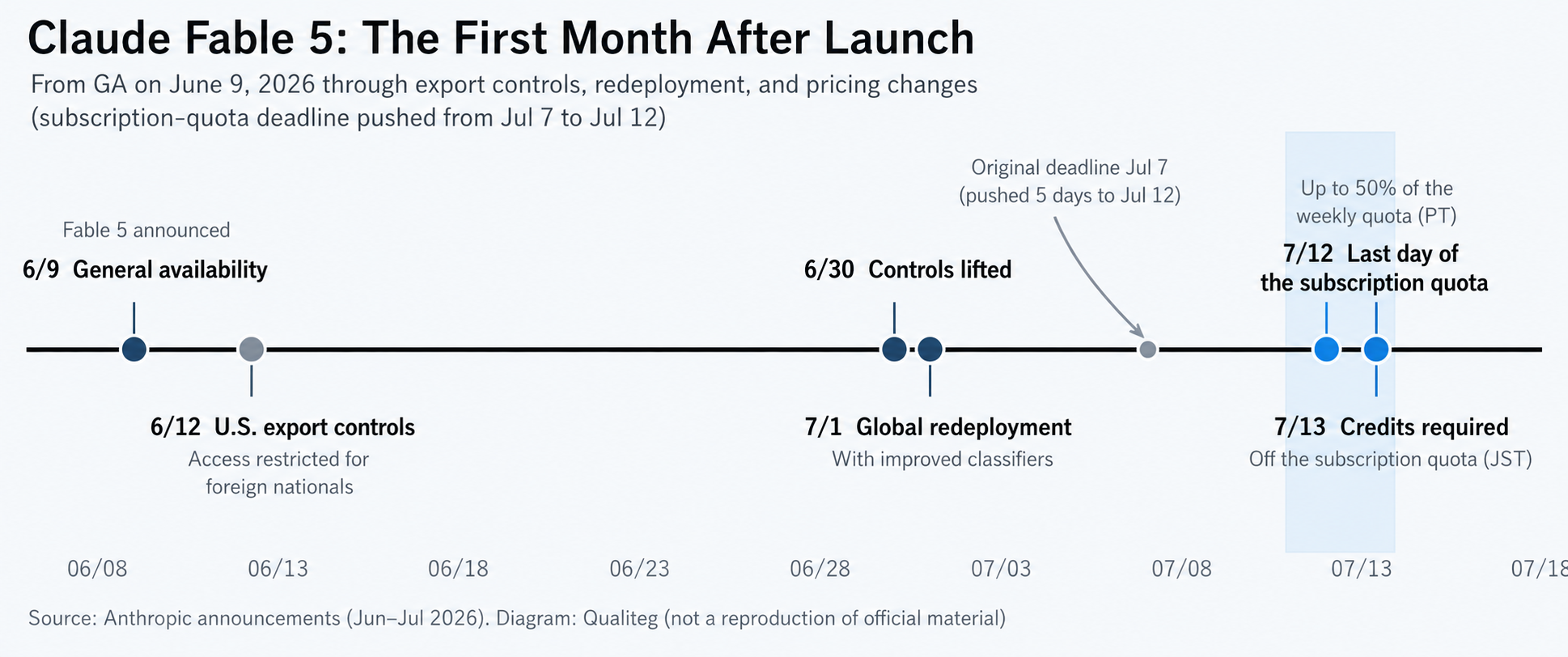
| Date (2026) | Event |
|---|---|
| June 9 | Claude Fable 5 becomes generally available on the API, Claude.ai, and Claude Code. Claude Mythos 5, which has no safety classifiers, is limited to Project Glasswing participant organizations and similar. |
| June 12 | The U.S. government applies export controls to the new models, restricting access by foreign nationals. In the background, an Amazon researcher had discovered a technique for bypassing Fable 5's safeguards. |
| June 30 | The export controls are lifted. |
| July 1 | Fable 5 is re-released globally with an improved classifier, available on the Claude Platform, Claude.ai, Claude Code, and Claude Cowork (Mythos 5 remains limited). |
| July 7 (original deadline) | This was initially the last day Fable 5 could be used within the subscription's weekly allowance (up to 50% of the weekly allowance). |
| Around July 7 | Anthropic announces a five-day extension of the deadline to July 12, 23:59:59 (PT), stated explicitly in the official support article. That corresponds to July 13 Japan time. |
| July 12 (PT / final day after extension) | The last day of use within the subscription's weekly allowance on Pro / Max / Team and premium-seat Enterprise plans (up to 50% of the weekly allowance). |
| After July 12 ends (from July 13 Japan time) | Fable 5 leaves the subscription allowance and moves to access via usage credits. |
For the re-rollout, Anthropic introduced a new safeguard classifier. Per the official explanation, "the specific technique described in Amazon's report is now blocked in more than 99% of cases," while "the safety margin has been expanded substantially" — with the result that more benign requests are also blocked than before.
Anthropic explicitly states
"In the near term, some routine tasks like coding and debugging may be flagged more often."
(meaning: for the time being, everyday tasks such as coding and debugging may be flagged more often than before)
. Because this matters in practice for using Fable 5 in Claude Code, we revisit it in Part 3.
The suspension under export controls and the re-rollout themselves — and the "new availability risk of AI" they reveal — are explored in depth in
Suspended Three Days After Release — the U.S. Government Directive on Fable 5 / Mythos 5 and the New Availability Risk of AI
.
Specifications as a Model
Here are the key specifications, based on the official documentation. Unit prices are as of July 9, 2026, as noted below.
| Item | Value |
|---|---|
| Model ID | claude-fable-5 |
| Context window | 1M (1,000,000) tokens (default = maximum; no long-context premium) |
| Max output tokens | 128K (128,000) tokens / request |
| Input price | $10 / million tokens |
| Output price | $50 / million tokens |
| Cache reads | approx. $1 / million tokens |
| Cache writes | 5-minute retention $12.50 / million; 1-hour retention $20 / million |
| Tokenizer | Same as Opus 4.8 (introduced with Opus 4.7) |
| Data retention | 30-day retention required (not available under zero data retention = ZDR) |
| Thinking mode | Adaptive thinking only (always on) |
| Supported features | effort, memory tool, code execution, context editing (beta), compaction, Vision (high resolution), and more |
- The 1M context comes at standard pricing, with no surcharge (premium) for long context.
- The tokenizer is identical to Opus 4.8's, so if you migrate from Opus 4.7 / 4.8, the token count for the same text is essentially unchanged.
What changes is the unit price. If you move from Opus 4.6 or earlier, Sonnet, or Haiku, token counts will shift, so re-measure withcount_tokens.
Constraints to Check Before Enterprise Use (Data Retention)
Fable 5 comes with the following constraints.
If they do not immediately click on first reading, that is fine.
Below them we have added a plain-language explanation.
Fable 5 / Mythos 5 are "Covered Models," and 30-day data retention is mandatory. They cannot be used under zero data retention (ZDR).
More than performance or price, this is the constraint that decides whether enterprise adoption is possible. Before adopting, check at least the following.Do your contracts and internal rules permit sending confidential code and data to Fable 5?Existing ZDR-based workloads cannot be migrated as they are. Thirty-day retention is required on every serving platform, but400 invalid_request_erroris officially documented only for Claude API (when the organization/workspace retention settings do not meet the requirement). Display and error behavior via Claude Code or each cloud varies by endpoint (for example, Fable disappearing from the model choices).For each connecting platform — Bedrock / Vertex / Foundry and so on — confirm where and under what conditions data is retained.
Plain-language explanation → the basic rule
What the above means is this: the text we send to Fable 5, and the text Fable 5 returns, is always stored for 30 days. You cannot delete it. You cannot opt out.
Other Claude models (Opus 4.8 and so on) can be set to "do not store." Only Fable 5 cannot.
Why is it stored?
Because Fable 5 is powerful, it is monitored for abuse. Abuse cannot be spotted in a single exchange; only when hundreds of exchanges are laid side by side does it become clear that "this is an attack." The stored data is not used to train AI.
What is the problem?
Some companies hold contracts (ZDR) stating "none of our data is ever stored." That contract does not apply to Fable 5. The retention requirement takes precedence over the contract.
In other words, if you send confidential source code or customer data to Fable 5, it will remain somewhere for 30 days. And if it is judged dangerous, a human may look at its contents.
How to Read the Benchmarks
For benchmark details, we defer to our separate article below.
 Qualiteg コンサルティング
Key API Differences
First, let us look at the API-level differences from Opus.
Fable 5 largely shares the API request surface with the Opus tier (4.7 / 4.8), but there are differences that can turn existing implementations into 400 responses on migration.
Here are the main ones (not exhaustive).
1. Thinking is always on
Adaptive thinking is the only thinking mode, and omitting thinking enables it automatically.Explicitly sending thinking: {type: "disabled"} returns a 400 (specific to Fable 5; disabled is accepted on Opus 4.7 / 4.8).budget_tokens has also been removed and returns a 400 if sent. Depth is controlled with output_config.effort (low to max).
2. Sampling parameters are not supported
temperature / top_p / top_k return a 400 if you send non-default values. Steer output tendencies through the prompt.
3. max_tokens is the total of thinking plus the final answer
max_tokens is a cap that includes both thinking tokens and the final answer. At high effort, thinking consumes many tokens, so a small cap will cut the answer off midway.
4. Raw chain of thought is not returned
What comes back is a normal thinking block; with display: "summarized" it contains a summary, and with "omitted" (the default) it is an empty string. Thinking runs and is billed regardless of the display setting.
5. A stop reason called refusal
Fable 5 runs a safety classifier over the input. When refused, you get an HTTP 200 success response, not an error, with stop_reason: "refusal" returned and stop_details carrying the category.
- Before output — refusal:
contentis empty, and there is no charge. - Mid-stream refusal: the portion already generated is billable (discard the partial output; do not use it).
response.content[0] — code that reads this unconditionally will break.Always check stop_reason first. In practice, judge in the following order: (1) HTTP status → (2) stop_reason → ③stop_details logged → (4) content confirmed non-empty → (5) on refusal, do not use the partial output.
6. Fallback (rescuing refusals with another model)
Server-side fallbacks automatically re-runs the same request on another model upon a policy refusal — an opt-in beta feature (server-side-fallback-2026-06-01) that must be specified explicitly (it is not on by default).
Currently it is available on the Claude API and Claude Platform on AWS;
on the Message Batches API, Amazon Bedrock, Google Cloud, and Microsoft Foundry it is not available,
requiring client-side re-execution or SDK middleware. The model to fall back to is specified explicitly in the request's fallbacks array.
(The official example is Opus 4.8; the Anthropic API does not automatically pin the fallback to Opus 4.8.)
What differs by endpoint is "whether server-side fallbacks can be used." If you are writing new claude-fable-5 code, we recommend putting this fallback in explicitly.
Relationship to Mythos 5
Claude Mythos 5 (claude-mythos-5) shares the same base model, context length, maximum output, and pricing structure with Fable 5.
However, it does not carry the safety classifiers added to Fable 5, so the actual API behavior, including refusals and automatic fallback, is not identical
(the refusal and fallback descriptions apply to Fable 5 only).
Mythos 5 is limited to Project Glasswing participant organizations and the like; general users use claude-fable-5.
It is the successor to the formerly invitation-only claude-mythos-preview. For the difference in positioning between Mythos 5 and Fable 5 and a reading of the benchmarks, see also Finally Generally Available: Reading Claude Mythos 5 / Fable 5 from a Practitioner's Perspective.
Part 2: Pricing and the Move out of the Subscription Allowance (Most Important)
The Change in Delivery and the Deadline Extension from July 7 to July 12
When Fable 5 was re-released on July 1, its inclusion in subscriptions came with a deadline.
That deadline was initially July 7, 2026, but just before it arrived, Anthropic abruptly extended it by five days, finally setting it at July 12, 2026 (23:59:59 U.S. Pacific Time; July 13 Japan time).
The cap of up to 50% of the weekly allowance, and the switch to credit-based use after the deadline, have been unchanged since the July 1 re-release.
| Period | Treatment of Fable 5 |
|---|---|
| Until the original July 7, 2026 (before the change) | The subscription-inclusion deadline was initially set for this date. |
| Until July 12, 2026 (after extension, PT basis / until July 13 Japan time) | Usable on Pro / Max / Team and premium-seat Enterprise plans, up to 50% of the normal weekly allowance. |
| After July 12 ends (from July 13 Japan time) | Leaves the subscription allowance and moves to pay-as-you-go via usage credits (standard API pricing). Without credits enabled, Fable 5 requests will not run. |
The cutoff is 23:59:59 on July 12 (U.S. Pacific Time; the afternoon of July 13 in Japan). Confirm the actual switchover timing on your account screen (described below) as well.
On the possibility of returning to subscriptions
Anthropic has indicated it would like to bring Fable 5 back into the subscription allowance if capacity can be secured, but neither the timing nor the implementation is guaranteed. Deadlines have moved once already, so the realistic approach is to keep checking the latest official guidance while planning operations on a credit basis for now.
How Usage Credits Work and the Management Screen
Usage credits are a pay-as-you-go layer available on paid plans such as Pro / Max. Originally designed so you could "keep working after hitting your plan limit," after July 12 (from July 13 Japan time) they become the entry point to Fable 5.
Note, however, that "general extra usage credits (for continuing after hitting the plan cap)" and "the delivery of Fable 5 after July 12" are officially separate announcements.
Anthropic describes the latter as "provided via usage credits," and we will not assert the specific consumption order — whether Fable 5 draws down the normal allowance first before moving to credits, or consumes credits from the start. Confirm actual allowance consumption on your account screen and in the latest official guidance.
Management happens in claude.ai under Settings → Usage. Looking at the actual screen (with the subscription allowance used up and credits turned on) makes the mechanics concrete.
Who can configure this differs by plan. The screen examples and steps below assume a Pro / Max individual account.Team and seat-based Enterprise plans: the Owner / Primary Owner enables credits and sets limits from Organization settings → Usage.usage-based Enterprise is not a use-up-included-allowance scheme; in principle it is billed per token from the first token.

* Display example from our own account in early July 2026. You can see the Fable 5 subscription allowance has been used up and usage has moved to the credit allowance.
Here is what can be read from this screen.
- Usage allowances are displayed per model. "All models" and "Fable" appear as separate bars; in the example above, the Fable allowance is 100% used (the subscription allowance is exhausted).
- Usage credits can be toggled ON/OFF. The framing is that you turn credits on "to keep using Claude even after reaching your limit."
- Usage is displayed in real time (e.g., $68.69 used / 27% of the limit, with the reset date).
Limits, Balance, and Prepaid Discounts (Each a Separate Thing)
"If I turn credits on, won't spending run away without limit?"
You may worry about that, but
you can set a spending limit on credits
With credits on, there are three concepts to know
- Monthly spending limit
The cap on credit spending for the month (e.g., $250.00). You can change it via "Adjust limit." However, "no limit" is also selectable, so merely enabling credits does not guarantee a spending cap. Especially if you use auto-reload, always confirm the monthly limit is set to the amount you intend. - Credit balance
The balance you currently hold (e.g., $181.31).Auto-reloadAn ON/OFF switch controlling whether the balance is automatically topped up as it runs down, or replenished manually (auto-reload combined with "no limit" can effectively become unbounded). - Discount bundles (prepurchase)
A "bulk purchase" product separate from limits and balance. Think of it as charging up your billing allowance in advance.
$50 worth = 10% off (pay $45)
$250 worth = 20% off ($200)
$1,000 worth = 30% off ($700)
For example, buying $250 worth applies the 20% discount, so you pay $200. In practice, 10% consumption tax is added, for a payment of $220.
In short, Fable 5 costs are managed with separate levers: the monthly limit (no limit unless you set one), the held balance, auto-reload, and prepurchased discount bundles.
Set a monthly limit to avoid unbounded spend, and charge up in advance to buy your billing allowance at a modest discount — that is the shape of it.
Cost Estimates, and How to Measure for Yourself
Here are simple estimates based on Fable 5's unit prices (input $10 / output $50 per 1M).All assume no caching, no retries, no fallback, and no tax or exchange-rate effects.
Case A: chat-centric (200K input + 50K output tokens per day)
- Input: 0.2M × $10 = $2.0
- Output: 0.05M × $50 = $2.5
- About $4.5 per day → about $135 per month
This is a simple estimate that assumes all Fable 5 usage is billed to credits.
Case B: autonomous coding in Claude Code
What drives cost is less chat than agentic coding. Long Claude Code sessions repeatedly load context, call tools, and self-verify, so token consumption is large.
Actual consumption, however, varies greatly with the model, codebase size, parallelism (number of subagents), caching, retries/fallback, and usage pattern.
The official documentation likewise explains that costs vary substantially with these factors.
Generalizations like "X dollars per hour" are unreliable unless measurement conditions match.Measuring in your own environment is the dependable way.
Concretely, record the following per session and apply the price table (input $10 / output $50 / cache reads $1 / cache writes $12.50–$20, all per 1M):
- Model used / input tokens / output tokens
- Cache-creation tokens / cache-read tokens
- Fallback count / number of subagents / session duration
Fable 5 costs twice Opus 4.8 per token, so with regular use, credit consumption can reach a scale that cannot be ignored.
That is exactly why the Part 3 question of "when to use Fable 5" is itself cost management.
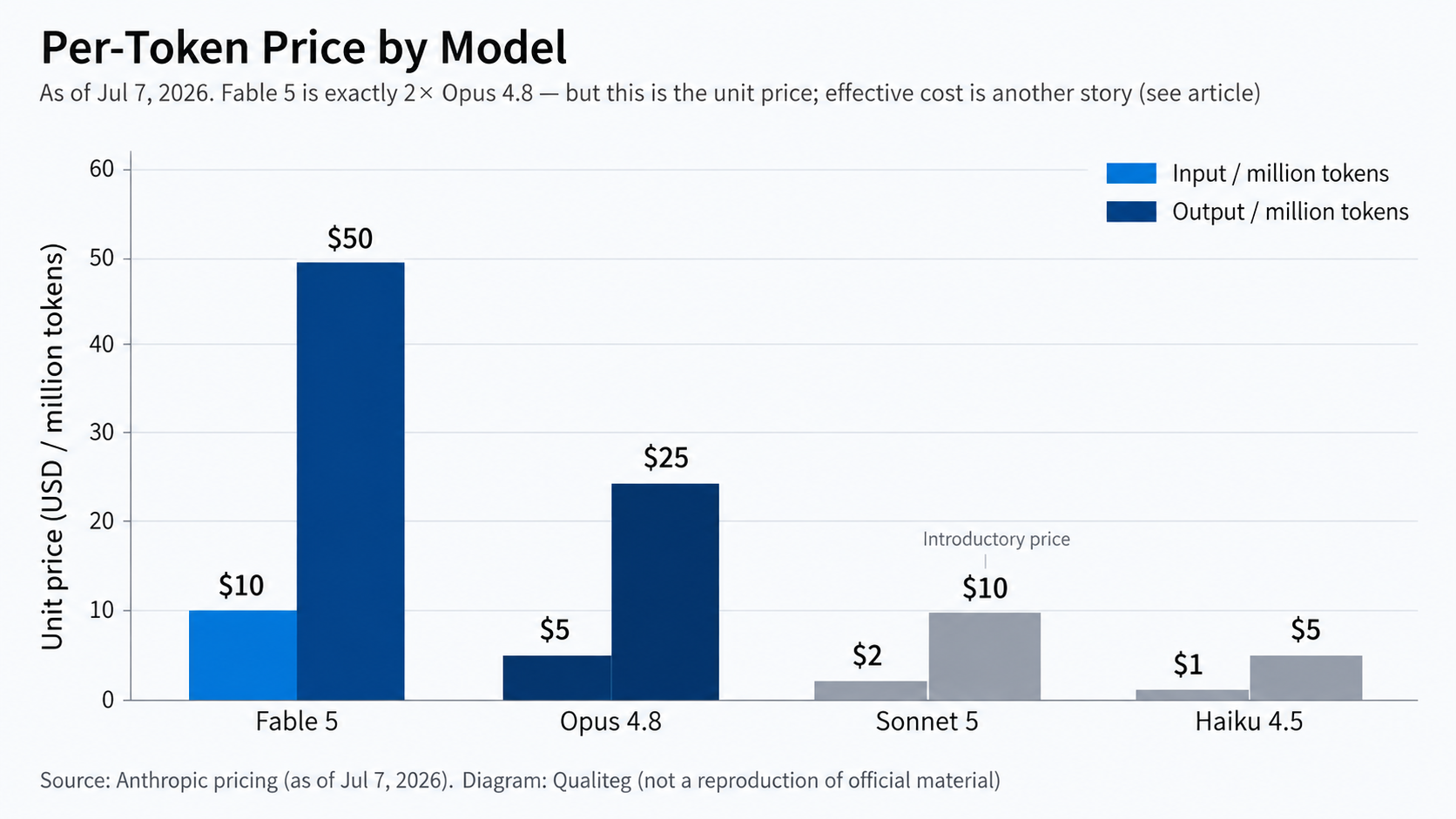
Price Comparison (as of July 9, 2026)
| Model | Input / 1M | Output / 1M | Context | Notes |
|---|---|---|---|---|
| Claude Fable 5 | $10.00 | $50.00 | 1M | The top tier, for the hardest and long-horizon autonomous tasks |
| Claude Opus 4.8 | $5.00 | $25.00 | 1M | Newest in the Opus tier; the standard for practical work |
| Claude Sonnet 5 | $2.00 (introductory price) | $10.00 (introductory price) | 1M | A balance of speed and intelligence |
| Claude Haiku 4.5 | $1.00 | $5.00 | 200K | Fast and low-cost |
- Sonnet 5 carries an introductory price of $2 input / $10 output through August 31, 2026 (the price currently in effect). The standard price from September 1 is $3 input / $15 output.
- Fable 5's unit price is exactly double Opus 4.8's, placing it among the most expensive of the mainstream generally available models (not "the most expensive ever" — models with higher unit prices, such as Opus 4.1, have existed, and Anthropic itself describes Fable 5 as less than half the price of the old Mythos Preview).
"Double the unit price" and "double the effective cost" are different things
This is the easiest point to misread. The $10 / $50 above is a comparison of token unit prices, and the actual cost per task will not necessarily stay within 2x. There are two main reasons effective cost tends to exceed the 2x price ratio.
- Fable 5 has Adaptive thinking always on.
Thinking tokens are billed as output ($50 / 1M on Fable 5), andmax_tokensis the sum of thinking plus the final answer. Opus 4.8, by contrast, can turn thinking off (thinkingomitted runs without thinking), so for the same task Fable 5 tends to consume more of the expensive side — output tokens. Because tokens grow on the high-priced output side, the cost compounds. - Fable 5 is designed to think deeply and at length.
On hard tasks a single request can easily run several minutes to well over ten, and thinking and output tokens accumulate accordingly. The longer the autonomous task, the larger this gap grows.
In other words, effective cost is determined by "2x unit price × growth in generated tokens." The multiplier can be 2x or more (higher still at high effort). Budget on the assumption that "paying double Opus 4.8 buys the same work" and the invoice will exceed expectations.
Levers that actually reduce cost
effort: turn it down. Fable 5 remains strong even at low effort, and this directly reduces thinking tokens (the most effective lever on effective cost).max_tokens: constrain it appropriately, or control the tokens of the whole loop with Task Budgets (API only).- Use the measurements from the previous section to track input, output, thinking (included in output), and cache separately.
- Note: prompt caching discounts only the input side. The thinking and output tokens that tend to grow are not made cheaper by caching, so do not assume "caching will keep it within 2x."
The question of whether to choose Fable 5 is therefore not "the unit price is double" but
"do I want to solve problems Opus 4.8 cannot reach, even at a cost that can effectively exceed 2x?".
Part 3: Fable 5 in Claude Code
Here we consider the scenarios for putting Fable 5 to serious use in Claude Code.
Prerequisites and Model Selection
Fable 5 is a supported model in Claude Code. First, the prerequisites.
- Check the supported version. Per the official documentation, Fable 5 requires a relatively recent Claude Code. In practice: use the latest Claude Code CLI.
- The default model differs by plan
Fable 5 is not the default model on any plan, so if you want it, select Fable 5 explicitly with the/modelcommand.
Enabling Credits and Setting Limits
As noted above, after July 12 (from July 13 Japan time), calling Fable 5 from Claude Code requires credits to be enabled on the claude.ai side.
The 1M Context and Prompt Caching
Fable 5 offers a 1M-token context at standard pricing, but the more you load, the more tokens (= cost) you consume. For large fixed context (codebases, specifications), use prompt caching. Its pricing needs to be understood, though.
- Cache-hit reads are $1 / 1M — inexpensive.
- On the other hand, the initial cache write costs $12.50 / 1M at 5-minute retention, or $20 / 1M at 1-hour retention.
In other words, unless the fixed context is referenced repeatedly, caching actually costs more. It pays off precisely in workflows that reuse the same prefix many times.
Task Budgets cannot be used in Claude Code
The API offers Task Budgets (beta), which conveys a token budget for the entire agentic loop to the model, but this is a Messages API feature and is not available in Claude Code / Cowork. It is also a "guideline" conveyed to the model, not a hard cap. It applies only if you implement your own Messages API agent.
Refusals and Fallback in Practice
Because the re-released Fable 5 has widened its safety margin, benign tasks such as coding and debugging are more likely than before to be refused as false positives.
- If you use Claude Code as-is
When the endpoint can correctly identify Fable 5 and the fallback Opus model, it falls back automatically on refusal.
It is, frankly, quite sensitive and produces false positives fairly often. More on that below. - If you build your own agent against the API
stop_reason == "refusal"must be handled, and the opt-in server-sidefallbacksshould be specified explicitly. It is available on the Claude API and Claude Platform on AWS; elsewhere (Batches, Bedrock, Vertex, Foundry) you need client-side re-execution or SDK middleware. Specify the fallback model explicitly in the request'sfallbacksarray (the official example is Opus 4.8). What differs by endpoint is availability.
Using Fable 5 Realistically in Claude Code —
Commander (Fable) and Workers (Opus, Sonnet): Split Your Models by Role
After the pricing change, Fable 5 is expensive (2x Opus 4.8, and with thinking always on the effective cost tends to climb further); having it do absolutely everything — file reading, trial and error, long autonomous runs — is frankly not economical.
What we at Qualiteg actually do is split a single Claude Code session into a "commander" and "workers," assigning a different model to each role.
The basic idea is simple
- Commander = Fable 5
Devotes itself to deciding policy, decomposing tasks, issuing work orders, accepting or rejecting reports, and judging the next move. It does not read code or logs itself, and it does not implement. - Workers = Opus 4.8 / Sonnet 5 subagents
Take on all the hands-on work — exploration, investigation, implementation, testing, documentation — and return only short reports to the commander. - Use two tiers of workers
Work requiring judgment or design understanding goes to Opus; fully specified, mechanical routine work (bulk renames, log collection, and the like) drops to Sonnet.
The aim is plain: the expensive model's value is concentrated in "judgment".
Let the process (large volumes of file reading, trial and error, logs) be digested inside the subagents' context and have only conclusions returned to the commander, and Fable 5's credits and context are spent only on the "moments of judgment."
Moving from "Fable 5 does everything" to "Fable 5 thinks, cheaper models do the hands-on work"
alone cuts credit consumption substantially.
Of course, for small day-to-day fixes it is faster and cheaper to skip the commander entirely and work directly with the default models (Opus 4.8 / Sonnet 5).
The commander method pays off in the "hard and heavy" situations: large migrations, large implementations with clear acceptance criteria, and large investigations using parallel subagents.
This Fable commander method — including setup steps, the shape of delegation prompts, orchestrating parallel subagents, and pinning models via CLAUDE_CODE_SUBAGENT_MODEL — will be covered in detail in a separate article, so stay tuned.
For this article, the one idea to take away is: put the expensive Fable 5 in the commander's seat, and leave the hands-on work to Opus / Sonnet.
Handling False Positives from the Safety Classifier
The re-released classifier widens the safety margin around areas such as cybersecurity and biology/chemistry.
Here it is important not to conflate "intentional blocks" with "false positives".
- Treat refusals as "content results," not "errors"
stop_reason— check it, and on refusal route to fallback or a switch to Opus 4.8. - Clearly intended block targets
Building exploit chains, generating malware, creating attack tools — requests that directly provide offensive cyber capability are, naturally, what Fable 5's classifier intentionally restricts. These are design-level restrictions, not false positives. - Safety-margin blocks and false positives
Vulnerability research, penetration testing, and PoC development are ambiguous areas that can serve attack or defense depending on content. Because Fable 5 judges broadly on the safe side, legitimate defensive work can also be blocked. In addition, ordinary coding, debugging, configuration changes, dependency updates, and other inherently unproblematic work can get caught up as well.
Anthropic characterizes refusals of such harmless requests as false positives and says it will improve toward "better distinguishing true abuse from legitimate requests." In ambiguous areas or suspected false positives, restate the request with the legitimate purpose, ownership, and scope of authorization made explicit; if it is still refused, consider fallback or switching to Opus 4.8.
Related articles: our firsthand account of Fable 5 on Claude Code detecting, refusing, and reflecting on "an attack that never came" is in The AI "Detected," "Refused," and "Reflected On" an Attack That Never Came, and our treatment of legitimate operational work being judged a Usage Policy violation is in Why Legitimate Operations Work Gets Flagged as a "Usage Policy Violation" in Claude Code.
Conclusion — How to Live with Fable 5
Claude Fable 5 is the most capable model Anthropic makes generally available. Five key points.
- Fable 5 is not Opus's successor; it is a separate bracket above it
The default models (Opus 4.8 / Sonnet 5) for everyday work, Fable 5 only for the hard parts — that is the baseline. - It stays within the subscription allowance only through July 12, 2026 (July 13 Japan time)
Past that deadline, it cannot be used unless credits are enabled on claude.ai.
That said, dates and policy may change again at the last minute; this is not necessarily permanent and deadlines can move, so keep checking the latest official guidance while planning around credits for now. - Manage credits by setting your own limit
(without one, spending can be "unlimited"). The monthly spending limit, held balance, auto-reload, and discount bundles (up to 30% off) are separate levers. The unit price is double Opus 4.8, but always-on thinking increases token consumption, so effective cost can exceed 2x (effortis the most effective lever to turn down). Always measure. - The longer, more autonomous, and more complex the task, the stronger it is
State the goal and constraints up front, use appropriate effort, and exploit parallel subagents. But wherever possible, use Fable 5 for "thinking and judgment" and Opus / Sonnet as the hands — that keeps things economical. - Mind the safety classifier
Benign coding/debugging can be refused (false positives). Attack code, authentication bypasses, and the like, by contrast, are intentional restrictions rather than false positives, and may not pass even for legitimate business.stop_reasonmust be handled; prepare a fallback, and route the affected areas to another model such as Opus 4.8.
"Do I want to solve problems Opus 4.8 cannot reach, even at a cost that can effectively exceed 2x?"
Commit Fable 5 only to tasks where the answer is yes. And rather than letting Fable 5 do everything, split the commander and worker models. That is the realistic way to live with this powerful — and expensive — model.
Closing — Staying Steady amid a Shifting Model Landscape
The whole sequence around Fable 5 (suspension under export controls, global re-rollout, departure from the subscription allowance, and hard-to-read effective costs) once again drove home the risk of depending heavily on a single model.
The higher a model's performance, the faster its availability and pricing can change. That is precisely why the question "if this model becomes unavailable or expensive, can we switch to an alternative immediately?" matters.
Qualiteg's consulting services draw on a deep store of practical AI-native development knowledge, including the insights introduced here, and we provide support for AI-native software development process innovation leveraging AI agents, and for making full use of Claude Code.
If you are interested, please get in touch with Qualiteg.
Building on our knowledge of frontier AI models, AI-native development processes, and AI security, we will propose the form that fits your organization best.
See you next time!