
Finally Generally Available: A Practitioner's Read on Claude Mythos 5 / Fable 5


Hello! This is the Qualiteg Product Development Team.
On June 9, 2026, Anthropic announced Claude Fable 5 and Claude Mythos 5.
In this article, we sort out
what Fable 5 is, how it differs from Mythos 5,
and what changes from the standpoint of using Claude Code and AI agents in real work
. If you follow this blog, you may recall our April pieces "The Model Too Powerful to Release: "Mythos"" and "When Will a Mythos-Level Open Model Arrive?" — this is also the story of that Mythos class finally arriving in a generally available form.
What this article covers
- That Fable 5 and Mythos 5 are "the same underlying model, differing only in safeguards"
- That in high-risk areas, responses fall back to Opus 4.8, how that mechanism works, and what to watch for in practice
- That for enterprise use, pricing, model switching, 30-day data retention, and false positives need to be built into your operational design
- Concrete benchmark figures, and the strength in "long-horizon autonomous tasks" that caught our attention
- Where the $10 / $50 pricing sits, and how to think about smart model routing
1. Fable 5 and Mythos 5
"Twins with the same underlying model, differing only in safeguards"
The first source of confusion is that two models were announced at the same time.
The different names make them look like different things, but
Anthropic explicitly states that the two are the same base model (in their words, the "same underlying model").
The only difference is whether safeguards are applied.
- Fable 5
The generally available version. Restrictions apply to high-risk areas such as cyber, biology, chemistry, and distillation (via the fallback described below). Available to everyone. - Mythos 5
The version with some restrictions lifted. Available only to vetted organizations, such as cyber-defense partners in Project Glasswing. Anthropic itself describes it as "the model with the most powerful cybersecurity capabilities in the world."
The names, too, reflect this "twins" framing.
In a footnote, Anthropic explains that "Fable" derives from the Latin fabula — "that which is told" — sharing a root with the Greek mythos (myth).
The substance is the same lineage of storytelling; only the presence or absence of safeguards divides the two
Hence the separate names.
This point — a difference in safeguards, not in capability — shows up in the benchmark table below.
| Category / Benchmark | Mythos 5 / Fable 5 | Opus 4.8 | GPT-5.5 | Gemini 3.1 Pro |
|---|---|---|---|---|
| Coding | SWE-Bench Pro | 80.3% | 69.2% | 58.6% | 54.2% |
| Coding | FrontierCode (Diamond) | 29.3% | 13.4% | 5.7% | — |
| Knowledge work | GDPval-AA (ELO rating) | 1932 | 1890 | 1769 | 1314 |
| Vision | GDP.pdf (no tools) | 29.8% | 22.5% | 24.9% | 16.7% |
| Spatial reasoning | Blueprint Bench 2 | 38.6% | 14.5% | 36.2% | 26.5% |
| Tool use | AutomationBench | 17.4% | 15.5% | 12.9% | 9.6% |
| Computer use | OSWorld Verified | 85.0% | 83.4% | 78.7% | 76.2% |
| Legal | Legal Agent Benchmark | 13.3% | 10.4% | 2.1% | 0.0% |
| General reasoning | Humanity's Last Exam (no tools) | 59.0%*Fable effective ≈49.8% | 49.8% | 41.4% | 44.4% |
| General reasoning | Humanity's Last Exam (with tools) | 64.5%*Fable effective ≈57.9% | 57.9% | 52.2% | 51.4% |
| Biology | BioMysteryBench (hard) | 46.1%*Fable effective ≈40.0% | 40.0% | — | — |
| Agent development | Terminal-Bench 2.1 | 88.0%*Fable effective ≈82.7% | 82.7% | 83.4% | 70.7% |
| Cyber | ExploitBench | 78.0%*Fable effective ≈40% / near 0% when blocked | 40.0% | 34.0% | — |
| Health | HealthBench Professional | 66.0%*Fable effective ≈56.9% | 56.9% | 51.8% | — |
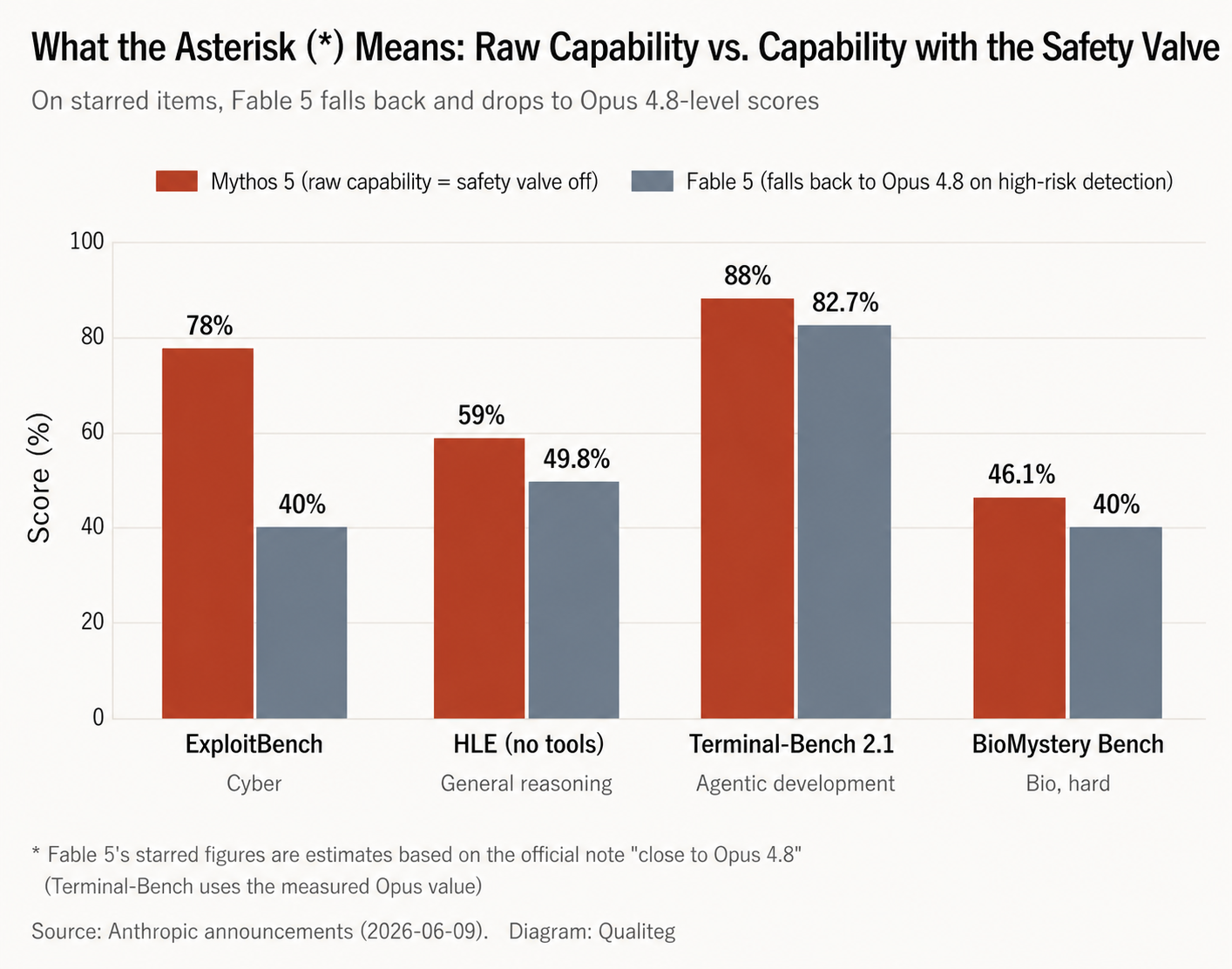
Some rows in this benchmark table carry an asterisk (*); the figures shown there are the values of Mythos 5 with safeguards off.
On rows without an asterisk, Fable 5 is nearly identical (the gap is typically within 1–3 points), but on the asterisked rows — cyber, biology, and the like — the Fable 5 you can actually use drops substantially, toward Opus 4.8
(for example, ExploitBench: 78% for Mythos 5 versus an effective figure of around 40% for Fable 5).
In other words, Fable 5's raw capability is the same as Mythos 5's, and the benchmark gap between them reads as a difference in how strongly the safeguards bite — not a difference in ability.
The chart below is our visualization of this gap.
In high-risk areas such as cyber (ExploitBench) and biology (BioMysteryBench), a large gap appears between Mythos 5's raw capability and Fable 5 with the fallback engaged (roughly Opus 4.8-equivalent).
Put the other way around, this gap is precisely "how strongly the safeguards bite."
2. Key point 1:
High-risk areas fall back to Opus 4.8
This is the single most important point to grasp for enterprise use.
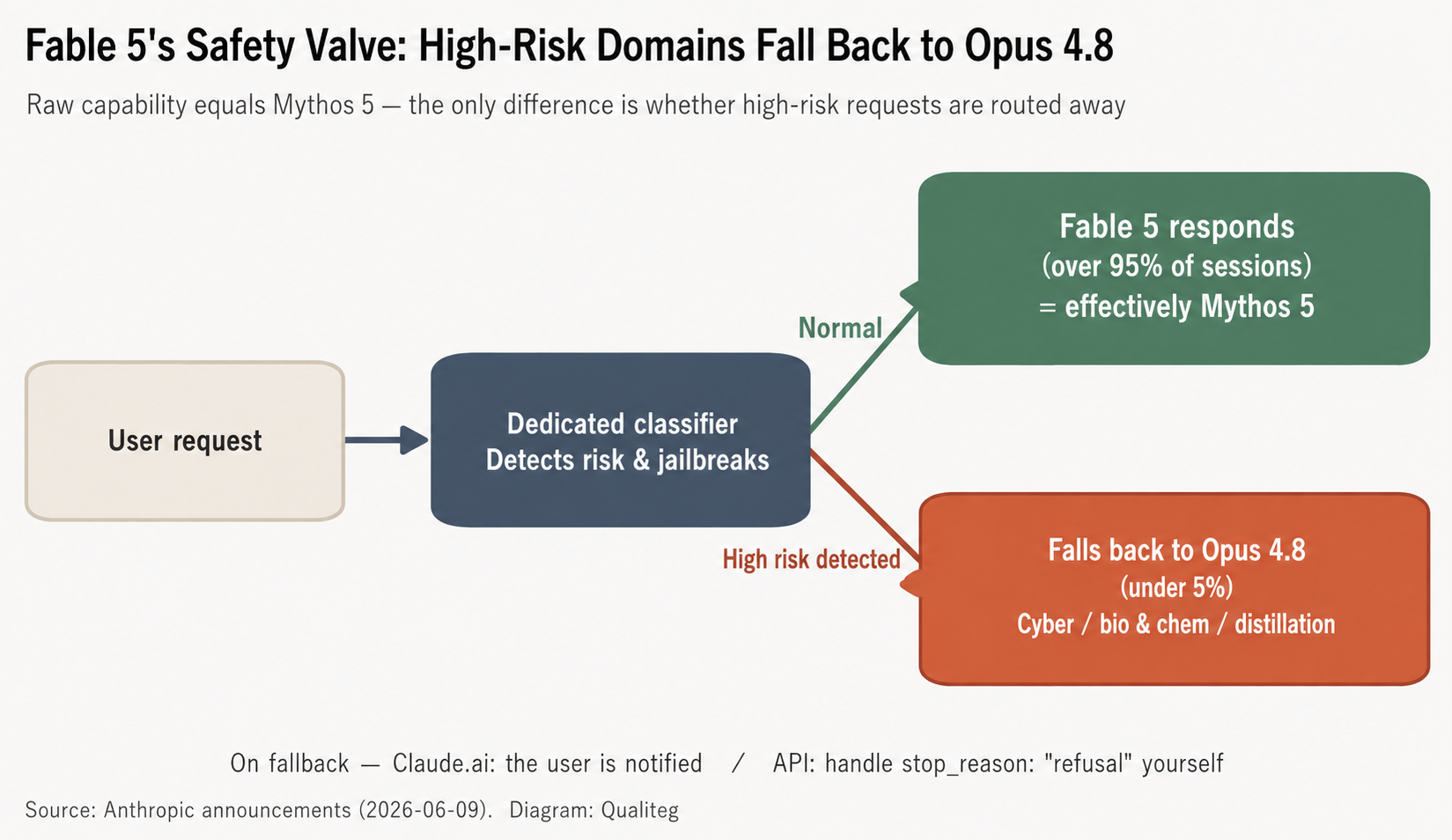
Fable 5 includes a mechanism whereby, upon detecting requests related to cybersecurity, biology, chemistry, or distillation, it does not respond itself but can fall back to another model such as Opus 4.8.
A dedicated classifier runs as a separate AI system, detecting risky requests and jailbreak attempts; rather than letting Mythos-class capability be used directly, it diverts processing to a lower-risk, next-best model.
Here is the mechanism as a diagram.
In practice, note that behavior differs depending on the delivery surface.
On Claude.ai, users are notified when a fallback occurs; with API usage, however, it is not guaranteed to "always switch automatically to Opus 4.8."
With the Messages API, when Fable 5 refuses, a stop_reason: "refusal" is returned, and retrying on another model must be designed around the fallbacks parameter, SDK middleware, or client-side retries. When building agents, it is safest to plan for handling this refusal response from the start.
What the official materials say
The key points of the official announcement are as follows.
- The safeguards are deliberately tuned to be conservative (strict), and Anthropic acknowledges they are "still stricter than ideal."
→ We tried it ourselves and did indeed experience that strictness firsthand. Once we can characterize it more quantitatively, we hope to report on it separately. - As a result, harmless requests occasionally get caught (false positives). Anthropic states plainly that "some users will find this frustrating."
- That said, it triggers in less than 5% of sessions on average. Put the other way, in over 95% of sessions no fallback occurs, in which case Fable 5 performs essentially on par with Mythos 5.
- False positives are slated to be reduced in future updates.
- When a fallback occurs, on Claude.ai the user is notified (API behavior is covered below).
The classifier covers three areas:
● Cyber (broadly blocking not only vulnerability discovery and exploitation but also "agentic hacking" such as reconnaissance and lateral movement),
● Biology / chemistry (falling back broadly for now; as an example of the dual-use potential, a Mythos-class model reportedly outperformed a specialized model on an AAV design-prediction task for gene therapy),
● Distillation (detecting attempts to extract Claude's capabilities to train competing models).
Note that the choice of handing off to Opus 4.8 rather than an outright refusal reflects a design philosophy: being answered by Opus — itself a highly capable model — is a better experience than being flatly refused. Frankly, we consider this an improvement.
Our reading — the connection to our false-positive article
What follows is our own interpretation.
We recently published "Why Legitimate Operations Work Becomes a "Usage Policy Violation" in Claude Code — Real-Time Cyber-Safeguard False Positives and How to Handle Them" — about a phenomenon in which entirely non-offensive work, such as SSH deployments to our own servers or commits to our own repositories, gets caught and blocked by cyber-related safeguards.
Fable 5's "fallback" can be read as an operational challenge very similar to the cyber-safeguard false positives we have encountered in Claude Code, now made visible as official specification.
We cannot assert it is "the same mechanism," but in practice it carries the same class of caveats.
Here are three things we believe practitioners should keep in mind.
- It does not switch silently, but behavior can partially change.
On Claude.ai the user is notified at fallback time; with the API, as noted above, you handle the refusal response yourself. Either way, if Opus 4.8 gets mixed in partway through a long autonomous task, output quality and tool-calling habits can partially change. As we wrote in our Opus 4.7 guide, when the model changes, so does its interpretation of instructions. In designs that run agents for long stretches, this is a point to verify. - The more legitimate your security or bio work is, the more likely it is to get caught.
In fields where legitimate defensive uses and malicious offensive uses are inherently dual-use, it is realistic to assume that, for now, being blocked while doing the right thing is somewhat unavoidable. Anthropic itself notes that the same question that is useful to an expert can be dangerous in the hands of a bad actor. For biology, a vetted "trusted access program" is expected to open soon, giving qualifying researchers access to Fable 5 with the bio/chem safeguards removed. - Jailbreak resistance is quite robust.
Over 1,000 hours of external bug-bounty testing reportedly found no universal jailbreak, and there were zero responses to single-shot harmful requests concerning attack planning, exploit development, or defense evasion (unchanged even when 30 published jailbreak techniques were used). There is also an honest note that the U.K. AISI made partial progress in brief early testing.
3. Key point 2:
The 30-day data retention policy
Unglamorous, but a change every enterprise deployment must check.
For Fable 5, Mythos 5, and future models with equal or greater capability,
30-day data retention becomes mandatory for business customers' traffic going forward
(across both first-party and third-party channels).
Anthropic explains: "not used for training," "not used for anything other than safety purposes," "every instance of human access is logged," and "deleted after 30 days in nearly all cases"
.
The stated reasons are detecting and defending against new jailbreaks and multi-request attacks, and identifying and reducing false positives.
While this is a measure to improve security,
companies handling confidential information will need to check how their data is treated during those 30 days against internal policies and customer contracts.
As we have said repeatedly in our series on putting AI agents into production, AI adoption is not just technology selection — it comes bundled with the design of data, permissions, and accountability.
Before leaping at a new model's capabilities, we strongly recommend aligning with your legal and IT teams first.
4. Key point 3 — Pricing, and designing "which work to use it for"
Pricing is $10 input / $50 output (per 1M tokens). That is less than half of Mythos Preview, but to place it accurately, it is about twice Opus 4.8.
| Model | Input | 5-min cache write | 1-hour cache write | Cache hit | Output |
|---|---|---|---|---|---|
| Claude Fable 5 | $10 | $12.50 | $20 | $1 | $50 |
| Claude Mythos 5 (limited availability) | $10 | $12.50 | $20 | $1 | $50 |
| Claude Opus 4.8 | $5 | $6.25 | $10 | $0.50 | $25 |
(All figures are per 1M tokens)
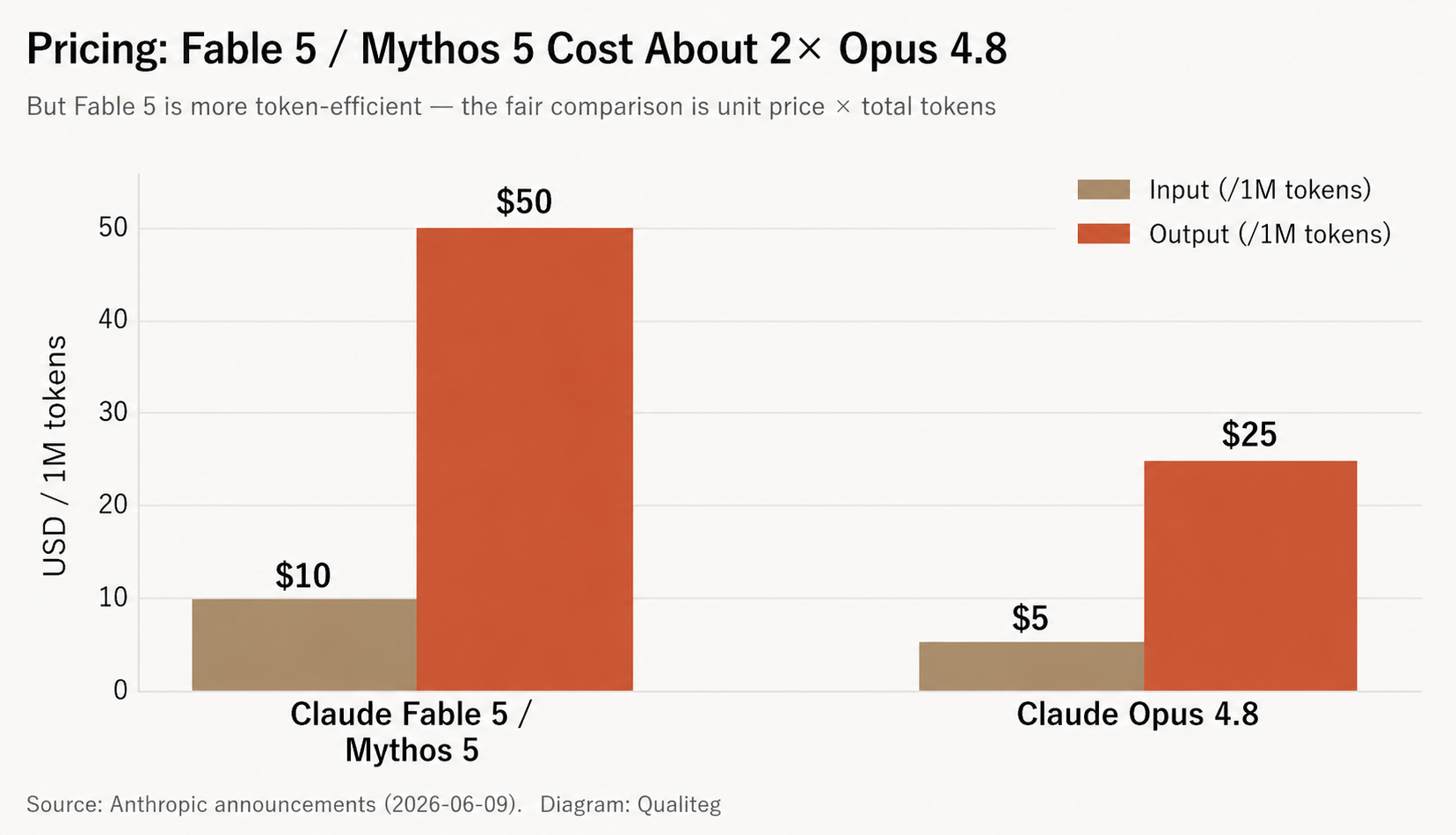
It sits in the highest price tier among major models, but Fable 5 is said to have improved token efficiency (finishing the same work in fewer tokens), so
the fair comparison is total tokens to task completion, not just per-token price
.
In practice, rather than "run everything on Fable 5," the cost-wise standard play will likely be routing only long, high-difficulty core tasks to Fable 5, and everything else to Opus / Sonnet / Haiku. Our API price list for major LLM providers will be updated accordingly.
5. Performance — what caught our eye was the "marathon," not the "sprint"
We covered operational matters first; now let's cover performance.
Anthropic describes Fable 5 as "more capable than any model we have ever made generally available" and "state of the art on nearly every benchmark."
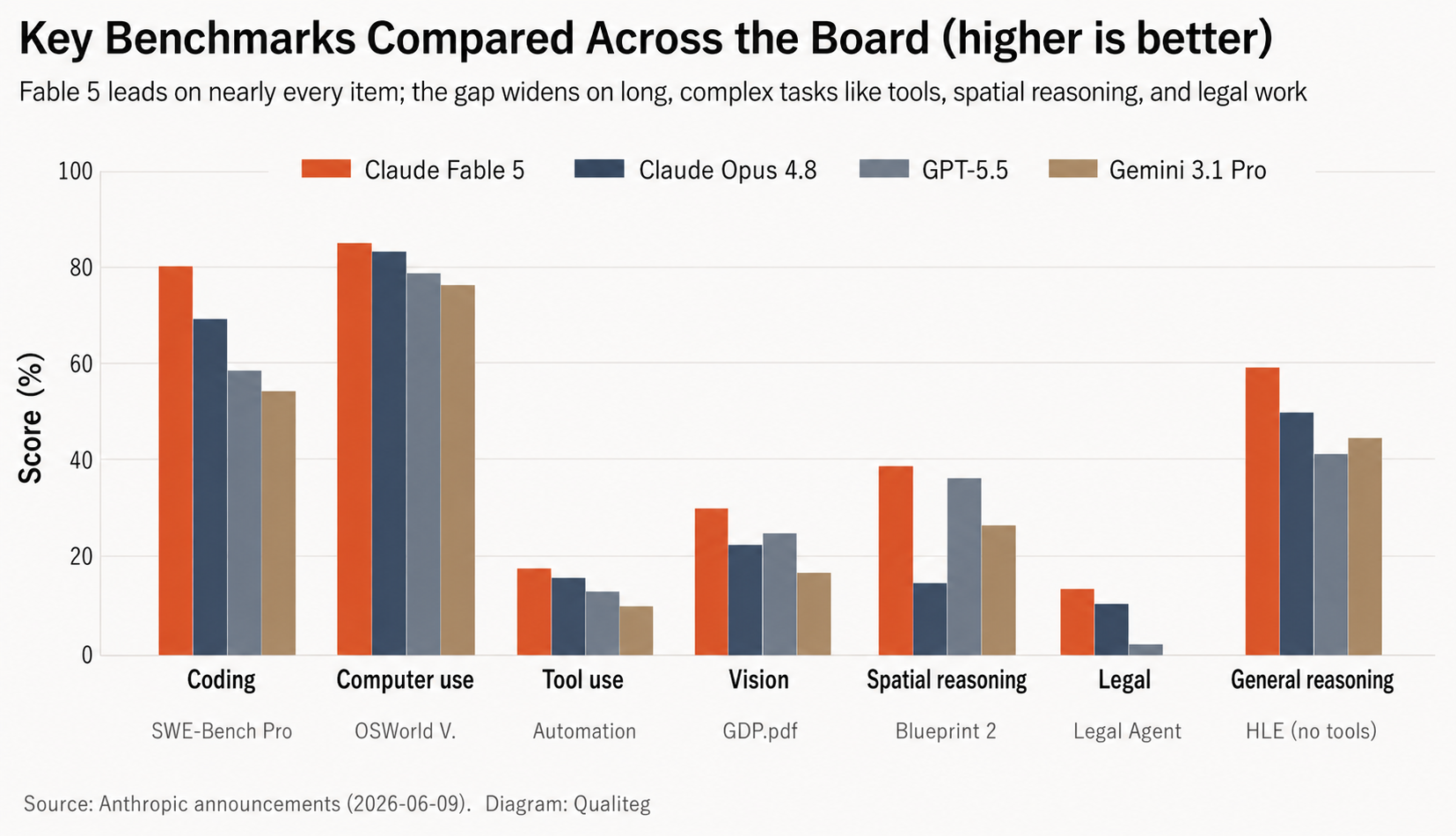
What is interesting is that the longer and more complex the task, the wider the gap over other models.
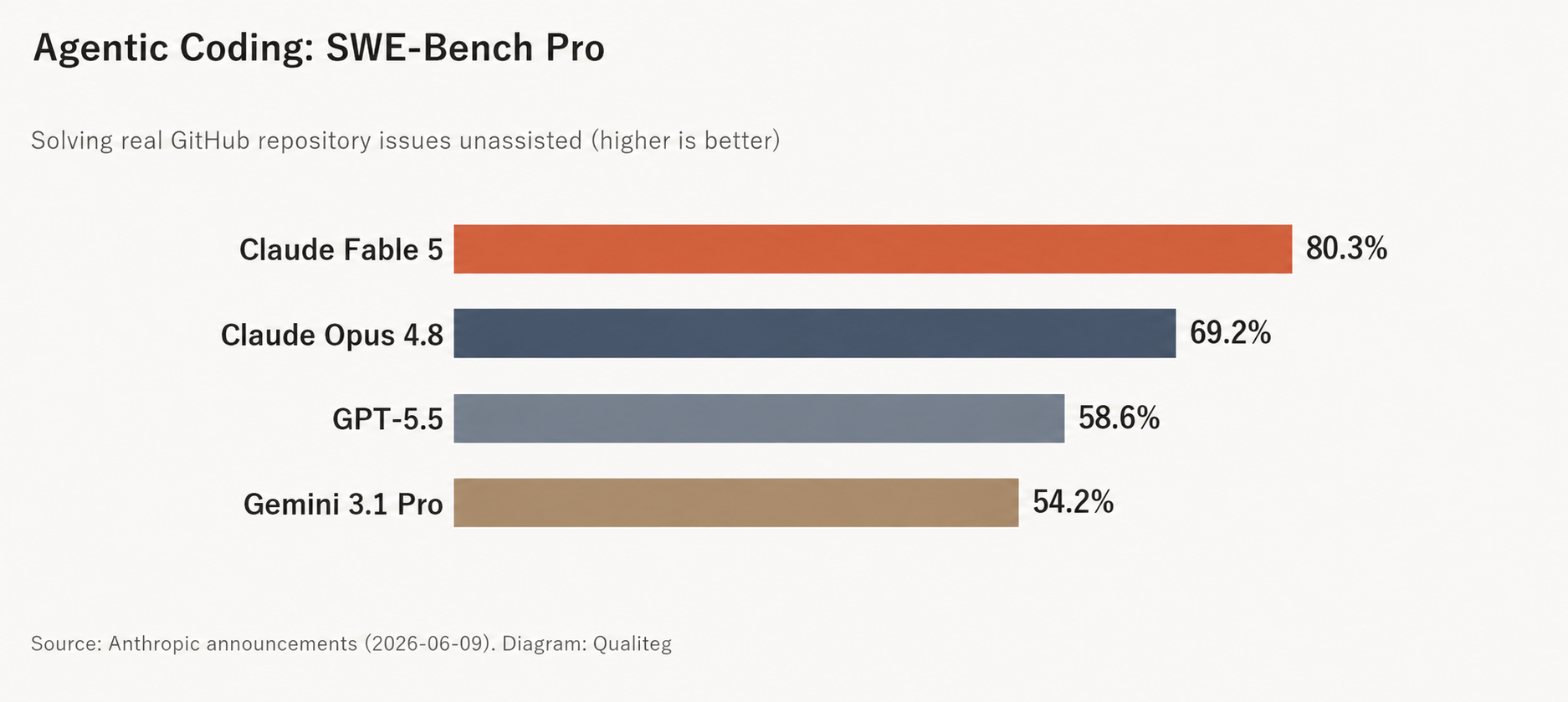
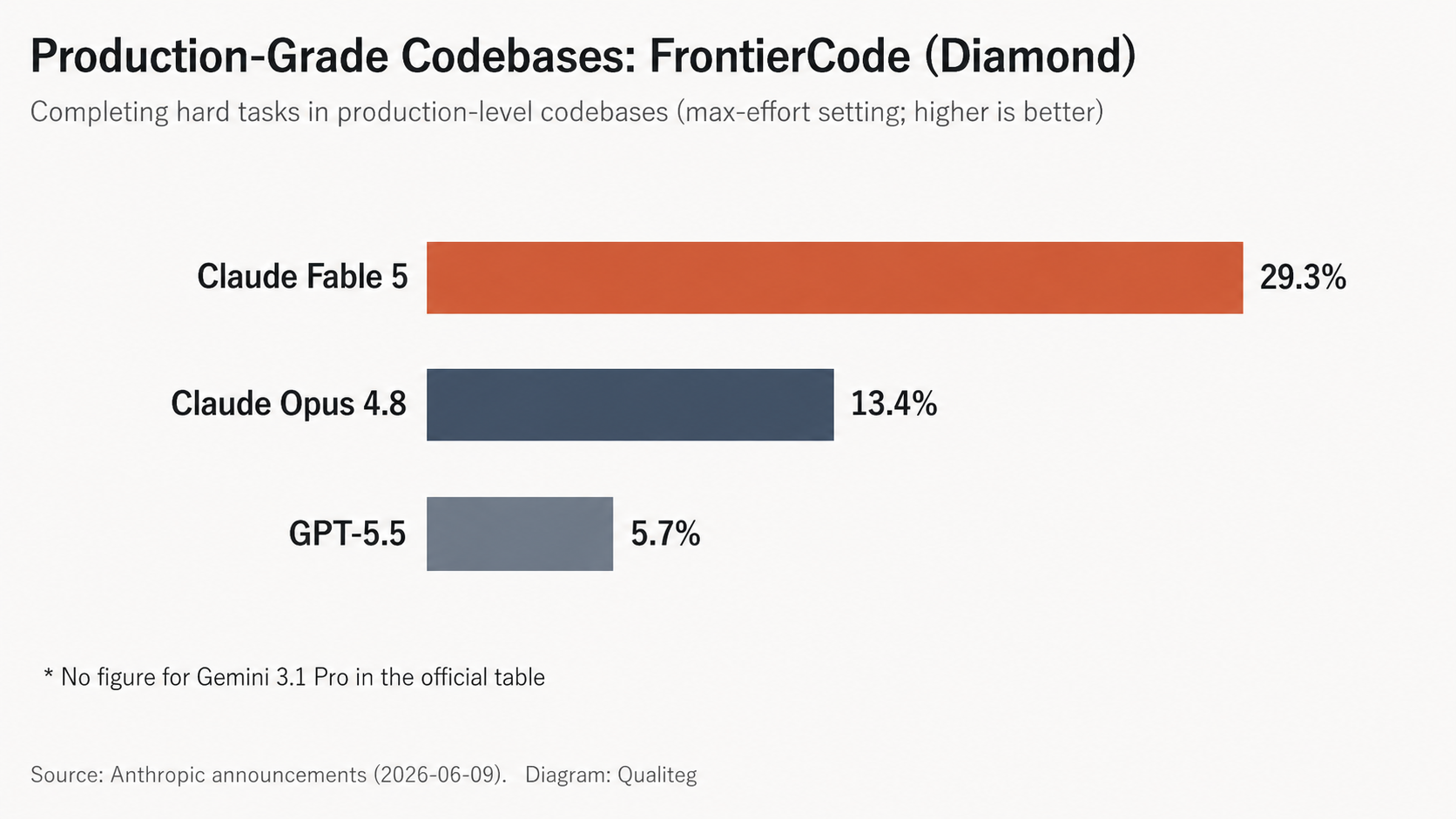
For the full benchmark picture, see the table at the top (official figures organized by Qualiteg). Here we supplement the key points with charts.
| Category / Benchmark | Mythos 5 / Fable 5 | Opus 4.8 | GPT-5.5 | Gemini 3.1 Pro |
|---|---|---|---|---|
| Coding | SWE-Bench Pro | 80.3% | 69.2% | 58.6% | 54.2% |
| Coding | FrontierCode (Diamond) | 29.3% | 13.4% | 5.7% | — |
| Knowledge work | GDPval-AA (ELO rating) | 1932 | 1890 | 1769 | 1314 |
| Vision | GDP.pdf (no tools) | 29.8% | 22.5% | 24.9% | 16.7% |
| Spatial reasoning | Blueprint Bench 2 | 38.6% | 14.5% | 36.2% | 26.5% |
| Tool use | AutomationBench | 17.4% | 15.5% | 12.9% | 9.6% |
| Computer use | OSWorld Verified | 85.0% | 83.4% | 78.7% | 76.2% |
| Legal | Legal Agent Benchmark | 13.3% | 10.4% | 2.1% | 0.0% |
| General reasoning | Humanity's Last Exam (no tools) | 59.0%*Fable effective ≈49.8% | 49.8% | 41.4% | 44.4% |
| General reasoning | Humanity's Last Exam (with tools) | 64.5%*Fable effective ≈57.9% | 57.9% | 52.2% | 51.4% |
| Biology | BioMysteryBench (hard) | 46.1%*Fable effective ≈40.0% | 40.0% | — | — |
| Agent development | Terminal-Bench 2.1 | 88.0%*Fable effective ≈82.7% | 82.7% | 83.4% | 70.7% |
| Cyber | ExploitBench | 78.0%*Fable effective ≈40% / near 0% when blocked | 40.0% | 34.0% | — |
| Health | HealthBench Professional | 66.0%*Fable effective ≈56.9% | 56.9% | 51.8% | — |
It leads on "nearly" every item — though on the long-horizon Vending-Bench, Fable 5 narrowly trails Opus 4.8 (about $5,680 vs. $5,787).
The showcase demos are striking as well.
Stripe completed a full migration of a 50-million-line Ruby codebase — "what would take a human team more than two months, in one day."
Given persistent memory, its improvement in Slay the Spire was three times that of Opus 4.8.
It cleared Pokémon FireRed — which previously required elaborate helper tooling — using a minimal harness with raw screenshots only (that is, improved vision).
A lineup of games can look like mere play, but from our hands-on perspective, this is proof of the agentic ability to "keep running for a long time, relying on its own notes, verifying its own output". In the shift from "AI that writes" to "AI that directs," the biggest bottlenecks were losing context over long stretches and failing to notice one's own mistakes midway; we see this as an improvement that addresses those weaknesses head-on (see: our coding-agent series).
In knowledge work as well, early customers report top scores on financial benchmarks and near-sweeps of trading-analysis items. It should pay off in read-and-reason work.
6. When can you use it? — Mind the subscription rollout schedule
- Claude API / usage-based Enterprise plans … Fully available from June 9. Developers can call it as
claude-fable-5. - Subscriptions (Pro / Max / Team / seat-based Enterprise) … Phased rollout.
- 6/9〜6/22: available at no extra charge.
- From June 23: temporarily removed from plans; usage requires credits (usage credits). The free window may be extended if capacity allows.
- After that: planned to return as a standard feature once sufficient capacity is secured.
The cautious rollout reflects demand expected to be "very high and hard to predict."
"Free to try until June 22; credits required after that"
is the takeaway to remember.
If you want to try it, now is the time.
Note that on Claude.ai it is reportedly treated as "2x usage" (consuming twice the normal quota).
Summary
Claude Fable 5 is not simply news that "a new high-performance model is out."
It brings Mythos-class capability closer to general use while building in fallback for high-risk areas — cyber, bio, chemistry, distillation — and making 30-day data retention part of the premise for business use. The myth (Mythos) said in April to be "too powerful to release" has come down as a fable (Fable) wearing safeguards.
What matters, then, is not looking at performance alone, but designing which work to use it for, where humans verify, and which data may go in. Fable 5 advances the practical use of AI agents by a step — and at the same time asks companies for more careful operational design.
Our enterprise AI agent platform Bestllam gives you Claude Fable 5 and more than 30 other LLMs under a single contract, routing each task to the most suitable model.
The routing described in this article — core tasks on Fable 5, everything else on Opus / Sonnet / Haiku — can be realized while keeping contracts and operations unified. And for the concerns raised here — 30-day data retention and safeguard false positives — LLM-Audit®'s input/output auditing and cross-border protection (operations that keep data in-country) provide, as standard, the governance needed to clear corporate approval.
If you are weighing how to put Fable 5 and other leading-edge AI to work in your business,
please feel free to contact us.

See you next time.
Note: this article is based on Anthropic's official announcement (June 9, 2026) and various press reports. Pricing, availability terms, and safeguard specifications are subject to change. For the latest information, please check Anthropic's official pages.
Note: all charts, comparison tables, and explanatory figures in this article were independently created and organized by Qualiteg based on figures from Anthropic's official announcement (they are not reproductions of official graphics). The header and illustrations are original images created with our generative AI. Figures were cross-checked against multiple sources based on the official benchmark tables, but please verify final accuracy on the official pages.