Qualiteg Selection, Idea Creation #6: How to Use the Creative Matrix


Hello to everyone visiting the Qualiteg blog—I'm Michele. Working on AI-driven new businesses and marketing, I hear certain questions from clients again and again. Through this blog, I would like to share my own answers to the challenges that anyone exploring AI-powered business development is likely to face.
Stuck for ideas? Use the Creative Matrix to expand your possibilities
When you launch a new project or want to bring innovation to an existing service, you need fresh ideas. Yet good ideas often refuse to come, and it is easy to hit a wall. That is where the Creative Matrix comes in.
What is the Creative Matrix?
The Creative Matrix is a framework for generating new ideas by combining existing elements and looking at them from different perspectives. You place different sets of elements along the vertical and horizontal axes, and expand your thinking from the combinations that emerge at each intersection.
Concretely, you place different elements on the vertical and horizontal axes and generate new ideas from their intersections. Typically, the vertical axis holds user needs or problems, while the horizontal axis holds technologies, resources, and the like. By focusing on the points where the two axes meet, novel ideas surface that you would never have thought of otherwise. Because the matrix gives you both comprehensive coverage and multiple angles of attack, it works well even on your own—and when you fill in the grid while discussing with others, unexpected ideas emerge and people build on each other's thinking in ways no one could have imagined, which makes it genuinely fun as a group exercise.
In the consulting engagements and new-business workshops I run, the Creative Matrix is consistently the participants' favorite, so today I would like to introduce it to you.
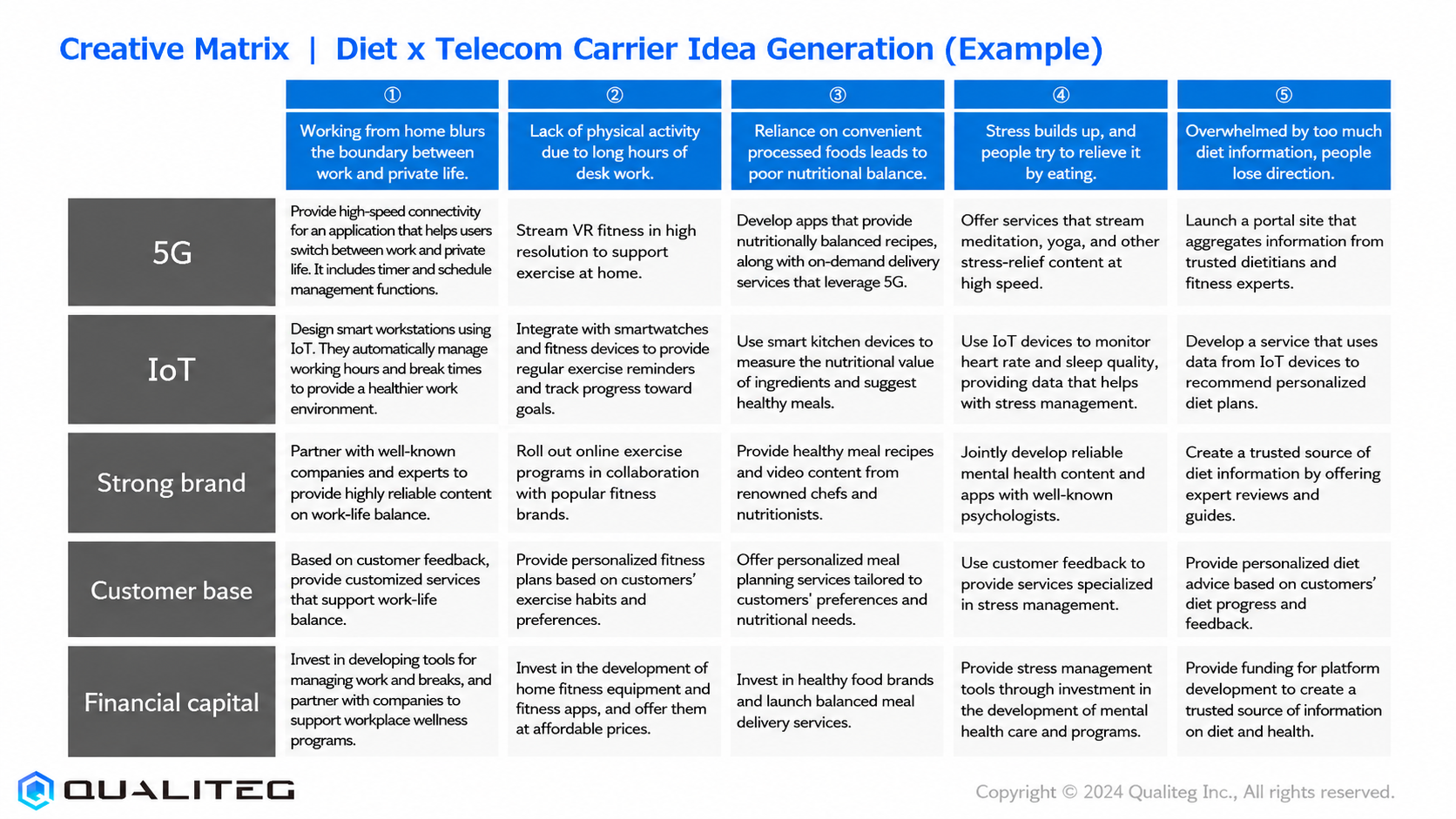
How to use it in practice
- Set a theme: First, clarify the theme you want to generate ideas around—for example, "developing a new cafe menu" or "improving customer satisfaction for an existing service."
- Define the axes: Assign elements related to the theme to the vertical and horizontal axes. For cafe menu development, for instance, the vertical axis could be ingredients (coffee, tea, fruit, and so on) and the horizontal axis could be preparation styles (hot, iced, smoothie, and so on).
- Build the matrix: Create a matrix that combines the elements on the two axes.
- Brainstorm ideas: Write concrete ideas into each intersection. For "coffee × hot," for example, you might come up with espresso or caffe latte.
- Evaluate and develop the ideas: Assess the ideas that emerge, weighing feasibility and appeal. Then refine them further by combining existing ideas or approaching them from a different angle.
The wave of digitalization, shifting markets, intensifying competition—companies today face a moment of major transformation. Innovation-Cross from Qualiteg Inc. is a support program that accelerates that transformation through the power of co-creation. We analyze a company's current state and challenges, formulate a strategy for creating innovation through external collaboration, and provide comprehensive support for new value creation through open innovation and partner development.
We drive your company's transformation through a wide range of approaches, including idea workshops, hackathon planning, and the use of cutting-edge AI technology. Experienced consultants work alongside you to realize the kind of innovation that is hard to achieve in-house alone, through co-creation with outside partners—supporting sustainable growth and stronger competitiveness.
Benefits of the Creative Matrix
- Generate ideas from diverse perspectives: By combining existing elements, you can produce novel ideas you would not have arrived at otherwise.
- Idea generation flows more smoothly: The matrix structure organizes your thinking, so ideation proceeds more smoothly.
- Effective for team brainstorming: Sharing the matrix with the whole team encourages lively discussion and yields many more ideas.

Use cases
- New product development: Combine existing products with new technologies to create innovative offerings.
- Marketing strategy: Combine target segments with promotion methods to design effective marketing strategies.
- Problem solving: Combine problems with candidate solutions to find the best fit.
Tips for getting even more out of it
- Axis selection matters: Choosing axes well suited to the theme leads to more productive ideation.
- Keep your thinking free: Don't let the matrix constrain you—it is important to let your imagination roam.
- Combine it with other brainstorming techniques: Pairing it with other ideation methods such as classic brainstorming or mind mapping makes it even more effective.
The Creative Matrix is a remarkably useful tool when you are stuck for ideas or need a fresh perspective. Give it a try and let your creativity flow.
In closing
The Creative Matrix is, in the end, an aid to thinking. What matters most is taking on new possibilities with free-flowing ideas and a flexible mind. Use this framework to give shape to your own ideas.
Thank you very much for reading this column to the end. At Qualiteg, we provide training and consulting on AI technology and new business planning. If this has piqued your interest, or if you have specific needs, please feel free to reach out via our contact form.

We also offer a popular workshop for those who want to master the steps of new business creation. The training focuses on having each participant think about the business from an executive's point of view, and the content is designed not only for planners but also for their counterpart engineers, designers, and marketers.