The AI Revolution Driven by ChatGPT and the Road Ahead


Today I would like to write about the revolution brought about by ChatGPT and what lies ahead.
As is widely known, ChatGPT is having a major impact on almost every industry.
This text-based AI is contributing to the automation and streamlining of work, and its influence is expected to be far-reaching. At the same time, several challenges stand along the path of ChatGPT's growth and evolution. Here, I would like to take a closer look at the AI revolution ChatGPT is driving, its impact on industries, and the outlook for the future.
How ChatGPT Is Transforming Industries
ChatGPT is said to have already brought dramatic change to 90% of the world's industries. This AI technology is automating and streamlining work across a wide range of fields, from customer service and marketing to insurance, HR, and even software development.
(In our own development work, it has delivered tremendous results in tasks that humans used to handle, such as defining and organizing specifications and designing unit tests.)
In customer service, for example, ChatGPT-powered chatbots can now respond to customer inquiries around the clock, greatly reducing the burden on human resources. ChatGPT is also active in areas once considered distinctly human and creative, such as content creation and automatic code generation, helping to improve both the quality and speed of work.
The Limits of Growth and the Road Ahead
However, a question remains as to whether ChatGPT's growth is limited by training on public data alone. Even ChatGPT, trained on roughly 13 trillion tokens of data, depends on public sources such as the internet, Wikipedia, and paid corpora. Such data inevitably has its limits, which constrain the breadth of what AI can understand and apply.
If the scaling law—that models get smarter as they get bigger—holds true, then making a model smarter means making it larger, and a larger model means feeding it enough data to satisfy that many more parameters and weights.
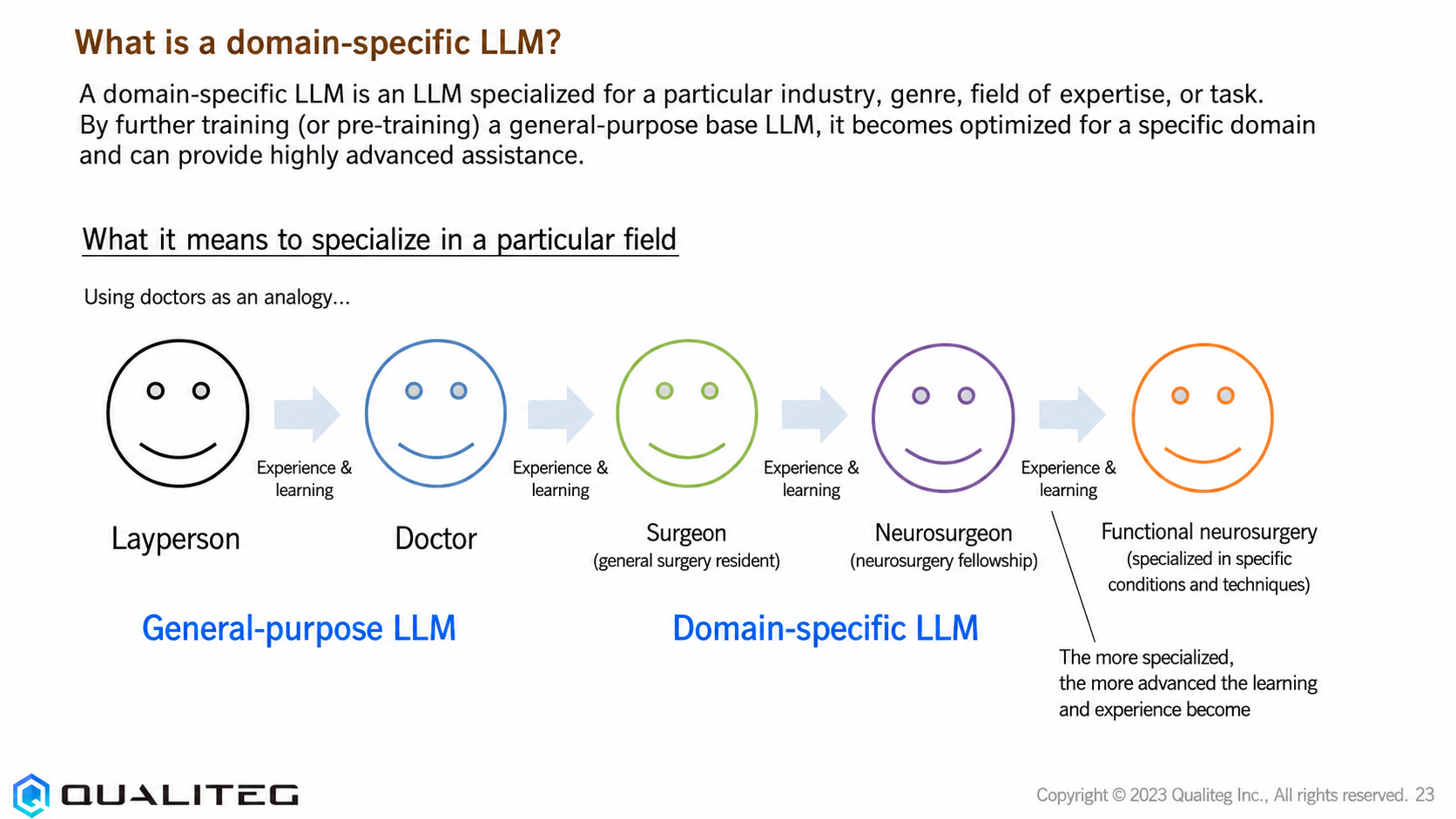
There are two ways to increase the amount of data: breadth and depth. Breadth means broad, general knowledge of the kind found in Wikipedia; depth means highly specialized knowledge about a particular domain. The question is how much data containing such knowledge can be gathered, and I expect the coming movement to focus on depth.
In other words, I believe we will see increasingly active movement along the axis of "specializing in a particular industry"—taking in that industry's data, or a company's own proprietary data, and figuring out how to grow the model from there.
By incorporating company-specific data and specialized industry data into training, ChatGPT can acquire more concrete, specialized knowledge and perform more advanced tasks within a particular industry.
Evolving Toward Industry-Specific (Domain-Specific) Models
As ChatGPT gains broad acceptance across many industries, it is increasingly expected to address each industry's particular needs. In the early stages, ChatGPT excels broadly at general tasks, but companies come to demand solutions built on their own data and tailored to industry-specific challenges. In finance, for instance, a deep understanding of regulatory compliance and risk management is required, while in healthcare, the ability to analyze individual medical records while protecting patient privacy is essential.
The Impact of the Open LLM Movement
When we look at the AI landscape, and open LLMs (Large Language Models) in particular, it is worth turning our attention not only to major LLM providers such as OpenAI, Anthropic, and Cohere, but also to open-source LLM projects. What will become of the open LLM projects that we ourselves are deeply involved with? We believe that "industry specialization" represents a major opportunity for the open LLM community.
Currently, many open LLM providers are focused on approaching or surpassing ChatGPT's performance. However, once a certain level of performance in "general knowledge" is achieved, the next focus will shift to the ability to build models specialized for particular industries or domains. The key here is the balance between making pre-training more efficient by leveraging deep industry knowledge and the fine-tuning that accompanies it. Achieving this within a short development cycle (TAT: Turn Around Time) will be the technical challenge.
In specialized fields such as medicine and law, for example, understanding and correctly applying technical terminology is essential. To develop an LLM capable of handling advanced tasks in these fields, it is indispensable to collect training data that incorporates expert knowledge and to fine-tune on case studies from the specific domain. In finance and energy, moreover, the ability to respond quickly and in a timely manner to market movements and regulatory changes will also be required. Developing these industry-specific models will depend heavily on collecting industry-specific data and on real-time data processing capabilities.
As these developments unfold, I expect (hopefully!) that ChatGPT will no longer dominate the market single-handedly, and that providers capable of offering a diverse range of "industry-specific" models will rise to prominence. Supporting such models requires a powerful inference platform and the foundations and frameworks that underpin inference applications. ChatStream and the related services we provide offer strong support for developing and deploying industry-specific models in this new era, enabling customers to solve industry-specific problems in a timely and flexible way. Thinking about how our technology can deliver value in the deployment of next-generation LLMs is truly exciting. And a lot of fun!
navigation