[AI-Driven New Business Creation] How Qualiteg Designs and Prepares Research for Hypothesis Exploration and Customer Understanding
How to identify target users' problems and propose solutions as preparation for idea generation: define the purpose and goals of problem discovery, interview users of competing services, clarify the research method and target users, and ask probing questions repeatedly to gain deep insight.

![[AI-Driven New Business Creation] How Qualiteg Designs and Prepares Research for Hypothesis Exploration and Customer Understanding](https://images.unsplash.com/photo-1523726491678-bf852e717f6a?crop=entropy&cs=tinysrgb&fit=max&fm=jpg&ixid=M3wxMTc3M3wwfDF8c2VhcmNofDF8fGRlc2lnbnxlbnwwfHx8fDE3MTMwNDIxNDJ8MA&ixlib=rb-4.0.3&q=80&w=1200)
Hello to everyone visiting the Qualiteg blog. I'm Michele. In my work on AI-driven new business development and marketing, there are questions I hear from clients again and again. Through this blog, I'd like to offer my own answers to the challenges that anyone considering an AI-based business is likely to face.
As preparation for generating ideas, I'll explain how to identify the problems your target users are facing and how to propose solutions to them. Today, I'll walk through what kind of research you should conduct in order to clarify what those target users' problems actually are.
For the user problem-discovery study: Clarifying the Purpose and Goals
The first thing to do is to clarify the purpose and goals of your user problem-discovery study. Define clearly what information you want to collect and what you want to get out of the study. At this stage, set specific research questions and decide the scope and focus of the study.
Concretely, if you intend to hear about the problems of users of a competing service and turn that into your own service proposal, your interviewees should be people who currently use that competing service and pay a high amount for it, or people who have stopped using it.

In this way, clarify at this stage what results you want to obtain from the study and what you intend to do with that data.
You also need to be clear at this point about whether the method will be interviews or an online survey, roughly how many people you will ask, and what you will ask them.
These points not only clarify your own research objectives, but can also serve as advance information for getting internal approval of the research budget, so I recommend taking the time to organize them here rather than skipping this step.
Selecting and Recruiting Target Users
Once the purpose and goals of the study are set, the next step is selecting the target users. It is common to make research easier by asking people in your own department to be interviewees, but at Qualiteg we do not recommend interviewing people close to you; we recommend using a research agency instead.
For a company to survive in a highly uncertain environment, it is important to hold multiple options for the future. Innovation-Cross from Qualiteg Inc. is a program that expands a company's options for the future through co-creation. Based on an analysis of the current situation, it uncovers a diverse range of possibilities that "we could never have thought of on our own" through open innovation and partner development.
Through a wide variety of approaches, including idea workshops, hackathon planning, and the use of cutting-edge AI technology, we bring together knowledge from inside and outside the company to create innovative options that go beyond the conventional path. Our experienced consultants draw on your company's strengths to chart new routes through external collaboration, enhancing strategic flexibility and competitive advantage in an era of rapid change. Opening multiple doors to the future: that is our role.
The reason is clear: if you approach similar people who are not actually target users and get polite approval from them, you risk losing sight of the original objective, which is to hear about customers' problems.
In this phase, you need to identify the user segment to be studied and understand how those users are using products or services. So, in order to interview them about your current hypothesis on the problems with the competing service, I recommend having a research agency screen users of that competing service and then interviewing them.

How to Think About Sample Size and Interview Length
When conducting interviews, many client companies want to run group interviews so they can hear as many voices as possible, but Qualiteg's recommendation is the "in-depth interview." As for duration, around 60 to 90 minutes per person is appropriate. In terms of numbers, we recommend interviewing at least 3 people, and ideally around 5 to 7.
The purpose of the interview is to ask what prompted them to start using the competing service and what they are satisfied or dissatisfied with while using it. But if you mechanically fire off the questions you want answered and get yes/no responses, there is no point in doing interview research at all.

For every item, you need to repeat "why" questions, as in the "five whys," and dig thoroughly into why the user arrived at that decision, including the circumstances and psychological state at the time. That is why you should use the first 20 minutes as an icebreaker to build trust and create an atmosphere in which the person feels comfortable talking freely; only then, by asking your various questions, can you hear the "real user problems" you were hoping to uncover.
For that reason, 30 minutes is not enough for a substantive conversation, and we recommend conducting exploratory interviews of at least 60 minutes, and ideally around 90 minutes.
Thank you very much for reading this column to the end. At Qualiteg, we provide training and consulting on AI technology and on how to plan new businesses. If you are interested, or if you have a specific request, please feel free to contact us via the inquiry form here.

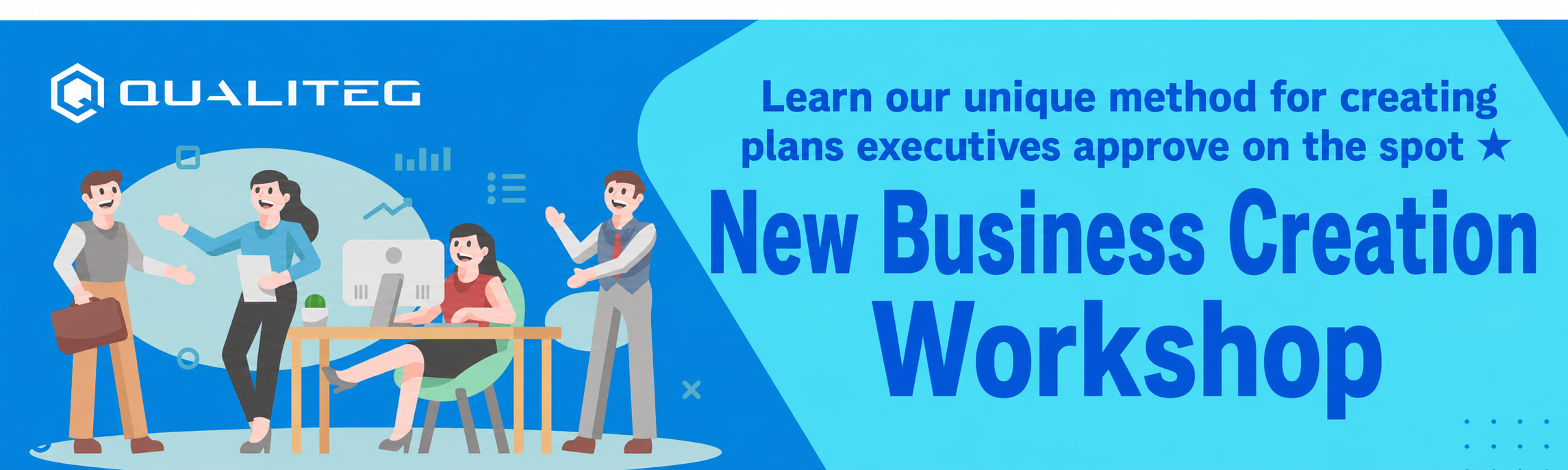
We also run a well-received workshop for those who want to master the steps of new business creation. The training focuses on having each participant think about the business from an executive's point of view, and the content is suitable not only for planning staff but also for their counterparts in engineering, design, and marketing.
We sincerely look forward to hearing from you. Please stay tuned for the next column.
navigation