Is GPT-6 Astra AGI? How It Differs from Claude Fable 5.1, Pricing, and What It Means for Your Work
What makes GPT-6 Astra stand out? We compare performance and pricing with Claude Fable 5.1, plus the ChatGPT Pro and Claude Max 20x plans, and share the AGI-like progress and what we noticed in real development, with diagrams.

Hello!
OpenAI has released GPT-6 Astra.
"Which is better, this or Claude Fable 5.1?"
"Is this finally AGI?"
"How will my work change?"
This time we dig into exactly those questions.
To state the conclusion first, what deserves attention this time is
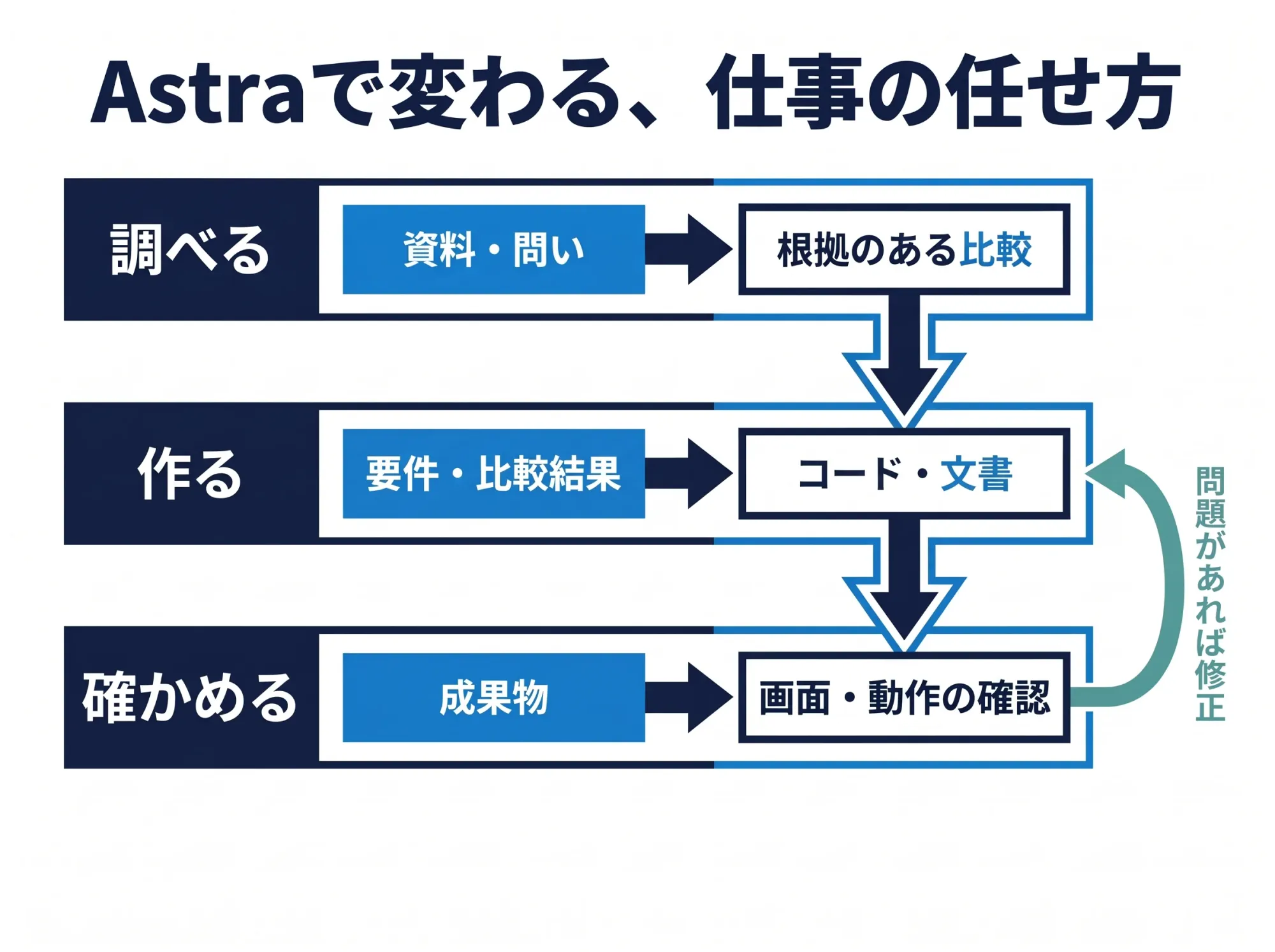
the ability to carry a whole job forward: research, build, and verify.
In our Japanese LLM Rankings 2026 (September 1 Edition), we covered where GPT-5.6 Sol, Terra, and Luna stand.
This time we go deeper: the progress visible in 3D production and screen operation, how Astra's strengths differ from Fable 5.1, and the $200-a-month 20x plans.
Astra's API price is 2.5 times Sol's. Yet in a terminal-work evaluation, it produced a higher score at a lower cost than Sol. We will also look at why this reversal happens.
Part 1: Astra's highlights are 3D production and app operation
The easiest way to grasp Astra's progress is the 3D example. OpenAI has published a demo in which Astra models a house in Blender, brings it into Unreal Engine 5, and turns it into a scene you can walk through.
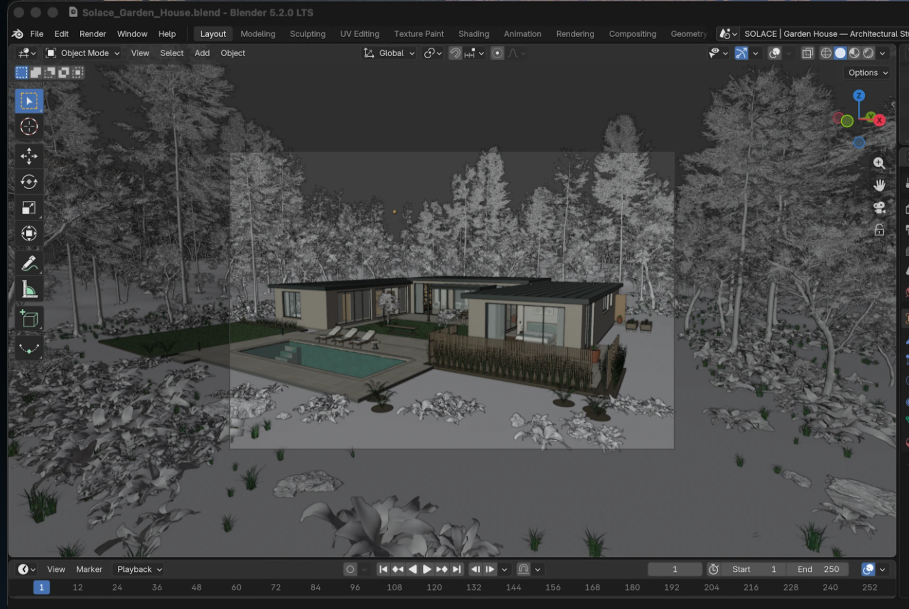
From looking at the exterior to stepping inside the space and checking it. For an architectural proposal, one use that comes to mind is sharing, on the spot, how the rooms connect and how the impression changes from different viewpoints.
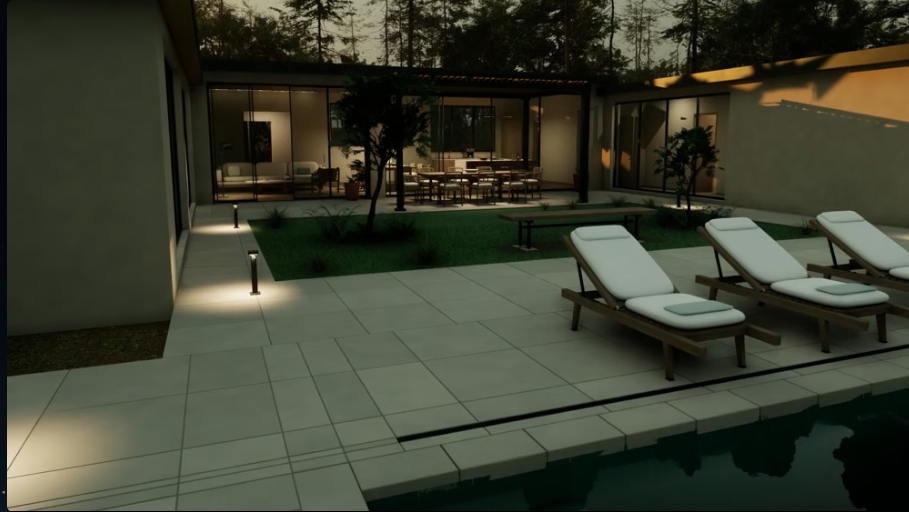
The ability to build 3D models and the ability to operate production software grew together
This is the interesting part. Beyond generating shapes, the scope now covers handing the result to another application and actually running it.House example (OpenAI)
In CAD, reconstructing shapes from multi-view images
BenchCAD has the model generate CAD code from renderings taken from several directions and evaluates how well the shapes overlap. Astra scores 95.9%, Sol 83.3%. The progress in handling 3D shows up not only in good-looking examples but also in an evaluation of reconstructing geometry.
GPT-6 Astra: basic specifications
| Item | GPT-6 Astra |
|---|---|
| API model ID | gpt-6-astra |
| Context window | 1,050,000 tokens |
| Max input | 922,000 tokens |
| Max output | 128,000 tokens |
| Input | Text, images |
| Output | Text |
| Knowledge cutoff | April 30, 2026 |
| API reasoning effort | low, medium, high, xhigh, max |
Part 2: What grew from Sol is implementation and operation beyond search
In the comparison with Sol, two items stand out: Terminal-Bench 4.0 for terminal work and AutomationBench for business workflows. On BrowseComp, the search benchmark, both models are in the 90s, but on these two items Astra improved substantially.
| Benchmark | GPT-5.6 Sol | GPT-6 Astra |
|---|---|---|
| OSWorld 2.0 | 65.7% | 72.6% |
| Terminal-Bench 4.0 | 37.3% | 57.9% |
| AutomationBench | 18.1% | 41.4% |
| BrowseComp | 90.4% | 91.5% |
Scores are from OpenAI's published tables. The highest score obtained among the reasoning-effort settings tried for each model and evaluation is shown. OSWorld uses the v2026.08.08 offline set with partial scores.
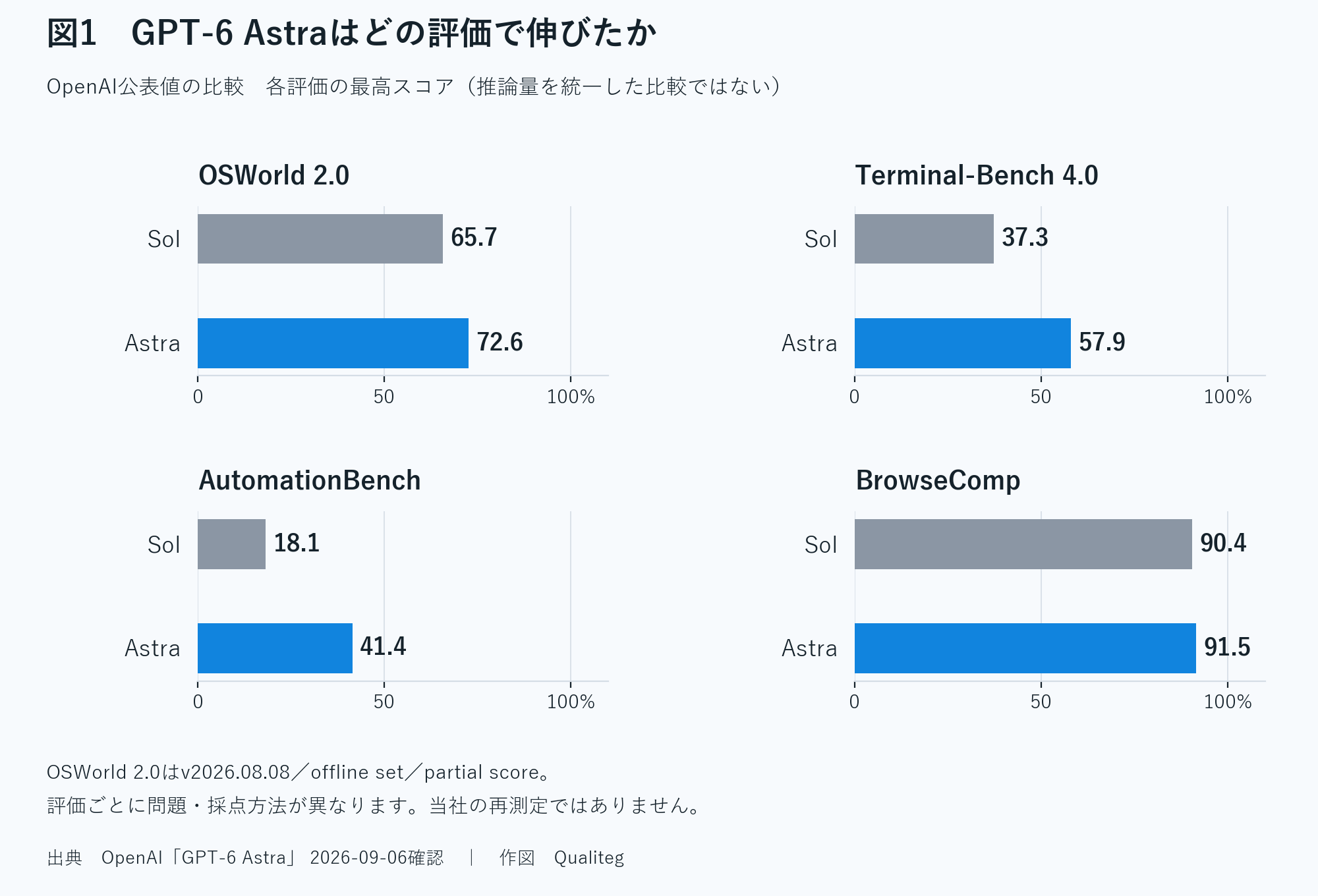
Terminal-Bench tests software development, environment setup, and data analysis done through a terminal. You hit an error while writing code, investigate the cause, run it, and confirm. On tasks that involve this kind of operation, Astra moved from Sol's 37.3% to 57.9%.
AutomationBench also rose from 18.1% to 41.4%. What these results raise expectations for is the part after search finds an answer: using that information to get work done inside applications.
Screen operation also changed in waiting time
In the OSWorld 2.0 time simulation, Sol takes about 75 minutes while Astra takes about 40. Astra raised the score from 65.7% to 72.6% while cutting the time by about 47%.
In addition, in a Mind2Web comparison combined with improvements to the operating layer on the Codex side, task completion is reported to be 1.9 times faster. For work that involves a lot of screen-based operation, this shorter waiting time should also matter for usability.
Part 3: How does it differ from Claude Fable 5.1?
Claude Fable 5.1 is also a top-tier model built to take on long development and business processes. Compared with Astra, the clear differences are not so much in terminal-work scores as in the business-workflow evaluation and the cost of long inputs.
Same base price. The difference appears in long inputs and caching
First, here are the specifications of both companies' directly offered APIs side by side. Prices are in US dollars per 1 million tokens, and for Astra they are the Standard tier with inputs of 272,000 tokens or fewer.
| Item | GPT-6 Astra | Claude Fable 5.1 |
|---|---|---|
| Total context | 1,050,000 tokens | 1,000,000 tokens |
| Max output | 128,000 tokens | 128,000 tokens |
| Base input price | $10 | $10 |
| Base output price | $50 | $50 |
| Cache read | $1.00 | $0.25 |
| Long-input pricing | Surcharge on the whole request above 272,000 tokens | Base price up to the 1M-token window |
For input that is read repeatedly, Fable 5.1's price is one quarter of Astra's. For example, reading 200,000 cached tokens 100 times costs $20 on Astra and $5 on Fable 5.1 for the read portion. New input, cache writes, and output are charged separately.
Long inputs differ too. On Astra, once the input exceeds 272,000 tokens the entire request switches to the surcharged rate, while Fable 5.1 stays at the base price up to its 1-million-token window. For API use that keeps a large codebase or set of documents loaded across many turns, Fable's pricing design pays off.
Terminal work is close; Astra leads on business workflows
In OpenAI's comparison table, Astra scores 57.9% on Terminal-Bench versus 55.8% for Fable 5.1. On AutomationBench the gap widens to 41.4% versus 31.4%.
| Benchmark | GPT-6 Astra | Claude Fable 5.1 |
|---|---|---|
| Terminal-Bench 4.0 | 57.9% | 55.8% |
| AutomationBench | 41.4% | 31.4% |
| Artificial Analysis Intelligence Index v4.1.1 | 61.2 | 65.7 |
On the other hand, the Artificial Analysis Intelligence Index, which aggregates knowledge, reasoning, and other areas, favors Fable 5.1. In other words, the ranking flips between the composite index and evaluations of getting work done with tools.
The source is OpenAI's published comparison table. It shows the highest score obtained among the reasoning-effort settings tried for each model and evaluation.
Part 4: Is Astra AGI? What impresses, and what still gives pause
It operates screens it has never seen, researches, writes code, and finishes the deliverable. Watching that, it is easy to see why people feel "this is starting to look like AGI."
What feels like AGI is the ability to make progress on unfamiliar work
ARC-AGI-3 is an evaluation in which the model explores an unknown environment, infers the rules and goals, and acts. Beyond whether it knows a fixed answer, it tests how the model learns and behaves in a situation it faces for the first time.
According to OpenAI's announcement, Astra scored 99.9% on ARC-AGI-3. That is the result on tasks that require exploring a new environment, discovering the rules, and acting.
What still did not feel like AGI: losing sight of the premise
At our company, too, when we entrusted it with developing a product that handles a wide variety of 3D data, we felt this high capability and a shaky judgment at the same time. It happened when we had it build a sample for verification and then fix that sample's behavior.
The AI carried out a difficult implementation and reported that the tests passed. But when we checked with ordinary usage, problems remained, and the fix it reached for was a special case that worked only for that one sample.
The product's purpose is to handle whatever data users bring. Adding logic that works only for that sample makes the immediate defect disappear but undermines the product's generality.
Pulled along by the additional instruction, the premise that should have been preserved dropped out.
It has the ability to implement difficult code. Even so, in its hurry to get the tests passing, the judgment of whether that solution was sound for the product as a whole was pushed aside. High capability and this basic misjudgment coexisted.
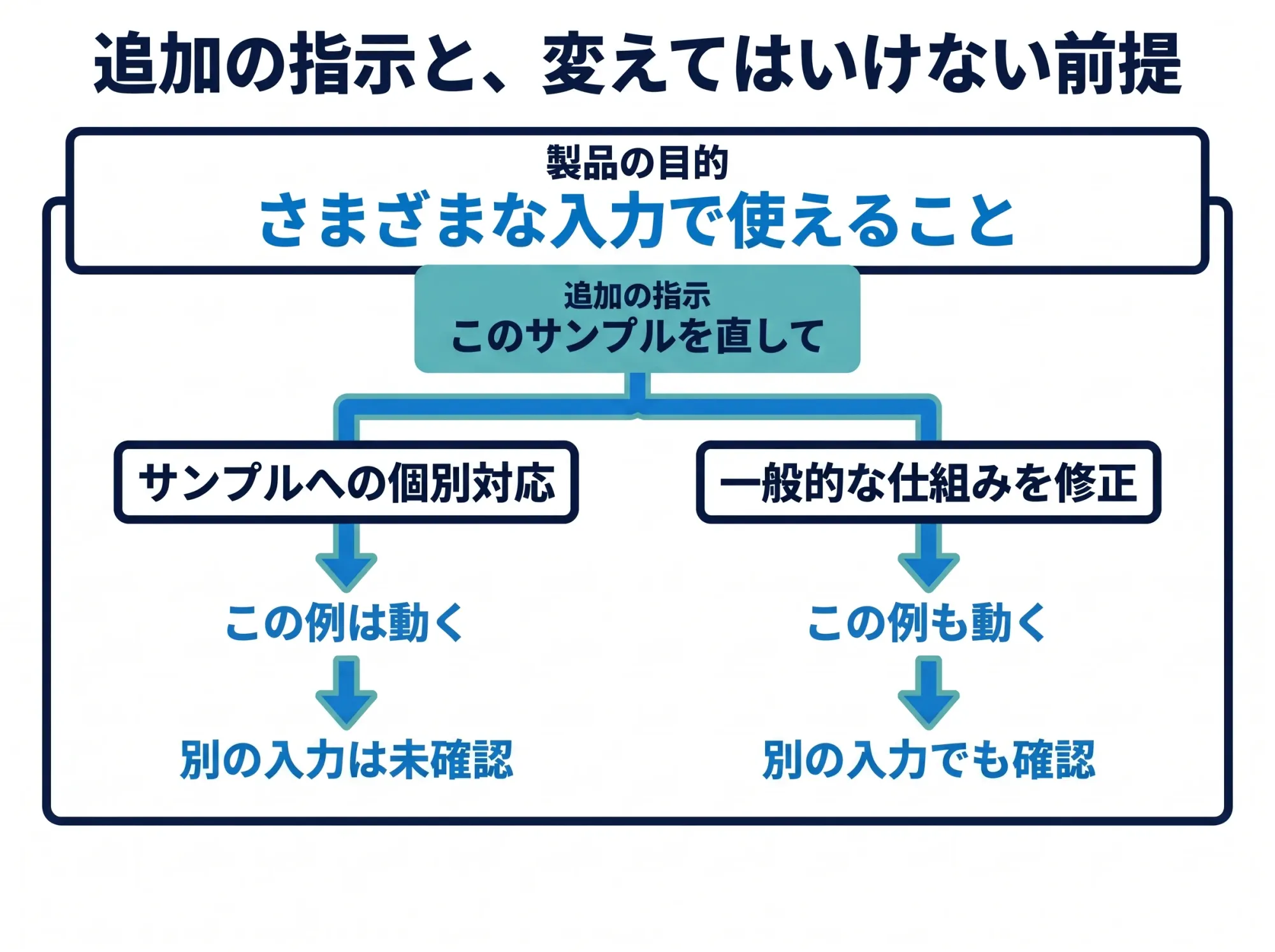
This is a moment where a human developer would go back to the product's purpose and hold the line. When we pointed it out, Astra was able to proceed with the correction, but we had to notice and speak up.
Part 5: You can interact with it while the work is in progress
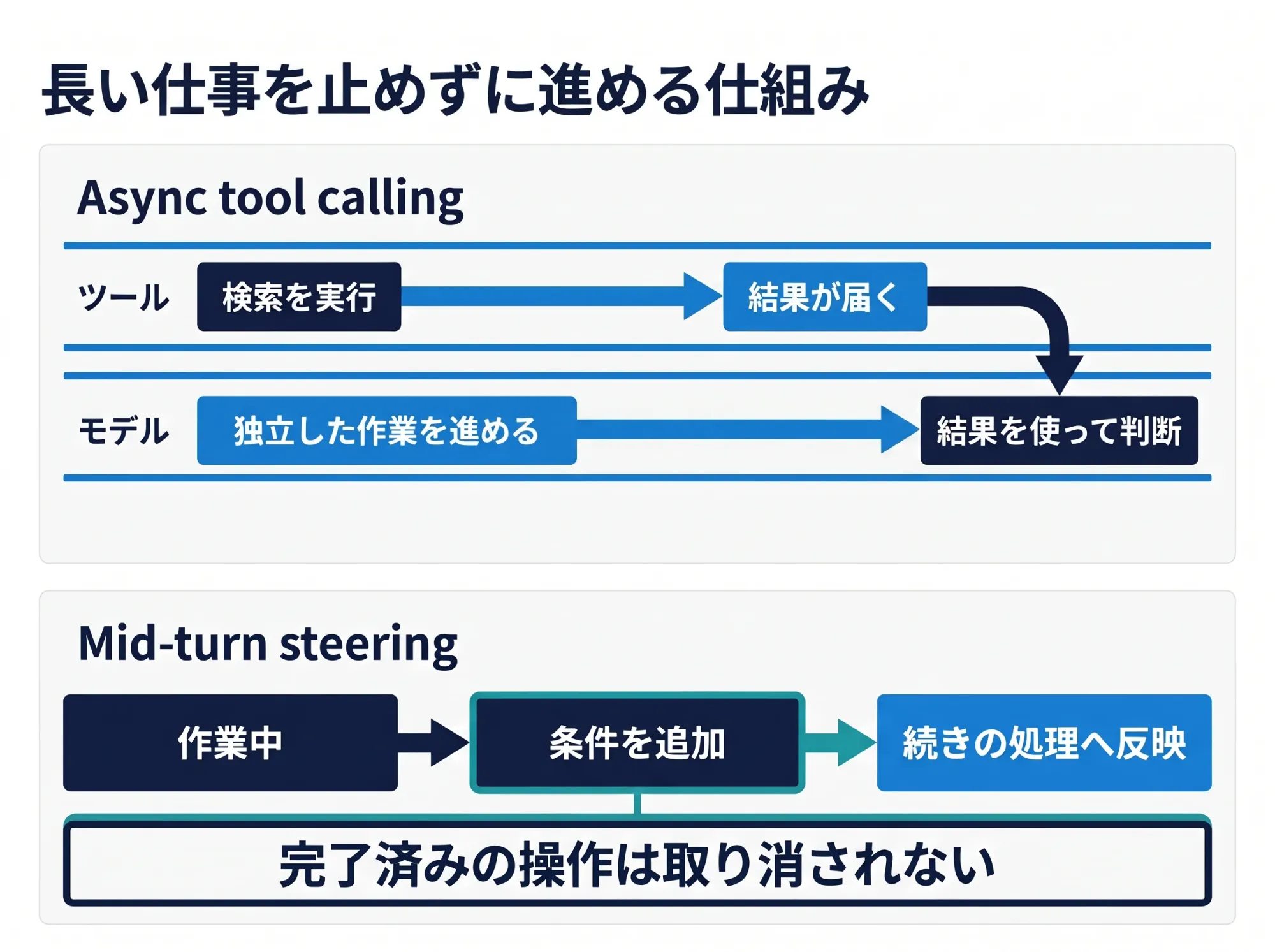
Telling it "actually, use these conditions instead" partway through a long job. With Astra, that kind of exchange can be built in through the Responses API. Add parallel work while waiting on tools and switching of reasoning effort, and the way agents are run changes.
Continue other work while a tool is running
Async tool calling lets the model continue other reasoning or independent work before a tool's result comes back.
For example, you can run a time-consuming aggregation tool and, meanwhile, have the model check a separate, independent document. When the aggregation result arrives, it is returned to the conversation as the result for the original call_id.
You enable it with async: true in a function or custom tool definition. Launching the tool and collecting its result are implemented on the application side.
Add conditions before the response is finished
Mid-turn steering lets the user add conditions or direction while the model is still working. In the API, it applies to Astra over a WebSocket connection to the Responses API.
While it is drafting a proposal, you can add "cut the budget in half" or "exclude this candidate" and have that reflected in the rest of the work. It reduces the round trips of waiting for a long answer to finish and then asking for changes.
The change applies to the work that follows. Stopping a tool that has already started, or undoing a write to an external service, is something the application has to handle.
Raise reasoning effort only for the hard steps
Adding a configuration_update to the input switches reasoning.effort starting from the next response. It applies to standard and single-agent mode.
Unlike changing the settings for the whole request, this keeps the leading part of the prompt used for caching intact. It is useful for designs where, in a conversation that has already shared long documents, you raise reasoning effort only for the difficult deliberations.
Part 6: GPT-6 Astra API pricing. How to think about 2.5 times Sol
Under OpenAI API Standard pricing, Astra costs $10 per million input tokens and $50 per million output tokens. The comparison below is for inputs of 272,000 tokens or fewer, in US dollars.
| Model | Input / 1M tokens | Output / 1M tokens |
|---|---|---|
| GPT-6 Astra | $10.00 | $50.00 |
| GPT-5.6 Sol | $4.00 | $20.00 |
| GPT-5.6 Terra | $2.00 | $12.00 |
| GPT-5.6 Luna | $0.20 | $1.20 |
Sol's listed price is a promotional price, officially announced to run at least until November 21, 2026.
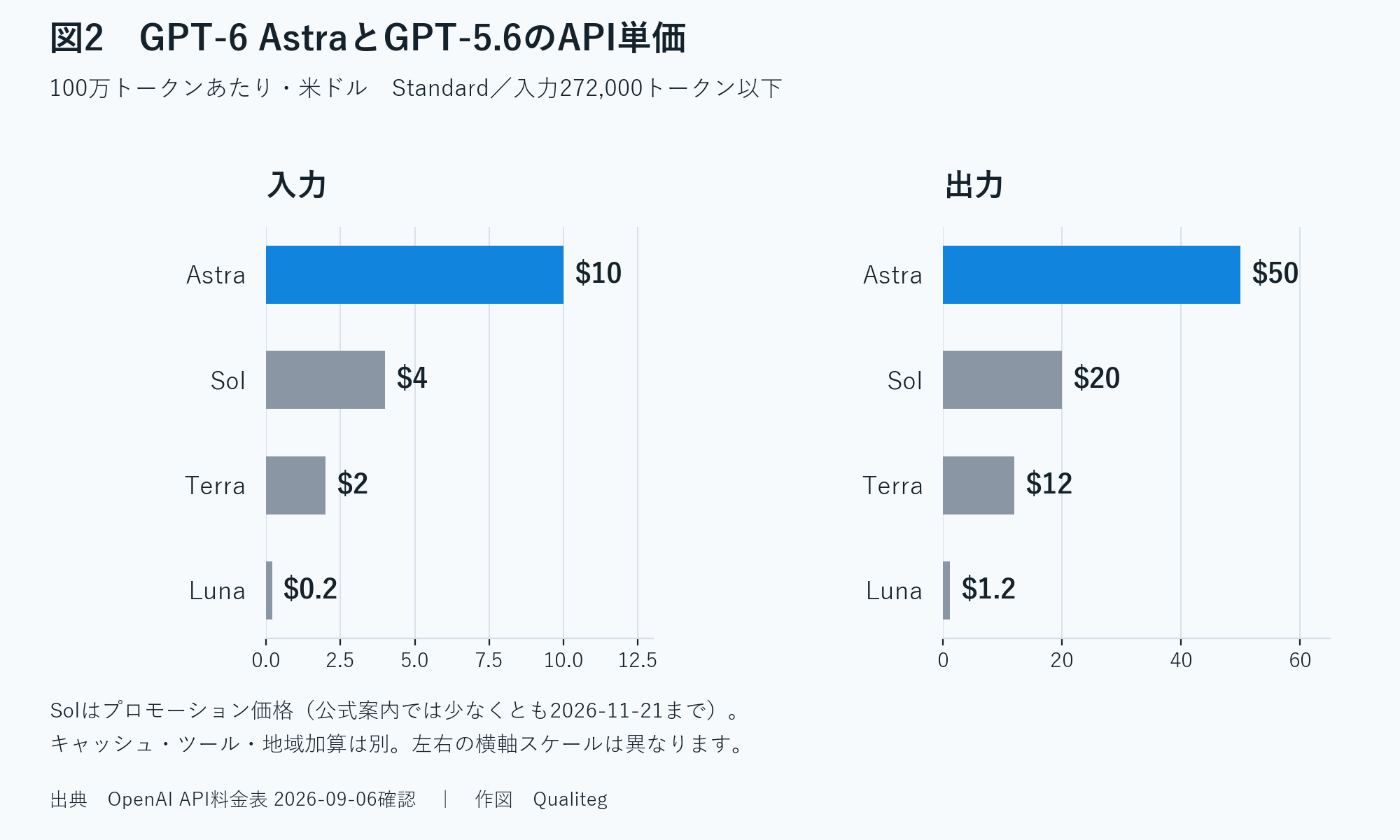
Astra reduces output tokens substantially across several evaluations. Even at 2.5 times Sol's per-token price, consuming fewer tokens to finish a task produced results where the cost reverses.
On Terminal-Bench 4.0 for terminal work, comparing the settings that produced each model's best score, Astra's estimated API cost is about 9% lower than Sol's. On complex tasks, in other words, it reached a higher score at a lower cost.
Estimating the cost when retries decrease
Take a request with 10,000 input tokens and 2,000 output tokens as an example: Astra costs $0.20 and Sol $0.08. Output is calculated as the billable amount including reasoning tokens.
The assumptions are Standard pricing with no caching. Tool fees and regional surcharges are excluded.
| Model | Input | Output | Total |
|---|---|---|---|
| GPT-6 Astra | $0.10 | $0.10 | $0.20 |
| GPT-5.6 Sol | $0.04 | $0.04 | $0.08 |
Under these conditions, two attempts on Sol still cost $0.16. Three attempts come to $0.24, exceeding one run of Astra. How many rounds of rework it takes to recoup the 2.5x price difference becomes concrete.
Conversely, jobs that feed in long documents keep their input cost. In this example, Astra's input portion alone is $0.10, so shortening the output alone will not reach Sol's $0.08 total.
Long context and caching fall into different pricing tiers
Astra's cache reads cost $1 per million tokens and cache writes $12.50. Once the input exceeds 272,000 tokens, the long-context rate applies to the entire request.
In the long-context tier, prices per million tokens are $20 for input and $75 for output, with cache reads at $2 and writes at $25. Because the price of the entire input doubles once you cross the boundary, this has a large effect on designs that load documents in one go.
In the API, Batch and Flex are half the Standard price, and Fast mode is double. Batch or Flex for overnight bulk processing and Fast for results you are waiting on in front of you are pricing options as well.
Part 7: The same 20x, but different. Using ChatGPT Pro versus Claude Max
ChatGPT Pro 20x and Claude Max 20x, both $200 a month. For anyone who wants to run Astra for long stretches, OpenAI's current advantage is that Pro does not apply the 5-hour limit for the time being.
What we compare are the flat-rate usage allowances of Codex and ChatGPT Work versus Claude Code and similar. Both companies offer a 20x plan, but the short-window limits and the allowance that can go to the top model differ.
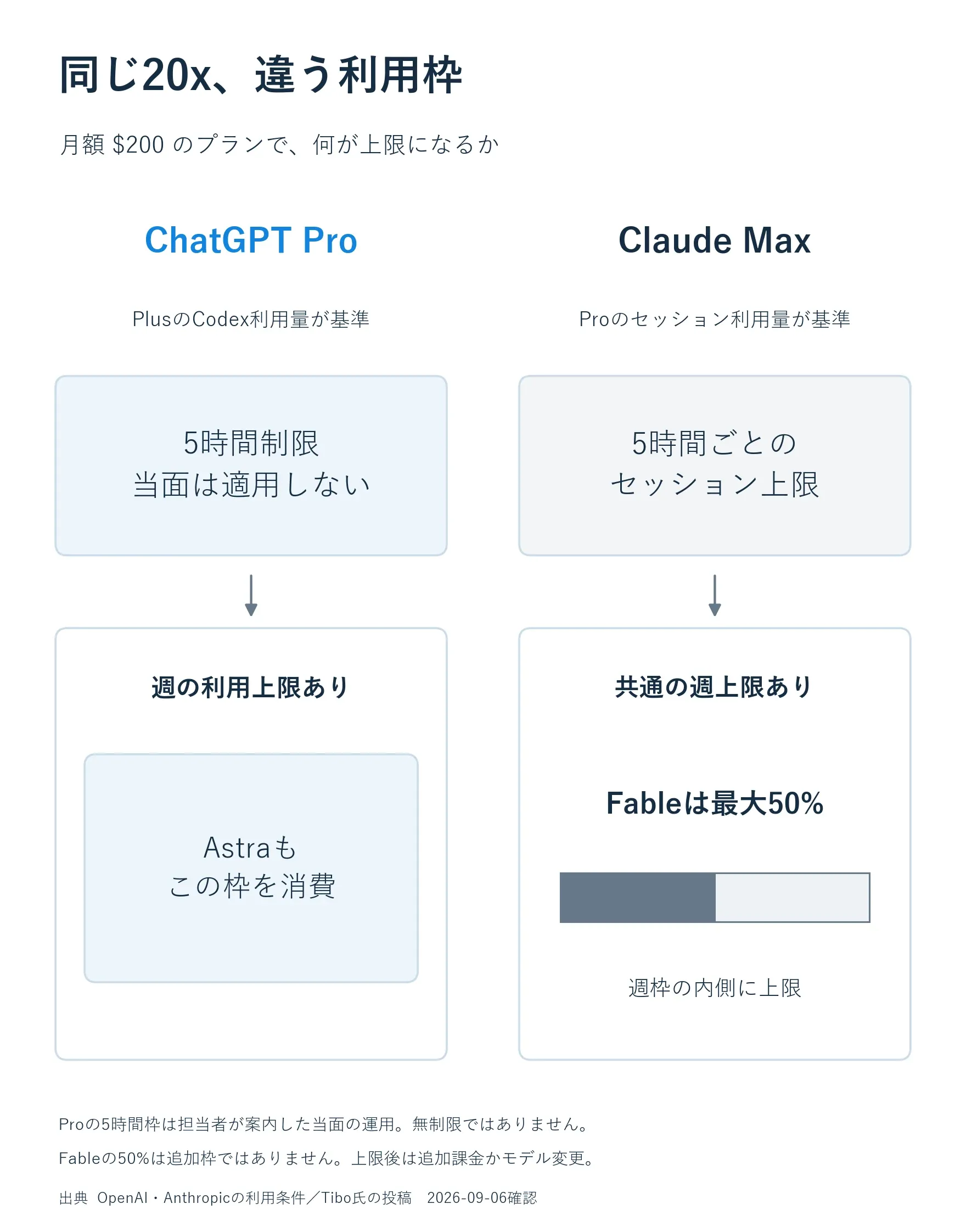
| Point of comparison | ChatGPT Pro 20x | Claude Max 20x |
|---|---|---|
| Listed monthly price | $200 | $200 |
| Basis of 20x | Codex usage of ChatGPT Plus | Per-session usage of Claude Pro |
| Short-window limit | Pro announced not to apply the 5-hour limit for the time being | Session cap every 5 hours |
| Weekly limit | Weekly usage cap applies | Weekly cap shared across all models |
| How Astra / Fable is handled | Astra consumes the plan's allowance | Fable up to 50% of the shared weekly allowance at no extra cost |
Monthly prices in US dollars, excluding tax. Claude prices are the web-contract prices.
OpenAI's appeal is that it is easy to use in bulk on days you want to focus
The $100 and $200 Pro plans are announced not to apply the 5-hour limit for the next several months. This operating policy was indicated in an OpenAI staff member's post on August 25, 2026. Announcement
For example, when you push through a large implementation over a weekend, there is less of the problem of being cut off by the 5-hour window while weekly allowance remains. Astra, which can keep working on long jobs, pairs well with this way of allocating usage.
What remains as a cap is the weekly allowance. The more heavy reasoning and long-running work you batch together, the faster that remaining balance is used up.
Claude Max gives Fable up to 50% of the shared weekly allowance
Claude Max has both a 5-hour window and a weekly allowance, and the amount available to Fable 5 and 5.1 is up to 50% of the shared weekly allowance. Even with allowance remaining, you can hit the Fable-side cap first.
If you want to keep going with the same model after reaching the Fable cap, you move on to pay-as-you-go usage credits. To stay within the flat-rate allowance, you switch to Opus or another model.
If you reserve Fable for the hard parts, this allocation is easy to work with. On the other hand, if you want to push one job forward for a long time on the top model, the current Pro, with fewer interruptions from short-window limits, is attractive.
Part 8: Migrating the API changes more than the model name
| Existing setting or use | What to check for Astra |
|---|---|
Reasoning effort is none or minimal |
Not supported; start comparing from low |
| Using tool calls | Use the Responses API for tool calls |
Sending temperature, top_p, etc. |
Remove unsupported parameters per the official guide |
| Using EU data residency | Astra's Fast mode is not covered. Use Standard |
Receive monitoring stops as a dedicated error
Astra introduces misalignment monitoring, which detects behavior that departs from the user's intent. It is a mechanism that checks the model's reasoning and actions asynchronously.
In the API, whether it goes as far as automatic stopping depends on how conversation context is maintained. Chat Completions is outside the scope of this monitoring, while other safety checks continue to apply.
The code on a stop is misalignment_policy_violation. When you receive it, stop the automatic retry loop and route it for review together with the most recent tool execution history.
Because the monitoring runs asynchronously, some operations will already have completed at the time of the stop. Keeping a record of writes that have been executed helps you decide how to avoid double execution when resuming.
Part 9: A feature that helps in long development: searching past work
Astra is being rolled out in stages to ChatGPT Plus, Pro, Business, and Enterprise, the API, Azure, and Amazon Bedrock. In Codex, a new capability has also been added to the mechanism that handles memory for long tasks.
In supported Codex clients, an experimental context management feature is announced in which Astra keeps notes across contexts and searches past messages and tool results from the same task.
You can retrieve past requirements that did not survive summarization, or the results of failed fixes, through search. In a large refactoring, being able to trace "why did we abandon this approach" is promising for reducing returns to the same dead end.
The experimental feature is off by default. At launch it is available in supported clients signed in with ChatGPT Plus or Pro, and is enabled from the Codex settings.
Placing this alongside the development example above, we want both: a mechanism that can retrieve past premises, and the ability to prioritize those premises when judging. With Astra, these are the two advances we want to keep following.
Summary: Astra widened the range you can delegate, from production to operation
Build a house in Blender and make it walkable in Unreal Engine. Fix an app and operate the screen yourself. Astra's published examples show progress in connecting multiple stages of production.
It shares the same base API price as Fable 5.1, with Astra stronger on the business-workflow evaluation and Fable stronger on long-context and cache pricing. For those who want to run it intensively on a flat rate, Pro's temporary relaxation of the 5-hour limit is also a big difference.
Watching it work through unknown environments does feel like AGI. At the same time, in our own development, there were moments when it lost sight of the product's purpose while handling a difficult implementation. What a human brought it back to was the judgment: "With this fix, will the product still handle other data?" The power to carry out advanced work, and the judgment to keep the purpose in view. Astra today shows both.
Together with our Japanese LLM rankings, we hope this helps you choose a model.
See you next time!
Sources and references
- Claude Fable 5.1 model specifications (Anthropic)
- Claude API pricing (Anthropic)
- Announcement of Claude Fable 5.1 and Mythos 5.1 (Anthropic)
- ChatGPT Pro plan comparison
- Claude Max usage limits
- Plan-specific conditions for Fable models
- Announcement on Pro's 5-hour limit
- GPT-6 Astra announcement, evaluation tables, and evaluation conditions (OpenAI)
- GPT-6 Astra model specifications (OpenAI API)
- GPT-6 Astra features and migration guide (OpenAI API)
- API pricing (OpenAI)
- Async tool calling (OpenAI API)
- Mid-turn steering (OpenAI API)
- Changing reasoning effort mid-conversation (OpenAI API)
- Misalignment monitoring (OpenAI API)
- Choosing a model and experimental context management (ChatGPT Learn)
- ChatGPT Work and Codex pricing and usage limits (ChatGPT Learn)
Research cutoff date: September 6, 2026