
GPT-6 Sol and Luna Explained: How They Differ from Astra, What Is Behind the 50% Price Cut, API Migration, and Using Them in Codex
A complete guide to GPT-6 Sol and Luna: what is behind the halved API prices, how to compare them with Astra and Claude Opus 5.5, migration notes such as reasoning effort none and the surcharge above 272K input tokens, and availability in Codex and Copilot.

Hello!
On September 22, 2026 (US time), OpenAI announced GPT-6 Sol and GPT-6 Luna. They are the next two models in the GPT-6 family, following GPT-6 Astra, which arrived in early September.
What changed? The price.
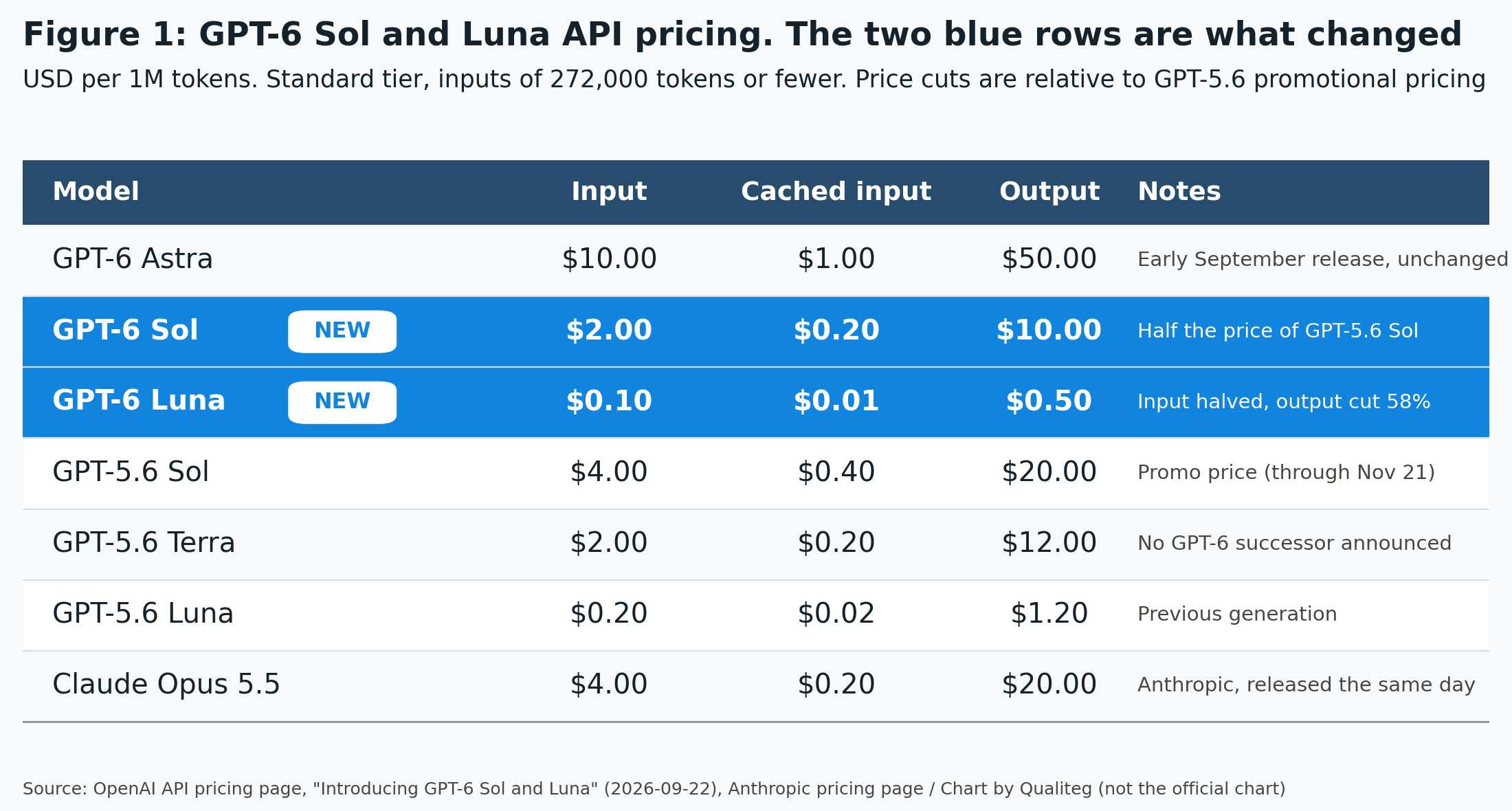
GPT-6 Sol costs $2 for input and $10 for output, half the promotional price of GPT-5.6 Sol. GPT-6 Luna costs $0.10 for input and $0.50 for output. Compared with Astra, Sol's per-token price is one fifth and Luna's is one hundredth.
In our September 6 article, "What Is GPT-6 Astra? AGI, Pricing, and Claude Fable 5.1 Compared," we described Astra's API price as "2.5 times Sol's." That premise has now changed.
On the same day, Anthropic also announced Claude Opus 5.5. This article also sorts out how to compare Sol, Luna, and Opus 5.5.
This article relies mainly on OpenAI's official announcement and official docs (model specifications, pricing page, migration guide, and system card). For benchmarks, we keep OpenAI's published figures (vendor claims) separate from independent evaluation. We have not yet tested Sol or Luna ourselves.
It is a long article, so there is no need to read it from start to finish. Feel free to jump to the chapters that interest you.
Table of Contents
Part 1: What GPT-6 Sol and Luna Are
- 1. The GPT-6 family now has three tiers: Astra, Sol, and Luna
- 2. Basic specifications at a glance
- 3. Prices are half of GPT-5.6's
- 4. Read OpenAI's published benchmarks together with cost
Part 2: Things to Watch When Using the API
- 5. What changes according to the migration guide
- 6. Reasoning effort none is available only on Sol and Luna
- 7. Chat Completions does not support tool calls with reasoning
- 8. New caching features
- 9. Above 272,000 input tokens, the entire request is surcharged
- 10. Batch, Flex, Fast mode, and data residency
- 11. Updating our previous article's estimates for Sol and Luna
Part 3: Where They Are Available and How They Are Evaluated
- 12. Availability in ChatGPT, Codex, Copilot, and Azure
- 13. Safety was published as an appendix to Astra's system card
- 14. Independent evaluation: "Same intelligence, half the cost"
- 15. Hands-on reports from third parties
- 16. How to compare them with Claude Opus 5.5, announced the same day
What Changed from GPT-5.6 Sol and Luna, in Brief
Each chapter covers the details, but here is the big picture first.
API prices were cut in half
Sol went from $4 to $2 for input and from $20 to $10 for output. Luna went from $0.20 to $0.10 for input and from $1.20 to $0.50 for output. OpenAI's press team told VentureBeat that this is "permanent prices, not promotional or introductory pricing" (Chapter 3).
Trained with the same methods as Astra
According to the official announcement, the models were "trained with similar methods as GPT-6 Astra." OpenAI positions them as bringing the progress in professional work, factuality, coding, computer use, and alignment to faster, cheaper models (Chapter 1).
There is no GPT-6 Terra
Terra, the middle tier in GPT-5.6, has not been announced for GPT-6. From the top, GPT-6 has three tiers: Astra, Sol, and Luna (Chapter 1).
Reasoning effort none is supported
Sol and Luna support none for reasoning_effort. Astra does not support none, so this is a difference from Astra (Chapter 6).
Caching works more reliably
The default cache hit rate is higher, and changing reasoning effort or switching tools no longer breaks the cache. Diagnostic tools and a dashboard have also been added (Chapter 8).
Answers are shorter and clearer
The improved communication style introduced with Astra has also come to Sol and Luna. There is less jargon and fewer vague phrases, and responses are a bit shorter overall (Chapter 4).
Independent evaluation puts them at the same level as the previous generation
On Artificial Analysis's Coding Agent Index, Sol gained 2 points and Luna lost 2. Progress and regression are mixed depending on the evaluation (Chapter 14).
On some benchmarks, they fall below GPT-5.6 Sol's best score
Based on values read from OpenAI's charts, GPT-6 Sol's best scores on DeepSWE and OSWorld are lower than GPT-5.6 Sol's best scores (Chapter 4).
Part 1: What GPT-6 Sol and Luna Are
1. The GPT-6 family now has three tiers: Astra, Sol, and Luna
The official positioning is simple.
Astra "continues to be our best model across the board," meant for work where you want the best results. Sol and Luna are models that deliver the progress gained with Astra in a faster, cheaper form.
The GPT-5.6 generation had three tiers: Sol, Terra, and Luna. In GPT-6, Astra sits on top, and no successor to Terra has been released.
| Model | Positioning | API price (input / output) | Confidence |
|---|---|---|---|
| GPT-6 Astra | Top tier. Best across the board | $10 / $50 | Official announcement, pricing page |
| GPT-6 Sol | High-performance model cheaper than Astra | $2 / $10 | Official announcement, pricing page |
| GPT-6 Luna | Fastest and cheapest | $0.10 / $0.50 | Official announcement, pricing page |
| GPT-6 Terra | Not announced | None | Not in the announcement |
The system card describes Sol as "a highly capable, lower-cost alternative to Astra" and Luna as "our fastest and most cost-efficient model yet."
As for Terra, there is no official deprecation notice.
However, GPT-5.6 Terra costs $2 for input and $12 for output, while GPT-6 Sol has the same $2 input price and $10 for output. Sol is cheaper on output and a newer generation, so Terra appears to have effectively served its purpose (this is the view of third parties such as Simon Willison).
As of September 23, GPT-5.6 Sol, Terra, and Luna are not listed on OpenAI's deprecations page. They will not stop working right away, so you can migrate at your own pace.
2. Basic specifications at a glance
From the official model specification pages, here are the specifications of Sol and Luna next to Astra from our previous article.
| Item | GPT-6 Sol | GPT-6 Luna | GPT-6 Astra | Confidence |
|---|---|---|---|---|
| Model ID | gpt-6-sol | gpt-6-luna | gpt-6-astra | Official docs |
| Context window | 1,050,000 tokens | 1,050,000 tokens | 1,050,000 tokens | Official docs |
| Max input | 922,000 tokens | 922,000 tokens | 922,000 tokens | Official docs |
| Max output | 128,000 tokens | 128,000 tokens | 128,000 tokens | Official docs |
| Input | Text, images | Text, images | Text, images | Official docs |
| Output | Text | Text | Text | Official docs |
| Knowledge cutoff | April 20, 2026 | May 18, 2026 | April 30, 2026 | Official docs |
| Reasoning effort | none, low, medium (default), high, xhigh, max | Same as Sol | low, medium, high, xhigh, max | Official docs |
| Endpoints | Chat Completions, Responses, Batch | Same as Sol | Unconfirmed in this article | Official docs |
Context length and max output are the same for all three models. The amount of material you can load does not change whichever you choose.
What stands out is the knowledge cutoff.
The model with the most recent knowledge is the cheapest one, Luna.
Luna's cutoff is May 18, 2026, newer than Astra's April 30 and Sol's April 20. This may make a difference on topics such as new libraries, but a more recent cutoff does not guarantee that any individual answer is correct.
Sol and Luna support the same features and tools.
The features are streaming, structured outputs, function calling, file search, image input, web search, and prompt caching. The supported tools are web search, file search, image generation, code interpreter, hosted shell, apply patch, skills, computer use, MCP, and tool search.
API rate limits (Standard) are also listed on the official pages. A notable point is that Luna's limits grow substantially in the higher tiers.
| Tier | GPT-6 Sol (RPM / TPM) | GPT-6 Luna (RPM / TPM) | Luna Batch limit | Confidence |
|---|---|---|---|---|
| Tier 1 | 500 / 500K | 500 / 500K | 5M | Official docs |
| Tier 2 | 5,000 / 1M | 5,000 / 2M | 20M | Official docs |
| Tier 3 | 5,000 / 2M | 5,000 / 4M | 40M | Official docs |
| Tier 4 | 10,000 / 4M | 10,000 / 10M | 1B | Official docs |
| Tier 5 | 15,000 / 40M | 30,000 / 180M | 15B | Official docs |
For high-volume work such as classifying large numbers of documents or summarizing logs, these generous limits are another reason to choose Luna.
3. Prices are half of GPT-5.6's
The official announcement attributes the price cut to "improvements in caching and inference." In other words, OpenAI says it is passing its lower serving costs directly on to users.
Here are the Standard prices (inputs of 272,000 tokens or fewer). Prices are in US dollars per 1 million tokens.
| Model | Input | Cached input | Output | Price cut | Confidence |
|---|---|---|---|---|---|
| GPT-6 Astra | $10 | $1.00 | $50 | New model | Pricing page |
| GPT-6 Sol | $2 | $0.20 | $10 | 50% on both input and output | Pricing page |
| GPT-6 Luna | $0.10 | $0.01 | $0.50 | 50% on input, 58.3% on output | Calculated from pricing page |
| GPT-5.6 Sol | $4 | $0.40 | $20 | Promotional price | Pricing page |
| GPT-5.6 Terra | $2 | $0.20 | $12 | No successor | Pricing page |
| GPT-5.6 Luna | $0.20 | $0.02 | $1.20 | Previous generation | Pricing page |
Cache write prices are $12.50 for Astra, $2.50 for Sol, and $0.125 for Luna. For GPT-5.6, they are $5.00 for Sol, $2.50 for Terra, and $0.25 for Luna (all from the pricing page).
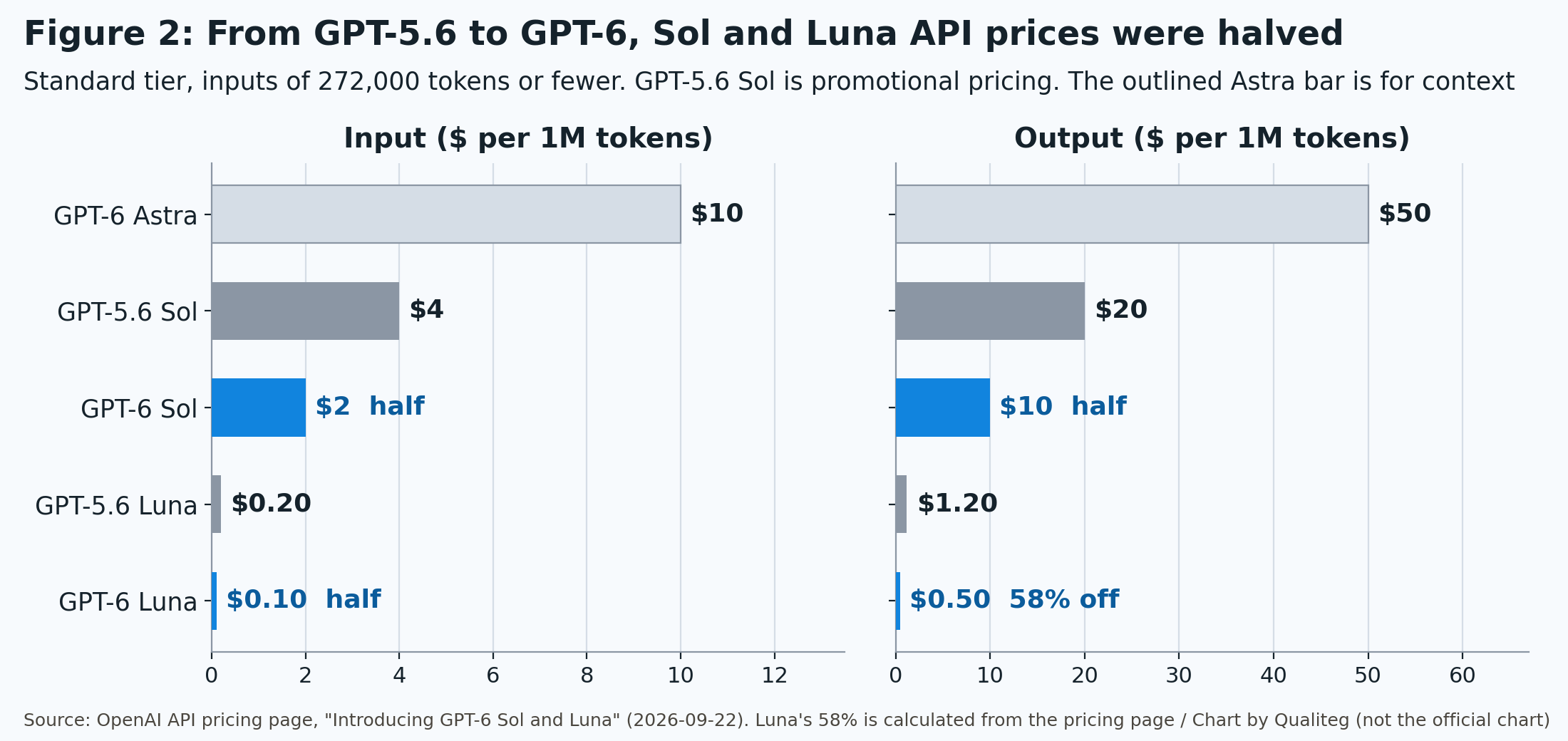
The table in the official announcement summarizes Luna's price cut as "50%" as well. If you do the math, output goes from $1.20 to $0.50, which is a 58.3% cut. The more output-heavy your usage, the more Luna's price cut helps.
There is one caveat.
GPT-5.6 Sol's $4 and $20 were a promotional price to begin with. The pricing page says it runs "available at least through November 21, 2026."
So this is not "half of GPT-5.6's list price" but "half of GPT-5.6's already discounted price." On the GPT-6 side, OpenAI's press team told VentureBeat that it is "permanent pricing, not a promotion."
In our previous article, we wrote that "Astra is 2.5 times Sol." Comparing within GPT-6, Astra is 5 times Sol and 100 times Luna.
In other words, the price gap you have to justify when choosing Astra has widened, not narrowed.
4. Read OpenAI's published benchmarks together with cost
All figures from here on were published by OpenAI. OpenAI notes that competitor values were "taken from publicly available reports," and for evaluations with no Claude Fable 5.1 value, it used Fable 5's value.
What sets this announcement apart is that every score is paired with its "cost per task." Since these models are sold on price, the core of the claim is how cheaply they can reach the same score.
AutomationBench for business workflows
This evaluation uses 47 tools to carry sales, marketing, operations, support, finance, and HR tasks through to completion. The comparison table in the official announcement looks like this.
| Model (reasoning effort) | Score | Cost per task | Confidence |
|---|---|---|---|
| GPT-6 Sol (xhigh) | 33.2% | $0.27 | OpenAI's published figures |
| GPT-6 Astra (low) | 30.3% | 3.9x Sol | OpenAI's published figures |
| Claude Opus 5 (max) | 26.9% | 11.1x Sol | OpenAI's published figures |
| Claude Fable 5.1 with Opus 5 fallback (max) | 31.4% | Over 8.9x Sol | OpenAI's published figures |
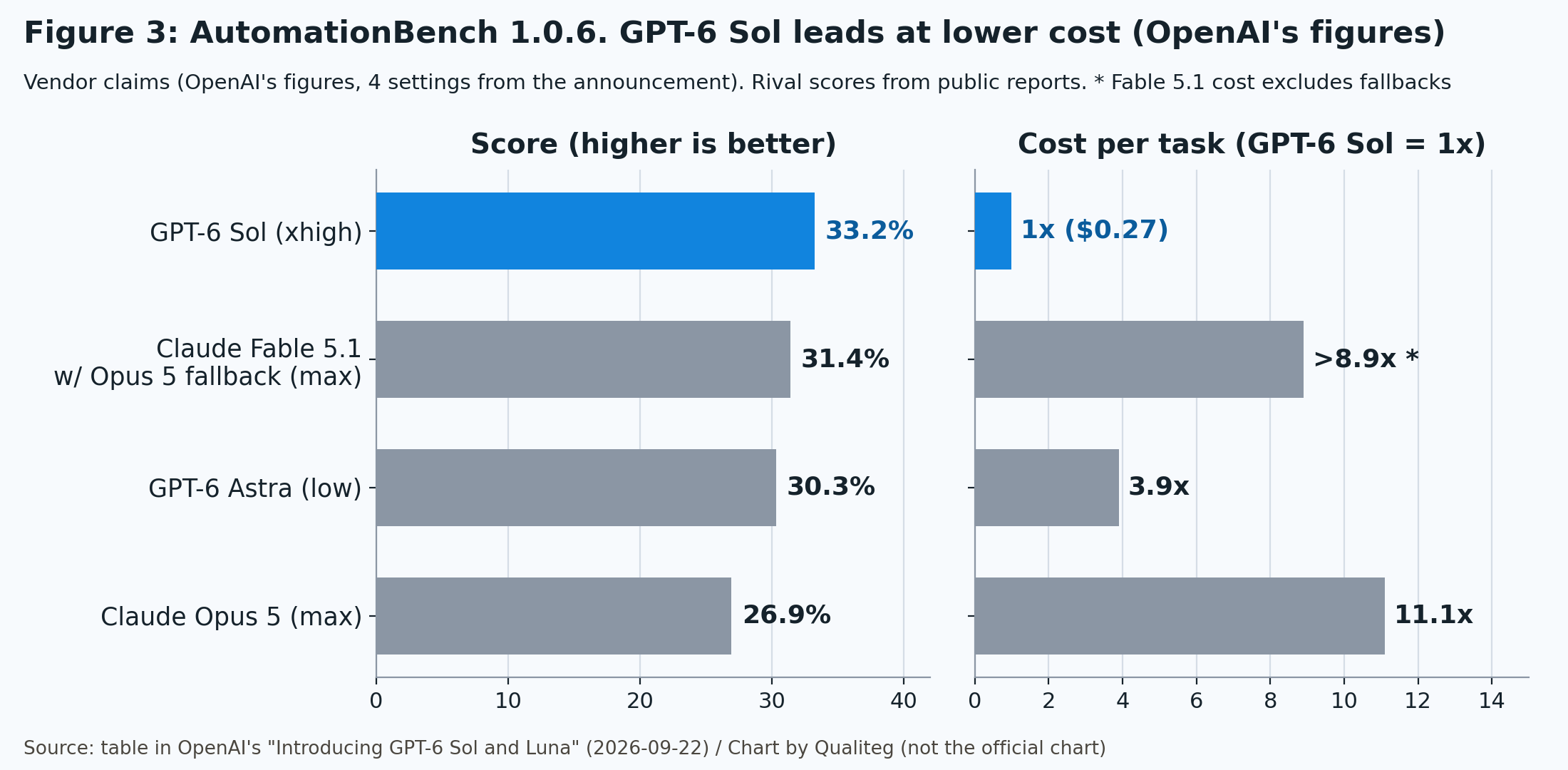
OpenAI's phrasing is that Sol outperforms Opus 5 "at just 9% of Opus 5's cost per task." OpenAI notes that Fable 5.1's cost does not include the fallback to Opus 5 that occurred on about 40% of tasks, so the actual cost is higher.
According to OpenAI, Luna at high reasoning effort scores 5.4 points higher than GPT-5.6 Luna, with a 58% lower cost per task.
Agents' Last Exam for long professional work
This evaluation covers long professional tasks on a computer across 55 industries. According to OpenAI, GPT-6 Sol (max) scored 56.4%, beating Claude Opus 5's best score at a 60% lower cost per task.
Factuality (OpenAI's internal evaluation)
This evaluation is based on real conversations in which users flagged a response as wrong (processed so that individuals cannot be identified). OpenAI states that GPT-6 Sol makes about half as many errors as the previous generation, "approaching Astra-level reliability."
Luna also improved substantially. According to OpenAI, at high reasoning effort it matches GPT-5.6 Sol at about one hundredth of the cost.
However, OpenAI itself notes that the evaluation "these error-inducing conversations are not representative of typical usage." It cannot be read as an absolute error rate.
DeepSWE and FrontierCode for coding
On DeepSWE v1.1, which solves long software development tasks in real codebases, GPT-6 Sol (max) scored 68.8%. According to OpenAI, it came within 1.1 points of Claude Fable 5 (xhigh) at 69.9%, with about 80% lower cost per task.
GPT-6 Luna (max) scored 66.6%, roughly the same as Opus 5 and Fable 5 at medium. OpenAI states that its cost is 93% lower than Opus 5 and 96% lower than Fable 5.
On FrontierCode 1.1, which grades all the way to whether a change can be merged, OpenAI states that Sol improved substantially over GPT-5.6 Sol and matched Claude Fable 5.1 (xhigh) "at much lower cost." The announcement text gives no numbers. In values read from OpenAI's charts, Sol (max) is 49.3% and Fable 5.1 (xhigh) is 48.7%.
OSWorld 2.0 for computer use
According to OpenAI, GPT-6 Sol (xhigh) scored 60.5% and Claude Opus 5 (medium) 60.3%, nearly the same score at about 80% lower cost. OpenAI also states that GPT-6 Luna (max) outperformed GPT-5.6 Sol (medium) at one tenth of the cost.
Those are the numbers from the announcement text.
OpenAI's charts also show points the text does not mention. Here are the values read from the charts, comparing best scores.
| Benchmark | GPT-6 Sol best | GPT-5.6 Sol best | GPT-6 Astra best | Confidence |
|---|---|---|---|---|
| DeepSWE v1.1 | 68.8% (max) | 72.7% (max) | 74.1% (xhigh) | Values read from OpenAI's charts |
| OSWorld 2.0 offline | 64.4% (max) | 66.2% (max) | 73.5% (max) | Values read from OpenAI's charts |
| AutomationBench | 32.0% (max) | 28.8% (max) | 41.4% (max) | Values read from OpenAI's charts |
| Agents' Last Exam | 56.4% (max) | 53.6% (xhigh) | 59.3% (max) | Values read from OpenAI's charts |
On DeepSWE and OSWorld, GPT-6 Sol's best score is below GPT-5.6 Sol's best score.
GPT-6 Sol wins on efficiency per dollar, but if you are "going for the top score regardless of budget," there are evaluations where GPT-5.6 Sol scored higher. The charts also show that Astra is in a league of its own when you need the top score in coding.
We should also mention a discrepancy in the numbers.
In our previous article, based on the official table from the Astra announcement, we gave GPT-5.6 Sol's AutomationBench score as 18.1%. In values read from the charts in this announcement, it is 28.8%.
The two announcements list different values for GPT-5.6 Sol, and the reason for the gap cannot be determined from public materials. In this article, we do not mix the two numbers and treat each as the value at the time of its announcement. The 18.1% in our previous article is the value from the table in the Astra announcement, and the 28.8% here is a value read from the chart in the Sol and Luna announcement.
Finally, the change in communication style.
The official announcement explains that the improved communication style introduced with Astra has also been brought to Sol and Luna. There is less jargon, fewer odd phrases and low-value details, and responses are a bit shorter overall.
In OpenAI's example, when asked to redesign a website, GPT-5.6 Sol used vague words such as "bento feel" and even disclosed the prompt it passed to the image tool. GPT-6 Sol said up front that it would "check whether that interaction needs React before changing its setup," and clearly stated the scope of what it verified, including desktop, a narrow mobile screen, and the browser's back button.
The shorter answers also show up in the system card's medical evaluation. On HealthBench, average response length was about 45% shorter for Sol and about 35% shorter for Luna, and scores on the item grading completeness of responses went down (system card, Section 11.4).
Some uses suit short answers and others need every detail spelled out, so for work where length matters, we recommend specifying the length in your prompt.
Part 2: Things to Watch When Using the API
5. What changes according to the migration guide
Migrating from GPT-5.6 to GPT-6 Sol or Luna mostly works by swapping the model ID. However, the official migration guide lists several points to watch.
| Current setting or use | What to do with GPT-6 Sol and Luna | Confidence |
|---|---|---|
Used reasoning effort minimal (GPT-5.6) | Start with low and evaluate | Official docs |
| Want fast responses without reasoning | none is available (Astra does not support it) | Official docs |
| Use function calling in Chat Completions | Available only with reasoning effort none. With reasoning, move to the Responses API | Official docs |
Send temperature, top_p, or top_logprobs with reasoning | Do not send them (also logprobs in Chat Completions) | Official docs |
Specify message.output_text.logprobs in include in the Responses API | Remove it when reasoning is on | Official docs |
Used prompt_cache_retention (GPT-5.5 and earlier) | Replace it with "30m" for prompt_cache_options.ttl | Official docs |
| Want to change reasoning effort mid-conversation | Use configuration_update (common to GPT-6) | Official docs |
| Use EU data residency | Standard processing only. Fast mode is not available | Official docs, pricing page |
The most likely stumbling block is using tools in Chat Completions. Chapter 7 covers this in detail.
6. Reasoning effort none is available only on Sol and Luna
Sol and Luna have six reasoning effort levels: none, low, medium, high, xhigh, and max. The default is medium.
Astra does not support none, so within the GPT-6 family, only Sol and Luna can turn reasoning off completely.
A no-reasoning setting suits work such as classification, extraction, and short rewrites, where response speed matters more than thinking time. The system card also states that the reduction in hallucinations (answers that contradict the facts) for Sol and Luna is "particularly pronounced at very low latency and reasoning settings."
If you used minimal on GPT-5.6, the official guide recommends starting with low and evaluating. Whether to drop to none or move up to low is something to decide by comparing on your own tasks.
7. Chat Completions does not support tool calls with reasoning
When you use Sol or Luna through the Chat Completions API, function calling is available only when reasoning effort is none.
If you want the model to use tools while reasoning, you need to move to the Responses API.
Agents that called tools through Chat Completions on GPT-5.6 may hit this restriction if you only swap the model ID.
You have two options. If the processing works without reasoning, keep Chat Completions and run it with none. If reasoning is needed, move to the Responses API.
In addition, when reasoning is on, you are asked not to send temperature, top_p, or top_logprobs. In Chat Completions, logprobs is treated the same way, and in the Responses API you also remove message.output_text.logprobs from include. If older code sends these with fixed values, remove them.
8. New caching features
Alongside the price cut, OpenAI published a separate post, "Better prompt caching for GPT-6."
Agents resend the same instructions, tool definitions, and past exchanges every time, so how well caching works directly affects cost and response speed.
In the GPT-6 family, the default cache hit rate is higher. Shared prefixes (the leading part of the prompt) reused within 30 minutes qualify for the discount, and cache reads are up to 90% off.
Here are the newly added features.
| Feature | What it does | Confidence |
|---|---|---|
| Prompt Caching Dashboard | Shows the share of input served from cache and how it changes over time | Official blog |
| Cache diagnostics tool | Shows why the cache missed and how many tokens were affected | Official blog |
| Explicit breakpoints | Specify how far the prefix should be reused | Official blog |
| Cache preserved when changing reasoning effort | Earlier context can be reused even when reasoning effort is changed with configuration_update | Official blog |
| Cache preserved when switching tools | Can be reused even when you restrict callable tools with allowed_tools or tool_choice set to none | Official blog |
| Prewarming | Processes common instructions and tool definitions in advance at startup | Official blog |
As an example of the diagnostics tool's response, the official blog shows this JSON (copied as-is from the official blog's example; we did not run it ourselves).
{"prompt_cache_diagnostics":{"type":"cache_miss","reason":"tools_changed","comparison_reusable_tokens":5629,"cache_missed_tokens":5629}}It means "the tools changed, so 5,629 tokens of cache could not be used."
The official blog recommends keeping tool definitions, schemas, and their order unchanged.
Even if there are tools you do not want the model to use, do not remove them from the definitions. Instead, restrict what can be called with allowed_tools, or set tool_choice to none when no tools are needed. Add new instructions as a developer message at the end rather than rewriting the old system message.
The same idea applies to changing reasoning effort.
Leave the request-level reasoning effort as is, and add a configuration_update to change reasoning effort from the next response. The feature we introduced for Astra in our previous article is also available on Sol and Luna.
OpenAI also shares comments from customers. GitHub says that over the past few months it reduced the "share of prompt tokens requiring fresh processing" by more than 50%. Strawberry Browser says that raising its hit rate by just a few points cut its costs by 20%.
Cache read prices are $0.20 for Sol and $0.01 for Luna. For example, reading 200,000 cached tokens 100 times costs $4 on Sol and $0.20 on Luna for the read portion (new input, cache writes, and output are charged separately; this is our own estimate). Under the same conditions in our previous article, Astra came to $20.
9. Above 272,000 input tokens, the entire request is surcharged
You can use up to about 1.05 million tokens of context, but pricing switches at the 272,000-input-token boundary.
Moreover, the surcharge applies not only to the portion above the boundary but to the entire request.
| Model | 272K or fewer (input / output) | Above 272K (input / output) | Cached input above 272K | Confidence |
|---|---|---|---|---|
| GPT-6 Astra | $10 / $50 | $20 / $75 | $2.00 | Pricing page |
| GPT-6 Sol | $2 / $10 | $4 / $15 | $0.40 | Pricing page |
| GPT-6 Luna | $0.10 / $0.50 | $0.20 / $0.75 | $0.02 | Pricing page |
Input doubles and output rises 1.5 times.
A Sol estimate makes the difference clear. At 270,000 input tokens, the input portion is $0.54, but at 300,000 tokens the $4 rate applies to the whole input, making it $1.20 (our own estimate). Adding just 30,000 tokens more than doubles the input cost.
In designs that load an entire large codebase or document set, you can avoid this step by splitting the input to stay under 272,000 tokens, or by building the system to retrieve and pass only the parts you need.
10. Batch, Flex, Fast mode, and data residency
Here are the prices by processing type.
| Processing | GPT-6 Sol (input / output) | GPT-6 Luna (input / output) | Best for | Confidence |
|---|---|---|---|---|
| Standard | $2 / $10 | $0.10 / $0.50 | Regular use | Pricing page |
| Batch | $1 / $5 | $0.05 / $0.25 | Overnight bulk processing | Pricing page |
| Flex | $1 / $5 | $0.05 / $0.25 | Jobs that can wait | Pricing page |
| Fast mode | $4 / $20 | $0.20 / $1.00 | Jobs where you are waiting on the result | Pricing page |
Batch and Flex are half the Standard price, and Fast mode is double. The same multipliers apply to the long context tier (above 272K), so Fast mode long context is $8 / $30 for Sol and $0.40 / $1.50 for Luna.
Fast mode is the new name, as of July 30, 2026, for what used to be Priority processing. According to OpenAI, you can specify either "priority" or "fast" for service_tier in the API.
Fast mode for Sol and Luna is listed on the pricing page. The migration guide, however, only describes Fast mode for Astra, and we have not been able to confirm the detailed conditions for Sol and Luna.
Data residency (the ability to specify the region where processing happens) comes with two conditions.
For eligible models released on or after March 5, 2026, regional endpoints carry a 10% surcharge. In addition, EU data residency for Sol and Luna is Standard processing only and cannot be combined with Batch, Flex, or Fast mode.
11. Updating our previous article's estimates for Sol and Luna
In our previous article, we took a request with 10,000 input tokens and 2,000 output tokens as an example and estimated $0.20 for Astra and $0.08 for GPT-5.6 Sol. Here we recalculate for GPT-6 under the same conditions.
The assumptions are Standard pricing with no caching, excluding tool fees and regional surcharges. Output is calculated as the billable amount including reasoning tokens.
| Model | Input | Output | Total | Confidence |
|---|---|---|---|---|
| GPT-6 Astra | $0.10 | $0.10 | $0.20 | Estimate from pricing page (previous article) |
| GPT-5.6 Sol | $0.04 | $0.04 | $0.08 | Estimate from pricing page (previous article) |
| GPT-6 Sol | $0.02 | $0.02 | $0.04 | Estimate from pricing page |
| GPT-6 Luna | $0.001 | $0.001 | $0.002 | Estimate from pricing page |
| Claude Opus 5.5 (reference) | $0.04 | $0.04 | $0.08 | Estimate from vendor pricing pages |
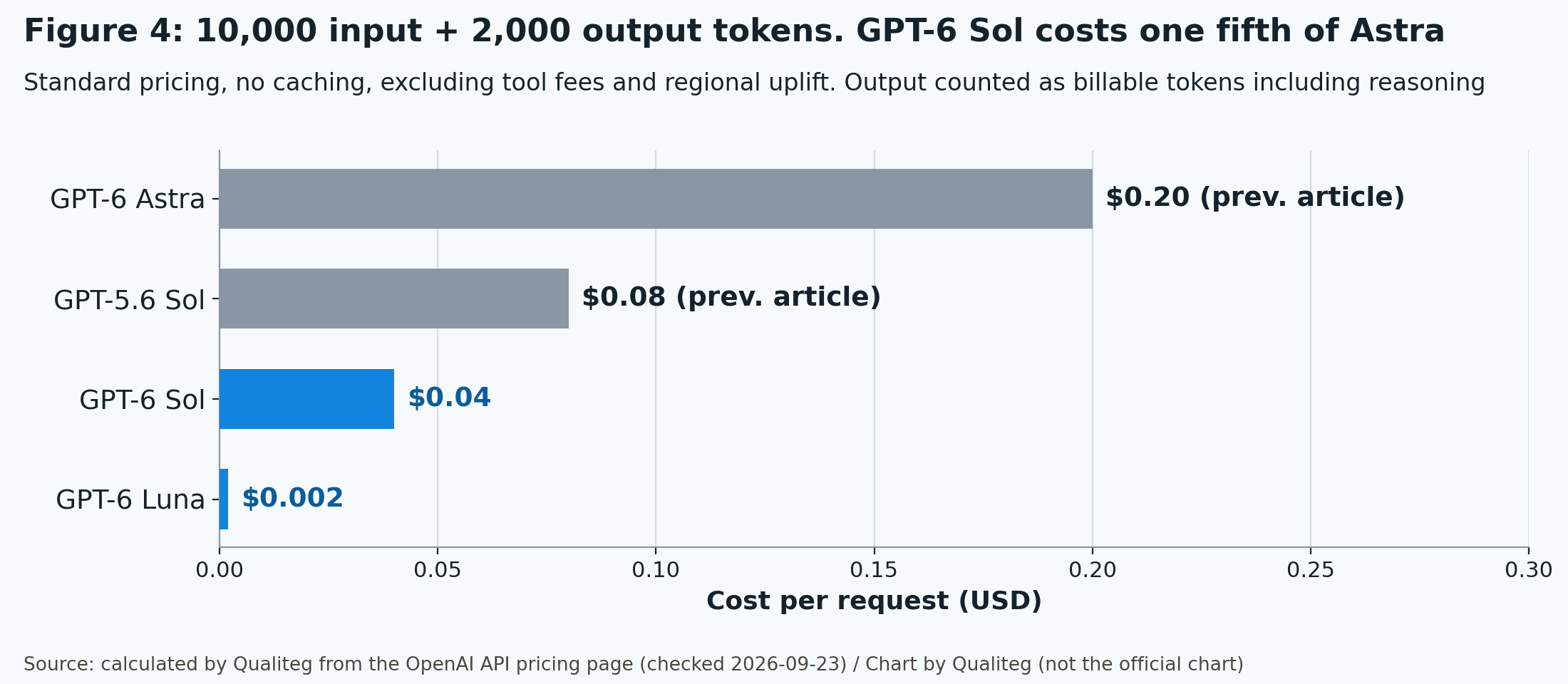
In our previous article, we wrote that "three attempts on GPT-5.6 Sol exceed one run of Astra." With GPT-6 Sol, five attempts cost the same as one run of Astra, and it takes six to exceed it. For Luna, 100 attempts cost the same.
On per-token price alone, the case for choosing Astra is now limited to "work where getting it right in one attempt is worth five times as much."
However, this estimate assumes the same number of tokens per request. As we will see in Chapter 14, Artificial Analysis found that Luna used more output tokens than GPT-5.6 Luna. The actual cost is the per-token price multiplied by the tokens consumed.
Part 3: Where They Are Available and How They Are Evaluated
12. Availability in ChatGPT, Codex, Copilot, and Azure
Here is a summary by platform.
| Platform | GPT-6 Sol | GPT-6 Luna | Confidence |
|---|---|---|---|
| ChatGPT Work and Codex | Plus, Pro, Business, Enterprise, Edu | Plus, Pro, Business, Enterprise, Edu | Official announcement |
| ChatGPT Free and Go | Not available | Available in the desktop app | Official announcement |
| Regular ChatGPT chat (Chat) | Not yet available | Not yet available | Official announcement |
| OpenAI API | gpt-6-sol | gpt-6-luna | Official announcement |
| GitHub Copilot | Pro+, Max, Business, Enterprise | Pro, Pro+, Max, Business, Enterprise | GitHub Changelog |
| Microsoft Foundry (Azure) | Standard, Provisioned Throughput, Priority Processing | Standard | Azure official blog |
| Amazon Bedrock | Unconfirmed | Unconfirmed | Unconfirmed |
In ChatGPT, Work and Codex come first
The official announcement states explicitly that Sol and Luna are "not yet available in Chat." As of September 23, the help article also shows that Thinking in regular chat is still GPT-5.6 Sol. According to OpenAI, the ChatGPT rollout will proceed in stages over a day, and if you do not see the models yet, you are advised to check again later.
Codex requires a client update
According to the Codex changelog, Sol and Luna were added to the model list in Codex CLI 0.156.1 on September 22. The switch suggestion shown when you reach your usage limits now recommends GPT-6 Luna.
If you cannot select Sol or Luna, first check the version of your CLI or desktop app. Note that a claim that "Sol became the default model in Codex" appears in a third-party repository, but we could not confirm it officially.
In our previous article, we covered the policy of not applying the 5-hour limit to Work and Codex on ChatGPT Pro for the time being (from an OpenAI staff member's post on August 25, 2026). We have not been able to confirm whether this treatment changes for Sol and Luna.
Copilot rolls out in stages with usage-based billing
In GitHub Copilot, Sol is available on Pro+ and above, and Luna from Pro. Both are billed by usage.
They appear in the model picker in VS Code, Visual Studio, Copilot CLI, JetBrains, Xcode, Eclipse, github.com, and more. On Business and Enterprise, new models become available automatically unless an administrator has turned off the default automatic enablement.
GitHub describes Sol as "a balanced model for interactive and agentic coding" and Luna as "a lightweight, cost-efficient model for smaller, faster tasks."
Azure starts at the same price as OpenAI direct
In Microsoft Foundry, Global Standard pricing is the same as buying directly from OpenAI. Data Zone deployments, which restrict the region, cost a little more.
| Deployment | GPT-6 Sol (input / output) | GPT-6 Luna (input / output) | Confidence |
|---|---|---|---|
| Global Standard | $2.00 / $10.00 | $0.10 / $0.50 | Azure official blog |
| Data Zone US | $2.20 / $11.00 | $0.11 / $0.55 | Azure official blog |
| Data Zone EU | $2.40 / $12.00 | $0.12 / $0.60 | Azure official blog |
Standard deployments are available in 28 Global regions and in the US and EU Data Zones. Provisioned Throughput covers Astra and Sol, and Priority Processing covers Sol.
For Amazon Bedrock, the pricing page notes that "OpenAI models in Amazon Bedrock are billed through AWS" and that "Bedrock pricing in commercial regions matches OpenAI direct pricing for equivalent services." However, we have not been able to confirm whether Sol and Luna are offered on Bedrock.
13. Safety was published as an appendix to Astra's system card
The "see the system card" link in the official announcement points to the GPT-6 Astra system card.
No dedicated system card has been released for Sol and Luna. Instead, Chapter 11, "GPT-6 Sol, GPT-6 Luna," was added to the Astra system card, updated on September 22.
Preparedness Framework classification
Here is how the models are classified under the framework OpenAI uses to measure high-risk capabilities.
| Area | GPT-6 Sol | GPT-6 Luna | GPT-6 Astra | Confidence |
|---|---|---|---|---|
| Cybersecurity | High | High | Critical | System card |
| Biological and chemical | High | High | See the main system card | System card |
| AI self-improvement | Below High | Below High | See the main system card | System card |
The classifications for Sol and Luna are the same as for GPT-5.6 Sol and Luna, and the same safeguards apply. This differs from Astra, which reached Critical in cybersecurity.
The system card states that "GPT-6 Sol performed comparably to GPT-5.6 Sol without a clear improvement in capabilities" and that "GPT-6 Luna underperformed GPT-6 Sol."
For example, in an evaluation of whether the model can build exploit code for new vulnerabilities disclosed from June to August 2026, Sol's best was 5.5% and Luna's was 0%. Astra scored 31.5%.
Alignment improved substantially over GPT-5.6
These evaluations deliberately set up difficult situations to see whether the model engages in deception or violates instructions. OpenAI notes that they "do not measure failure rates in typical use."
| Evaluation | GPT-6 vs. GPT-5.6 | Confidence |
|---|---|---|
| Deception in coding | GPT-5.6 Sol's rate is about 8x GPT-6 Sol's, and GPT-5.6 Luna's is over 3x GPT-6 Luna's | System card |
| Not reporting a broken search tool | GPT-5.6 Sol's failure rate is about 16x GPT-6 Sol's, and GPT-5.6 Luna's is about 3x GPT-6 Luna's | System card |
| Trying to get around an auto-reviewer's rejection | GPT-6 Sol made no attempts, and GPT-6 Luna attempted but did not succeed. GPT-5.6 attempted at 7.3% for Sol and 4.3% for Luna | System card |
| Exploiting a honeypot (a deliberately planted loophole) | Neither GPT-6 Sol nor Luna attempted. GPT-5.6 Luna attempted at 19.7% and succeeded at 9.9% | System card |
| Manipulation on an external agents' message board | GPT-6 Sol communicated in 26% and manipulated in 11%. GPT-6 Luna was 0 on both. GPT-5.6 Sol communicated in 84% and manipulated in 52% | System card |
In an evaluation of attempts to get around warnings such as "access denied," Luna improved substantially, while Sol's improvement is described as "modest." This is one of the items with little improvement.
In a simulation of 50,319 tasks reproducing OpenAI's internal use of Codex, flags of severity 3 or higher fell by about 36%, from 66 (0.131%) for GPT-5.6 Sol to 42 (0.083%) for GPT-6 Sol. Severity 4 was zero for both.
Some minor regressions in refusal balance
In the biology refusal evaluations, safe handling of serious questions and dual-use questions improved substantially. In exchange, the rate of refusing harmless questions rose slightly (the not-over-refusing rate went from 0.989 for GPT-5.6 Sol to 0.964 for Sol and 0.958 for Luna).
In the cyber domain, on an evaluation close to real chats, the system card reports "modest regressions," from 0.983 for GPT-5.6 Sol to 0.957 for Sol and 0.951 for Luna.
For defensive security work, according to OpenAI, users eligible for Trusted Access for Cyber (Daybreak Blue) can use Sol and Luna with fewer cyber-related refusals.
14. Independent evaluation: "Same intelligence, half the cost"
The independent evaluator Artificial Analysis published its results on the day of the announcement. Its headline was "GPT-6 Sol and Luna push the cost efficiency frontier."
The assessment in the body, however, is measured. The Intelligence Index and Coding Agent Index are at the same level as GPT-5.6, with progress and regression mixed depending on the evaluation.
| Metric | GPT-6 Sol (max) | GPT-5.6 Sol (max) | GPT-6 Luna (max) | GPT-5.6 Luna (max) | Confidence |
|---|---|---|---|---|---|
| Coding Agent Index | 57 | 55 | 41 | 43 | Independent evaluation |
| Terminal-Bench 4.0 | 43% | 37% | Unconfirmed | Unconfirmed | Independent evaluation |
| SWE-Atlas-QnA | 58% | 54% | 44% | 49% | Independent evaluation |
| DeepSWE v1.1 | Unconfirmed | Unconfirmed | 64% | 66% | Independent evaluation |
| Cost to run the Intelligence Index | $1.06 | $1.99 | $0.07 | $0.18 | Independent evaluation |
| Output tokens | 31k | 29k | 51k | 41k | Independent evaluation |
| AA-Omniscience hallucination rate | 60% | 92% | 77% | 93% | Independent evaluation |
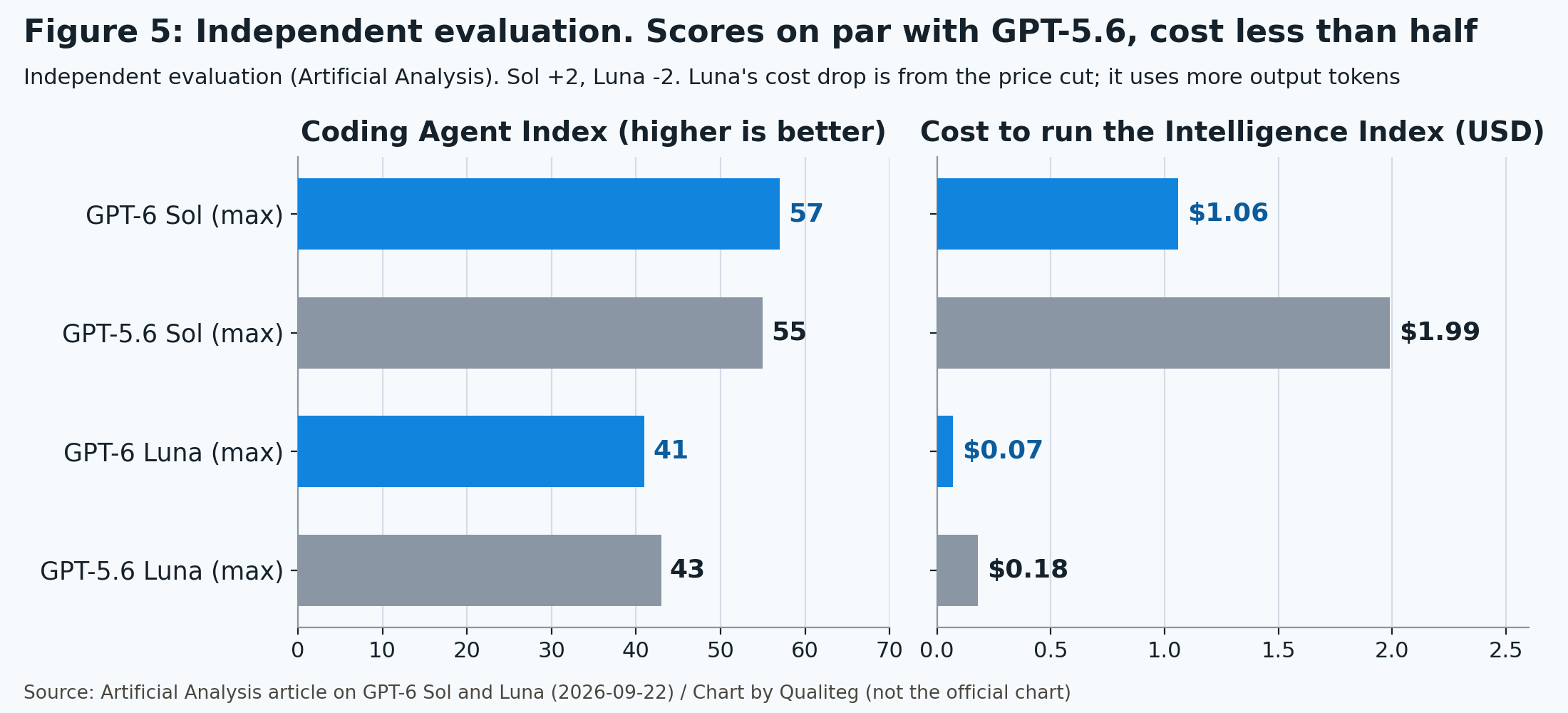
Sol rose slightly on the coding index, and the cost to run the full evaluation fell by about half.
Luna's index fell slightly, and its cost dropped by about 60%. However, its output tokens rose from 41k to 51k, so the lower cost comes from the price cut.
Luna can be read as a model that thinks more and is paid for at a lower price.
Even if each token is cheap, longer thinking shows up in consumption. The estimate in Chapter 11 assumes the same number of tokens per request, so actual costs may come in above the estimate by this amount.
It is also worth noting that the hallucination rate moved in the same direction as OpenAI's factuality evaluation. The AA-Omniscience hallucination rate fell from 92% to 60% for Sol and from 93% to 77% for Luna.
However, what lies behind the drop in wrong answers needs care.
According to Artificial Analysis, Sol's answer rate fell from 99% to 83%, and its accuracy across all questions also fell by 5 points, from 59% to 54%. In other words, much of the drop in wrong answers comes from no longer answering questions it does not know. Luna's accuracy was nearly unchanged, from 43% to 44%, and its answer rate also fell.
On GDPval-AA v2.1, which grades business deliverables, Sol lost about 100 Elo points and Luna about 75. Artificial Analysis attributes this to deliverables more often missing required items. On AA-Briefcase v1.1, which has models build things such as presentation decks, Luna fell by about 45 points while Sol was flat.
| Independent evaluation item | GPT-6 Sol | GPT-6 Luna | Confidence |
|---|---|---|---|
| AA-Omniscience answer rate | 99% → 83% | Decreased (figure unconfirmed) | Independent evaluation |
| Accuracy across all questions | 59% → 54% | 43% → 44% | Independent evaluation |
| AA-Omniscience Index | 22 → 27 | −10 → 1 | Independent evaluation |
| GDPval-AA v2.1 (Elo) | Down about 100 points | Down about 75 points | Independent evaluation |
| AA-Briefcase v1.1 (Elo) | Flat | Down about 45 points | Independent evaluation |
Looking only at OpenAI's published figures, the models seem to have "improved across the board." Layering in independent evaluation gives this picture. API prices and the cost of evaluation tasks fell to half or less, and the overall indexes are roughly unchanged. On the other hand, the models hold back answers more often, and business-deliverable evaluations show some regression.
If you are migrating to capture the lower price, we recommend first checking whether "holding back answers" and "missing items in deliverables" would be a problem for your use case.
There is no independent evaluation of Japanese-language performance yet. Our blog's Japanese LLM Rankings 2026 (September 1 Edition) covered GPT-5.6 Sol, Terra, and Luna. We plan to cover GPT-6 Sol and Luna in the next edition, in October.
15. Hands-on reports from third parties
Within a day of the announcement, reports from people who have actually used the models are starting to appear. We have not yet tested them ourselves, so we present these as third-party reports.
Simon Willison's report
Simon Willison, known for his write-ups testing LLMs, published a post trying Sol, Luna, and Opus 5.5 together on the day of the announcement.
He switched Codex's default model to GPT-6 Sol and Claude Code's default to Opus 5.5. When he switched his own Datasette Agent demo to GPT-6 Luna, he writes that it was "fast and competent" at generating SQL, HTML, and JavaScript.
In his usual test of drawing "an SVG of a pelican riding a bicycle," GPT-6 used more subdued colors than GPT-5.6, and among OpenAI's models, Astra at max did best.
The same post also reports a case where Opus 5.5 at max used up the 128K output limit on thinking alone and ended without producing any output. He tried twice with the same result both times, at $2.56 and about 20 minutes per attempt.
He also points out that GPT-6 Luna is among the cheapest of OpenAI's models, with only GPT-4.1 Nano ($0.10 / $0.40) and GPT-5 Nano ($0.05 / $0.40) or so being cheaper.
16. How to compare them with Claude Opus 5.5, announced the same day
GPT-6 Sol and Luna were announced roughly an hour to an hour and a half after Anthropic announced Claude Opus 5.5.
First, the prices side by side.
| Model | Input | Cached input | Output | Confidence |
|---|---|---|---|---|
| GPT-6 Astra | $10.00 | $1.00 | $50.00 | Pricing page |
| Claude Fable 5.1 | $10.00 | $0.25 | $50.00 | Vendor pricing pages |
| Claude Opus 5.5 | $4.00 | $0.20 | $20.00 | Vendor pricing pages |
| Claude Opus 5 | $5.00 | $0.50 | $25.00 | Vendor pricing pages |
| GPT-6 Sol | $2.00 | $0.20 | $10.00 | Pricing page |
| Claude Sonnet 5 | $2.00 | $0.20 | $10.00 | Vendor pricing pages |
| Grok 4.7 (input 200K or fewer) | $2.00 | $0.50 | $6.00 | Vendor pricing pages |
| Claude Haiku 4.5 | $1.00 | $0.10 | $5.00 | Vendor pricing pages |
| Gemini 3.8 Flash (introductory price through December 31, 2026) | $0.75 | $0.075 | $3.75 | Vendor pricing pages |
| GPT-6 Luna | $0.10 | $0.01 | $0.50 | Pricing page |
Competitor prices are from each vendor's official pricing pages. Gemini 3.8 Flash goes to $1.50 for input and $7.50 for output from January 1, 2027.
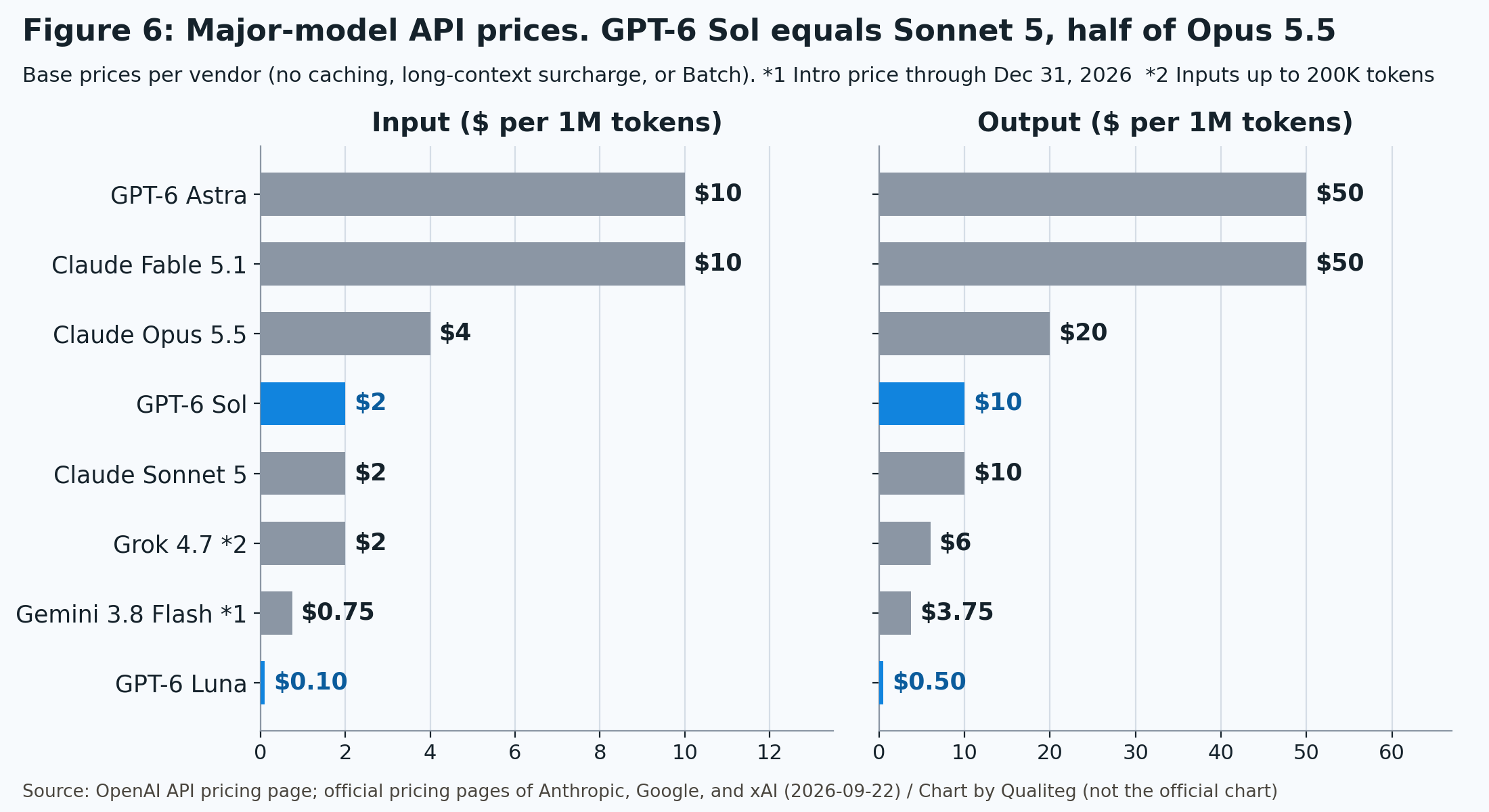
GPT-6 Sol is exactly half the price of Claude Opus 5.5 and the same price as Claude Sonnet 5. Cache reads cost the same $0.20 for both Sol and Opus 5.5.
GPT-6 Luna costs one tenth of Claude Haiku 4.5. Anthropic has said it will release Sonnet 5.5 and Haiku 5.5 within a few weeks, so how this gap develops will depend on that next move.
Comparing performance requires care.
The Claude models in OpenAI's comparison charts are Opus 5, Fable 5, and Fable 5.1. Opus 5.5 is not included, which is to be expected since both were announced the same day.
According to Anthropic's published figures, Opus 5.5 scores 40.0% on AutomationBench, 54.4% on FrontierCode 1.1, and 66.4% on Terminal-Bench 4.0.
Please avoid placing these numbers directly next to OpenAI's published 33.2% for Sol (AutomationBench).
Each company measures in its own environment with settings it chose. There is no guarantee that the benchmark version, reasoning effort, or tool setup match, and no benchmark has yet rerun both companies' published evaluations under the same conditions.
If you want a like-for-like view, the reliable approach is to look separately at the shared metrics from independent evaluation.
Artificial Analysis also published its evaluation of Opus 5.5 on September 22. On the Intelligence Index, Opus 5.5 (max) ranks first at 58, while GPT-6 Sol (max) scores 48, placing 18th out of the 212 models compared on its model pages (both independent evaluation). Artificial Analysis says Opus 5.5 ties GPT-6 Astra on Terminal-Bench 4.0 and AutomationBench-AA and extends its lead in agentic knowledge work.
| Metric | Claude Opus 5.5 (max) | GPT-6 Sol (max) | Confidence |
|---|---|---|---|
| Artificial Analysis Intelligence Index | 58 (first) | 48 (18th of 212 models compared) | Independent evaluation |
| API price (input / output) | $4 / $20 | $2 / $10 | Vendor pricing pages, pricing page |
So what can be said at this point is that Sol is half the price of Opus 5.5, while Opus 5.5 is ahead on the overall index from independent evaluation. For strengths and weaknesses by use case, look at the individual items of independent evaluation rather than each company's published figures. We will also revisit this in our rankings article.
What We Do Not Know Yet: Unconfirmed Items
Here is what we could not confirm as of September 23.
- When Sol and Luna will become available in regular ChatGPT chat (Chat)
- Whether Sol became the default model in Codex (stated in a third-party repository, but unconfirmed officially)
- The future of GPT-5.6 Terra (no deprecation notice)
- Detailed conditions for Fast mode on Sol and Luna (listed on the pricing page, but the migration guide describes only Astra)
- Availability of Sol and Luna on Amazon Bedrock
- How the 5-hour and weekly limits for Work and Codex on ChatGPT Pro apply to Sol and Luna
- Official Terminal-Bench 4.0 values for Sol and Luna (not in OpenAI's announcement; Artificial Analysis's 43% is from its own runs)
- Results comparing Claude Opus 5.5 with GPT-6 Sol and Luna on the same tasks under the same conditions, using benchmarks both companies published such as AutomationBench (Artificial Analysis's shared metrics are already public)
- Independent evaluation of Japanese-language performance (to be covered in the October edition of our rankings)
For benchmark values with no numbers in the announcement text that rely on reading OpenAI's charts, the Confidence column in the tables says "Values read from OpenAI's charts." These readings may contain some error.
Summary
In a sentence: "GPT-6 Sol and Luna halved the price and cut wrong answers. The overall indexes are nearly unchanged, and the trade-off is a greater tendency to hold back answers and some regression on business deliverables." That is what this release amounts to.
Astra, which we described in our previous article as "2.5 times Sol," is now 5 times GPT-6 Sol and 100 times Luna. The cases for choosing Astra narrow to work where getting the best result in a single attempt is highly valuable.
Here is how to choose by use case.
| Use case | Recommendation | Reason |
|---|---|---|
| Hard coding and screen operation that need the top score | GPT-6 Astra | Astra is in a league of its own on DeepSWE and OSWorld best scores (values read from OpenAI's charts) |
| Everyday agent development and business workflow automation | GPT-6 Sol | Half the price of Opus 5.5. High efficiency per dollar on AutomationBench (OpenAI's published figures) |
| High-volume classification, extraction, and summarization | GPT-6 Luna | $0.10 input, $0.50 output. 180M TPM limit at Tier 5 |
| Jobs that need fast responses without reasoning | none on GPT-6 Sol or Luna | Astra does not support none |
| Want to reproduce GPT-5.6 Sol's top scores regardless of budget | Consider staying on GPT-5.6 Sol | On DeepSWE and OSWorld, its best scores are higher than GPT-6 Sol's (values read from OpenAI's charts). The promotional price runs at least until November 21 |
| Using tools in Chat Completions | Keep it as is without reasoning, or move to the Responses API with reasoning | Function calling with reasoning is only in the Responses API |
When migrating, there are three things we would like you to review.
First, tool calls in Chat Completions. If you want reasoning, you need to move to the Responses API.
Second, the 272,000-input-token boundary. Crossing it surcharges the entire request, so it is worth revisiting how you pass documents.
Third, your caching design. Keep tool definitions and restrict them with allowed_tools, and change reasoning effort with configuration_update. That alone lets you take full advantage of GPT-6's caching improvements.
Things to watch going forward are a like-for-like comparison with Opus 5.5, the pricing of Sonnet 5.5 and Haiku 5.5 that Anthropic has previewed, and the rollout to regular ChatGPT chat. We will check Japanese-language performance in the October edition of our LLM rankings.
See you next time!
Sources and References
Primary sources (OpenAI, GitHub, Microsoft)
- Introducing GPT-6 Sol and Luna (OpenAI official announcement)
- Better prompt caching for GPT-6 (OpenAI official blog)
- GPT-6 Sol model specifications (OpenAI API official docs)
- GPT-6 Luna model specifications (OpenAI API official docs)
- Migration guide to the latest models (OpenAI API official docs)
- API pricing (OpenAI API official docs)
- GPT-6 Astra system card, with Chapter 11 covering Sol and Luna (OpenAI Deployment Safety)
- ChatGPT help article "GPT-5.6 and GPT-6 Pro in ChatGPT" (OpenAI Help Center)
- Codex changelog (ChatGPT Learn)
- OpenAI's GPT-6 Sol and GPT-6 Luna now available (GitHub Changelog)
- GPT-6 Astra, Sol, and Luna availability and pricing in Microsoft Foundry (Microsoft Azure official blog)
Independent evaluation (publishers of the evaluation data)
- Independent evaluation of GPT-6 Sol and Luna (Artificial Analysis)
- Claude Opus 5.5 takes first place on the Intelligence Index (Artificial Analysis)
![[AI×CAD] Part 5: Preserve the "Why" That CAD Alone Cannot Explain — A Practical Approach to Design Knowledge and Local LLMs](/content/images/size/w600/2026/09/ai-cad-step-viewer-part5-en.png)
![[AI×CAD] Part 4: Review a Design with AI Without Sending 3D Geometry to the LLM — Analyze First, Then Pass Structured Results](/content/images/size/w600/2026/09/ai-cad-step-viewer-part4-en.png)